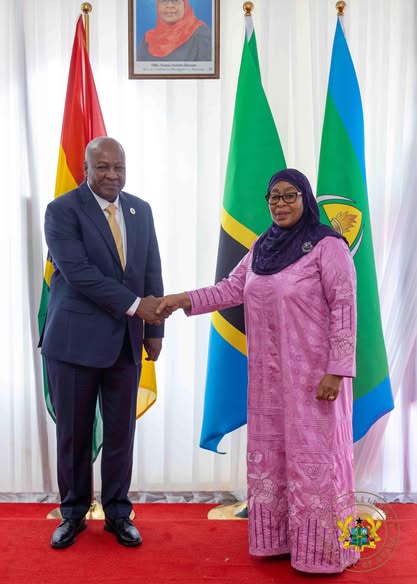
President John Dramani Mahama has cautioned that rising military confrontations in the Middle East could trigger serious economic shocks across Africa, particularly through disruptions in global oil supply and rising crude prices.
Speaking during bilateral talks with Tanzanian President Samia Suluhu Hassan at the State House in Arusha, President Mahama said recent attacks involving the United States, Israel and Iran have created a new and unstable geopolitical environment.
“We are watching the geopolitical events with alarm,” he stated, noting that the Middle East remains the centre of global oil production. According to him, any sharp increase in crude oil prices would negatively affect African economies that rely heavily on fuel imports.
He urged African governments to prepare proactively to shield their citizens from potential economic hardship, stressing that the continent must not wait for the shocks to fully materialise before acting.
Visit to Arusha
President Mahama is in Arusha as Special Guest of Honour for the official opening of the 2026 Legal Year and the 20th anniversary celebration of the African Court on Human and Peoples’ Rights. He encouraged African countries to take pride in the court’s work and called on nations that have yet to ratify its protocol to do so.
On Ghana and Tanzania relations, President Mahama indicated that both countries are working to strengthen economic cooperation. He revealed plans to establish a permanent Joint Commission for Cooperation ahead of a possible state visit currently under discussion.
Resource Sovereignty and Economic Strategy
Touching on Ghana’s domestic economic agenda, President Mahama said his administration has adopted a firm approach to asserting sovereignty over natural resources, particularly in the gold sector.
He disclosed that new regulations in the small scale mining sector increased gold exports from 63 tonnes to 104 tonnes within nine months, generating an estimated 10 billion dollars in revenue over the same period.
The President urged African nations to prioritise control and value addition in their resource sectors to create jobs for the continent’s youthful population.
In agriculture, he outlined Ghana’s plan to reduce dependence on external financing arrangements that use cocoa as collateral. Beginning next season, he said at least 400,000 tonnes out of Ghana’s nearly 700,000 tonne cocoa production will be processed locally before export to increase value retention.
As the African Union Champion on Reparations, President Mahama also confirmed that a resolution seeking recognition of the Transatlantic Slave Trade as a crime against humanity will be tabled at the United Nations General Assembly on March 25, 2026.
Strengthening Ghana–Tanzania Ties
President Samia Suluhu Hassan highlighted the historic relationship between Ghana and Tanzania, recalling the close friendship between Kwame Nkrumah and Julius Nyerere.
She described Arusha as not only a major tourist destination but also a continental hub for diplomacy and justice. The city hosts key institutions including the East African Community, the Pan-African Postal Union, the African Union Advisory Board on Corruption and the African Court on Human and Peoples’ Rights.
On Tanzania’s economic outlook, President Hassan reported steady growth of about six per cent, with inflation ranging between 3.5 and four per cent. She said her government’s focus remains on economic transformation through value addition, human capital development, particularly for a population where about 60 per cent are youth, and strengthening climate resilience.
The bilateral discussions underscored both countries’ shared commitment to deeper cooperation, economic independence and stronger continental institutions in an increasingly uncertain global climate.