General News
OSP Opens Preliminary Investigation into Alleged GH¢70,000 Payment Linked to Parliament’s Vetting


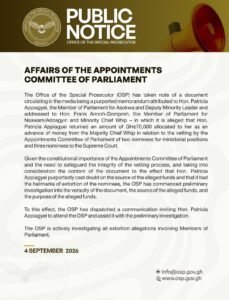
The Office of the Special Prosecutor (OSP) has commenced a preliminary investigation into an alleged GH¢70,000 payment linked to Parliament’s Appointments Committee and involving Deputy Minority Leader and Asokwa Member of Parliament, Patricia Appiagyei.
The investigation follows the circulation of a purported memorandum allegedly authored by Mrs Appiagyei and addressed to the Minority Chief Whip and Member of Parliament for Nsawam-Adoagyiri, Frank Annoh-Dompreh.
According to the OSP, the contents of the document raise questions about the authenticity of the memorandum, the source of the alleged funds and the purpose for which the money was provided.
The memorandum, dated September 2, 2026, reportedly indicates that Mrs Appiagyei returned GH¢70,000 she had allegedly received as an advance from the Majority Chief Whip of Parliament.
The money was reportedly connected to the Appointments Committee’s activities, including vetting ministerial nominees and three nominees to the Supreme Court.
Mrs Appiagyei allegedly explained that she decided to return the money because she was unaware of its source. She also reportedly expressed reservations about receiving any financial benefit associated with the vetting of members of the Majority leadership.
The memorandum reportedly made specific reference to the vetting of Majority Leader Mahama Ayariga and Deputy Majority Leader Dr Zanetor Agyeman-Rawlings.
The alleged payment has also been linked to the Minority Caucus’ decision not to participate in the vetting of three Supreme Court nominees.
The nominees are: Justice Sophia Rosetta Oduokuwa Bernasko Essah, Justice Edward Amoako Asante, Justice Anthony Forson Jnr.
Members of the Minority on the Appointments Committee walked out of the proceedings on August 27, 2026, citing concerns about the procedure adopted for the exercise.
The Minority argued, among other things, that the nominees had been scheduled for vetting without sufficient notice.
Mrs Appiagyei reportedly stated in her memorandum that, having taken a principled position against participating in the exercise, she considered it inappropriate to accept money connected to the process.
She also reportedly said she did not intend to benefit financially from, or “extort any money” from, the nominees.
The OSP said its preliminary investigation is focused on establishing three key issues:
Whether the purported memorandum is genuine;
The source of the alleged GH¢70,000; and
The purpose for which the money was provided.
The Special Prosecutor’s Office further indicated that the contents of the document could potentially raise questions about whether the alleged funds had characteristics associated with extortion of parliamentary nominees.
However, the OSP stressed that the investigation is at a preliminary stage and that the allegations contained in the circulating document have not been established as facts.
As part of its inquiries, the OSP has dispatched a communication inviting Patricia Appiagyei to appear before the office.
Her invitation is intended to enable investigators to establish the circumstances surrounding the alleged payment and the memorandum attributed to her.
Investigators are also expected to determine whether the document accurately represents her position and whether the alleged GH¢70,000 was indeed connected to Parliament’s vetting activities.
The development has triggered broader questions about the financial arrangements surrounding the work of Parliament’s Appointments Committee.
The Committee plays an important constitutional role in scrutinising presidential nominees for ministerial positions and other major public offices.
Consequently, allegations that Members of Parliament may receive money connected to the vetting of nominees have raised concerns about the integrity, transparency and independence of the parliamentary vetting process.
The Africa Centre for Parliamentary Affairs (ACEPA) has called for an independent investigation into the matter.
Its Executive Director, Dr Rasheed Draman, has reportedly urged authorities to determine whether the alleged payment was an isolated incident or indicative of a wider practice within parliamentary committees.
Anti-corruption campaigner Vitus Azeem has also called for investigations by the OSP and the Commission on Human Rights and Administrative Justice (CHRAJ).
He has urged authorities to establish who authorised the alleged payment, why it was made and whether similar payments were made to other MPs.
The purported memorandum also reportedly indicated that Mrs Appiagyei’s decision to return the GH¢70,000 was consistent with a decision by Minority Leader Alexander Afenyo-Markin to return his own share of the money.
Mrs Appiagyei consequently requested that her GH¢70,000 be returned to the Majority Chief Whip, together with an explanation for her decision to reject the funds.
The authenticity of the document remains a central issue in the controversy.
The Minority Caucus has reportedly disputed aspects of the claims surrounding the memorandum, while the OSP has specifically identified verification of the document as one of the main objectives of its preliminary investigation.
The OSP’s inquiry will therefore have to establish whether the memorandum was genuinely authored by Mrs Appiagyei before assessing the allegations contained in it.
In its September 4 public notice, the OSP also indicated that it is actively investigating extortion allegations involving Members of Parliament.
The GH¢70,000 matter therefore forms part of a wider scrutiny of allegations concerning financial transactions and parliamentary vetting.
At this stage, the OSP has not announced criminal charges against Patricia Appiagyei or any other person in connection with the alleged GH¢70,000 payment.
The immediate focus of the investigation is to authenticate the document, establish the source of the alleged funds and determine the purpose for which the money was allegedly provided.
The investigation remains ongoing.