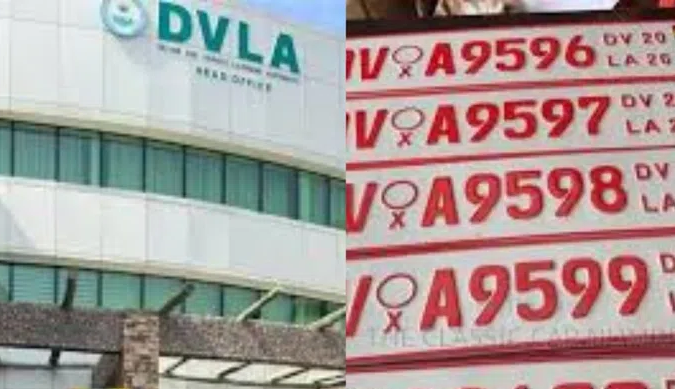
The Ghana Police Service has warned that vehicles found using fake Dealer Vehicle (DV) number plates will be impounded, even if their owners claim they were unaware the plates were forged.
The warning follows an intensified nationwide crackdown by the Driver and Vehicle Licensing Authority (DVLA) on a suspected criminal network believed to have placed more than 30,000 counterfeit DV plates on vehicles across the country.
Speaking at a press briefing in Accra on Tuesday, March 10, 2026, Chief Superintendent Alexander Kweku Obeng said police officers have been deployed on major roads nationwide with the authority to remove and inspect DV plates on vehicles.
He explained that any plate confirmed to be fake would result in the vehicle being treated as unregistered under the law. Such vehicles would be impounded at the nearest police station while legal action is initiated against the offenders.
“Nobody can own or drive a vehicle if that vehicle is not assigned with a registration or plate by the Driver and Vehicle Licensing Authority,” Chief Superintendent Obeng said, citing Section 38 of the Road Traffic Act, 2004 (Act 683). “You cannot own it or drive it, let alone having a forged one.”
He acknowledged that the enforcement exercise could slow traffic on some roads but stressed that police officers are legally required to act when such violations are detected. Individuals found using forged plates could face multiple criminal charges.
DVLA uncovers large-scale fake plate network
The DVLA revealed that investigations conducted over the past two weeks, in collaboration with National Security and the police, uncovered more than 30,000 counterfeit DV plates already circulating on roads nationwide.
Based on the official price of GH¢417.25 per plate, authorities estimate the street value of the fake plates to exceed GH¢12.51 million. Officials also believe the illegal trade may be costing the state about GH¢20 million annually in lost revenue.
Deputy Chief Executive in charge of Services at the DVLA, Foster Akwasi Asante, said the counterfeit plates were distributed through an organised network.
According to him, the plates were produced at an undisclosed location before being transported to a shop at La Paz in Accra, which served as the main distribution centre. From there, consignments were sent to Kumasi, Takoradi and Tamale.
Mr Asante said national security operatives who raided the La Paz facility recovered plates with distribution records dated February 23, 2026. The records showed plates numbered DV C4353 to DV 4673 had been dispatched, suggesting that large batches were distributed within a single day.
Investigators also discovered that the counterfeit plates were often supplied together with forged documents to make the vehicles appear legitimately registered.
These documents included fake motor insurance certificates, roadworthy certificates, and counterfeit Form D and Form E vehicle logbook documents. Authorities believe these documents were produced at the same location as the plates.
Officials also found that some of the insurance certificates seized during the operation did not bear the signature of any licensed insurance broker.
Earlier at the briefing, the Chief Executive of the DVLA, Julius Neequaye Kotey, warned that the use of forged documents could leave accident victims without any protection.
“In the event of an accident, victims may find that the supposed insurance cover is fraudulent, leaving them without protection or compensation,” he said.
How to identify fake DV plates
Mr Asante also outlined key features that distinguish genuine DV plates from counterfeit ones.
He explained that authentic DV plates produced by the DVLA are made from a material known as Alucore, which has a non-reflective surface. The Ghana flag on genuine plates is also embedded during production rather than attached as a sticker.
In contrast, fake plates usually have the Ghana flag applied as a surface sticker and often feature a shiny, reflective background.
“The ones with a shining background are fake plates,” Mr Asante said.
He added that genuine plates contain additional security features, but the authority would not disclose those details for operational reasons.
Arrests and ongoing investigations
Authorities have so far arrested five suspects during operations in La Paz, Kumasi and Takoradi.
Among them is a man who told investigators he worked as an okada rider and served as a distributor, transporting packaged plates from La Paz to Kaneshie for onward delivery to other regions.
A woman identified as Vivian, believed to be the Tamale contact in the distribution chain, was also arrested. Officers recovered a number of fake plates and forged documents from her.
All five suspects are currently on remand and are expected to reappear in court on March 17, 2026.
Mr Asante said two other suspects believed to be key figures in the network remain at large. The DVLA and National Security are expected to apply to the courts to have them declared wanted.
Once declared wanted, their photographs will be released in the national media. The DVLA also plans to announce a financial reward for information that leads to their arrest.
The DVLA has advised individuals authorised to use DV plates under the Road Traffic Regulations, 2012 (L.I. 2180) — including motor traders, vehicle importers, mechanics, fleet owners and licensed plate dealers — to obtain them only from DVLA offices at the approved cost of GH¢417.25.
Members of the public who suspect that a vehicle is using a fake DV plate have been encouraged to report the matter to the nearest DVLA office or police station.