General News
Two political parties, one lesson: Afuntummireku and Tikro Nkɔ Agyina for Ghana


A reflection on Ghana’s Founders’ Day debate has drawn on two traditional symbols — Afuntummireku and Tikro Nkɔ Agyina — to call for political unity, consultation and a shared national purpose.
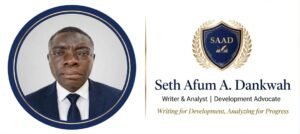
The writer, Seth Afum A. Dankwah of J. G. Knol Technical Institute at Adukrom-Akuapem in the Eastern Region, argues that although Ghana’s two major political parties, the New Patriotic Party (NPP) and the National Democratic Congress (NDC), may have different political identities, they ultimately share the same national interest.
In a statement dated Monday, September 21, 2026, Mr Dankwah said the lesson could be captured in the traditional concept of Afuntummireku, represented by the Funtunfunefu Denkyemfunefu symbol — two creatures with separate heads but sharing one stomach.
He said another symbol, Tikro Nkɔ Agyina, which conveys the idea that one head cannot go into council alone, equally offers an important lesson for Ghana’s political system.
According to him, the two symbols became particularly meaningful to him during a recent visit to the Presbyterian College of Education at Akropong-Akuapem.
Mr Dankwah said that while walking through the campus one morning, he noticed the two symbols displayed on the walls of separate halls.
He explained that he had used the route several times but had never stopped to pay attention to the inscriptions until that particular morning.
“On one wall was the Afuntummireku symbol — Funtunfunefu Denkyemfunefu — two creatures with two separate heads but sharing one stomach. On another wall, a few footsteps away, was Tikro Nkɔ Agyina — two heads joined together as one,” he wrote.
For him, the two walls carried one message for Ghana: political and ideological differences should not destroy the shared national interest.
Mr Dankwah linked the traditional symbolism to the long-running debate over Ghana’s Founders’ Day commemoration.
He noted that the political interpretation of Ghana’s founding history has differed depending on which political party is in government.
“When the NPP is in power, it is called Founders’ Day. When the NDC is in power, it is called Founder’s Day,” he said.
He added that one political side argues that Ghana’s independence cannot be attributed to only one individual, while another places particular emphasis on Dr Kwame Nkrumah as the founder.
“Same independence, same history. Different heads, different spellings, but same stomach called Ghana,” Mr Dankwah wrote.
He said the debate becomes particularly significant on September 21, a date associated with the commemoration of Dr Kwame Nkrumah.
According to him, Ghanaians often debate whether the appropriate emphasis should be on Founder or Founders, or whether the country’s independence story should focus on Nkrumah or include the wider group of personalities associated with the independence struggle.
He argued that the debate should not become an excuse for one side to diminish the contribution of another.
“We argue as if by diminishing the other head, our head becomes taller,” he said.
Mr Dankwah used the Afuntummireku symbol to describe the relationship between the NPP and NDC.
He said the two parties have spent decades competing against each other through elections, parliamentary debates, political campaigns and public commentary.
“For thirty-two years, our democracy has lived like those symbols. The NPP and the NDC represent the two heads of ‘AFUNTUMMIREKU’,” he wrote.
He accused both sides of engaging in political battles without always considering the wider consequences for Ghana.
According to him, the parties may be politically divided, but they are connected by the country’s economy, environment, institutions and overall wellbeing.
“They snap at each other every morning on radio, they argue in Parliament, they campaign as if the other must not eat. Each wants to eat first. Each wants to starve the other,” he said.
But he argued that, like the two creatures represented by Afuntummireku, both political sides ultimately share one “stomach” — Ghana.
“When the economy bleeds, it is that one stomach that bleeds,” he wrote.
He cited issues including illegal mining, popularly known as galamsey, economic difficulties, fuel prices, the depreciation of the cedi and investor confidence as matters that can affect Ghanaians regardless of their political affiliation.
He specifically referenced the impact of galamsey on water bodies in areas such as Obuasi and Tarkwa, arguing that environmental damage does not discriminate between supporters of different political parties.
“When galamsey poisons the rivers at Obuasi or Tarkwa, both creatures will drink the same poisoned water,” he stated.
He also criticised what he described as partisan reactions to economic difficulties, arguing that celebrating negative economic developments simply because one’s political opponent is in government ultimately harms the country.
“If that stomach gets an ulcer from winner-takes-all politics by the government, from propaganda, from debt and greed, both heads will die with it,” he wrote.
Mr Dankwah said the central lesson from Afuntummireku should not be interpreted as a call for the NPP and NDC to stop competing.
Instead, he said political competition is necessary in a democracy, but it should not become destructive.
“That is the first thing the wall taught me: We can have different heads, but we cannot afford a divided stomach. Competition is allowed. Destruction is not,” he said.
He further applied that principle to Ghana’s history, particularly the debate over the country’s founders.
He argued that presenting Ghana’s independence story exclusively through the contribution of Dr Kwame Nkrumah would leave out other personalities and groups, just as presenting the story only through the Big Six would overlook Nkrumah and the wider mass movement that supported the independence struggle.
“To tell Ghana’s story with only Nkrumah and without Danquah and the Big Six is incomplete history,” he said.
He added: “To tell it with only the Big Six and without Nkrumah and the thousands of market women, farmers, students and ex-servicemen who followed him is also incomplete history.”
Mr Dankwah therefore described Ghana’s independence as a collective national achievement involving different individuals and groups.
“Ghana’s independence had many heads, but one stomach — freedom,” he stated
The second symbol, Tikro Nkɔ Agyina, according to Mr Dankwah, carries a different but complementary message.
He interpreted it as a reminder that one person or one group should not assume that it has all the answers.
“Tikro Nkɔ Agyina. One head does not go into council,” he wrote.
He said the principle should guide political leadership regardless of which party controls government.
“Our greatest mistakes as a nation have come when one head thought it was singularly enough. And both sides have been guilty of this act,” he stated.
Mr Dankwah argued that successive governments have sometimes acted as though they possessed all the answers and did not need sufficient input from others.
He also extended the criticism to Parliament, saying majorities can sometimes behave as though they do not need minority voices.
According to him, the situation can reverse when political power changes hands, with a new majority potentially repeating the same pattern.
“One majority in Parliament sometimes decides it does not need the minority, and when the tables turn, the new majority repeats the same arrogance,” he wrote.
Mr Dankwah said Ghana’s governance would benefit from greater consultation, particularly on major national policies and historical issues.
He argued that political power should not become a one-head council, regardless of the political party in government.
“Ghana suffers when power becomes a one-head council, no matter which head wears the crown,” he said.
He claimed that the consequences can include policies being introduced without adequate consultation, historical narratives being changed without broad agreement and opposition parties being treated as enemies rather than alternative voices in a democratic system.
He also said ordinary citizens should have a place in the national conversation.
He mentioned teachers, farmers, students and traditional leaders as among the groups whose views should not be excluded from the national agyina or council.
Mr Dankwah ultimately urged supporters of both major political parties to see themselves as participants in the same national project.
He said the NPP and NDC should not be treated as enemies despite their political differences.
“The NPP and NDC are not enemies. They are Siamese twins,” he wrote.
He used the metaphor to emphasise that the two parties may have separate political identities but remain connected by Ghana’s national interest.
He argued that if the country were to adopt the lessons represented by Afuntummireku and Tikro Nkɔ Agyina, political parties could continue to compete strongly during elections while cooperating on matters affecting the long-term wellbeing of the country.
“If we lived by those two inscriptions, our politics would change. We would still compete fiercely at elections, but we would protect the stomach together after elections,” he said.
Mr Dankwah concluded his reflection by returning to the two symbols he encountered at the Presbyterian College of Education at Akropong-Akuapem.
He said Afuntummireku should remind both the NPP and NDC that their political differences do not change the fact that they are connected by Ghana.
“Afuntummireku tells both NPP and NDC: You are different, but you are joined. Stop fighting over food that will end up in the same stomach,” he wrote.
He said the debate over whether the country should commemorate “Founder’s” or “Founders’” Day should not overshadow the broader national interest.
“Whether you call it Founders’ or Founder’s, the stomach you are feeding is Ghana,” he stated.
He said Tikro Nkɔ Agyina, on the other hand, should serve as a reminder to whoever holds political power that no government or leader has all the answers.
“Your head alone is not enough. Come into council. You cannot decide Ghana’s history alone; you cannot govern Ghana alone. Listen to dissenting opinions,” he said.
He described the two inscriptions as a lesson extending from the walls of the Presbyterian College of Education at Akropong-Akuapem to Ghana’s political institutions in Accra.
“That is the lesson from the walls of the Presbyterian College of Education at Akropong-Akuapem to the walls of power in Accra,” he wrote.
Mr Dankwah ended the statement with a message marking the September 21 commemoration:
“Happy Founder’s Day. Happy Founders’ Day. Happy Birthday Ghana — our one stomach.”
Ghana’s official public discourse around national unity has also continued to emphasise the idea of a shared national identity. In a New Year message for 2026, President John Dramani Mahama said Ghana’s political differences should not undermine the country’s common purpose, stressing that there is only one Ghana.