Entertainment
Agya Koo Nimo: The Extraordinary Life of Ghana’s Palmwine Music Legend Who Became a Cultural Treasure


Long before Ghana’s music industry was transformed by hiplife, Afrobeats, streaming platforms and social media, there were musicians whose guitars, voices and stories carried the sounds of Ghana from village gatherings to international stages.
Among the most important of these musicians is Agya Koo Nimo, the legendary guitarist, composer, singer, storyteller and cultural custodian whose career has become inseparable from the history of Ghanaian palmwine music and acoustic highlife.
Born Kwabena Boa-Amponsem on October 3, 1934, at Foase in the Ashanti Region, he was later christened Daniel Amponsah. Over the years, Ghanaians came to know him simply as Koo Nimo, and later affectionately added “Agya” to his name as a mark of respect.
Today, his name represents much more than an old highlife musician.
It represents a generation of Ghanaian music in which songs were stories, guitars were voices, and proverbs were an important part of entertainment.
His music preserved aspects of Ghanaian culture at a time when Western musical influences were rapidly changing the country’s sound.


Koo Nimo was born into a family where music was already part of everyday life.
His father was a trumpeter, while his mother was a singer and member of the local Methodist church choir.
Music therefore surrounded him from childhood.
In an interview with the Daily Graphic’s Springboard programme, Koo Nimo famously joked that his music career started from the moment he was born because, as he put it, When I cried, that was my first melody.
His childhood environment exposed him to both church music and traditional Ghanaian sounds.
He recalled joining elderly women in his community who woke up at dawn on weekends to sing songs they described as songs for nation-building.
He also received early musical training from a teacher identified as D.K. Sam, who taught him music while he was still a child.
At one point, when his teacher was ill, the young Koo Nimo was asked to rehearse hymns for church.
He successfully played the organ and was subsequently allowed to play regularly during church services.
Those early experiences would later influence the musician he became.


From Kwabena Boa-Amponsah to Daniel Amponsah
The musician’s names tell part of his story.
He was born Kwabena Boa-Amponsah and was baptised Daniel Amponsah as a Methodist.
When he began performing professionally, he adopted the name Koo Nimo.
According to Koo Nimo himself, Koo refers to a male born on Friday in Akan naming tradition, while “Nimo” refers to someone who accepts blame for something he did not do.
The public later added Agya, meaning father, to his name as a sign of affection and respect.
That name would eventually become known across Ghana and among lovers of African music around the world.
Koo Nimo was not only interested in music. He was also academically inclined.
He attended Adisadel College in Cape Coast from 1947 to 1952.
His connection with the school was also influenced by his relationship with the late Asantehene Otumfuo Opoku Ware II, who had also attended Adisadel College.
After secondary school, Koo Nimo pursued technical and scientific training.
He spent a year taking a technician’s course at the Medical Research Institute at Korle Bu.
He later worked at Komfo Anokye Teaching Hospital from 1955 to 1960 as a technician.
His professional life would eventually take him much further into the scientific world.
One of the lesser-known aspects of Agya Koo Nimo’s story is that he was not initially a full-time professional musician.
While many people knew him primarily for his guitar, he also built a career in science.
He eventually worked in the chemistry field and became a chief laboratory technician in the Chemistry Department of the University of Science and Technology in Kumasi, now known as Kwame Nkrumah University of Science and Technology (KNUST).
He remained in the profession for years and retired from it in 1998, according to AllMusic’s biographical record.
This unusual combination of science and music became one of the most fascinating features of his life.
By day, he could work in a laboratory.
Outside his professional duties, he could pick up his guitar and perform music deeply rooted in Ghanaian tradition.


His guitar journey
Koo Nimo eventually became one of Ghana’s most respected guitarists.
His approach was different from the large electric dance bands that dominated sections of Ghana’s popular music industry.
He became particularly associated with palmwine guitar music, an acoustic style that combines intricate guitar patterns with traditional rhythms, percussion, storytelling and vocals.
His guitar playing became famous for its two-finger picking technique.
But his sound was not completely isolated from foreign musical influences.
His guitar style absorbed ideas from Ghanaian brass-band highlife, Western guitar traditions and even Spanish guitar techniques.
AllMusic also identifies the influence of American guitarist Charlie Christian on his playing.
The result was a sound that was both sophisticated and unmistakably Ghanaian.


The birth of Addadam Agofomma
In 1957, the year Ghana gained independence, Koo Nimo formed the Addadam Agofomma ensemble.
The group became an important vehicle for his musical work.
The ensemble concentrated on traditional Ghanaian music, particularly palmwine music and acoustic highlife.
It used guitars, voices and traditional percussion rather than relying on the large arrangements and electric instrumentation associated with some contemporary bands.
The group became recognised for combining music with storytelling.
Through the ensemble, Koo Nimo helped preserve a form of highlife that was closely connected to Ghanaian oral traditions.


What exactly is palmwine music?
To understand Koo Nimo’s importance, one must understand palmwine music.
Palmwine music developed around informal social gatherings, particularly places where people gathered to drink palm wine and socialise.
Guitarists performed intimate acoustic music, often accompanied by percussion.
The songs could be humorous, philosophical, romantic or reflective.
The musician could observe what was happening around him and immediately turn it into a song.
This made palmwine music more than entertainment.
It became a form of social commentary.
Koo Nimo became one of its most important modern custodians.
In 2025, the Kwan Pa Band specifically credited Koo Nimo and Agya Osei Korankye with helping prevent Ghana’s palmwine music tradition from disappearing.


Koo Nimo’s music is notable because of the variety of traditional instruments used alongside the guitar.
His ensembles have featured instruments including: Apentemma, Dondo, Frikyiwa, Prempensua, Nnawuta, Ntowa, Dawuro
The frikyiwa, for example, provides a metallic rhythmic sound, while the prempensua is a Ghanaian lamellophone sometimes described as a type of rhumba box.
The ntowa is a hollow gourd rattle covered with beads or seeds, while the dawuro is a traditional bell.
These instruments provide the rhythmic foundation over which the guitar and vocals tell the story.
Perhaps Koo Nimo’s greatest strength was not simply his guitar technique.
It was his ability to tell stories through music, and his compositions frequently deal with everyday experiences, including love, Poverty, Illness, Death, Migration, human relationships, Farming, Friendship, and moral behaviour.
His songs often use Twi proverbs and traditional expressions, making them both entertaining and educational.
That is why his work has attracted the attention of ethnomusicologists and cultural researchers.

Some of his best-known songs
Koo Nimo’s catalogue includes several compositions that have become associated with Ghanaian traditional highlife.
Among them are:
Odɔnsɔn — translated as a call for love to prevail.
Akuafo Monno Mfuo — a song encouraging farmers to cultivate the land.
Abrokyire Abrabo— reflecting on life abroad.
Mewu Na Agoro Agu — dealing with death and its impact on a musical group.
“Ohia Ne Yareɛ Yɛ Ya — reflecting on the pain of poverty and illness.
Adampa/Wo Wu a Na Wadane Saman — reflecting on death and the transition into the spiritual realm.
These titles demonstrate how far his songwriting moved beyond conventional love songs.
Aburokyire Abrabo
One of the most recognised recordings associated with Koo Nimo is Aburokyire Abrabo.
The song examines life abroad, a subject that became increasingly relevant to Ghanaians as migration and international travel grew.
It is also featured on his album Osabarima, a major recording in his catalogue.
Through songs such as this, Koo Nimo turned personal and social experiences into musical commentary.

Osabarima and Ghana’s recording history
Koo Nimo’s Osabarima is one of the most important recordings associated with his career.
The recording dates to the 1970s, while the album was later released internationally.
AllMusic records the recording date as 1976, with the album later released outside Ghana in 1990 and subsequently issued again in 1994.
The project is particularly important because Koo Nimo is widely credited as the first Ghanaian musician to have a CD released, making him part of an important transition in the country’s recording history.
The first Ghanaian CD
The significance of this achievement cannot be underestimated.
Ghanaian music had traditionally circulated through live performances, vinyl records, cassettes and other physical formats.
The arrival of the CD represented a technological shift.
Koo Nimo’s association with the first Ghanaian CD demonstrated that traditional acoustic music could move into a modern recording format without losing its cultural identity.
It was a bridge between Ghana’s traditional music heritage and the technological future of recorded music.
A career outside Ghana
Koo Nimo’s music eventually reached audiences outside Ghana.
He performed in several countries and became known internationally as one of the leading practitioners of African acoustic music.
One of his notable international performances was at Lincoln Centre in New York in 1988.
His work also appeared on international music compilations, helping introduce Ghanaian palmwine guitar music to listeners who might otherwise never have encountered it.
His songs were included on collections such as The Rough Guide to Highlife and The Rough Guide to Acoustic Africa.


Koo Nimo’s international career was not limited to performing. He also became involved in academic work.
In 1998, he went to the University of Washington in Seattle as a professor/visiting artist in ethnomusicology.
He later joined the University of Michigan, according to Ghanaian biographical accounts.
His academic involvement was particularly significant because he was not merely explaining Ghanaian music from a textbook.
He was teaching from decades of lived experience, having performed the music and studied the instruments.
He had preserved the tradition, and he had watched Ghanaian popular music change across generations.
His role at MUSIGA
Koo Nimo also played an important role in Ghana’s music administration.
In 1979, he was elected President of the Musicians Union of Ghana (MUSIGA).
He reportedly served in the position for about a decade.
His leadership came at a time when musicians were increasingly concerned about issues including professional welfare, copyright, industry organisation and recognition.
He therefore contributed to the music industry both as a performer and administrator.


In 1985, Koo Nimo was appointed interim chairman of the Copyright Society of Ghana (COSGA), which preceded today’s Ghana Music Rights Organisation, GHAMRO.
His involvement reflected his understanding that musicians needed stronger systems to protect their creative work.
This is another side of his career that is often forgotten when discussions focus only on his guitar playing.
Koo Nimo was also appointed to the National Folklore Board of Trustees in 1991.
The appointment was important because folklore preservation requires people who understand traditional songs, stories, instruments and oral traditions.
Koo Nimo’s career placed him in a unique position to contribute to that work.
He was both an active musician and a custodian of traditional knowledge.
Koo Nimo also had a close professional relationship with another Ghanaian highlife legend, Nana Kwame Ampadu.
The two first encountered each other in London in the early 1960s.
According to Koo Nimo, Ampadu visited a music shop where Koo Nimo was working part-time, tuning guitars and fixing strings while studying laboratory technology.
Their meeting eventually developed into a lasting friendship.
Later, when Koo Nimo became president of MUSIGA, Nana Kwame Ampadu served as his secretary.
The two also served together on the National Folklore Board of Trustees.
Their relationship is an example of the close networks that existed among Ghana’s older generation of musicians.
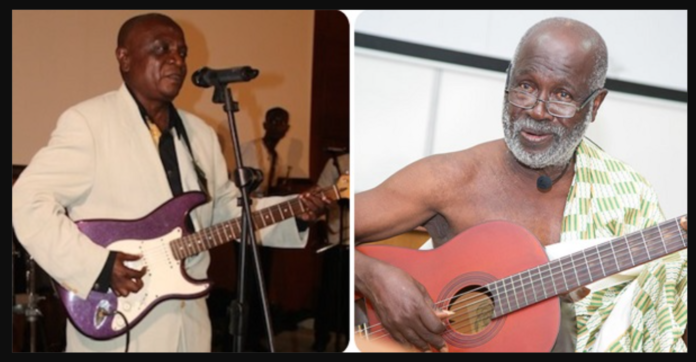

A musician who avoided partisan politics
Unlike some musicians who became strongly associated with political parties, Koo Nimo largely avoided partisan political music.
The Graphic reported that despite witnessing several governments from the colonial period through Ghana’s later democratic administrations, he did not build his career around political songs or party endorsements.
Instead, his music focused largely on love, death, morality and human experiences.
That helped him maintain a reputation as a cultural figure rather than a musician tied to a particular political camp.
Koo Nimo’s contribution has been recognised repeatedly.
In March 1997, as Ghana marked the 40th anniversary of independence, he was among 40 distinguished citizens awarded Gold Medals for their contributions to the country.
His recognition was specifically connected to his efforts to preserve traditional culture.
A month later, in April 1997, he received the Konkoma Award for his contribution to Ghanaian highlife music.
These honours confirmed that his contribution went beyond commercial entertainment.
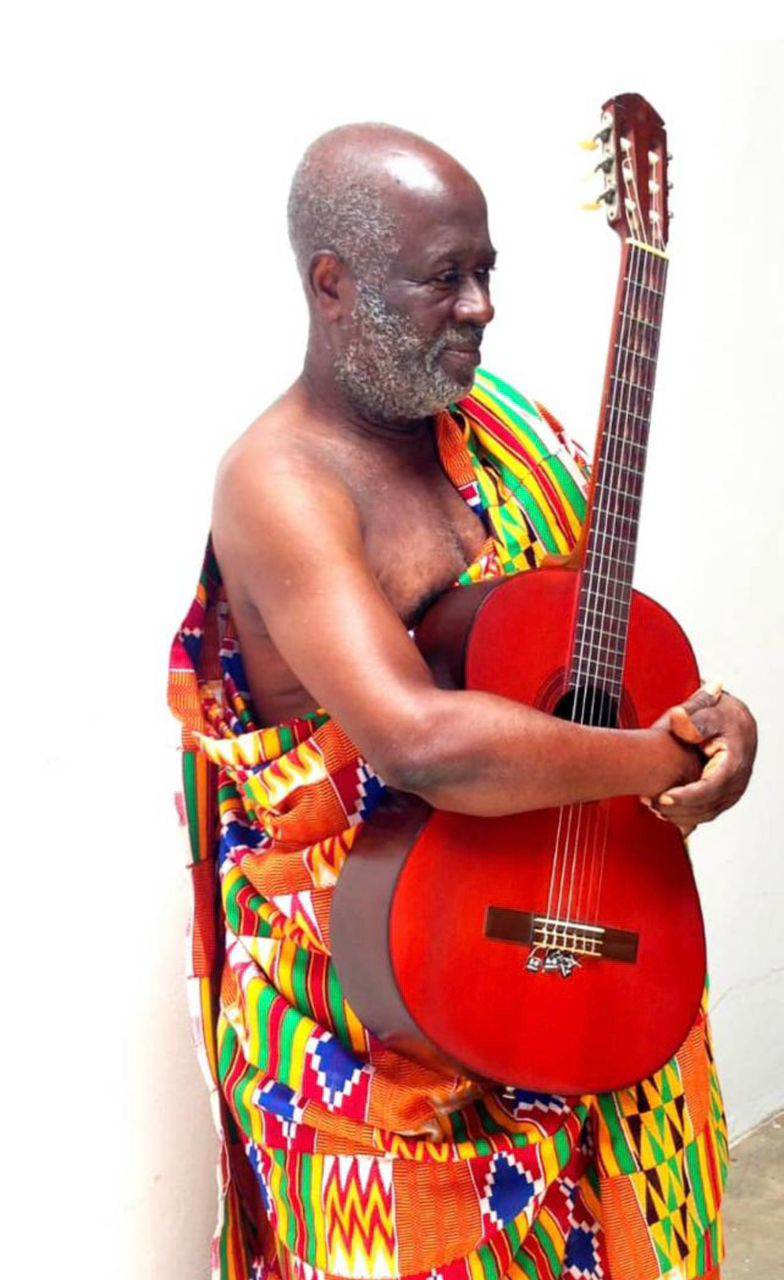

In 2017, the University of Education, Winneba honoured Koo Nimo with a Lifetime Achievement Award through its Music Department.
The honour recognised his decades of work in Ghanaian music and cultural preservation.
In 2022, Koo Nimo received a Lifetime Achievement Award at the Vodafone Ghana Music Awards in Accra.
The award recognised his enormous contribution to Ghana’s music industry and his role in preserving highlife and palmwine music.
By this point, he had already spent more than six decades connected to music.
In 2023, the African University College of Communications (AUCC) presented Koo Nimo with its inaugural Baobab Lifetime Achievement Award.
The ceremony celebrated him as one of Ghana’s foremost living exponents of acoustic guitar highlife.
Although he could not attend because of ill health, the organisers still proceeded with the celebration.
The Graphic reported that Koo Nimo’s music with the Addadam Agofomma group had long been known for compositions dealing with everyday life, often with humour.


Koo Nimo’s wisdom has become almost as interesting to audiences as his music.
In a 2021 interview on Joy FM’s Springboard, he discussed the principles that guided his life.
Among the principles he listed were: Determination, Order, Excellence, Practice, Mentoring, Systematic building, Promptness, Resourcefulness
He also spoke about discipline and healthy living.
His approach to life reflected the same patience and consistency that characterised his music.
Why his music matters today
It would be easy for younger audiences to dismiss palmwine music as something belonging to an older generation.
But that would mean overlooking one of the foundations of Ghanaian popular music.
Palmwine music helped develop the guitar-based musical language that later influenced different forms of highlife.
And Koo Nimo helped keep that tradition alive.
In 2025, the Kwan Pa Band said its decision to explore palmwine music was partly driven by concern that Ghana was losing touch with its musical heritage.
The group specifically mentioned Koo Nimo’s contribution and said that without pioneers such as him and Agya Osei Korankye, the tradition could have faded.
Koo Nimo’s cultural importance was highlighted again in May 2025.
During the launch of the Black Star Experience at Black Star Square in Accra, President John Dramani Mahama asked the Minister of Tourism, Culture and Creative Arts, Abla Dzifa Gomashie, to organise a ceremony to honour the legendary musician while he is still alive.
The President specifically described palmwine music as part of Ghana’s musical archive and folklore and argued that people such as Koo Nimo should be honoured during their lifetime rather than only after their death.
That statement underlined a concern frequently raised about Ghana’s treatment of its cultural legends.
Koo Nimo’s influence can be seen in musicians and bands trying to revive traditional Ghanaian music.
The growth of groups such as Kwan Pa and the Legon Palm Wine Band demonstrates that there remains interest in the acoustic traditions associated with musicians such as Koo Nimo.
Kwan Pa has openly acknowledged Koo Nimo as one of the pioneers whose work helped keep palm wine music alive.
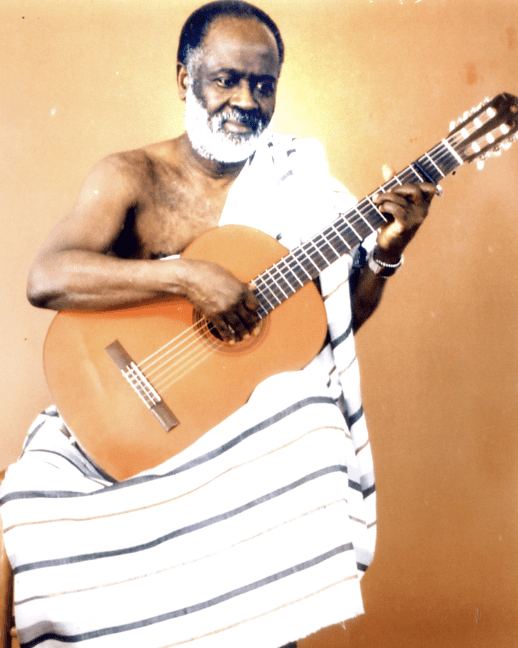

His music is not just old music
One of the biggest misconceptions about traditional music is that it is simply old music.
Koo Nimo’s work shows otherwise.
His music contains observations about migration, relationships, poverty, health, death, work and human behaviour.
These subjects remain relevant.
What has changed is the musical technology surrounding them.
The stories themselves remain familiar.
The albums that preserve his legacy
Among the recordings associated with Koo Nimo are: Osabarima, Tete Wobi Ka, Vintage Palmwine, Highlife Roots Revival
AllMusic also documents his appearance on several international compilations, including The Rough Guide to Highlife, The Rough Guide to Acoustic Africa, African Troubadours and Music from the Source.
His work therefore exists both as individual albums and as part of broader collections documenting African music.
Highlife Roots Revival
His 2012 album, Highlife Roots Revival, was particularly appropriate for an artist whose career had always been concerned with preserving the roots of Ghanaian music.
The project brought his acoustic sound to an international audience at a time when Ghana’s younger music industry was increasingly moving towards hiplife and Afrobeats.
Rather than competing with the new genres, Koo Nimo continued doing what he had always done — telling Ghanaian stories through traditional musical forms.


The importance of Vintage Palmwine
The album Vintage Palmwine, released in 2003, also captures the musical identity for which Koo Nimo became famous.
The palmwine tradition is not simply about the location where the music was played.
It is a musical approach built around intimacy, guitar technique, percussion, storytelling and interaction with listeners.
Koo Nimo became one of the musicians who preserved that approach for future generations.
Koo Nimo has effectively become a living archive.
He carries memories of Ghanaian music from before independence.
He witnessed independence in 1957.
He saw highlife develop through different eras.
He witnessed the rise of recording technology.
He worked in the laboratory while building his musical career.
He led MUSIGA.
He participated in folklore preservation.
He taught music internationally.
And he watched younger genres emerge.
Few Ghanaian musicians have lived through such a wide stretch of the country’s musical history.
The word Agya is significant.
It means father.
It is a term of respect.
For Koo Nimo, the name reflects the position he eventually occupied within Ghanaian music.
He was no longer simply one of the musicians performing highlife.
He had become an elder whose knowledge was sought by younger musicians.
His advice, stories and memories became part of the country’s musical heritage.


In February 2025, highlife musician Kwabena Kwabena and his team paid a courtesy call on Koo Nimo at his residence in Kumasi.
During the visit, the veteran musician shared advice on healthy living, including warnings against excessive consumption of hard liquor.
He spoke from his own experience and encouraged the younger musician to take care of his health.
The encounter showed that even in advanced age, Koo Nimo remained a respected figure whose words carried weight among younger artistes.
Some musicians are remembered mainly because of their biggest hits.
Koo Nimo’s legacy is different.
His importance cannot be measured only by chart positions or commercial sales.
His contribution lies in preservation, including preserving guitar techniques and rhythms. preserved instruments. He preserved stories. He preserved proverbs. He preserved musical arrangements.
And he helped ensure that Ghanaian palmwine music remained part of the national conversation.

Why Ghana must remember Agya Koo Nimo
At a time when the Ghanaian music industry is increasingly focused on international charts, streaming numbers and digital popularity, Koo Nimo represents another measure of success.
He shows that an artist can influence generations without relying on social media.
He shows that an acoustic guitar can compete with an entire modern production.
He shows that a song can entertain while teaching, and he shows that music can function as an archive of a people’s history.
Agya Koo Nimo’s story is still ongoing. He remains one of the country’s most respected traditional musicians and a living link to Ghana’s early highlife tradition.
His music continues to be studied, performed and rediscovered.
Young bands continue to draw inspiration from his palmwine sound.
Academics continue to examine his contribution.
And cultural institutions continue to recognise his role in preserving Ghanaian heritage.
His career, which began in the early decades of the 20th century, has crossed colonial Ghana, independence, military governments, democratic administrations and the digital age.
Few Ghanaian musicians can claim such a journey.
From Foase to Kumasi, from the laboratory to the stage, from palmwine gatherings to international concert halls, Agya Koo Nimo has spent a lifetime proving that Ghanaian music does not have to abandon its roots in order to travel the world.
His guitar has carried stories that might otherwise have disappeared.
His songs have preserved memories.
His music has kept traditional rhythms alive.
And his life has become part of the history he spent decades documenting through sound.
For a younger generation that knows Ghanaian music mainly through Afrobeats and hiplife, discovering Agya Koo Nimo is therefore more than discovering an old musician.
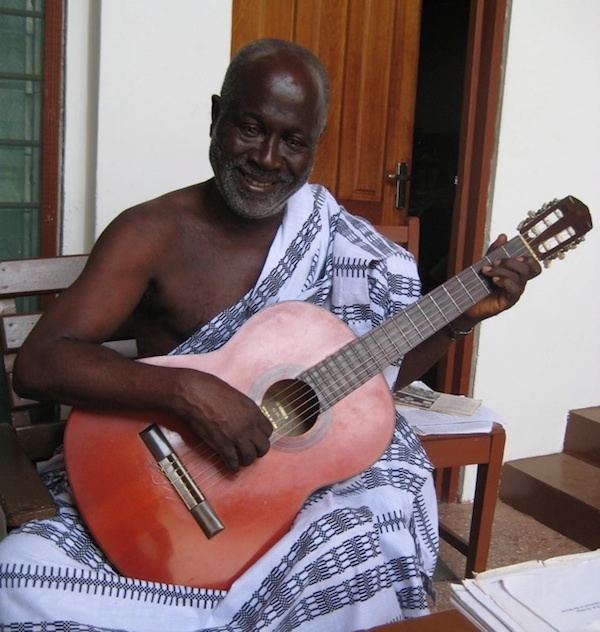

It is discovering one of the roots of the music Ghana is proud to export to the world today.
And that is why the story of Agya Koo Nimo deserves to remain in Ghana’s headlines — not only as nostalgia, but as a living part of the country’s cultural history.