General News
GBA Petitions Chief Justice to Stop Compelling Lawyers to Appear During Legal Vacation


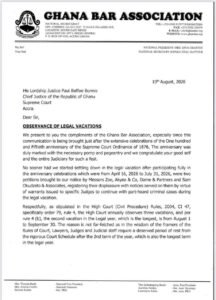
The Ghana Bar Association (GBA) has petitioned Chief Justice Paul Baffoe-Bonnie to ensure that the established rules and traditions governing Ghana’s legal vacation are respected, particularly in cases where lawyers have indicated that they are unavailable to appear in court.
In a letter dated August 10, 2026, and signed by GBA National President Mrs Efua Ghartey, the Association raised concerns over notices served on lawyers requiring them to appear before specific judges to continue part-heard criminal cases during the legal vacation.
The GBA said the concerns followed petitions brought to its attention by Zoe, Akyea & Co., Dame & Partners, and Sam Okudzeto & Associates, whose lawyers expressed displeasure over the notices issued pursuant to warrants authorising particular judges to continue hearing the cases during the vacation.
The Association referred to Order 79, Rule 4 of the High Court (Civil Procedure) Rules, 2004 (C.I. 47), which provides for three annual court vacations.
According to the GBA, Rule 4(b) provides that the second and longest vacation in the legal year runs from August 1 to September 30.
The Association explained that the purpose of the vacation is to give lawyers, judges and judicial staff a deserved period of rest after the rigorous court schedule, particularly following the second term, which is the longest term of the legal year.
The GBA’s intervention also comes after the Judiciary’s celebrations of the 150th anniversary of the Supreme Court Ordinance of 1876, which the Association said ran from April 16 to July 31, 2026. The Bar congratulated the Chief Justice and the Judiciary on the anniversary celebrations.
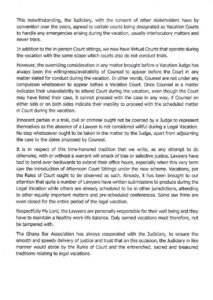
The GBA acknowledged that, over the years, the Judiciary, with the consent of other stakeholders, has designated certain courts as Vacation Courts to deal with emergencies that arise during the vacation.
However, it stressed that such courts have traditionally been limited to urgent and interlocutory matters and not trials.
The Association noted that the same principle applies to Virtual Courts operating during the vacation, saying they also do not conduct trials.
A major concern raised by the GBA is the availability of counsel.
The Association said the overriding consideration in matters brought before a Vacation Court has traditionally been the willingness and availability of counsel to appear.
It argued that lawyers are not under any compulsion to appear before a Vacation Court if they have indicated that they are unavailable during the vacation.
According to the GBA, even where a case has already been listed, the court should not proceed if counsel on either side, or both sides, have indicated that they are unable to attend.
The Association further argued that an accused or other party to a civil or criminal trial should not be forced to represent themselves simply because their lawyer is unavailable during the legal vacation.
It said the absence of counsel during the vacation should not be treated as wilful and that, in such circumstances, the appropriate step should be to adjourn the case to dates proposed by counsel.
The Bar warned that attempts to continue proceedings despite the established vacation arrangements could create the appearance of bias or selective justice.
It said lawyers have already had to extend their working hours because of the demands of the legal year, particularly following the introduction of afternoon court sittings under the new scheme.
The Association maintained that vacations should be observed as provided under the Rules of Court.
It also disclosed that several lawyers have already made plans for the vacation, including preparing written submissions, travelling to other jurisdictions, attending previously scheduled professional engagements and participating in conferences.
The GBA added that some law firms have closed for the entire legal vacation.
The Association also linked its position to the welfare and work-life balance of lawyers.
It argued that lawyers are personally responsible for their well-being and should be allowed to maintain a healthy work-life balance.
The GBA therefore insisted that duly earned vacations should not be interfered with.
The Association said it has consistently cooperated with the Judiciary to promote the smooth and speedy delivery of justice and expressed confidence that the Judiciary would, in return, respect the Rules of Court and the long-standing traditions surrounding legal vacations.
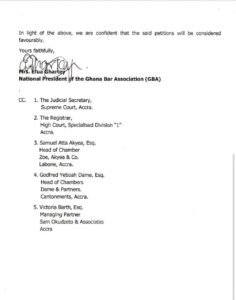
The GBA concluded its letter by expressing confidence that the petitions concerning the continued criminal proceedings would be considered favourably by the Chief Justice.
The letter was copied to the Judicial Secretary of the Supreme Court, the Registrar of the High Court, Specialised Division “1”, and representatives of the three law firms involved.
The copied recipients included Samuel Atta Akyea, Head of Chamber at Zoe, Akyea & Co.; Godfred Yeboah Dame, Head of Chambers at Dame & Partners; and Victoria Barth, Managing Partner of Sam Okudzeto & Associates.
The GBA’s position comes amid ongoing challenges over the continuation of selected part-heard criminal cases during the current legal vacation, with lawyers in some cases arguing that proceeding without their availability could undermine established legal practice and the right of accused persons to representation by counsel of their choice.