Entertainment
Queen Asabia Cropper: The Highlife Queen Who Turned Kente Into Her Signature


Long before Ghanaian music became dominated by Afrobeats, digital streaming and social media, there were female musicians who were already proving that women could command the highlife stage.
One of the most distinctive among them was Queen Asabia Cropper.
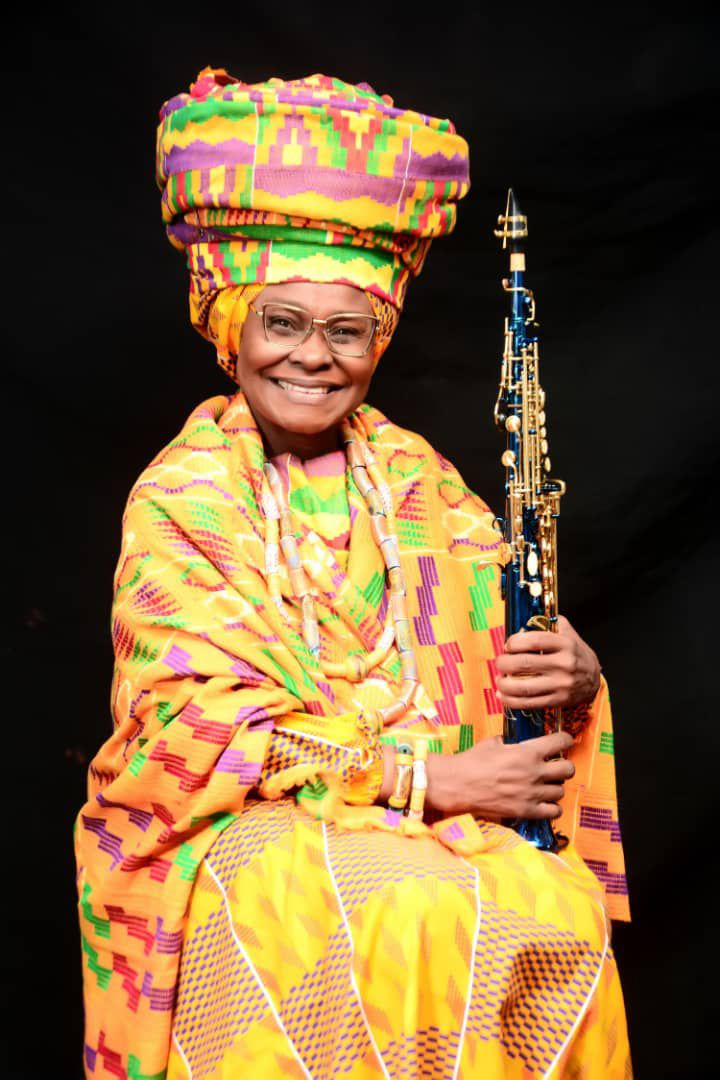

Born Eugenia Asabia Cropper, she became known as a singer and soprano saxophonist and eventually earned the title Queen of Highlife Music. Her career has also been closely connected with fashion, particularly the use of colourful Ghanaian kente as part of her stage identity.
Her story is not simply about music. It is a story about family, highlife, fashion, African identity, international performance and a woman who created a recognisable identity at a time when Ghana’s music industry was overwhelmingly male-dominated.


Queen Asabia was born, raised and educated in Ghana.
She grew up in an environment where music and fashion were both important parts of her life. Her mother and grandmother played a significant role in developing her interest in fashion and headgear.
According to accounts of her life, they taught her different ways of tying and arranging headwear.
That childhood influence would eventually become one of the most recognisable aspects of her public image.
Her colourful headgear was not simply an accessory.
It became part of the Asabia brand.

She later developed distinctive styles associated with names such as Mt Kilimanjaro, Afajato Kloyo and Yogaga.
Music also came into her life through her twin brother, Kenteman, whose birth name is Eugene Nene Agyeman Cropper.
Kenteman became a respected bassist, multi-instrumentalist, arranger, composer and producer.
He was instrumental in introducing Asabia to music.
During the 1970s, he taught her to play the piano and acoustic guitar.
Asabia later developed her skills on the soprano saxophone, receiving instruction from the renowned Ghanaian saxophonist Tex Korley in 1978 and later from Sammy Lartey Snr., a bandleader associated with the Ghana Broadcasting Corporation band, in 1983.
This meant that Asabia was not merely a vocalist standing in front of a band, and she was also an instrumentalist.


In 1975, Asabia and her twin brother became associated with the legendary Sweet Talks Band.
This period marked an important stage in her development as a professional musician.
The Sweet Talks were among the notable highlife groups of their generation, and being part of such a band placed Asabia in the middle of Ghana’s vibrant live-band culture.
It was also around this period that she began incorporating her distinctive kente headwear into her stage appearance.
She has said that she first wore the kente headwrap on stage in 1975. Fifty years later, she was still using the style as part of her performances.


From Ghana to Côte d’Ivoire
Asabia’s career was not restricted to Ghana.
She and Kenteman later became associated with the Black Hustlers Band, which operated in Côte d’Ivoire.
This became one of the most important periods of their international musical journey.
The band included Asabia as singer and saxophonist, Kenteman on bass, Pope Flynn, Alfred Young on lead guitar, Alex Abito on drums and Max Cozy on keyboards.
The Côte d’Ivoire experience exposed the siblings to a wider West African audience and helped them build an identity beyond Ghana.
The birth of Pagne du Asabia
It was in Côte d’Ivoire that Asabia’s fashion identity became even more influential.
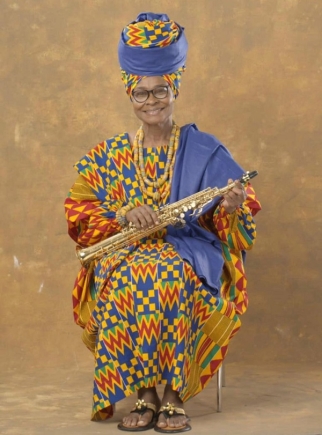
Her use of Ghanaian kente as part of her performance clothing became so distinctive that the material was associated with her name.
The style became known as Pagne du Asabia, essentially referring to Asabia’s cloth or trademark style.
She and Kenteman used kente not simply as clothing but as a cultural statement.
Their stage appearances combined music with Ghanaian textile traditions and helped project the image of Ghanaian kente to audiences outside the country.
This combination of music and fashion eventually became one of the strongest parts of their identity.

Recording Wamaya
One of the songs strongly associated with Queen Asabia is Wamaya.
The song was recorded through Eboni Records in Côte d’Ivoire, with Abdoulaye Soumare involved in the recording process.
The Eboni Records band also had connections with internationally recognised African musicians.
Kenteman, for instance, played bass when the band backed Mory Kanté on his N’Diarabi project.
Wamaya later became one of Asabia’s signature songs and remains one of the tracks audiences associate with her career.

Asabia’s career also involved collaborations beyond Ghana.
In 1982, she collaborated with Samuel Mangwana and Jimmy Hyacinthe on the album Sam Asabia.
Her career therefore developed within a wider West African musical environment rather than being limited to the Ghanaian market.
This was particularly significant at a time when musicians did not have today’s digital platforms to reach international audiences.
Cross-border performances, physical records, radio and live concerts were among the main ways African musicians expanded their audiences.
Her music catalogue
Some of the recordings associated with Queen Asabia include: Wamaya, Torwia, Inamosi, I Love So Much, Asabia.
Her songs have continued to appear in performances and retrospectives celebrating Ghanaian highlife.
At a 2019 Signature Concert, for example, Asabia performed Torwia, Inamosi, and finished with Wamaya.
Becoming the Queen of Highlife
Asabia’s career eventually earned her one of the most recognisable titles in Ghanaian music.
She was honoured as the Queen of Highlife Music through the Union of National Radio and Television Organisations of Africa (URTNA) awards.
She also received a gold disc in 1984 from Daniel Cuxac, an international music executive associated with Disco Stock International in Côte d’Ivoire.
In the same period, she and Kenteman were increasingly being recognised not only as musicians but also as cultural ambassadors.

A cultural ambassador
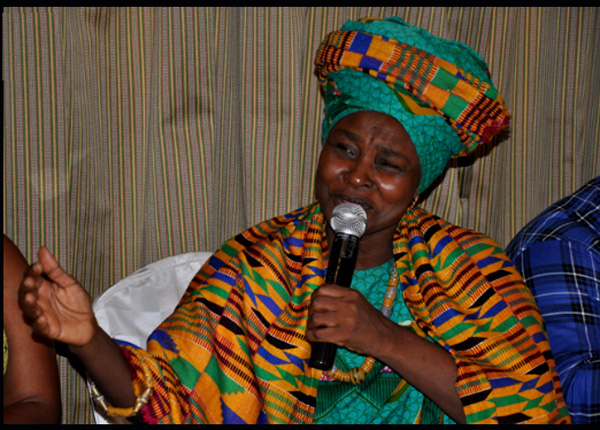
In 1993, the URTNA awards recognised Asabia and Kenteman as cultural ambassadors of Africa.
That recognition reflected the wider cultural dimension of their work.
They were promoting music, but they were also presenting a visual representation of Ghana through their kente clothing.
Their performances communicated Ghanaian identity through sound, colour, fashion and stage presentation.
Asabia’s achievements were also recognised within Ghana’s entertainment industry.
Her self-titled album Asabia was reportedly selected as Album of the Year, while she was named Artist of the Year at the 1985 Entertainment Critics and Reviewers Association of Ghana awards.
This was a significant moment for a female instrumentalist and singer working within a largely male-dominated highlife environment.


More than a musician
One of the things that separates Queen Asabia from many musicians of her generation is the fact that she built a complete artistic identity.
She had: Music, Fashion, Kente, Saxophone, Stage performance, African cultural representation.
The different elements became inseparable from the Queen Asabia image.
Asabia’s contribution did not disappear as Ghanaian music changed.
In 2019, she was honoured at the Rhythms On Da Runway fashion show for her contribution to fashion in Ghana.
She was also honoured at the MUSIGA Presidential Grand Ball and received an Industry Heroes Award.
In March 2021, she was among personalities recognised at the 3Music Awards Women’s Brunch for their contributions to the entertainment industry.


Unlike many musicians from her generation who have completely withdrawn from public performances, Asabia has continued to appear at highlife and cultural events.
In 2024, she and Kenteman returned to the stage at an Authentic Highlife Night organised to support the Musicians Union of Ghana’s Aged Musicians Welfare Fund.
Asabia, who serves as chairperson of AMWEF, performed alongside musicians from different generations.
Their entrance in colourful kente clothing once again brought together the two elements that have defined their careers: music and fashion.
In 2025, Asabia marked approximately 50 years of using kente headwear as part of her public image.
At the Highlife Heritage Concert 2025, she performed and also brought young women onto the stage to model some of her distinctive headwear styles.
The moment demonstrated how a practice she learned from her mother and grandmother had evolved into a major part of her artistic identity.


Asabia has continued to speak about the importance of preserving Ghanaian music.
At a Highlife Heritage Monthly Concert in June 2026, she performed with the New Ramblers Band, played her soprano saxophone and spoke about the connection between music, culture and Ghanaian identity.
She described highlife as something people continue to cherish as they grow older and emphasised that it belongs to Ghana and deserves to be treasured.
Why Queen Asabia deserves to be remembered
For younger Ghanaians who know highlife mainly through its modern interpretations, Queen Asabia’s story offers another perspective.
She represents a generation when musicians were expected to be more than recording artists.
They had to perform live.
They had to entertain audiences without social media.
They had to build their own visual identity.
And for Asabia, that identity became unmistakable.
The soprano saxophone.
The voice.
The colourful kente.
The headgear.
The twin brother beside her.
And the name Queen Asabia.
Her journey from the Sweet Talks era through Côte d’Ivoire and the Black Hustlers Band to later highlife heritage performances makes her one of the important women in Ghana’s popular music history.
Today, she continues to appear at cultural and highlife events, keeping alive a musical tradition that has passed through several generations.
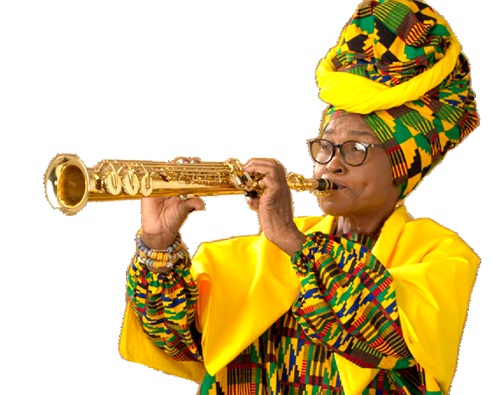
Queen Asabia Cropper — singer and soprano saxophonist
Kenteman — twin brother, bassist, multi-instrumentalist and producer
Tex Korley — saxophone tutor
Sammy Lartey Snr. — GBC bandleader and saxophone tutor
Sweet Talks Band — group with which she performed in the 1970s
Black Hustlers Band — group associated with her Côte d’Ivoire period
Mory Kanté — African musician whose N’Diarabi project was backed by the Eboni Records band with Kenteman on bass
Queen Asabia’s story is ultimately about music, identity and the deliberate preservation of Ghanaian culture. Her career demonstrates how a musician could use both sound and fashion to create an identity that remained recognisable decades after the first performance.

And while many names from Ghana’s golden highlife era have gradually faded from mainstream conversation, Queen Asabia Cropper remains one of the women whose story deserves to be brought back into the spotlight.