General News
Minority Insists GoldBod Must Account for GH¢22bn Reported Loss


The Minority Caucus in Parliament has maintained that the Ghana Gold Board (GoldBod) must account for a reported GH¢22 billion financial loss linked to the Domestic Gold Purchase Programme (DGPP) in 2025.
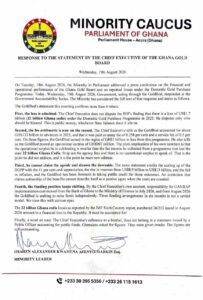
In a statement issued on Wednesday, August 19, 2026, and signed by Minority Leader Osahen Alexander Afenyo-Markin, the Caucus said GoldBod Chief Executive Officer Sammy Gyamfi’s response to concerns raised over the programme had not adequately addressed the financial issues at stake.
The Minority’s statement followed a press conference it held on Tuesday, August 18, on the financial and operational performance of GoldBod and reported losses associated with the Domestic Gold Purchase Programme.
The Caucus said its assessment was based on the International Monetary Fund’s findings on the programme. The IMF’s 2026 report discusses the Domestic Gold Purchase Programme and GoldBod’s evolving role in Ghana’s gold sector.
The Minority argued that Mr Gyamfi had not disputed the IMF’s reported finding of a US$1.7 billion loss under the Domestic Gold Purchase Programme in 2025.
“First, the loss is admitted,” the statement said, adding that the Chief Executive had not disputed the IMF’s finding but had instead sought to determine which institution or officials should be blamed.
According to the Caucus, regardless of which state institution’s balance sheet carries the loss, the financial impact ultimately concerns public funds.
The Minority therefore insisted that the reported loss, estimated at approximately GH¢22 billion, must be properly accounted for.
The Caucus also challenged GoldBod’s explanation of the fees it earned from the programme.
According to the statement, Mr Gyamfi indicated that GoldBod accounted for approximately GH¢133 billion in advances in 2025 and received an assay fee of 0.25 per cent and a service fee of 0.5 per cent.
Based on those figures, the Minority calculated that GoldBod earned about GH¢1 billion in fees from the programme.
The Caucus contrasted that figure with GoldBod’s reported operational surplus of approximately GH¢907 million.
It argued that once the agency fees collected from the programme are separated from GoldBod’s other operations, there would be little or no operational surplus attributable to the programme itself.
“The plain implication of his own numbers is that the operational surplus he is celebrating is smaller than the fee income he collected from a programme that lost the state 22 billion Ghana Cedis,” the statement said.
The Minority consequently called on the GoldBod CEO to provide a clearer explanation of the relationship between the fees earned and the reported financial loss.
The Caucus further accused Mr Gyamfi of taking credit for positive economic developments while distancing GoldBod from the reported downside associated with the programme.
It pointed to improvements in Ghana’s debt-to-GDP position, the increase in international reserves from about US$8.9 billion to US$11.3 billion, and the decline in inflation.
The Minority said GoldBod had been “foremost in taking public credit” for some of these outcomes.
It argued that an institution that claims responsibility for the benefits associated with a policy should also be prepared to accept responsibility for costs arising from the same policy.
The Minority also raised concerns about what it described as shifting arrangements for financing the Ghana Reserves Accumulation and National Assets Protection (GANRAP) programme.
According to the statement, Mr Gyamfi indicated that responsibility for the implementation cost of GANRAP moved from the Bank of Ghana to the Ministry of Finance in July 2026.
The Caucus said GoldBod was subsequently seeking to raise funds independently from August 2026.
It described the movement between three different funding arrangements within six months as evidence that the financing model had not yet been settled.
“Three funding arrangements in six months is not a settled model,” the Minority stated.
The IMF has previously noted that GoldBod’s operational model was significantly expanded from April 2026, with the institution taking over the Bank of Ghana’s role in the Domestic Gold Purchase Programme and handling financing, purchasing, assaying and exporting artisanal gold. From July 1, 2026, the government was to cover operating costs related to gold purchases, with costs subject to a 5 per cent ceiling of the overall cost of gold purchased.
The Minority concluded that the reported GH¢22 billion loss, which it said was contained in the IMF’s Sixth Country Report, must be accounted for.
The Caucus specifically referenced IMF Country Report No. 26/213, issued in August 2026, and maintained that the reported amount represented a financial loss to the Republic of Ghana.
The statement said the issue should not be dismissed simply because the loss appeared on the books of another state institution.
The IMF’s July 2026 assessment confirms that the Domestic Gold Purchase Programme had created a temporary breach of a Bank of Ghana performance criterion because of cost-sharing arrangements, while also noting Ghana’s broader improvements in reserves and macroeconomic stability.
The Minority Leader also criticised the tone adopted by the GoldBod CEO during his response to the Minority’s allegations.
Mr Gyamfi had reportedly used a reference to a “brothel” while dismissing the Minority’s criticisms during the Government Accountability Series.
Mr Afenyo-Markin described the remark as inappropriate for a public official responding to questions about the management of public funds.
“The Chief Executive’s reference to a brothel does not belong in a statement issued by a Public Officer accounting for public funds,” the Minority Leader said.
He added that Ghanaians were demanding financial figures and explanations rather than insults.
“Ghanaians asked for figures. They were given insults. The figures are still outstanding,” he stated.
The dispute comes amid competing interpretations of the financial figures. While the Minority has focused on the reported US$1.7 billion loss associated with the Domestic Gold Purchase Programme, the Institute of Fiscal Policy Governance has argued that GoldBod’s own audited accounts show a GH¢5.44 billion surplus for 2025 rather than a GH¢22 billion loss.
The controversy therefore centres partly on whether the reported losses under the Bank of Ghana’s Domestic Gold Purchase Programme should be treated as losses incurred by GoldBod itself or as financial consequences of a programme implemented through GoldBod on behalf of the central bank.
The Minority, however, maintains that GoldBod cannot distance itself from the financial consequences of transactions it operationally managed and is demanding full accountability for the reported loss.