
Business
Government urged to absorb part of US tariff cost to support Ghanaian exporters

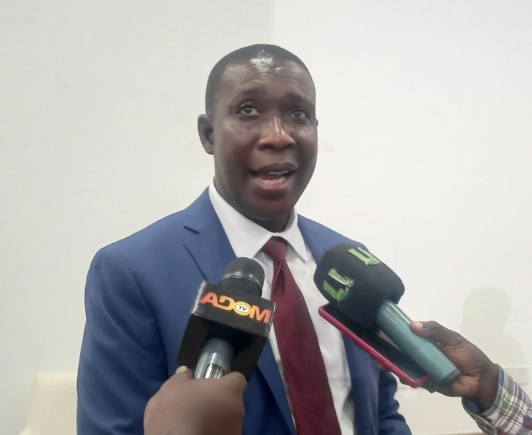
An economist at the University of Ghana, Professor William Baah-Boateng, has urged the government to consider absorbing part of the new 10 per cent tariff imposed by the United States on some Ghanaian exports to reduce its impact on local businesses.
He said such an intervention would provide short-term relief for exporters while broader efforts are made to address challenges facing the country’s export sector.
Speaking in an interview with JoyNews last Friday, April 5, 2025, Prof Baah-Boateng noted that although the tariff was not as high as those imposed on countries like China and Canada, its effect on Ghanaian exporters could not be ignored.
“If indeed this tariff is something that is going to worry us, can we absorb part of it so that at least when it goes out there it will not be sold at a higher price?” he asked.
The US government recently announced a 10 per cent tariff on a range of imported goods, including agricultural produce from several African countries, sparking concerns among Ghanaian exporters about the potential impact on their competitiveness.
Prof Baah-Boateng said while the tariff itself posed challenges, delays at Ghana’s ports and other structural problems within the export system often contributed more significantly to high production costs.
He pointed to the long waiting times transporters sometimes faced at the ports as a key issue that the government should address to reduce costs for exporters.
“For instance, if you are in Koforidua and you are exporting gari to the US, and the car that you rented is going to spend about three, four days there, can we do something to minimise those bottlenecks so that the car will just spend one day and then the goods will get out?” he asked.
Prof Baah-Boateng said removing such bottlenecks would likely have a greater impact on reducing costs for businesses than the 10 per cent tariff.
He urged the Ministry of Trade and Industry and other relevant state institutions to provide clear communication to exporters to prevent panic.
“I expect the Ministry of Trade and Agribusiness to come in and assure us because they have the figures. They will be able to know how the effect will be, that it is not rocket science,” he said.
He also cautioned against creating unnecessary alarm over the tariff, pointing out that Ghana’s situation was far less severe than that of some other countries.
“We are not Canada, where we’ve been slapped with over 50 per cent. We are not China, where we have in excess of 50 per cent. We have the 10 per cent. Let’s be sober so that we will not panic,” he advised.
Prof Baah-Boateng also warned against any rushed attempt by Ghana to enter into a bilateral free trade agreement with the US as a response to the tariff.
He said Ghana would be better served working through regional bodies like the African Union to strengthen its bargaining position in global trade negotiations.
Source: Graphic Online





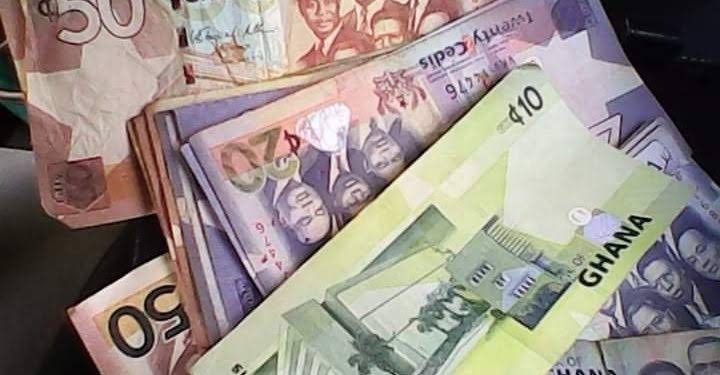
The Bank of Ghana says the recent decline in the value of the U.S. dollar has played a major role in supporting the Ghana Cedi, helping to steady the local currency despite continued challenges in the foreign exchange market.
According to the Central Bank, the U.S. dollar index fell by about 8 percent between January and August 2025. This was largely due to a slowdown in the American labour market and growing expectations that the U.S. Federal Reserve would begin cutting interest rates.
In its September 2025 Monetary Policy Report, the Bank explained that the weaker dollar, along with the increasing global use of alternative currencies like the Chinese Yuan for trade and commodity payments, contributed to the strengthening of several emerging market currencies — including Ghana’s cedi.
However, the local currency still faced headwinds during the period, mainly from high import demand and reduced foreign exchange supply. These challenges were linked to issues in the Gold-for-Forex programme and a dip in remittance inflows.
Despite these pressures, the Cedi recorded notable gains — appreciating by 28.95 percent against the U.S. dollar, 19.49 percent against the British pound, and 14.08 percent against the euro on a year-to-date basis. This marks a sharp turnaround from the significant losses seen during the same period in 2024.
The Bank of Ghana noted that the Cedi’s short-term stability will rely on maintaining high gold prices, improving forex liquidity through new directives to mining companies, and ensuring continued fiscal discipline.
Additionally, positive investor confidence from the recent IMF programme reviews and shifts in U.S. monetary policy are expected to further influence the Cedi’s outlook in the coming months.
Business
KGL Group Chairman, Alex Apau Dadey Honored with Forbes Best of Africa Corporate Leadership & Innovation Award
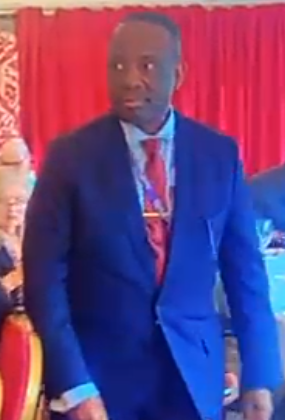
Alex Apau Dadey, the distinguished Executive Chairman of KGL Group, has been celebrated with the prestigious Forbes Best of Africa Corporate Leadership and Innovation Award at a high-profile Leadership and Philanthropy Forum held at the House of Lords in London.
The award was formally presented by Mark A. Furlong, President of Custom Solutions Media for Forbes Media, who commended Mr. Dadey’s exceptional achievements in steering KGL Group to remarkable technological heights.
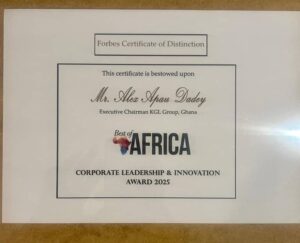
Presenting the honor, Mr. Furlong stated:
“On behalf of the Forbes Best of Africa Award Committee, it is my honor to present to you the Forbes Best of Africa Corporate Leadership & Innovation Award.”
The official citation praised Mr. Dadey’s transformative leadership:
“As Executive Chairman of KGL Group, you have successfully led the company’s expansion into digital solutions, fintech, and technology-driven platforms that have revolutionized Ghana’s lottery and gaming industry while fostering financial inclusion. Under your stewardship, KGL Group has risen to become a leading African corporate brand, exemplifying innovation, social impact, and sustainable business practices.”
Receiving the award alongside his wife and children, Mr. Dadey expressed heartfelt appreciation:
“I am truly humbled by this recognition. My sincere gratitude goes to the Forbes team for this honor, and to the extraordinary team at KGL Group, including our Board, Management, and Staff, whose dedication has made this possible. I want to encourage all Africans in the diaspora to return home and contribute their knowledge to building the continent. After living in London for over 20 years, I made the decision to return to Ghana to serve and create impact. Ten years on, I am proud to have built one of Ghana’s most successful technology-driven businesses, and I am honored that Forbes recognizes this journey.”
The Forbes Best of Africa Awards celebrate visionary business leaders who are building globally competitive enterprises while making significant contributions to Africa’s economic and social development.
Other distinguished honorees included:
• Dr. Olasupo Olusi, Managing Director and CEO of Nigeria’s Bank of Industry (BOI), the country’s oldest and largest development finance institution
• Prince Nnamdi Ekeh, Group CEO of Konga, renowned for advancing e-commerce, digital infrastructure, and payments across emerging markets.
CSR Dominance of KGL Group in Ghana:
Apart from leading KGL Group to become the leading corporate brand in Africa, Mr. Alex Dadey has also achieved significantly in the areas of Corporate Social Responsibility(CSR) and Corporate Social Investment(CSI) projects in Ghana including sponsoring the Ghana Black Stars to qualify for the 2026 World Cup, construction of multimillion-dollar ultra-modern Mental Health Facility in the Ashanti Region in partnership with the King of Ashanti Kingdom, Otumfuo Osei Tutu II, free supply of incubators to various hospitals in Ghana, GHS 3 million annually to support Stabilization Fund of NLA, GHS 2 million annually to support NLA Good Causes Foundation, Scholarships to several orphans & destitute children, sponsorship packages for various charity organizations across Ghana and Africa, and currently steps are being taken by KGL Group to partner Ghana Medical Trust Fund(also known as MahamaCares), a landmark initiative of President John Mahama aimed at providing financial assistance to individuals living with chronic diseases across Ghana. The Mahamacares seeks to cover the cost of care and medication for Non-communicable diseases not currently included under the National Health Insurance Scheme(NHIS), as well as invest in health infrastructure, medical equipment, specialist training, and research to enhance access to quality healthcare delivery in Ghana.
Indeed, Mr. Alex Dadey deserves to be celebrated as a Statesman and successful entrepreneur who uphold service to God, Country, and Humanity, and Forbes Media is proud to be associated with the brand of KGL Group and Mr. Alex Apau Dadey.
A federal jury in Marshall, Texas, has ordered Samsung Electronics to pay nearly $445.5 million in damages to Collision Communications after finding the tech giant guilty of infringing on multiple wireless communication patents.
The jury determined that Samsung’s Galaxy smartphones, laptops, and other wireless-enabled devices violated four patents owned by Collision Communications, which are related to 4G, 5G, and Wi-Fi communication standards.
This ruling adds to a series of multi-million-dollar patent infringement verdicts against Samsung in the same Texas court in recent years.
Collision Communications, based in Peterborough, New Hampshire, filed the lawsuit in 2023, alleging that Samsung used its patented technology—originally developed through research by defense contractor BAE Systems—to enhance wireless network efficiency. BAE Systems, however, is not involved in the case.
Samsung has denied the allegations, arguing that the patents in question are invalid. Representatives from both companies have yet to issue public comments following the verdict.
Source: Reuters

JUST IN: Asamoah Gyan Still Owes Over GHC 1 million Judgment Debt – His Accounts Frozen

German President Steinmeier to Visit Ghana — High-Level Talks with President Mahama Set for Monday

President Mahama Arrives in Cairo for Grand Egyptian Museum Opening


-
 Uncategorized1 week ago
End of an Era: Nana Konadu Agyeman-Rawlings, Ghana’s Iconic First Lady, Dies at 76
-
 General News5 days ago
Ato Forson to Present Mahama Government’s First Full-Year Budget on November 13
-

 Entertainment1 week ago
Broadcast Icon Kojo Preko Dankwa to Receive Honor at Elite Entertainment Awards 2025
-

 Entertainment1 week ago
Amerado Defies Expectations with Soulful Highlife EP “Defy All Odds”
-
 Politics4 days ago
Afenyo-Markin Chooses Neutral Path in NPP Presidential Race, Says His Role Demands Unity Over Loyalty
-
 General News3 days ago
Africa Extractives Media Fellowship Launches in Accra to Empower Next Generation of Journalists
-
 Business6 days ago
KGL Group Chairman, Alex Apau Dadey Honored with Forbes Best of Africa Corporate Leadership & Innovation Award
-
 General News6 days ago
From Fat Lies To Empty Lies: The new case of Fourth Estate against Razak Kojo Opoku