
Business
Bank of Ghana Warns Against Rejection of Cedi Coins, Announces Criminal Sanctions

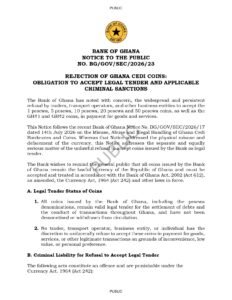
The Bank of Ghana (BoG) has issued a public notice warning traders, transport operators, businesses, and individuals that refusing to accept Ghana cedi coins as payment is unlawful and may attract criminal sanctions.
The notice, numbered BG/GOV/SEC/2026/23, addresses the growing practice of rejecting coins in commercial transactions across the country. According to the central bank, this behavior undermines the legal status of Ghana’s currency and violates existing laws.
Coins Remain Legal Tender
The Bank of Ghana stated that all coins it has issued—including 1 pesewa, 5 pesewa, 10 pesewa, 20 pesewa, 50 pesewa, GH¢1, and GH¢2 coins—remain valid legal tender throughout Ghana.
The central bank emphasized that none of these coins have been demonetized or withdrawn from circulation. Therefore, they must be accepted for the settlement of debts and payments for goods and services.
The notice follows an earlier BoG directive (Notice No. BG/GOV/SEC/2026/17), issued on July 14, 2026, which focused on the misuse, abuse, and illegal handling of Ghana cedi banknotes and coins. While the earlier notice dealt with physical damage and defacement of currency, the latest directive specifically addresses the unlawful refusal to accept coins.
Refusal to Accept Coins Is Illegal
The Bank made it clear that no trader, transport operator, business entity, or individual has the right to reject legal tender simply because the coins are considered inconvenient, of low value, or due to personal preference.
Businesses that refuse to sell goods or provide services because customers choose to pay with legal Ghana cedi coins may be committing an offence under the Currency Act, 1964 (Act 242).
Criminal Penalties
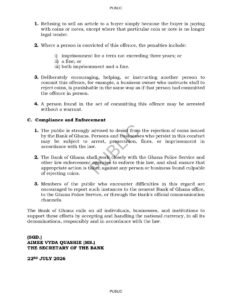
According to the notice, persons convicted of unlawfully refusing legal tender may face:
- Imprisonment for a term not exceeding three years;
- A fine;
- Or both imprisonment and a fine.
The Bank also warned that anyone who instructs, encourages, or assists another person to reject coins—for example, a business owner directing employees not to accept coins—may be held equally liable under the law.
Additionally, individuals caught committing the offence may be arrested without a warrant.
Enforcement Measures
The Bank of Ghana announced that it will collaborate closely with the Ghana Police Service and other law enforcement agencies to ensure compliance with the law.
The central bank warned that individuals and businesses that continue rejecting coins risk arrest, prosecution, fines, and possible imprisonment.
Members of the public experiencing difficulties with businesses refusing coins are encouraged to report such incidents to the nearest Bank of Ghana office, the Ghana Police Service, or through the Bank’s official communication channels.
Call to the Public
The Bank of Ghana urged all individuals, businesses, and institutions to support national efforts by accepting and responsibly handling Ghana’s currency in all its denominations.
The notice was signed by Aimee Vyda Quashie (Ms.), Secretary of the Bank, and is dated July 22, 2026.















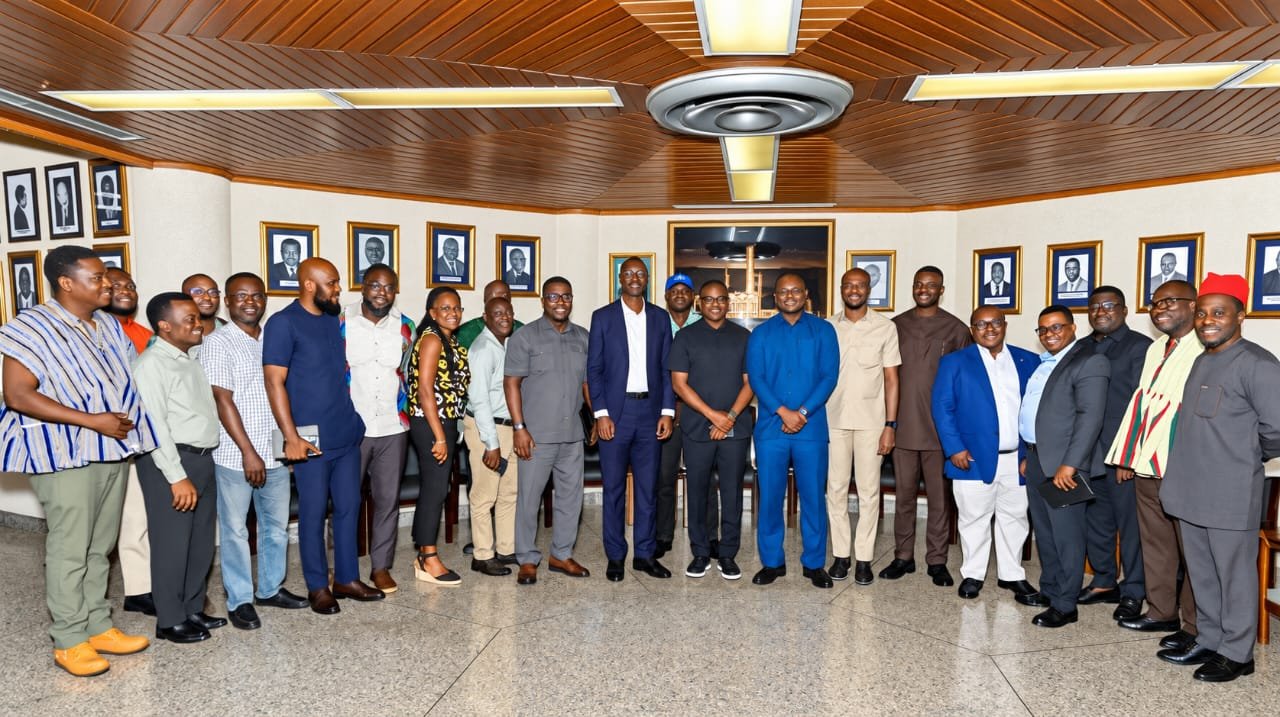
The Management of Tema Oil Refinery (TOR) and Ghana Oil Company Limited (GOIL) on September 2, 2026 held a strategic meeting to explore further opportunities for collaboration in the supply and offtake of petroleum products produced by the refinery, building on the existing business relationship between the two institutions.
Briefing the Managing Director of GOIL and his team, the Managing Director of TOR, Mr. Edmond Kombat, highlighted the significant strides made in ramping up refinery operations, with particular emphasis on the swift and smooth execution of ongoing restart and supply processes – demonstrating renewed operational discipline at the refinery.
As one of TOR’s key offtake partners, GOIL’s continued collaboration remains important as TOR works to increase the supply of petroleum products to the Ghanaian market. The engagement also provided an opportunity for both institutions to identify additional areas of cooperation as TOR continues its Resetting, Transformation and Optimization journey.
The discussions focused on strengthening and deepening the strategic partnership between TOR and GOIL to:
* Enhance petroleum products supply security
* Strengthen market resilience
* Support greater price stability at the pump
* Contribute to a more efficient and reliable downstream petroleum sector
The partnership between the two institutions is critical to strengthening Ghana’s energy security and advancing the broader national interest.
In conclusion , Mr. Kombat insisted that, TOR remains committed to building strong partnerships with key industry stakeholders such as GOIL to support Ghana’s energy security and deliver sustainable value to the Ghanaian consumer.
TOR remains Ghana’s Premier Refinery and ready to serve beyond Ghana, he noted.
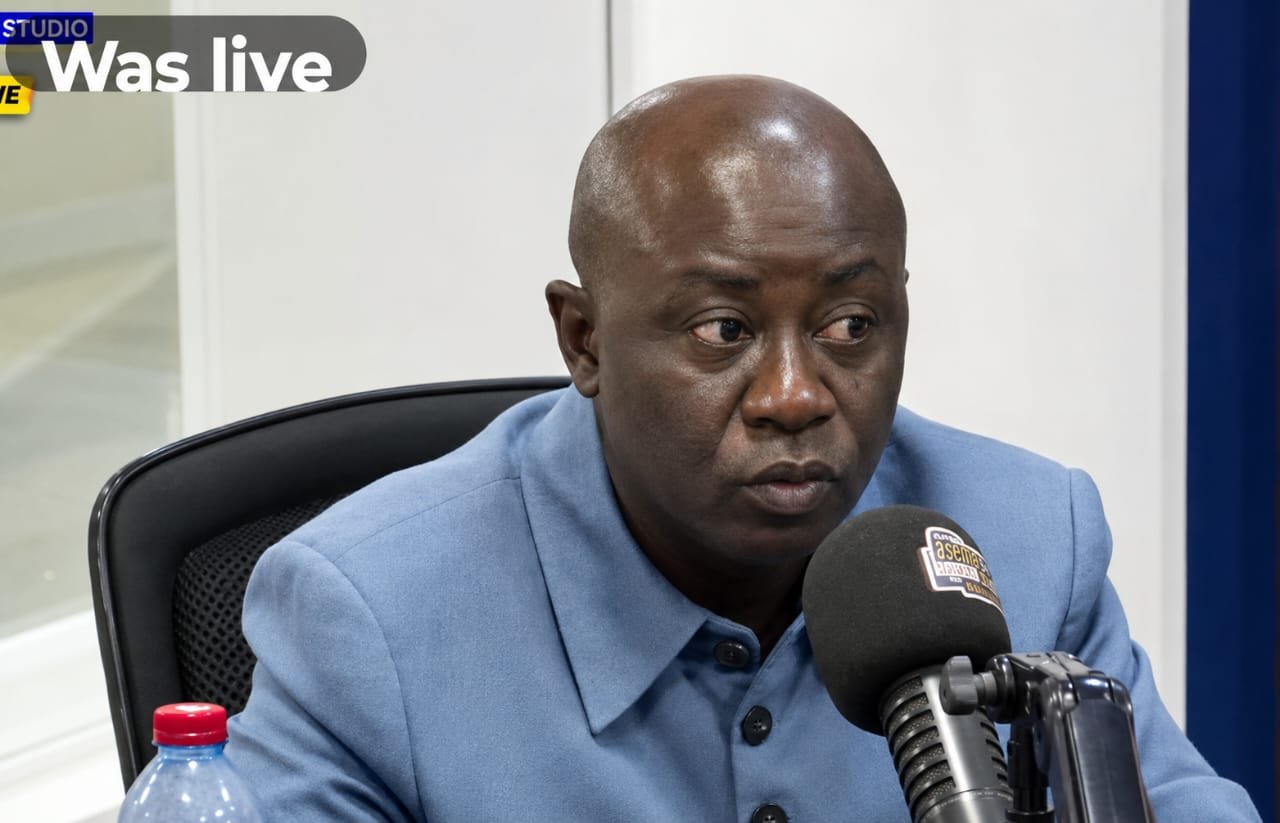
The Tema Oil Refinery (TOR) is showing signs of a major turnaround after years of operational difficulties, with renewed refining activities expected to help reduce Ghana’s dependence on imported petroleum products.
According to Emmanuel Duah’s remarks captured during an assessment of the refinery’s progress at Kessben Maakye show in Accra, he insisted, TOR previously faced severe operational challenges, at one point functioning largely as a tank farm after its refining operations became inactive.
The situation, he claimed however, is said to be changing, with the refinery now returning to refining activities.
The development follows President John Dramani Mahama’s challenge to TOR to increase production to about one million barrels per month, a target expected to strengthen local fuel production and potentially reduce the cost of imported petroleum products.
“If we are able to produce one million barrels every month, fuel prices would go down locally and reduce imports,” he indicated.
In addition he said, the revival is also being viewed as a significant boost to confidence among workers and stakeholders at TOR, following years of uncertainty over the refinery’s future.
He further praised the Managing Director of TOR, Edmond Kombat describing his leadership as people-oriented and crediting him for helping to steer the refinery through some of its most difficult periods.
Consequently he admonished the government to provide the refinery with the necessary financial and technical support to sustain the ongoing renewal process.
The call is aimed at ensuring that TOR does not only resume operations but develops into a strong and sustainable domestic refining facility capable of meeting a significant portion of Ghana’s fuel needs.
He also commended young professionals appointed to key positions across various sectors by the President John Dramani Mahama particularly the energy sector, for what was described as their significant contribution to Ghana’s development.
He reincarnated that, with sustained investment and support, stakeholders believe the revival of TOR could help strengthen energy security, reduce petroleum imports and create wider economic benefits for the country, Duah noted.
By Maurice Otoo

Charles McCarthy of the Hawk Newspaper has highlighted the scale of assets at the Tema Oil Refinery (TOR), arguing that the state-owned facility remains a valuable national asset despite years of operational and financial challenges.
Speaking in a discussion at Kessben Maakye show in Accra, McCarthy insisted, TOR has faced a significant debt burden over the years, with the refinery reportedly carrying substantial legacy liabilities of about $517 million.
He noted that the refinery’s revival has been made possible by the efforts of its workers, management and other stakeholders, stressing that the facility’s infrastructure and land hold considerable value.
“Even if you sell the infrastructure of TOR as scrap, you will get not less than $22 million,” McCarthy said.
He further pointed to TOR’s extensive land holdings, noting that the refinery occupies more than 100 acres, while its tank farm is described as one of the largest in Africa.
McCarthy also highlighted the refinery’s renewed production capacity, noting that TOR is currently targeting or operating toward 45,000 barrels of crude per day.
TOR’s official production information confirms that its revamped Crude Distillation Unit has a capacity of 45,000 barrels per stream day.
He argued that the government’s approach to the refinery’s operations and legacy obligations should be viewed in the context of the enormous financial burden inherited by the facility.
McCarthy further claimed that the government had not provided TOR with direct operational funding but had instead allowed the refinery to utilise revenues generated from its activities, while efforts were being made to address its legacy debt. According to McCarthy, the current Managing Director of TOR, Edmond Kombat has admitted, saying, “if you don’t have a committed President, you cannot operate TOR”.
The comments come as TOR continues efforts to restore sustainable refining operations. The refinery resumed crude processing in December 2025 following major maintenance works, with further upgrades aimed at restoring its 45,000-barrel-per-stream-day capacity.
While commending the strategic initiative made by the current Managing Director of TOR, Mr. Edmond Kombat, to reform the effective operation of the facility, he referenced failures chucked by the previous administration, saying, apart from Mr Isaac Osei who spent almost two years at TOR, the Akufo Addo government was practicing one year – one MD at TOR.
A practice he claimed yielded no gain for the nation and eventually turned the national asset to liability.
By: Maurice Otoo

New Patriotic Party (NPP) National Organiser hopeful Kwadwo Agyei Yeboah has raised concerns over the financial impact of the government’s domestic gold purchasing programme involving GoldBod and the Bank of Ghana (BoG).
Speaking on Kessben Maakye show in Accra, Mr. Agyei Yeboah claimed, an International Monetary Fund (IMF) report indicates that Ghana’s domestic gold purchasing programme generated significant financing and fiscal pressures during the 2025 fiscal year.
He argued that while the programme has contributed to an increase in Ghana’s national reserves and helped stabilize the cedi against major trading currencies, the IMF has advised the Central Bank to avoid financing GoldBod’s activities in ways that could weaken its balance sheet.
“While the operation programme increases national reserve and stabilizes the cedi, the IMF advice against Central Bank finance causing fiscal operation to prevent weakening the Central Bank balance sheet,” he stated.
Mr. Agyei Yeboah questioned how GoldBod could be considered profitable if its operations were simultaneously weakening the balance sheet of the Bank of Ghana.
He further claimed that the IMF’s position amounts to confirmation that Ghana’s gold business has contributed to the relative stability of the cedi amid volatility in major international currencies.
According to figures he attributed to GoldBod, the institution purchased 135,843 metric tonnes of gold between its establishment in May 2025 and May 2026.
He also cited a breakdown indicating that 135,221 metric tonnes, representing about 93% of the purchases, came from artisanal and small-scale miners (ASM).
However, Mr. Agyei Yeboah noted that illegal mining, popularly known as galamsey, remains a major source of purchases, raising questions about where the gold extracted through galamsey is being traded.
He also alleged that President John Dramani Mahama is aware that some of his associates are involved in illegal mining, suggesting that this could explain the government’s difficulty in tackling the menace.
On GoldBod’s finances, he claimed that the institution spent approximately $16 billion on gold purchases between May 2025 and May 2026, against $10.9 billion in revenue, which he described as a loss.
The comments are likely to intensify the ongoing debate over GoldBod’s operations, its impact on the Bank of Ghana’s balance sheet, and the broader economic benefits and risks associated with Ghana’s domestic gold purchasing programme.
By Maurice Otoo
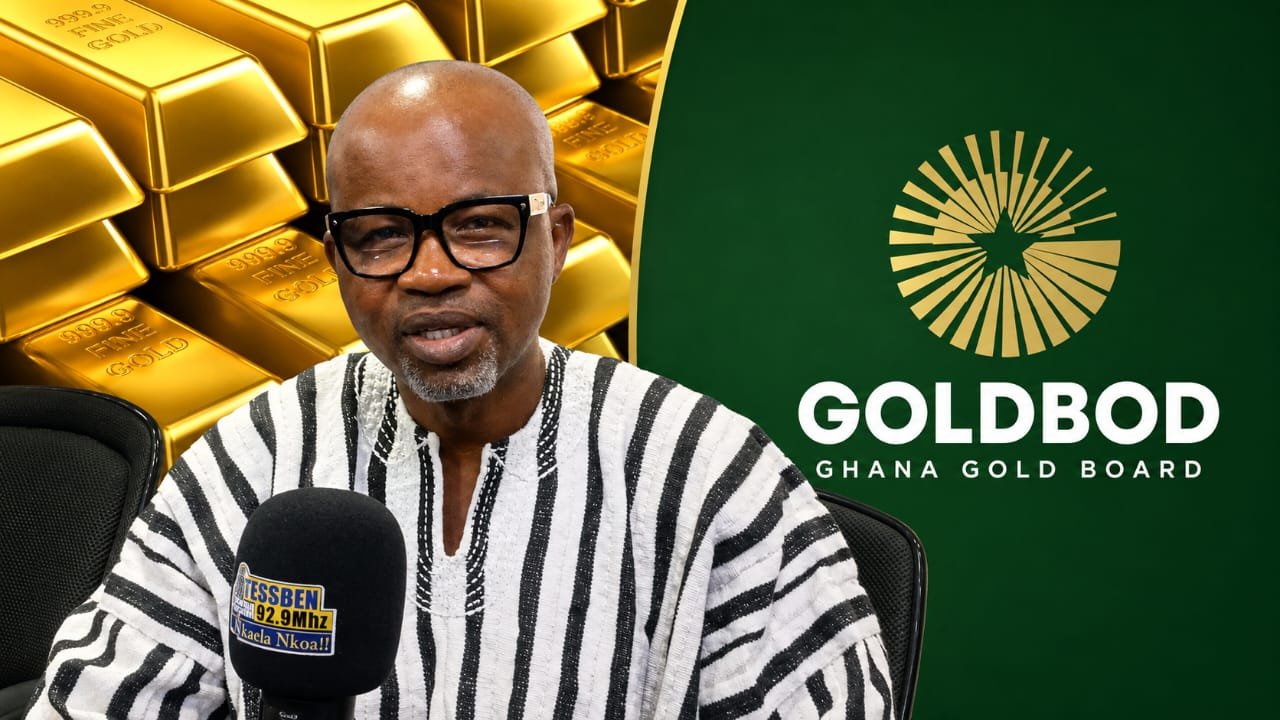
NDC former parliamentary aspirant for Bortianor Ngleshie Amanfro , Alexander Ackuokoh, has strongly rejected claims that the Ghana Gold Board (GoldBod) has incurred losses, accusing the opposition NPP of misrepresenting the International Monetary Fund’s (IMF) comments on the state-backed gold trading institution.
In a discussion at Kessben Maakye show in Accra, Ackuokoh said, the debate surrounding GoldBod has been driven by what he described as a “predetermined” attempt to portray the institution negatively.
“A predetermined mind is difficult to convince,” he said, arguing that there is no basis for the NPP to treat the IMF’s statement on GoldBod as though it were a major indictment.
Ackuokoh insisted that GoldBod has not run into losses, stressing that the IMF did not state that the institution had made losses.
He explained that the issue concerns losses associated with operational cost or accounting treatment, rather than GoldBod itself being a loss-making institution.
The NDC parliamentary aspirant further cited the Auditor-General’s report on GoldBod’s 2025 operations, claiming that the institution recorded a surplus of about GH¢5.5 billion.
He questioned why GoldBod should be judged primarily on profit-making when, according to him, the institution was established to help build Ghana’s gold reserves and contribute to financial-sector stability.
Ackuokoh also took aim at former Deputy Finance Minister and current Public Accounts Committee Chairperson Abena Osei Asare, accusing her of engaging in speculation over GoldBod.
He argued that such claims amount to an attempt to mislead the public.
According to him, Ghanaians should instead compare the benefits of GoldBod’s operations with the debt burden associated with what he described as former Finance Minister Ken Ofori-Atta’s “reckless” Eurobond borrowing.
Ackuokoh further argued that GoldBod’s activities are already contributing to greater stability in the local currency.
“Gone are the days that our cedi was running like Usain Bolt,” he said, suggesting that the current stability of the cedi should also be assessed against the impact of GoldBod’s operations.
He maintained that the focus should not be on labelling operational difficulties as losses but on finding practical solutions to challenges confronting GoldBod.
“The issue is how to resolve operational difficulties and not to consider it as a loss,” he stressed.
Ackuokoh’s comments come amid growing political debate over GoldBod’s financial performance, mandate and impact on Ghana’s economy, with the NPP and government supporters offering sharply contrasting interpretations of the institution’s performance.
By Maurice Otoo

FRIMPONG-BOATENG SPEAKS ON GALAMSEY — ‘ENFORCING ENVIRONMENTAL LAWS CARRIES POLITICAL COST’

CHIEF JUSTICE COMMENTS STIR DEBATE — QUESTIONS RAISED OVER JUDICIAL IMPARTIALITY

ACCRA–KUMASI EXPRESSWAY HITS MAJOR MILESTONE — GAF COMPLETES 175.6KM CORRIDOR CLEARING



-

 General News2 weeks ago
Nana Adwoa Tutuwaa Named Global Humanitarian of the Year 2026
-
 General News2 weeks ago
Police Arrest Suspect in GH¢1.1m Fake Gold Scam at Berekum
-
 General News1 week ago
GES Urged to Review Student Sexual Misconduct Rule Over Alleged Discrimination Against Boys
-

 Entertainment6 days ago
Oswald Okaitei Explains the Real Vision Behind Ghana’s Black Star Experience
-
 General News2 weeks ago
OSP Assesses Extortion Allegations Against Afenyo-Markin
-

 Entertainment2 weeks ago
Stonebwoy Is Not My Rival — Shatta Wale Reveals They Live Minutes Apart
-
 Politics2 weeks ago
Stop The Personal Attacks!” — Vitus Azeem Demands Probe Into Sammy Gyamfi–Afenyo-Markin Feud
-

 Entertainment2 weeks ago
Mzbel Says Age Gap Is No Barrier as She Opens Up About 19-Year-Old Admirer