
Entertainment
Burna Boy Reportedly Surpasses 4 billion YouTube Views


Nigerian Afrobeats superstar Burna Boy has reportedly surpassed four billion total views on YouTube, becoming the first Nigerian and Sub-Saharan African artiste to achieve the milestone.
The achievement is attributed to the combined views generated by videos on the Grammy-winning singer’s official YouTube channel, which has continued to attract a global audience.
Burna Boy has built a strong presence on the video-sharing platform over the years, with several of his music videos recording millions of views. His catalogue includes internationally successful songs such as “On The Low,” “Ye,” “Last Last,” and “For My Hand.”
The latest milestone adds to a series of records associated with the Afrobeats star’s digital success. In 2021, Burna Boy reportedly became the first Nigerian artiste to surpass one billion total YouTube views.
His continued growth on YouTube reflects the increasing global reach of Afrobeats and Burna Boy’s position as one of the genre’s leading international acts.
Source: dailypost.ng
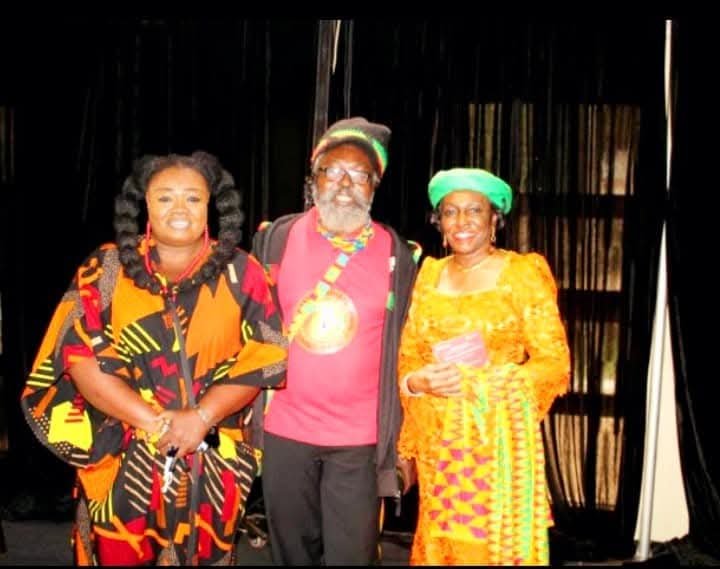
Musician and Pan-Africanist Ras Caleb Appiah-Levi has criticised what he describes as society’s tendency to celebrate people more after their death than while they are alive and in need of support.
In a passionate reflection, Appiah-Levi said he had observed the phenomenon for many years through his experiences as a musician, Pan-Africanist, community worker and son of the soil.
According to him, living people who are struggling to create, work and contribute to society are often ignored, criticised, envied or denied the support they need.
“When a man is alive, walking among us, struggling, creating, sweating, crying for support, we ignore him,” he said.
He argued that society sometimes labels people who are ambitious, outspoken or controversial negatively while failing to support their work.
Appiah-Levi said people could watch an individual’s phone calls go unanswered, attend poorly patronised programmes and see someone struggle to raise funds for projects without offering meaningful assistance.
However, he noted that the situation often changes dramatically after the person dies.
“But the moment he dies, we suddenly love him,” he said.
He explained that after death, society often puts up large banners bearing the deceased’s image, writes lengthy tributes, composes songs, travels long distances to attend funerals and raises substantial sums of money in their honour.
According to him, some of the same people who refused to provide financial assistance when the deceased needed medical treatment or support while alive later describe them as legends, heroes and icons.
Appiah-Levi identified three major reasons he believes contribute to the phenomenon.
He argued that living people can sometimes be perceived as competitors or threats because their achievements may expose the shortcomings or limitations of others.
He cited the late visual artist Yaa Padiki as an example, saying that while she was alive and engaged in her artistic work, some people viewed her activities as competition.
He also referenced his own experience as a musician who performs revolutionary songs, saying some people may perceive such work as a threat.
However, he said death eliminates the perceived competition, making it easier for people to praise the deceased without feeling that the person’s achievements diminish their own.
The musician further argued that it is easier for people to express affection towards someone who can no longer respond or challenge them.
He said the living can disagree with others, demand accountability or express dissatisfaction, whereas the dead remain silent.
“The dead are silent. They accept all flowers, even from those who poisoned them while alive,” he stated.
He therefore suggested that some public displays of affection after death may come at little personal cost compared with supporting someone while they are alive.
Appiah-Levi also blamed what he described as a culture that places greater emphasis on remembering the dead than building and supporting the present.
He linked this partly to colonial education, arguing that Africans have been conditioned to place significant emphasis on history while failing to invest adequately in living people and present-day visions.
He acknowledged the importance of honouring ancestors but questioned why people sometimes fail to provide basic support to living elders and other members of society.
“We pour libation to ancestors — which is good — but we forget to give water to the living elder who is thirsty today,” he said.
Appiah-Levi described the trend as a dangerous culture and warned that society could become one that mourns people after their deaths while failing to support their visions during their lifetime.
“If we continue this way, we will always be a continent that cries at funerals but sleeps during visions,” he said.
He subsequently called on Africans to change the way they demonstrate appreciation and support for people making contributions to society.
He urged the public to support artists by purchasing their work while they are alive, attend programmes organised by people while they can still appreciate the support, and provide assistance to musicians, inventors, teachers, farmers, beach cleaners and other community workers during their lifetime.
According to him, the support people receive after death often comes too late.
“Yaa Padiki did not need our tears today as much as she needed our hands yesterday,” he said.
He questioned how many other talented and hardworking people may currently be living without recognition, encouragement or financial assistance.
“And how many more Yaa Padikis are among us today, walking unknown, unsung, unsupported?” he asked.
Appiah-Levi concluded his reflection with a call for society to stop waiting until death before recognising the value of individuals.
He argued that while the dead cannot experience the love and support shown to them after death, living people can benefit directly from encouragement and assistance and potentially use that support to make a greater impact on society.
“For what is the use of loving the dead more than the living?” he asked.
His message ended with a call for people to embrace and support the living while they still have the opportunity to feel that appreciation and use it to continue changing their communities and the world.

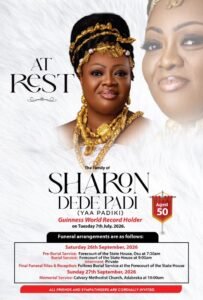
The family of Ghanaian visual artist and Guinness World Record holder Sharon Dede Padi, popularly known as Yaa Padiki, has announced arrangements for her final funeral rites.
Sharon Dede Padi passed away on Tuesday, July 7, 2026, at the age of 50. Her death has prompted tributes from colleagues, friends and admirers who have remembered her as a celebrated creative figure and Guinness World Record holder.
Her final funeral rites will be held on Saturday, September 26, 2026, at the Forecourt of the State House in Accra.
The programme will begin with a pre-burial service at 7:30 a.m., followed by the burial service at 9:00 a.m. Interment will take place afterwards, with the final funeral rites and reception also scheduled for the State House forecourt.
A memorial service will be held on Sunday, September 27, 2026, at Calvary Methodist Church, Adabraka, beginning at 10:00 a.m.
The family has invited friends, sympathisers and well-wishers to join them in celebrating and honouring the life and legacy of Sharon Dede Padi.
Entertainment
Travel Influencers Can Help Spotlight Ghana’s Hidden Tourism Gems – Maame Ama Boa Effah

Travel influencers and digital content creators could play a major role in promoting lesser-known tourist attractions across Ghana and helping to diversify the country’s tourism destinations, according to Maame Ama Boa Effah, an Intern at the Corporate Affairs Department of the Ghana Tourism Authority (GTA).
In an article titled “Off the Map: How Travel Influencers Can Put a Spotlight on Ghana’s Hidden Tourism Gems,” Maame Ama Boa Effah argued that Ghana’s tourism sector must look beyond its already popular attractions and use digital platforms to draw attention to hidden tourism sites across the country.
Her call comes amid renewed discussions about the development of major cultural and tourism facilities in Ghana.
She cited recent reports about planned transformations at the National Theatre in Accra, following bilateral engagements between the Minister of Commerce of the People’s Republic of China and stakeholders of the theatre.
According to her, the National Theatre remains one of Ghana’s major cultural and creative arts facilities, but similar attention and investment are needed at other important cultural centres across the country.
She specifically mentioned the Centre for National Culture in Cape Coast, describing it as an important event centre that hosts theatrical productions and regional programmes but has repeatedly faced calls from community stakeholders for infrastructural upgrades.
Maame Ama Boa Effah noted that the challenges confronting the Centre for National Culture are not isolated, arguing that several second-tier tourism destinations across Ghana continue to struggle with inadequate infrastructure and limited budgets.
She also raised concerns about the concentration of tourist visits around major urban centres.
Referring to Ghana’s 2025 tourism report, she observed that many of the country’s most visited tourist attractions were concentrated in Accra, Kumasi and Cape Coast, raising questions about the visibility and development of tourism destinations in other regions.
She cited the Aburi Gardens as an example of a well-known destination while drawing attention to lesser-known attractions such as the Oboadaka Waterfalls, also located around the Aburi area.
“Everybody has heard of the Aburi Gardens, but what about the Oboadaka Waterfalls, which is also near Aburi?” she asked, highlighting the need to bring relatively overlooked attractions into the national tourism conversation.
Maame Ama Boa Effah believes travel influencers can help bridge the visibility gap by using social media to showcase destinations that are often absent from tourists’ itineraries.
She pointed to the growing influence of social media on consumer decisions, noting that people around the world spend significant amounts of time on their phones and that a substantial portion of social media users are influenced by what they encounter on their feeds.
She therefore urged the tourism sector to take lessons from modern businesses, particularly those in the hospitality industry, which increasingly use digital creators and influencers as brand ambassadors.
According to her, strategic partnerships between the Ghana Tourism Authority and selected travel influencers could help promote both established tourist attractions and less-travelled destinations.
She proposed that influencers could be selected from each of Ghana’s regions and, under the guidance of the respective regional offices of the Ghana Tourism Authority, travel to tourism sites within their regions.
The creators would document their experiences through photographs, videos and other forms of digital content, while promoting the attractions to their audiences.
She further suggested that the initiative could incorporate the “Experience Ghana, Share Ghana” hashtag to create a coordinated digital campaign around Ghana’s tourism offerings.
According to her, such an approach could create greater visibility for destinations outside the traditional tourism hotspots while generating interest among both domestic and international travellers.
She believes the possibilities for Ghana’s tourism industry are extensive if digital creators are effectively integrated into tourism promotion.
However, she cautioned that social media content should ultimately serve as an invitation for people to experience the destinations physically.
“As beautiful as these places look through the screen, no pixel can capture the true effervescence these sites have to offer in person,” she said.
Maame Ama Boa Effah is an Intern with the Corporate Affairs Department of the Ghana Tourism Authority.
Entertainment
GTA PARTNERS AFRICA’S BRAIN BANK TO ADVANCE HEALTHCARE, INVESTMENT AND MEDICAL TOURISM IN GHANA


The Ghana Tourism Authority (GTA) has partnered with AFRICA’s BRAIN BANK® Global to support a six-day international summit in Ghana, culminating in the groundbreaking ceremony for a proposed Historic Medical City in Ada.
The initiative seeks to position Ghana at the intersection of healthcare development, investment, tourism and medical tourism, while creating a platform for international stakeholders to explore opportunities within Africa’s healthcare ecosystem.
The 7th Annual Summit, Charity Ball and Medical City Groundbreaking is scheduled to take place from September 3 to 8, 2026, across Accra and Ada, under the theme: “Africa’s Greatest Wealth, Its People; Restoring Africa’s Health Capital.”
At the heart of the programme is the proposed Medical City, envisioned as an integrated ecosystem combining healthcare, medical education, research, innovation and economic development.
The project is expected to expand access to affordable, specialised and technology-driven healthcare while creating opportunities for investment, employment, professional training and international collaboration.
GTA Chief Executive Officer Maame Efua Houadjeto said the partnership demonstrates the potential of tourism to catalyse broader investment and national development.

She noted that the summit and Medical City groundbreaking provide an opportunity to welcome international participants to Ghana while showcasing the possibilities that emerge when tourism, healthcare, investment and development converge.
According to the organisers, the initiative will bring together government representatives, investors, healthcare professionals, corporate executives, development partners, philanthropists and members of the African Diaspora.
Rev. Dr. Pam Fomunung, Visionary, Chief Executive Officer and Group Chair of AFRICA’s BRAIN BANK® Global, described the GTA’s involvement as an important endorsement of Ghana’s ambitions in healthcare, tourism and investment.
She said the proposed Medical City is intended to extend beyond conventional healthcare infrastructure, with the potential to contribute to medical tourism, job creation, Diaspora engagement, knowledge transfer and economic growth.
The proposed development is expected to focus on specialised healthcare services, medical education and professional training, advanced diagnostic and surgical systems, digital healthcare, telemedicine, research and international medical collaboration.
The project could also create opportunities for local suppliers and service providers while supporting workforce development, Diaspora investment and knowledge transfer. Its wider ecosystem is expected to generate opportunities within hospitality, tourism and medical-tourism services.
Six-Day Programme
The programme begins with a homecoming welcome reception in Accra on September 3, followed by a Business-to-Business Market and community awards on September 4.
A symposium focused on Africa’s health capital, together with a red-carpet summit and awards gala, will take place on September 5.
Activities on September 6 will include a Billionaire Breakfast Brunch and beach retreat, while September 7 will feature the Medical City groundbreaking ceremony and a Greater Accra tour.
The programme concludes on September 8 with a cultural and heritage tour of Cape Coast and Elmina Castles.
Organisers are inviting businesses and investors across sectors including healthcare, pharmaceuticals, tourism, construction, finance, technology, logistics, real estate and infrastructure to participate in the initiative.
Members of the African Diaspora are also being encouraged to engage with the project by contributing expertise, investment, professional networks and philanthropic support, while reconnecting with Ghana’s cultural and historical heritage.
Describing the initiative as more than an event, Maame Efua Houadjeto said it represents a potential legacy venture capable of creating opportunities, attracting international attention, strengthening communities and contributing to Africa’s healthcare future.
The partnership comes at a time when Ghana is seeking to broaden its tourism offering beyond traditional leisure and cultural tourism by promoting business events, conferences, investment tourism and other forms of purpose-driven travel.
If successfully developed, the proposed Medical City could provide a significant test of how tourism, healthcare, investment and Diaspora capital can be brought together to support a long-term development agenda.
Beyond the groundbreaking ceremony, the project’s success will ultimately depend on the ability to translate the proposed vision into sustainable infrastructure, investment, healthcare services and measurable benefits for communities in Ghana and across Africa.
Entertainment
Kelvin Kenneth Expands Professional Portfolio with New Appointment at Africa-Middle East Trade Investment Corporation

Chief Executive Officer of Eventguide Africa, Kelvin Kenneth, has been appointed Events and Business Manager of the Africa-Middle East Trade Investment Corporation, in a move expected to strengthen trade, investment and business collaboration between Africa and the Middle East.
In his new role, Kelvin Kenneth will be responsible for developing and coordinating strategic events and business platforms designed to connect investors, entrepreneurs, corporations and industry stakeholders across the two regions.
His responsibilities will include facilitating business networking events, investment forums, trade initiatives and strategic engagements aimed at identifying viable investment opportunities and creating sustainable partnerships between African and Middle Eastern businesses.
The Africa-Middle East Trade Investment Corporation operates across several sectors with significant investment potential, including gold and jewellery, shipping and yachts, automobiles, textiles, leather, construction, industrial machinery, real estate, tourism, media and entertainment, sports, healthcare and agriculture.
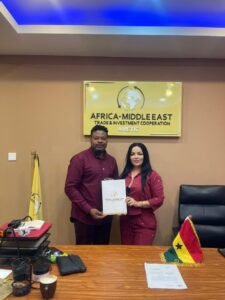
Through its trade and investment platforms, the corporation seeks to create opportunities for businesses and investors to explore new markets, establish strategic partnerships and develop projects capable of contributing to economic growth across both regions.
Kelvin Kenneth is expected to bring his experience in events management, business development, marketing and strategic networking to the position, with a particular focus on creating impactful platforms that connect businesses, investors and potential partners.
His appointment also underscores the increasing importance of the events industry as a catalyst for business development, investment promotion and international trade relations.
With Africa and the Middle East continuing to deepen economic and commercial ties, Kelvin Kenneth’s new position is expected to contribute to the creation of stronger business networks and investment opportunities between the two regions.
The appointment marks another significant milestone in his professional career and further positions him at the intersection of events, business development, investment and international trade.

Ras Caleb Appiah-Levi: Humans Love the Dead More Than the Living

Funeral arrangements announced for Guinness World Record holder Sharon Dede Padi

OSP Opens Preliminary Investigation into Alleged GH¢70,000 Payment Linked to Parliament’s Vetting



-

 General News2 weeks ago
Nana Adwoa Tutuwaa Named Global Humanitarian of the Year 2026
-

 General News2 weeks ago
Police Arrest Suspect in GH¢1.1m Fake Gold Scam at Berekum
-
 Entertainment2 weeks ago
Interfaith Tourism World Club Calls for Faith-Based Tolerance to Strengthen National Peace
-
 General News2 weeks ago
Assemblies of God Ghana Clears Headquarters Loan, Slashes Overdraft by GH¢3.2m
-
 General News1 week ago
GES Urged to Review Student Sexual Misconduct Rule Over Alleged Discrimination Against Boys
-
 General News1 week ago
OSP Assesses Extortion Allegations Against Afenyo-Markin
-

 Entertainment1 week ago
Stonebwoy Is Not My Rival — Shatta Wale Reveals They Live Minutes Apart
-

 General News2 weeks ago
GRIDCo Announces 15-Hour Power Outage in Parts of Accra as Emergency Tower Works Continue