
General News
How Kojo ‘Bamba’ Pulled Off a Stunning Upset to Become NPP First National Vice Chairman

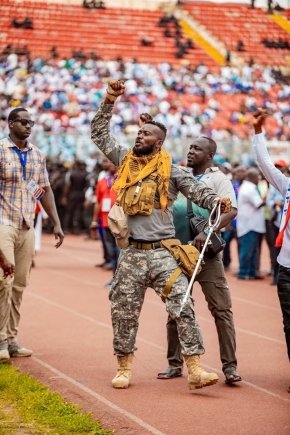
Kojo ‘Bamba’ has stunned the New Patriotic Party (NPP) establishment, emerging as the party’s First National Vice Chairman after defeating 12 other contenders in a fiercely contested election.
The victory of Kwadwo Fosu Boadu, popularly known as Kojo Bamba, came at the NPP’s National Delegates Conference in Kumasi, where delegates elected a new team of national executives to steer the party for the next four years.
Bamba secured 3,160 votes, finishing ahead of several well-known figures in the party. Henry Nana Boakye came second with 3,061 votes, while Nana Akomea secured the third vice-chairmanship position with 2,987 votes.
The Surprise Nobody Saw Coming
Bamba’s victory was widely viewed as a surprise because he was competing against a field packed with experienced and high-profile NPP figures.
Among those he defeated were Nana Akomea, Henry Nana Boakye, Richard Ahiagba, Samuel Pyne, Mustapha Abdul-Hamid, Masawudu Osman and Kwabena Abankwah Yeboah, among others.
Ahead of the election, Bamba was not widely regarded as one of the favourites. Reports indicate that some opinion polls placed him well behind the leading contenders, making his eventual victory even more striking.
His Grassroots Strategy Paid Off
While some of his opponents entered the race with lengthy political resumes, Bamba built his campaign around a simple message: the grassroots must be empowered and the party’s votes must be protected.
He repeatedly appealed to delegates as a grassroots man and urged them to choose experienced candidates while also giving him their support as the candidate who understood the party’s “foot soldiers.”
His campaign also repeatedly reminded delegates that he occupied number two on the ballot paper.
That strategy appears to have resonated with delegates.
From Auto Mechanic to National Party Leadership
Bamba’s political journey is one of the most unusual aspects of the victory.
He is reported to have started out as an auto mechanic in Kumasi’s Asafo area before becoming involved in NPP grassroots politics. He later became associated with the Delta Force group, a pro-NPP vigilante organisation that attracted national attention in 2017.
His involvement with Delta Force brought him into the national spotlight after members of the group stormed the Ashanti Regional Coordinating Council in March 2017.
Years later, Bamba has now moved from the controversial grassroots political scene to one of the NPP’s highest national executive positions.
A Victory Over Former Political Associates
The result is particularly striking because Bamba defeated several established party figures, including Henry Nana Boakye, popularly known as Nana B.
Nana Boakye ultimately secured the second vice-chairmanship with 3,061 votes, only 99 votes behind Bamba.
The narrow gap between the two made the contest one of the most closely watched races at the conference.
“The Journey to 2028 Starts Now”
Following his victory, Bamba pledged to make the NPP’s grassroots structures a major priority as the party prepares for the 2028 general election.
He said the party would work to empower its grassroots members and protect its votes from the polling station through to the collation centres.
His message after the election was clear: the victory was not just about him, but about the party’s foot soldiers, constituency executives, youth and women’s organisers and delegates who supported his campaign.
With John Boadu also taking over as National Chairman, the new NPP leadership now faces the task of rebuilding the party and preparing it for the next presidential and parliamentary elections.
For Kojo Bamba, however, the journey from an auto mechanic and controversial grassroots figure to First National Vice Chairman of Ghana’s main opposition party represents one of the biggest political surprises to emerge from the NPP’s latest internal elections.
The National Identification Authority (NIA), in collaboration with the National Health Insurance Authority (NHIA), has resumed the Ghana Card registration exercise for children aged between 6 and 14 years in the North East and Upper East Regions.
The exercise officially began on Monday, October 5, 2026, as part of the NIA’s phased rollout of Ghana Card registration for children within the specified age group.
In a statement dated September 28, 2026, the NIA announced that the exercise would continue in the two regions following earlier registration activities conducted in other parts of the country.
“The National Identification Authority (NIA), in collaboration with the National Health Insurance Authority (NHIA), will continue the Ghana Card registration exercise for children aged 6 to 14 years in the North East and Upper East Regions, effective Monday, 5th October 2026,” the statement said.
The child registration exercise first began in the Volta and Oti Regions in May 2026 before being extended to the Northern Region.
Under the latest phase, registration teams will visit public and private schools to register eligible children. The exercise will be conducted between 8:00 a.m. and 5:00 p.m.
Children who are not enrolled in school will also be eligible to register. Such children may complete the process at designated schools or other approved registration points within their communities.
Parents or guardians who present children for registration are required to provide an original birth certificate, a valid Ghanaian passport, or a Certificate of Acquired Citizenship.
Where none of these documents is available, the NIA says a parent, relative or legal guardian may complete an Oath of Identity form on behalf of the child.
For children who have no known relatives, two Social Welfare Officers may serve as witnesses or vouch for the child to facilitate the registration process.
The NIA is also encouraging parents and guardians to provide the child’s NHIS card or NHIS number, where available
According to the NIA, the person presenting a child must be a Ghanaian citizen, be 18 years or older, be of sound mind, and possess a valid Ghana Card.
The NIA has also cautioned children who participated in the 2024 pilot registration exercise but have not yet received their Ghana Cards not to register again.
Instead, the Authority has directed such persons to visit the NIA District Office where the child was originally registered to facilitate the issuance of the outstanding card.
The NIA is urging parents, guardians, schools and other stakeholders in the North East and Upper East Regions to support the exercise and help ensure that all eligible children are registered.
The Authority has further warned that providing false information or deliberately facilitating the registration of a non-Ghanaian constitutes an offence punishable under the law.
The statement was signed by Williams Ampomah Emmanuel Darlas, Head of the Corporate Affairs Directorate of the NIA.

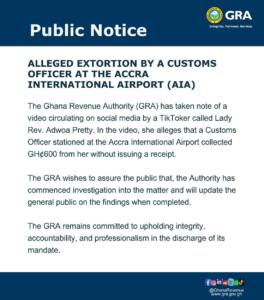
The Ghana Revenue Authority (GRA) has commenced investigations into an alleged extortion incident involving a Customs officer stationed at the Accra International Airport (AIA).
The investigation follows a video circulating on social media in which TikToker Lady Rev. Adwoa Pretty alleged that a Customs officer at the airport collected GH¢600 from her without issuing an official receipt.
In the video, Lady Rev. Adwoa Pretty raised concerns about the circumstances surrounding the payment and questioned the conduct of the officer involved.
The allegation has since generated attention on social media, prompting the GRA to issue an official response and assure the public that the matter is being investigated.
In a public notice statement, the GRA said it had taken note of the video and the allegations made by the TikToker.
“The Ghana Revenue Authority (GRA) has taken note of a video circulating on social media by a TikToker called Lady Rev. Adwoa Pretty. In the video, she alleges that a Customs Officer stationed at the Accra International Airport collected GH¢600 from her without issuing a receipt,” the Authority stated.
The GRA said it has commenced investigations to establish the circumstances surrounding the alleged payment and the conduct of the officer involved.
“The GRA wishes to assure the public that the Authority has commenced an investigation into the matter and will update the general public on the findings when completed,” it added.
The Authority, however, did not disclose the identity of the Customs officer allegedly involved in the incident.
It also did not provide further details on why the GH¢600 was allegedly collected or the circumstances under which the payment was made.
The GRA stressed that its operations are guided by principles of integrity, accountability and professionalism, noting that it remains committed to ensuring that these standards are upheld by its officers.
“The GRA remains committed to upholding integrity, accountability, and professionalism in the discharge of its mandate,” the Authority said.
The investigation is expected to determine the facts surrounding the allegation and establish whether any officer breached the Authority’s procedures or professional standards.
General News
One District, One Rabies Desk: Call for urgent action as Ghana battles deadly dog-bite disease


A call has been made for Ghana to establish a One District, One Rabies Desk as part of urgent measures to prevent deaths from rabies following dog bites.
The call was made by Seth Afum A. Dankwah of J. G. Knol Technical Institute, Adukrom-Akuapem in the Eastern Region, in a detailed public health advocacy statement dated Saturday, October 3, 2026.
The appeal follows a viral video involving a young Ghanaian girl who reportedly struggled to breathe after being bitten by a dog, an incident which triggered concern and prayers from many Ghanaians.
According to Mr Dankwah, while the video generated public sympathy, it also highlighted a recurring public health problem that often goes unnoticed until it is too late.
He said children are frequently bitten by dogs, with the wounds sometimes healing and families forgetting about the incidents, only for symptoms of rabies to appear weeks or months later.
Rabies remains a deadly threat
Mr Dankwah described rabies as a “silent killer” and said Ghana is not doing enough to prevent infections.
He noted that stray dogs remain common in many Ghanaian communities, with large numbers roaming freely and relatively few receiving regular rabies vaccinations.
He questioned whether Ghana has an accurate estimate of its dog population and how many of the country’s dogs are vaccinated annually.
According to him, although the law requires dogs to be vaccinated and licensed annually, enforcement remains weak.
He said District Veterinary Officers are often too few and lack essential resources, including vehicles, cold-chain facilities and adequate supplies of vaccines.
Mr Dankwah warned that this creates a dangerous situation where unvaccinated dogs live close to children and other vulnerable members of communities.
He explained that rabies is caused by a virus carried in the saliva of infected animals, particularly dogs and cats.
Unlike diseases that primarily spread through the bloodstream, he said the rabies virus enters the nerves after an infected animal bites or scratches a person and gradually travels towards the brain.
The incubation period can vary significantly, meaning an infected person may appear healthy for weeks or even months after the bite.
Mr Dankwah said the wound may heal during that period, causing families to forget about the incident.
However, once the virus reaches the brain and symptoms begin to appear, the disease is almost invariably fatal.
He listed symptoms including painful spasms of the throat when attempting to swallow water, known as hydrophobia, extreme agitation, fear of air, confusion, sleeplessness, excessive saliva and restlessness.
He stressed that medical intervention must happen before symptoms develop, describing prevention and timely post-exposure treatment as the critical opportunity to save a person’s life.
Mr Dankwah also raised concern about cultural and spiritual interpretations of rabies symptoms.
He said when a person begins behaving strangely, becomes agitated or develops difficulty swallowing water months after a dog bite, families may forget the bite and attribute the behaviour to witchcraft, spiritual attacks or poisoning.
He cited expressions such as “Y’abɔ no dua”, meaning the person has been cursed, and “Wɔato no aduro”, referring to spiritual poisoning, as examples of beliefs that could delay medical attention.
According to him, families may first turn to prayer camps, herbalists or spiritual leaders, potentially losing critical days before seeking hospital care.
He therefore urged pastors, imams, herbalists, chiefs and community elders to ask a simple question whenever someone develops unexplained difficulty swallowing water or unusual behaviour:
He said a positive history should trigger an immediate referral to a health facility rather than treating the condition solely as a spiritual problem.
Mr Dankwah identified several environments where the risk of dog bites is particularly high.
He said children between the ages of 6 and 15 are particularly vulnerable, especially along school routes where stray dogs may roam.
He also noted that some children hide dog bites or scratches from their parents because they fear being punished.
Markets and food joints, he said, can attract groups of stray dogs because of discarded food.
He further warned about security dogs in compound houses that may roam into neighbouring properties when not properly restrained.
He also raised concerns about people who handle or butcher sick dogs without adequate protection, noting that infected saliva entering an open cut can create a risk.
Another concern, he said, is the practice of treating dog bites at home with substances such as herbs, toothpaste or a black stone before covering the wound.
Call for free mass dog vaccination
Mr Dankwah called on the government to introduce annual free mass dog vaccination campaigns, comparing the initiative to routine childhood immunisation programmes.
He proposed that authorities first provide vaccination free of charge and subsequently enforce existing regulations, including fines for owners whose dogs remain unvaccinated.
He said the approach would help increase vaccination coverage while also improving enforcement of responsible dog ownership.
He also called for Post-Exposure Prophylaxis (PEP) to be made readily available at district-level health facilities.
PEP is the preventive treatment given after a potentially rabies-exposing bite or scratch to prevent the virus from developing into rabies.
Mr Dankwah argued that PEP should be available in district hospitals and CHPS compounds, rather than being concentrated in major referral facilities.
He further called for the treatment to be provided free to children under the National Health Insurance Scheme (NHIS).
He said the financial burden of treatment can become a major obstacle for families, particularly those in rural communities.
One District, One Rabies Desk
At the centre of his proposal is the establishment of a One District, One Rabies Desk.
Under the proposal, every district would have a rapid-response team made up of a Disease Surveillance Officer, Veterinary Officer and Environmental Health Officer.
The team would respond when a dog bite is reported, trace the animal involved and quarantine it within 24 hours where necessary.
He said such a system would strengthen coordination between human health, veterinary and environmental authorities and enable suspected rabies exposures to be dealt with quickly.
Mass sterilisation and stray-dog management
Mr Dankwah also called for stronger management of Ghana’s stray-dog population.
He proposed mass sterilisation and vaccination programmes, beginning with pilot projects in major towns and cities.
According to him, controlling the stray-dog population alongside vaccination would reduce the risk of transmission and improve responsible animal management.
Rabies education in schools
He further proposed that rabies prevention and responsible dog ownership be incorporated into Ghana’s pre-tertiary education curriculum.
He said children should be taught how to respond immediately after a dog bite or scratch, including washing the affected area thoroughly with soap and running water and promptly informing a responsible adult.
He also encouraged parents to teach children about rabies prevention in their local languages.
He gave the Twi expression:
“Kraman ka wo a, hohoro na ka kyerɛ obi ntɛm!”
meaning, “If a dog bites you, wash and tell someone quickly.”
Mr Dankwah urged anyone who is bitten by a dog to immediately wash the wound with soap and plenty of running water for about 15 minutes, avoid applying herbs or other substances and seek medical attention the same day.
He urged dog owners to vaccinate their animals every year and prevent them from roaming freely.
Parents, he said, should educate children about what to do after a dog bite and encourage them to report even minor scratches.
He also appealed to pastors, imams, herbalists and traditional leaders to consider a history of dog bites before attributing symptoms such as difficulty swallowing water or unusual behaviour to spiritual causes.
Assembly members, he added, could contribute by working with District Veterinary Officers to organise rabies vaccination exercises within their electoral areas.
We cannot pray away rabies, but we can prevent it
Mr Dankwah said the key lesson from the viral video involving the young girl should not be limited to sympathy and prayers.
He argued that the incident should trigger stronger action to improve dog vaccination, access to PEP, public education and coordination between health and veterinary authorities.
He described rabies as 100% preventable but warned that once clinical symptoms appear, it is almost always fatal.
“The danger is not that dogs are many. The danger is that we don’t vaccinate yearly and we act too late in treatment,” he said.
He urged Ghanaian authorities and communities to treat rabies prevention as a national public health priority rather than waiting for another tragic dog-bite case to generate public attention.

General News
Socrate Safo questions La Pleasure Beach demolition, warns of threat to judicial due process

Creative-industry practitioner and concerned citizen Socrate Safo has criticised the demolition of structures at La Pleasure Beach, questioning the use of military force in a dispute involving indigenous land rights, commercial interests and an ongoing legal process.
In a lengthy Facebook post, Safo described the development as a troubling example of what he called “state muscle” being used at a time when questions surrounding ownership, leases and the rights of affected parties remain before the courts.
The demolition took place on Friday, October 2, 2026, with excavators operated by the military’s 48 Engineer Regiment reportedly used to pull down structures at the beach.
According to Safo, the development raises a broader question about the relationship between state power, indigenous land rights and the rule of law in Ghana.
He asked whether disputes involving state-backed commercial interests and indigenous communities should be resolved through military intervention and demolition or through the courts and established legal processes.
Safo argued that the La Pleasure Beach situation should not be treated simply as a routine land-clearing exercise, insisting that it has implications for property rights, traditional land ownership and judicial authority.
History of La Pleasure Beach dispute
Safo traced the relationship between the state and the La Traditional Council over the beach to years of tourism development and negotiations.
He said a 2002 Memorandum of Understanding reportedly established a working relationship between the Ghana Tourist Development Company Limited (GTDC) and the La Traditional Council, which represents traditional interests in the land.
According to him, disagreements later emerged over the management of the facility and revenue generated from the beach, eventually leading to litigation.
Safo said that in 2014, the High Court established a revenue-sharing arrangement involving proceeds from the beach.
Under the reported arrangement, 20 per cent of gate proceeds was allocated to the traditional landowners, 30 per cent went into a Community Youth Development Fund, while 50 per cent was allocated for operations.
While acknowledging that the arrangement may have faced disagreements and administrative challenges, Safo said such disputes were precisely why Ghana has courts.
He argued that corporate disagreements, management disputes, contractual claims and land ownership questions should be resolved through evidence and judicial decisions rather than what he described as the sudden arrival of military excavators.
Labadi Beach Hotel boundary dispute
Safo also focused on a longstanding boundary dispute involving La Pleasure Beach and the adjacent Labadi Beach Hotel, whose interests are linked to Hotel Investments (Ghana) Limited and the Social Security and National Insurance Trust (SSNIT).
He said the hotel’s position, as reported, is that some commercial entertainment facilities, particularly the Polo Beach Club, encroached on land belonging to the hotel.
Concerns have also reportedly been raised about noise, security and activities taking place close to the hotel.
Safo acknowledged that such concerns deserved to be addressed but said the historical claims of the La Traditional Council and businesses that had operated on the beachfront for decades should also be considered.
He pointed to traditional accounts suggesting that structures and activities associated with La Pleasure Beach had existed from around 1960, before the establishment of the Labadi Beach Hotel.
He also referred to claims that the chiefs of La had historically allowed the hotel’s boundary to extend beyond the Maale Stream as an act of goodwill.
Safo argued that if that history is accurate, such traditional accommodation should not automatically be interpreted decades later as permanent ownership without a proper legal determination.
He described the issue as one requiring careful judicial consideration.
Safo said the controversy escalated after Spartan-Ives Limited, operators of the Polo Beach Club, commenced legal proceedings on September 16, 2026, against Hotel Investments (Ghana) Limited and Richard Jakpa, Director of Special Operations at the National Security Council Secretariat.
According to Safo, Spartan-Ives relied on a 20-year lease obtained from the La Stool in 2022 for GH¢1.5 million.
He said the company also claimed to have invested more than GH¢41.3 million in the property.
Safo stressed that the validity of those claims is ultimately a matter for the courts.
However, he questioned why demolition was allowed to proceed if litigation was active and an application for an interlocutory injunction was pending.
He argued that the issue goes beyond the Polo Beach Club, saying it touches on the confidence that individuals, businesses and traditional authorities have in the judicial system.
“If a party can lose its property or investment before a judge has ruled on an injunction because another arm of the state has decided to act physically,” Safo argued, “then what confidence should citizens have in judicial protection?”
Safo warned that the situation could create a dangerous precedent if executive or state power is allowed to effectively determine a disputed matter before the courts have ruled.
He acknowledged that there could be legitimate national security concerns, unlawful encroachment or other reasons for state intervention.
However, he maintained that such circumstances should not automatically eliminate due process.
He argued that if there was an unlawful encroachment, the question should be who legally owns the land, while any alleged breach of a lease should be assessed based on the terms of that lease.
For Safo, the answer to such questions should come through the appropriate legal process rather than demolition.
Beyond the legal dispute, Safo raised concerns about the impact of the demolition on people whose livelihoods depend on activities at La Pleasure Beach.
He said reports indicate that nearly 5,000 beach vendors, workers and small-business operators have been affected.
He listed food vendors, drink sellers, fishermen, entertainers, cleaners, security personnel, artisans, transport operators and other small businesses among those whose incomes are connected to the beach.
According to him, the beach is not simply a recreational destination for these people but an important source of livelihood.
Safo therefore questioned whether there was a transition programme for people whose businesses had been disrupted.
He said any government that demolishes or disrupts an economic ecosystem has a responsibility to explain how the resulting human and economic consequences will be addressed.
Concerns ahead of December tourism season
Safo also raised concerns about the timing of the demolition, coming just weeks before Ghana’s major December tourism season.
He noted that December has become an important period for Ghana’s tourism and hospitality industry, attracting visitors from the diaspora and other parts of the world.
According to him, beach entertainment, restaurants, nightlife, events and cultural experiences form part of the tourism ecosystem.
He therefore questioned whether destroying major commercial activity at an established coastal entertainment destination shortly before the peak season could have wider economic consequences for businesses, workers and the tourism sector.
Safo further questioned whether there was a coordinated plan involving the Ministry of Tourism before the action was carried out.
He said if allegations that the ministry was not adequately involved are accurate, it would raise questions about how major decisions affecting tourism infrastructure are being coordinated.
Safo also referred to the reported confrontation between La Dade-Kotopon MP Rita Naa Odoley Sowah and military personnel at the site.
He said the incident had further exposed the political sensitivity surrounding the demolition.
He also questioned the role of the National Security Secretariat, arguing that although national security remains an important component of the state, its powers should not become a substitute for the courts, regulatory agencies, ministries or traditional dispute-resolution mechanisms.
Safo said institutions with significant state power must be subject to transparency and accountability.
‘La is bigger than one beach’
In his concluding argument, Safo said the La Pleasure Beach controversy is bigger than the Polo Beach Club, Labadi Beach Hotel, SSNIT, the La Traditional Council or individual commercial interests.
He said the matter concerns whether indigenous communities can have confidence that their traditional land rights will be respected, whether investors can trust that contractual and property rights will be protected, and whether court processes will be respected.
He also questioned whether the government should deploy coercive state power against citizens while a legal dispute remains before the judiciary.
Safo acknowledged the legitimate role of government in protecting public land, enforcing planning regulations, preventing unlawful development and safeguarding national security.
However, he maintained that such enforcement must operate within the law.
He warned that the government must be particularly careful when exercising coercive powers in the middle of private or commercial disputes.
Safo said Ghana had spent decades building institutions intended to replace the rule of force with the rule of law, including the courts, regulatory bodies, ministries and institutions recognising traditional authorities and customary land rights.
He argued that the La Pleasure Beach situation should therefore become a national conversation about the limits of state power.
He warned that if state power is allowed to replace judicial due process, the consequences could extend far beyond La.
“I am just a concerned citizen and creative-industry practitioner,” Safo stated.
He added a disclaimer that the references used in his write-up were based on information available in the public domain and that he was willing to be corrected on any inaccuracies.
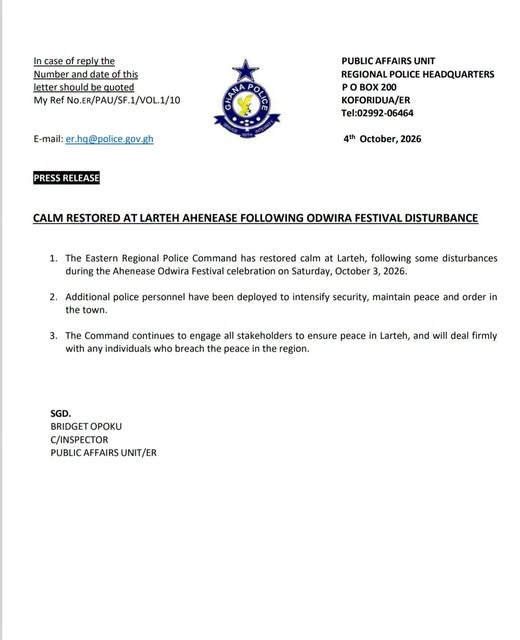
Normalcy has returned to Larteh Ahenease in the Eastern Region following a disturbance that disrupted activities during the Odwira Festival.
The incident, which sparked tension in the community, prompted security intervention as authorities moved to prevent the situation from escalating further.
Residents and visitors were reportedly thrown into uncertainty as the disturbance unfolded during the traditional festival, one of the significant cultural celebrations in the area.
Security Presence Helps Restore Order
Security personnel were deployed to the area to restore calm and ensure the safety of residents, traditional authorities and festival participants.
Following the intervention, the situation was brought under control, allowing normal activities to gradually resume.
Authorities have urged residents to remain calm and avoid actions that could reignite tensions.
Odwira Celebration Disrupted
The disturbance occurred against the backdrop of the Odwira Festival, a major traditional celebration that brings together chiefs, elders, residents and visitors to commemorate the cultural heritage of the people.
The disruption has generated concern within the community, particularly because traditional festivals are expected to be occasions of unity, thanksgiving and cultural preservation.
Authorities Urge Peace
Residents have been encouraged to cooperate with the security agencies and allow any investigations into the incident to proceed.
Community leaders and stakeholders are also expected to work toward maintaining peace and preventing further disturbances.
For now, calm has returned to Larteh Ahenease, with security authorities remaining alert to ensure that the situation does not deteriorate.
The latest development has brought relief to residents and festival participants, as attention shifts back to preserving the peace and cultural significance of the Odwira celebrations.

Ghana, Korea explore deeper cultural, tourism and creative ties

DBlack Reveals He and EL Once Dated the Same Woman Without Knowing

From Bamba’s Shock Win to JFK’s Landslide: 5 Biggest Surprises From NPP’s 2026 Elections



-

 General News2 weeks ago
Free Speech, False Publication and Presidential Criticism in Ghana: Where Does the Law Draw the Line?
-

 General News2 weeks ago
Rev. Dr. Christian Kwetey Kweitsu Set for International Recognition at 100 Most Influential Persons Awards in Kigali
-

 General News6 days ago
Fidelity Bank Chairman Named Ghana’s Topmost Transformational Board Chair 2026
-

 General News2 weeks ago
Don’t Expect Concerts When People Can’t Afford Food – Rex Omar on Black Star Experience
-
 Entertainment1 week ago
Ras Caleb assesses institutions under the Tourism Ministry, highlighting key roles.
-
 Entertainment1 week ago
Ras Caleb Appiah-Levi: The musician, Pan-Africanist and organiser whose career spans four decades
-

 Technology2 weeks ago
Rolls-Royce Expands Aviation Business with Major Philippine Airlines Engine Agreement
-

 Entertainment2 weeks ago
Kojo Preko Dankwa calls for investigation into GTA’s World Cup visa affairs