
General News
GRA Interdicts 5 customs Officers over Transit cargo Irregularities

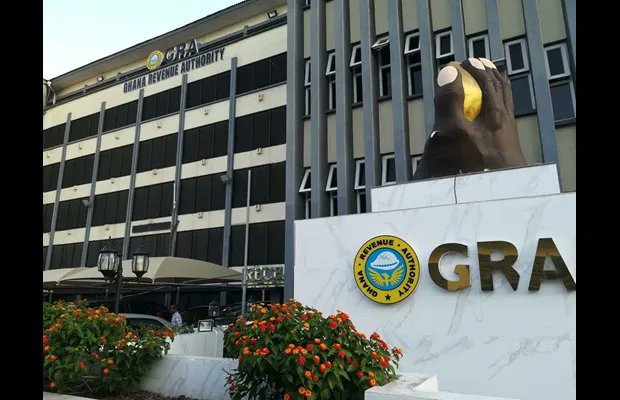
The Ghana Revenue Authority has interdicted five officers from its customs Division following what it described as discrepancies uncovered during an enforcement operation involving transit cargo bound for Niger.
In a press release issued on February 24, 2026, the Authority said the officers had been suspended with immediate effect pending the outcome of an internal investigation.
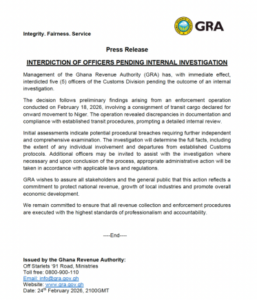
The action stems from preliminary findings linked to an operation conducted on February 18, 2026. According to the statement, the exercise focused on a consignment of goods declared as transit cargo for onward movement to Niger. However, officials identified irregularities in the accompanying documentation and compliance with established transit procedures.
Management said the anomalies were significant enough to warrant a comprehensive internal review.
“The decision follows preliminary findings arising from an enforcement operation conducted on February 18, 2026, involving a consignment of transit cargo declared for onward movement to Niger. The operation revealed discrepancies in documentation and compliance with established transit procedures, prompting a detailed internal review,” the statement said.
While the Authority did not specify the nature of the discrepancies, it indicated that early assessments pointed to possible breaches of procedure that required further scrutiny.
“Initial assessments indicate potential procedural breaches requiring further independent and comprehensive examination,” the statement added.
The GRA noted that the ongoing investigation would seek to establish the full facts, including whether there were individual departures from laid-down Customs protocols. It also signalled that the scope of the inquiry could widen if necessary.
“We remain committed to ensuring that all revenue collection and enforcement procedures are executed with the highest standards of professionalism and accountability.”


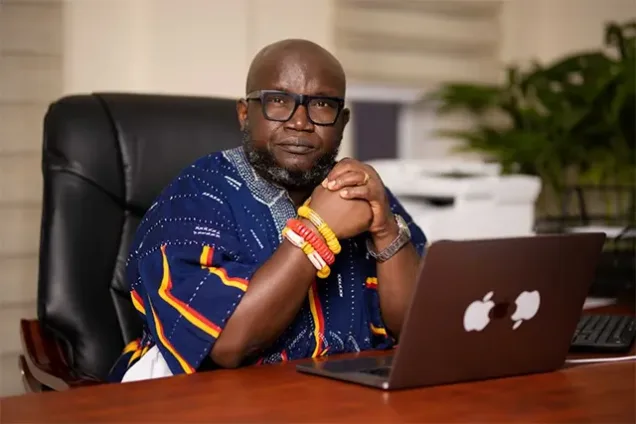
Chief Executive Officer of the Ghana Chamber of Mines, Ing. Kenneth Ashigbey,has strongly denied allegations that he influenced the High Court’s ruling in the case involving NPP Ashanti Regional Chairman Bernard Antwi-Boasiako, popularly known as Chairman Wontumi.
General News
Wontumi Was the Target, Not the Real Culprit – Ex-Lawyer Breaks Silence, Urges Appeal Against 20-Year Jail Term

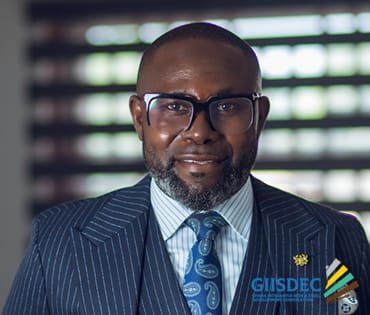
Former legal counsel for Charles Antwi Boasiako, popularly known as Chairman Wontumi, has questioned the basis of his former client’s conviction and 20-year prison sentence, arguing that the punishment raises serious legal concerns and should be challenged on appeal.
In an exclusive interview after the judgment, lawyer Ohene Amankwaa Gyan described the conviction as a “sad day,” saying he was deeply disappointed by the outcome.
“I have heard people celebrate the conviction as a deterrent to illegal mining, but I question whether the actual culprit has been punished,” he said.
The lawyer queried the presence of the man who at the court openly admitted involvement in activities linked to the Samleboi enclave, he believes there are unanswered questions about whether the real perpetrators of the alleged illegal mining operations were held accountable.
He further questioned whether his former client had become the main target of the prosecution.
“Does it mean Wontumi was the target rather than the real culprit? Does it mean other persons could go untouched just to incriminate him,” he stated.
Ohene Amankwaa Gyan revealed that he is dissatisfied with the court’s judgment and has advised Wontumi’s current legal team to file an appeal against both the conviction and the sentence.
He disclosed that while he was still part of the defence team, they filed an appeal after the trial judge issued a submission of no case to answer, but said the application had not yet been determined.
Expressing optimism, the lawyer said a fresh appeal could produce a favourable outcome if pursued diligently.
Addressing claims that he withdrew from the case because he anticipated defeat, the former counsel dismissed the speculation, insisting that no lawyer could predict a judge’s final decision.
He explained that his withdrawal was solely based on his client’s own decision and not because he foresaw a losing case.
He added that any appeal would likely challenge both the conviction and the sentence, with possible outcomes including the quashing of the conviction, a reduction of the prison term, or even an enhancement of the sentence, depending on the appellate court’s findings.
Despite the uncertainty, the former lawyer maintained that he remains hopeful Wontumi could obtain a positive outcome if his lawyers proceed with an appeal. has advised Wontumi’s current legal team to file an appeal against both the conviction and the sentence.
He disclosed that while he was still part of the defence team, they filed an appeal after the trial judge dismissed their submission of no case to answer, but said the application had not yet been determined.
Expressing optimism, the lawyer said a fresh appeal could produce a favourable outcome if pursued diligently.
Addressing claims that he withdrew from the case because he anticipated defeat, the former counsel dismissed the speculation, insisting that no lawyer could predict a judge’s final decision.
He explained that his withdrawal was solely based on his client’s own decision and not because he foresaw a losing case.
He added that any appeal would likely challenge both the conviction and the sentence, with possible outcomes including the quashing of the conviction, a reduction of the prison term, or even an enhancement of the sentence, depending on the appellate court’s findings.
Despite the uncertainty, the former lawyer maintained that he remains hopeful Wontumi could obtain a positive outcome if his lawyers proceed with an appeal.
General News
Notary Public Status Is a Privilege, Not a License to Be Careless — Ohene Amankwaa Warns Lawyers
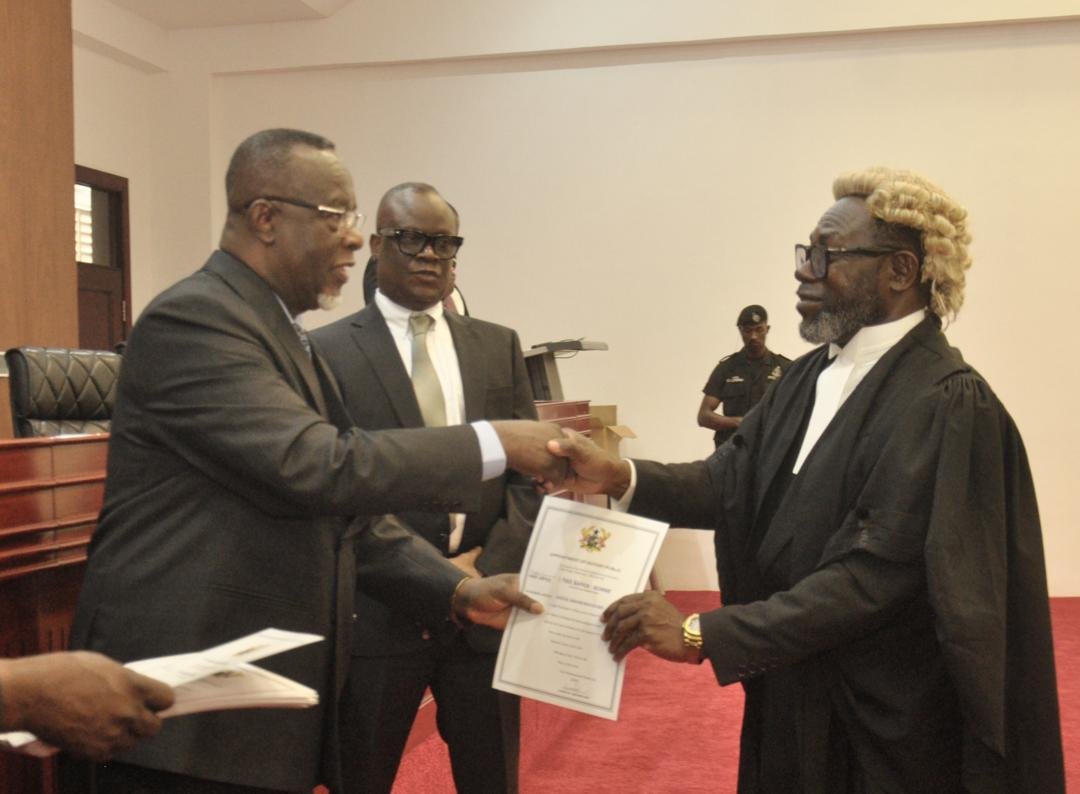
Legal practitioner Ohene Amankwaa Gyan has described the appointment of a Notary Public as a prestigious honour that comes with enormous responsibility, urging beneficiaries to uphold the highest standards of integrity and professionalism.
Speaking in an exclusive interview after receiving his Notary Public status, Amankwaa explained that a Notary Public licence is a special authorization granted by the courts to experienced lawyers who have diligently served at the Bar for more than 10 years, in accordance with the Notaries Public Act, 1960.
He noted that the appointment empowers lawyers to authenticate legal documents with an official seal, making the role critical to the administration of justice.
Expressing gratitude to the judiciary for the recognition, lawyer Amankwaa said he was honoured to be entrusted with such a prestigious responsibility.
He explained that the selection and appointment of Notary Public lawyers are based on a lawyer’s integrity, discipline, and professional record, adding that candidates undergo thorough scrutiny before being approved by the appropriate legal authorities.
According to him, the annual exercise, led by the Chief Justice and the Judicial Service, is intended to recognize lawyers who have distinguished themselves through exemplary service.
While celebrating the achievement, Amankwaa cautioned that the status should never be abused.
He warned that because Notary Public lawyers are relatively few, some people may attempt to exploit their official seals and authority for fraudulent purposes.
He also expressed concern that some Notary Public lawyers fail to properly scrutinize documents, especially those involving relatives or people they know personally, saying such negligence undermines the credibility of the office urged all beneficiaries to remain vigilant and exercise due diligence at all times, stressing that any abuse of the privilege or failure to follow the law could result in the withdrawal of their licence by the relevant authorities.
“Being a Notary Public is an honour worth celebrating, but it is also a responsibility that demands integrity, discipline and strict adherence to the law,” he emphasized.

Kenneth Ashigbey Denies Influencing Wontumi Case, Condemns False Claims

Wontumi Was the Target, Not the Real Culprit – Ex-Lawyer Breaks Silence, Urges Appeal Against 20-Year Jail Term

Notary Public Status Is a Privilege, Not a License to Be Careless — Ohene Amankwaa Warns Lawyers



-

 Entertainment1 week ago
Derrick Manny Calls for Better Support for Ghanaian Creatives Following Dede Padiki’s Death
-
 Entertainment2 weeks ago
Apostle Kwadwo Safo Kantanka’s Reported Will: Companies, Beneficiaries and Final Wishes
-

 General News2 weeks ago
Ghana’s Creative Industry Grieves the Loss of Renowned Visual Artist Sharon Dede Padiki Padi
-

 Entertainment2 weeks ago
Influencer Kwatemaa Andoh Says She Won’t Marry a Poor Man
-

 Entertainment6 days ago
“Stay Broke If You Want Peace” – Sarkodie Sparks Online Debate With Powerful Success Message
-
 Entertainment2 weeks ago
Captain Smart defends Abu Trica interview: ‘I only acted in my role as a journalist’
-

 Entertainment2 weeks ago
Focus on Saving Lives, Not Politicising My Sister’s Death:Mzbel
-
Entertainment7 days ago
Dede Padiki Felt Neglected by Ghana’s Creative Sector Before Her Death – Derrick Manny