Connect with us

General News

Ghana to Host UN High-Level Reparatory Justice Event — Mahama Calls for Historical Accountability

Published

on

Ghana is set to host a high-level special event on reparatory justice later this month at the United Nations, reinforcing global calls for justice for the transatlantic slave trade and racialized chattel enslavement of Africans.

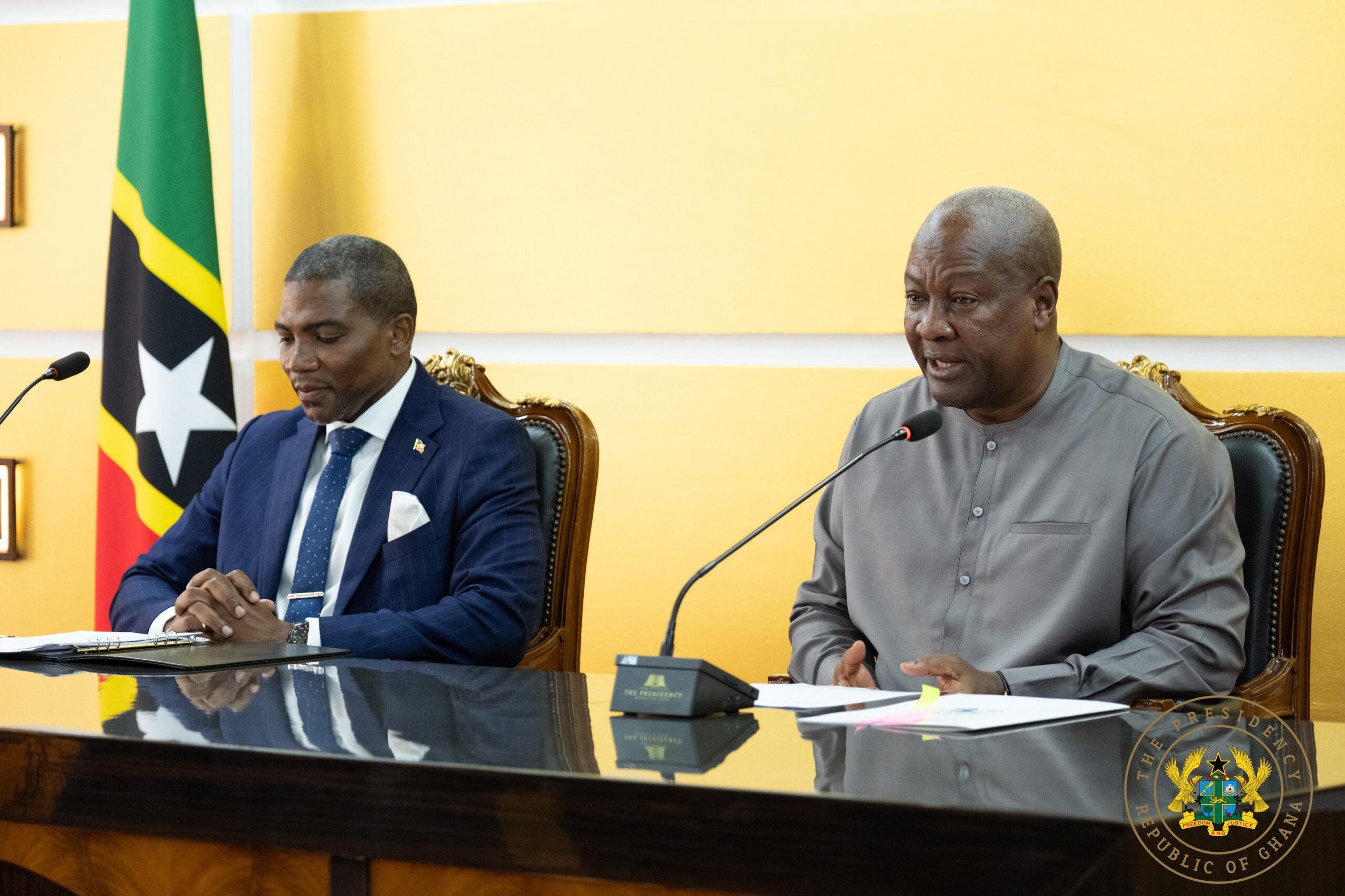
During a state luncheon held in honor of visiting Prime Minister of Saint Kitts and Nevis, Hon. Dr. Terrance Michael Drew, President John Dramani Mahama emphasized that the initiative is not about charity but about historical justice and accountability.

Speaking on the significance of the event, President Mahama said the legacy of slavery continues to shape global inequalities and must be addressed through collective international action.

“The transatlantic and racialized chattel enslavement of Africans constitutes one of the gravest crimes against humanity in history,” President Mahama stated. “Our call is not for charity. It is for justice rooted in truth, accountability, and recognition of the suffering endured by our ancestors.”

According to the President, the upcoming UN event will provide a platform for African and Caribbean nations to shape their own narrative about historical injustices. He stressed the importance of unity between Africa and the Caribbean in advancing reparatory justice discussions.

“It is time for our story to be told by us — grounded in truth, anchored in historical accountability, and driven by the determination to correct the injustices of the past,” he said.

Mahama further urged stronger solidarity between African and Caribbean nations, noting that shared historical experiences should translate into stronger diplomatic and policy collaboration.

“Together, Africa and the Caribbean must speak with one voice, with clarity, unity, and strong moral conviction,” he added.

The Ghanaian government believes that the event will strengthen global dialogue on reparatory justice, development cooperation, and cultural restoration. Officials say the initiative aligns with broader efforts to promote historical recognition and sustainable partnerships between nations affected by the transatlantic slave trade.

Continue Reading
Click to comment

Leave a Reply

Your email address will not be published. Required fields are marked *

General News

‘Cheap Justice?’ — Prof. Kwesi Yankah raises 4 ‘explosive’ concerns about Baffoe-Bonnie’s conduct

Published

on

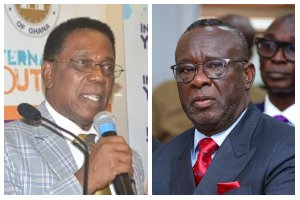
Professor Kwesi Yankah has launched a blistering critique of Chief Justice Paul Baffoe-Bonnie, raising a series of provocative questions about the conduct, public engagements and political neutrality of Ghana’s top judicial officer.

In a strongly worded opinion piece titled “Cheap Justice?”, the academic and former Minister of State for Tertiary Education questioned whether recent actions by the Chief Justice have weakened public confidence in the Judiciary.

Prof. Yankah’s intervention comes amid growing controversy over comments made by Baffoe-Bonnie during visits to state institutions, where he praised what he described as improved performance under the current administration while making comparisons with the previous government.

1. Has the Chief Justice crossed the political line?

At the heart of Prof. Yankah’s criticism is the Chief Justice’s recent engagement with state-owned enterprises.

According to Yankah, Baffoe-Bonnie appeared to venture beyond the traditional boundaries expected of the head of the Judiciary when he commented on the performance of public institutions and contrasted their current output with the situation under the previous administration.

The professor described the episode as the “last straw”, arguing that the Chief Justice appeared to have entered territory that was more political than judicial.

He suggested that such comments could damage the moral authority of the Judiciary, particularly when the institution is expected to remain independent and above partisan political contests.

2. ‘What happened to judicial neutrality?’

Prof. Yankah’s second major concern centres on the perception of judicial independence.

He questioned whether a Chief Justice who publicly comments on the performance of governments and state institutions could continue to command the same level of confidence from citizens across the political divide.

His concern comes against the backdrop of criticism from other prominent voices, including former Auditor-General Daniel Yaw Domelevo, who has warned that comments on politically sensitive matters could create a perception of bias if related issues eventually find their way before the courts.

For Yankah, the issue is not simply what the Chief Justice intended to say — but how those remarks could affect the public’s perception of the Judiciary.

3. From church dancing to political controversy

Prof. Yankah also revisited earlier moments involving Baffoe-Bonnie that, in his view, signalled a departure from the traditionally distant image associated with Ghana’s Chief Justice.

He recalled the Chief Justice’s appearance at a thanksgiving church service shortly after his appointment, where he was seen dancing and celebrating openly.

While acknowledging that there was nothing inherently wrong with such conduct, Yankah used the episode to paint a picture of a judicial leader who appeared increasingly comfortable operating in the public and political space.

He also referenced the Chief Justice’s participation in government delegations during international and national events, saying those developments had raised eyebrows even before the latest controversy.

4. The explosive ‘early retirement’ suggestion

Perhaps the most striking part of Prof. Yankah’s commentary was his suggestion that the controversy surrounding the Chief Justice could ultimately be interpreted as a signal for an early exit.

He noted that Baffoe-Bonnie has only a relatively short period left before his retirement and provocatively suggested that his controversial comments could be interpreted as an “application for early retirement.”

Yankah went even further, arguing that the Chief Justice’s conduct had already affected the prestige attached to his office.

His central warning is that once public confidence in the neutrality of the Judiciary begins to erode, rebuilding that confidence can become extremely difficult.

‘Cheap justice?’ — The bigger question

Prof. Yankah’s intervention has added another powerful voice to an increasingly heated national debate over the limits of public commentary by Ghana’s Chief Justice.

The Judicial Service has maintained that Baffoe-Bonnie’s observations were made in good faith and were not intended to undermine judicial independence, while other groups and individuals have called for restraint in his public engagements.

The Ghana Catholic Bishops’ Conference has also rejected calls for the Chief Justice to resign, arguing that he is entitled to his own convictions.

But Prof. Yankah’s latest intervention has ensured that the controversy is unlikely to disappear quietly.

For now, one question hangs over the Judiciary: can the Chief Justice remain politically neutral in the eyes of the public after making such politically charged observations?

Prof. Kwesi Yankah has fired the latest salvo — and the debate over Baffoe-Bonnie’s conduct is only getting hotter.

Continue Reading

General News

FRIMPONG-BOATENG SPEAKS ON GALAMSEY — ‘ENFORCING ENVIRONMENTAL LAWS CARRIES POLITICAL COST’
Published

on

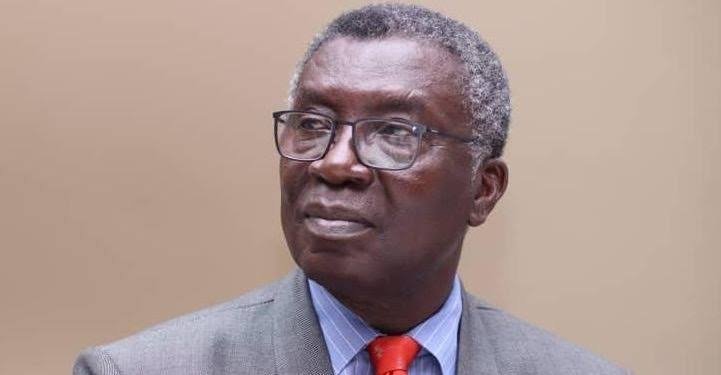
Former Environment Minister Prof. Kwabena Frimpong-Boateng has delivered a blunt assessment of Ghana’s prolonged battle against illegal mining, arguing that political calculations have repeatedly weakened efforts to protect the country’s rivers, forests and farmlands.

Speaking at the Fourth Annual Colloquium of the Department of Political Science Education at the University of Education, Winneba, Prof. Frimpong-Boateng said successive governments had introduced measures to tackle galamsey but struggled to sustain them.

‘THE POLITICAL COST FALLS ON THE ENFORCER’

Prof. Frimpong-Boateng argued that officials who enforce environmental laws often bear the political consequences, while those who fail to act face little or no cost.

He said this imbalance has contributed significantly to Ghana’s difficulty in defeating illegal mining.

“In Ghana, the political cost of enforcing environmental law falls on the enforcer, and the political cost of not enforcing it falls on nobody.”

ANTI-GALAMSEY SYSTEM WAS BUILT — THEN ABANDONED

The former minister recalled measures introduced between 2017 and 2018, including the ban on artisanal and small-scale mining, Operation Vanguard, district-level committees, miner training and systems to monitor mining concessions and excavators.

According to him, the measures initially produced visible results, with parts of the Pra River becoming clear and reports of fish returning to waters previously considered severely degraded.

He argued, however, that many of the safeguards were abandoned after the mining ban was lifted in December 2018.

GH¢21 BILLION? NO — $21 BILLION RESTORATION BILL

Prof. Frimpong-Boateng has also warned about the enormous financial cost of repairing the damage caused by illegal mining and other destructive activities.

He estimates that Ghana could require approximately US$21 billion to reclaim and restore degraded lands, with about 10% of the country’s surface area affected.

CALL FOR A NATIONAL ENVIRONMENTAL COMPACT

The former minister is proposing a National Environmental Compact to protect major environmental policies from being discarded whenever political power changes hands.

Under his proposal, any government seeking to abandon a major environmental commitment would have to explain the decision to Parliament and account for resources already invested in the policy.

He believes creating consequences for policy abandonment would make successive administrations more reluctant to sacrifice long-term environmental protection for short-term political considerations.

‘JAIL THOSE WHO APPROVE ILLEGAL PROJECTS’

Prof. Frimpong-Boateng has further called for personal criminal liability for public officials who approve developments in protected wetlands, watercourses, drainage channels and forest reserves.

His argument is that institutions cannot be imprisoned for unlawful decisions — the individuals responsible for approving them should face accountability.

THE GALAMSEY BATTLE CONTINUES

With Ghana still grappling with polluted water bodies, degraded farmlands and destroyed forest reserves, Prof. Frimpong-Boateng believes the country needs more than political promises and temporary interventions.

His latest intervention has once again shifted attention to the difficult question of political will, enforcement and accountability in Ghana’s fight against galamsey.

For Prof. Frimpong-Boateng, Ghana already knows many of the solutions. The real challenge is whether political leaders will have the courage to enforce them — and keep them in place.

Continue Reading

General News

CHIEF JUSTICE COMMENTS STIR DEBATE — QUESTIONS RAISED OVER JUDICIAL IMPARTIALITY

Published

on

Chief Justice Paul Baffoe-Bonnie has come under intense public scrutiny after remarks about the performance of state institutions triggered concerns over the perceived political neutrality of Ghana’s Judiciary.
The controversy follows comments he made during visits to the Social Security and National Insurance Trust (SSNIT) and the Minerals Income Investment Fund (MIIF) on September 2, where he praised improvements under the current administration while questioning how some institutions had been managed over the previous eight years.

‘WHAT HAVE WE BEEN DOING?’

During his visit to MIIF, the Chief Justice expressed admiration for what he had seen and heard about the performance of some state institutions.

He questioned what Ghana had been doing over the previous eight years, remarks that were interpreted by critics as an implicit comparison between the current NDC administration and the previous NPP government.

His comments have since sparked a wider debate about whether the head of the Judiciary should publicly assess the performance of successive governments.

CDD-GHANA CALLS FOR RESTRAINT

The Ghana Center for Democratic Development (CDD-Ghana) has urged the Chief Justice to exercise the highest possible restraint and discretion in his public engagements.

The organisation warned that comments contrasting the current administration with its predecessor could create a perception of political bias and potentially affect public confidence in the impartiality of the Judiciary.

CRITICS TURN UP THE HEAT

The comments have also attracted criticism from political actors and public commentators.

The NPP has accused the Chief Justice of making political commentary and called on him to resign, while political activist and physician Dr Arthur Kobina Kennedy has argued that the remarks were inappropriate for the head of an independent arm of government.

Former Auditor-General Daniel Yaw Domelevo has also urged the Chief Justice to avoid commenting on political matters that could potentially become subjects of litigation, warning that such statements could create a perception of bias.

JUDICIAL SERVICE RESPONDS

Amid the growing controversy, the Judicial Service has defended the Chief Justice’s intentions.

Judicial Secretary Musah Ahmed said the observations were made “in good faith” and were not intended to undermine judicial independence. The Service further reaffirmed the Chief Justice’s commitment to the integrity and independence of the Judiciary and to justice and equality before the law.

THE BIGGER QUESTION

At the heart of the controversy is a delicate constitutional issue: how far can the head of Ghana’s Judiciary go in publicly commenting on political and governmental performance without creating the appearance of taking sides?

While the Chief Justice’s supporters may view his comments as observations on institutional performance, critics believe the language and comparisons risk blurring the line between judicial leadership and political commentary.

With calls for restraint growing and the Judicial Service standing by the Chief Justice’s intentions, the debate over judicial independence, perception and political neutrality is far from over.

Continue Reading

General News

ACCRA–KUMASI EXPRESSWAY HITS MAJOR MILESTONE — GAF COMPLETES 175.6KM CORRIDOR CLEARING

Published

on

The Ghana Armed Forces has completed the right-of-way clearing for the proposed Accra–Kumasi Expressway, bringing the ambitious six-lane road project a major step closer to construction.

The military engineering team has cleared 175.6 kilometres of the corridor in 19 weeks, beating the original 20-week target by one week.

‘MISSION ACCOMPLISHED’

The completion marks a significant milestone in preparations for one of Ghana’s biggest infrastructure projects.

The Ghana Armed Forces was tasked with clearing the designated corridor to create the required right-of-way ahead of the next stages, including detailed engineering and construction. Defence Minister Kenneth Gilbert Adjei described the achievement simply as: “Mission accomplished.”

FROM 50% TO FULL CLEARING

The progress has been rapid.

As of June 25, only 89.5 kilometres, representing 50.9% of the corridor, had been cleared. By September 3, the figure had risen to 170 kilometres, leaving just six kilometres. The military has now completed the full 175.6-kilometre assignment.

$1.7 BILLION ALREADY SECURED

The government has also announced that US$1.7 billion has been deposited at the Bank of Ghana in a dedicated account for the project.

Finance Minister Dr Cassiel Ato Forson says the full funding required will be ready by the end of 2026 and insists that the project will not be financed through borrowing.

THE BIG ROAD PROJECT

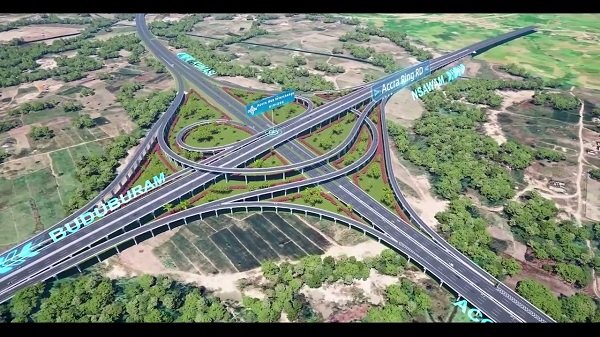
The proposed expressway will stretch 176 kilometres between Accra and Kumasi and is designed as a six-lane, bidirectional highway.

When completed, it is expected to cut travel time between the two cities to roughly two hours, while improving road safety, easing congestion and reducing transportation costs. Plans also include modern interchanges, bridges, intelligent transport systems, electronic tolling, emergency response facilities and rest areas.

NEXT STOP: CONSTRUCTION

With the right-of-way clearing now completed, attention shifts to the next phase of the project.

Government had previously indicated that procurement for the main construction contract would commence in September, following the completion of feasibility studies and detailed engineering designs.

The corridor is cleared. The money is being lined up. The next big question is when the machines will finally move in.

Accra–Kumasi Expressway: Ghana’s mega-road project is edging closer to reality.

Continue Reading

General News

ABLakwa GIVES AIRPORT VIP LOUNGE UPDATE — PROJECT SET FOR COMPLETION BY END OF 2026

Published

on

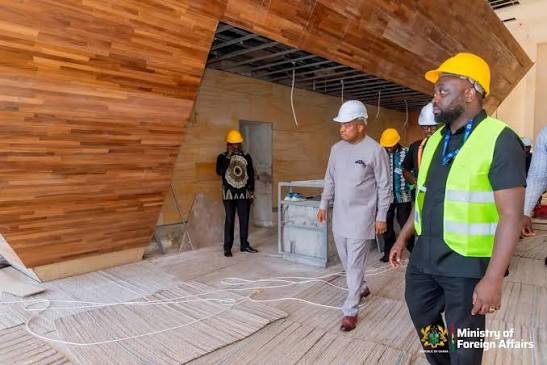
Foreign Affairs Minister Samuel Okudzeto Ablakwa says the ongoing ultramodern VIP Lounge at the Accra International Airport is progressing well and will be completed and handed over before the end of the year.

Ablakwa disclosed the update after inspecting the project on Friday, September 4, 2026, saying he was impressed with the pace and quality of work.

NO TAXPAYER MONEY USED

According to the Minister, the project is being delivered without drawing on taxpayer funds.

He explained that the financing model is based on corporate social responsibility contributions from local Ghanaian businesses, with participating companies paying contractors directly for various aspects of the project.

The Foreign Ministry’s Estate Bureau, he said, is responsible for supervising the works and ensuring that the required standards are maintained.

‘A GREAT SYMBOL OF WHAT CAN BE ACHIEVED’

Ablakwa described the initiative as an example of how private-sector partnerships can support major infrastructure projects without putting additional pressure on the public purse.

He said the arrangement has also allowed the project to proceed without conventional public procurement.

ULTRAMODERN FACILITY TAKING SHAPE

The VIP Lounge is intended to provide an upgraded facility for the reception and handling of dignitaries and other high-profile guests using the Accra International Airport.

Recent images from the project site show construction work nearing completion, with significant progress made on the facility.

HANDOVER EXPECTED THIS YEAR

With work advancing steadily, Ablakwa is confident the facility will be ready before the end of 2026.

The project has therefore become another closely watched development at Ghana’s main international gateway, with attention now turning to the final stages of construction and the eventual handover.

From funding to construction, Ablakwa says the project is moving without taxpayer money — and the new airport VIP experience could soon become a reality.

Continue Reading

Trending

Copyright © 2026 KPDOnline. Powered by AfricaBusinessFile