
General News
‘Justice Must Be Equal’ — Minority Mounts Legal Challenge Against Wontumi Conviction

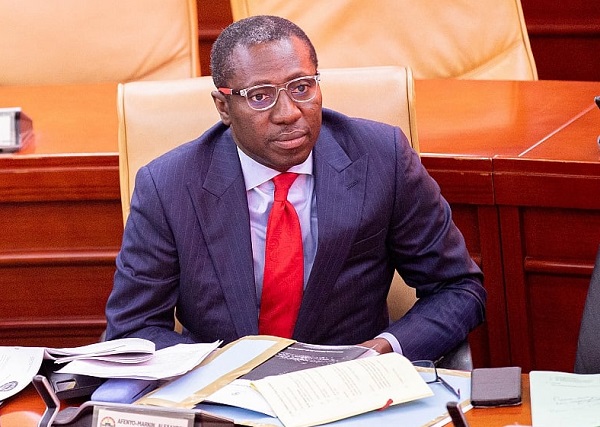
Ghana’s Parliamentary Minority has launched a strong legal and political challenge against the High Court’s conviction of New Patriotic Party (NPP) Ashanti Regional Chairman Bernard Antwi-Boasiako, popularly known as Chairman Wontumi, and Akonta Mining Limited, describing the judgment as constitutionally flawed and warning that it raises serious concerns about due process, judicial fairness and equal application of the law.
In a detailed statement dated July 20, 2026, and signed by Minority Leader Alexander Afenyo-Markin, the caucus insisted that its intervention was not intended to shield any individual from accountability but rather to defend constitutional governance and ensure that justice is administered fairly, transparently and without political bias.
The statement follows the High Court’s decision, delivered by Justice Audrey Kocuvie-Tay, which convicted Chairman Wontumi and Akonta Mining Limited on two counts each under the Minerals and Mining Act, 2006 (Act 703), as amended.
Minority Expresses Sympathy, Calls for Calm
The Minority extended its sympathies to Chairman Wontumi, his family, supporters and the NPP following what it described as the heavy burden imposed by the 20-year custodial sentence.
The caucus urged party supporters across Ghana and in the diaspora to remain calm and pursue lawful and constitutional means in expressing their dissatisfaction, warning against any acts of violence or disorder.
It further pledged to employ every available constitutional mechanism—including parliamentary oversight, legal advocacy and judicial processes—to challenge what it believes are significant legal defects in the judgment.
“Not an Attack on the Judiciary”
Although sharply critical of the ruling, the Minority emphasized that it continues to hold Ghana’s judiciary in high esteem.
According to the statement, questioning the legal reasoning behind a judgment should never be interpreted as an attack on judges or judicial independence.
The caucus stressed that appeals and public legal criticism are essential components of every constitutional democracy.
It also made clear that it was not questioning the personal integrity of Justice Audrey Kocuvie-Tay but believed the legal conclusions reached in the case deserved review by the appellate courts.
Minority Reaffirms Support for Anti-Galamsey Fight
The Parliamentary Minority reaffirmed its commitment to the fight against illegal mining, popularly known as galamsey.
It stated that it fully supports:
- Accountability for environmental crimes.
- Vigorous prosecution of illegal miners.
- Equal enforcement of mining laws irrespective of political affiliation.
However, it argued that anti-galamsey prosecutions must be carried out fairly, consistently and without political selectivity.
According to the caucus, no Ghanaian should receive immunity because of political affiliation, but neither should anyone become a target of politically motivated prosecution.
Alleged Denial of Right to Counsel
One of the central constitutional concerns raised by the Minority relates to what it describes as the denial of Chairman Wontumi’s right to legal representation of his own choosing.
The statement argues that before judgment was delivered, the High Court had been informed that Wontumi’s lead counsel was engaged in professional duties outside Ghana.
Despite this, the court proceeded to deliver judgment.
The Minority contends that Article 19(2)(g) of the 1992 Constitution guarantees every accused person the right to be defended by a lawyer of their own choice and that such a right cannot be limited except under exceptional circumstances after every reasonable accommodation has been exhausted.
The caucus believes that proceeding in the absence of lead counsel raises serious constitutional questions regarding Wontumi’s right to a fair trial.
Comparison with Tsatsu Tsikata Precedent
Drawing comparisons with the legal battle involving former Ghana National Petroleum Corporation Chief Executive Tsatsu Tsikata, the Minority argued that constitutional protections must apply equally regardless of political affiliation.
It recalled that Tsikata’s conviction was overturned by the Court of Appeal in 2016 after concerns were raised about due process and constitutional violations during his trial.
The statement maintained that if constitutional rights and the right to counsel were considered fundamental in Tsikata’s case, then the same standards must equally apply to Chairman Wontumi.
“If the right to counsel of choice mattered in 2003, it matters in 2026,” the statement declared.
Refusal to Refer Constitutional Questions to Supreme Court
Another major issue highlighted by the Minority concerns the trial court’s refusal to refer constitutional questions raised by the defence to the Supreme Court.
According to the statement, Wontumi’s legal team sought constitutional interpretation regarding provisions of the Minerals and Mining Act under Article 130 of the Constitution.
However, Justice Kocuvie-Tay ruled that the constitutional issues were sufficiently clear and therefore did not require referral to the Supreme Court.
The Minority argued that this decision itself amounted to constitutional interpretation, a function reserved exclusively for the Supreme Court.
The caucus cited the Supreme Court’s decision in the Ex Parte Zanetor Rawlings case, arguing that once a genuine constitutional question arises, trial courts are obliged to refer the matter to the apex court.
Legal analysts referenced by the Minority believe the refusal to make such a referral may amount to a jurisdictional defect capable of invalidating the entire proceedings.
Questions Over Corporate Liability
The statement also challenged the High Court’s decision to lift the corporate veil of Akonta Mining Limited and hold Chairman Wontumi personally liable for the company’s alleged conduct.
According to the Minority, piercing the corporate veil is an exceptional legal remedy that should only be exercised in limited circumstances after careful judicial analysis.
It argued that the basis upon which the court imposed personal liability deserves close scrutiny during the appellate process.
Allegations of Selective Justice
Beyond constitutional concerns, the Minority accused the State of selectively enforcing anti-galamsey laws.
The statement questioned why investigations reportedly ordered in July 2025 by Attorney-General Dr. Dominic Akuritinga Ayine into allegations involving Joseph Yamin and Yakubu Abanga have yet to result in prosecutions or court appearances.
It also referenced reports concerning alleged illegal mining activities linked to the Member of Parliament for Prestea Huni Valley at the Apinto concession, claiming no prosecutions have followed despite public allegations.
By contrast, the Minority noted that Chairman Wontumi’s prosecution moved swiftly and culminated in a 20-year custodial sentence.
The caucus further pointed to the case involving the Member of Parliament for Asutifi North, who was arraigned in November 2025 for allegedly obstructing an anti-galamsey task force and granted bail of GH¢150,000, highlighting what it described as inconsistencies in prosecutorial speed and severity.
According to the Minority, such disparities risk creating a public perception that justice is not being applied equally.
Constitutional Equality Before the Law
The Minority maintained that the alleged disparities violate the spirit of Article 17 of the 1992 Constitution, which guarantees equality before the law.
It argued that constitutional protections should never depend on political affiliation and warned that inconsistent prosecution could undermine public confidence in Ghana’s justice system.
Calls for Action
The Parliamentary Minority is calling for:
- A full appeal against Chairman Wontumi’s conviction.
- Judicial review of the alleged denial of counsel of choice.
- Review of the High Court’s refusal to refer constitutional questions to the Supreme Court.
- Publication of the Attorney-General’s enforcement record on illegal mining cases involving individuals across the political divide.
- Equal treatment of all accused persons regardless of political affiliation.
Broader Constitutional Implications
The caucus believes the Wontumi case has become a significant constitutional test for Ghana’s democracy.
It warned that unresolved jurisdictional concerns, questions over fair trial rights and allegations of selective prosecution could erode public confidence in both the judiciary and prosecutorial institutions if left unaddressed.
As appellate proceedings are expected to begin, the outcome of the case could shape future legal precedent regarding constitutional referrals, fair trial guarantees and prosecutorial discretion in politically sensitive cases.
The Minority concluded that its position is not a defence of illegal mining but rather a defence of constitutional governance, due process and equal justice under the law, insisting that every Ghanaian—regardless of political affiliation—is entitled to the full protection of the Constitution.













General News
FRIMPONG-BOATENG SPEAKS ON GALAMSEY — ‘ENFORCING ENVIRONMENTAL LAWS CARRIES POLITICAL COST’

Chief Justice Paul Baffoe-Bonnie has come under intense public scrutiny after remarks about the performance of state institutions triggered concerns over the perceived political neutrality of Ghana’s Judiciary.


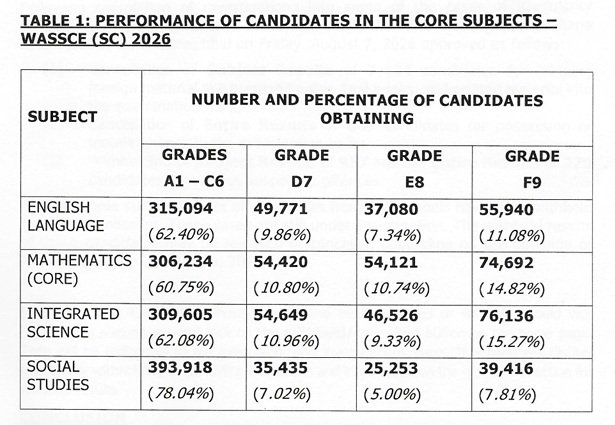
The West African Examinations Council (WAEC) has officially released the provisional results of the 2026 WASSCE for School Candidates, with Social Studies recording the strongest performance among the four core subjects.
WAEC announced the release on September 5, 2026, following the examination which saw 512,862 candidates from 1,022 schools registered to participate. The figure represents an 11.07% increase over the 461,736 candidates who entered for the 2025 examination.
SOCIAL STUDIES LEADS THE CORE SUBJECTS
Social Studies emerged as the best-performing core subject.
A total of 393,918 candidates, representing 78.04%, obtained grades between A1 and C6.
English Language followed with 62.40%, while Integrated Science recorded 62.08%. Core Mathematics saw 60.75% of candidates obtaining A1-C6.
ENGLISH PERFORMANCE CONTINUES TO DROP
One of the major talking points from the results is the continued decline in English Language performance.
WAEC’s four-year analysis shows the proportion of candidates obtaining A1-C6 in English falling from 73.11% in 2023 to 69.42% in 2024, 69.00% in 2025 and 62.30% in 2026.
Meanwhile, Mathematics and Social Studies recorded significant improvement compared with 2025, while Integrated Science also improved.
8,295 CANDIDATES FACE SANCTIONS
The release has also been accompanied by serious examination-malpractice concerns.
WAEC cancelled the entire results of 861 candidates after they were found with mobile phones in examination halls. The Council also cancelled the subject results of 7,434 candidates for bringing foreign materials, including prepared notes and textbooks, into examination halls.
In addition, the subject results of 957 candidates and the entire results of 270 candidates have been withheld over suspected offences.
Results involving candidates from 169 schools have also been withheld over alleged collusion, with investigations ongoing. WAEC says decisions on those cases may be made by October 30, 2026.
HOW CANDIDATES CAN CHECK
WAEC says the results have been hosted online, with school heads receiving login details to access their candidates’ results.
Candidates can also check their individual results through the Council’s official results-checking platform. WAEC has warned the public against fraudsters who claim they can upgrade examination results for money.

FRIMPONG-BOATENG SPEAKS ON GALAMSEY — ‘ENFORCING ENVIRONMENTAL LAWS CARRIES POLITICAL COST’

CHIEF JUSTICE COMMENTS STIR DEBATE — QUESTIONS RAISED OVER JUDICIAL IMPARTIALITY

ACCRA–KUMASI EXPRESSWAY HITS MAJOR MILESTONE — GAF COMPLETES 175.6KM CORRIDOR CLEARING



-

 General News2 weeks ago
Nana Adwoa Tutuwaa Named Global Humanitarian of the Year 2026
-
 General News2 weeks ago
Police Arrest Suspect in GH¢1.1m Fake Gold Scam at Berekum
-
 General News1 week ago
GES Urged to Review Student Sexual Misconduct Rule Over Alleged Discrimination Against Boys
-

 Entertainment6 days ago
Oswald Okaitei Explains the Real Vision Behind Ghana’s Black Star Experience
-
 General News2 weeks ago
OSP Assesses Extortion Allegations Against Afenyo-Markin
-

 Entertainment2 weeks ago
Stonebwoy Is Not My Rival — Shatta Wale Reveals They Live Minutes Apart
-
 Politics2 weeks ago
Stop The Personal Attacks!” — Vitus Azeem Demands Probe Into Sammy Gyamfi–Afenyo-Markin Feud
-

 Entertainment2 weeks ago
Mzbel Says Age Gap Is No Barrier as She Opens Up About 19-Year-Old Admirer