
Entertainment
GRA Clarifies Customs Rules on Travellers Carrying More Than Two Mobile Phones

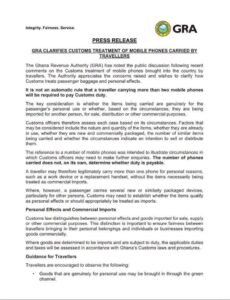
The Ghana Revenue Authority (GRA) has clarified that travellers entering Ghana are not automatically required to pay customs duty simply because they are carrying more than two mobile phones.
The clarification follows recent public discussions and concerns over the Customs treatment of mobile phones brought into the country by passengers.
In a press release issued on Thursday, September 3, 2026, the GRA explained that Customs officers assess travellers’ baggage and personal effects based on the circumstances of each case.
According to the GRA, there is no automatic rule requiring a traveller carrying more than two mobile phones to pay customs duty.
The Authority said the key consideration is whether the phones and other items being carried are genuinely intended for the traveller’s personal use or are being brought into Ghana for another person, for sale, distribution or other commercial purposes.
Customs officers may therefore consider several factors when assessing the items, including:
The nature and quantity of the items being carried.
Whether the phones are already in use.
Whether the devices are new and commercially packaged.
The number of similar items being carried.
Whether the circumstances suggest that the items are intended for sale or distribution.
The GRA explained that its earlier reference to some mobile phones was intended only to illustrate circumstances in which Customs officers might need to make further enquiries.
It stressed that the number of phones carried does not, on its own, determine whether customs duty is payable.
The Authority said a traveller may legitimately carry more than one mobile phone for personal reasons.
For instance, a passenger may be travelling with a work device and a personal phone, or may be carrying a replacement handset. In such circumstances, the phones would not necessarily be treated as commercial imports.
However, the situation may be different where a passenger is carrying several new or similarly packaged devices, particularly where the phones are intended for other people.
In such cases, Customs may need to establish whether the items qualify as personal effects or should be treated as imports subject to the applicable customs procedures.
The GRA said Ghana’s Customs system distinguishes between personal effects and goods imported for sale, supply or other commercial purposes.
The distinction, it noted, is important to ensure fairness between travellers bringing personal belongings into Ghana and individuals or businesses importing goods commercially.
Where goods are determined to be commercial imports and are subject to duty, the applicable duties and taxes will be assessed in accordance with Ghana’s Customs laws and procedures.
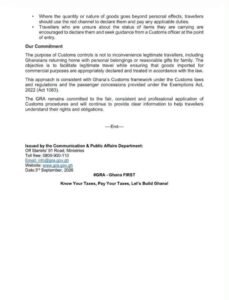
The GRA has encouraged travellers to observe the appropriate procedures when entering the country.
Goods that are genuinely for personal use may be brought into Ghana through the green channel.
However, where the quantity or nature of goods goes beyond what would reasonably be considered personal effects, travellers should use the red channel, declare the items and pay any applicable duties.
The Authority also advised travellers who are uncertain about the status of items in their possession to declare them and seek guidance from a Customs officer at the point of entry.
The GRA said the purpose of Customs controls is not to inconvenience legitimate travellers, including Ghanaians returning home with their personal belongings or reasonable gifts for family members.
Instead, the objective is to facilitate legitimate travel while ensuring that goods imported for commercial purposes are properly declared and treated according to the law.
The Authority said its approach is consistent with Ghana’s Customs framework, including the Customs laws and regulations and passenger concessions provided under the Exemptions Act, 2022 (Act 1083).
The GRA reaffirmed its commitment to the fair, consistent and professional application of Customs procedures and said it would continue providing information to help travellers understand their rights and obligations.
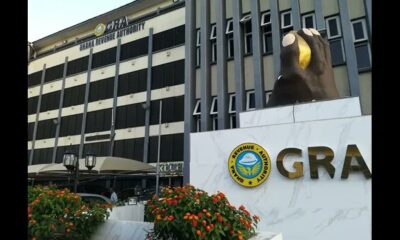
The statement was issued by the Communication & Public Affairs Department of the Ghana Revenue Authority, located at Off Starlets 91 Road, Ministries.


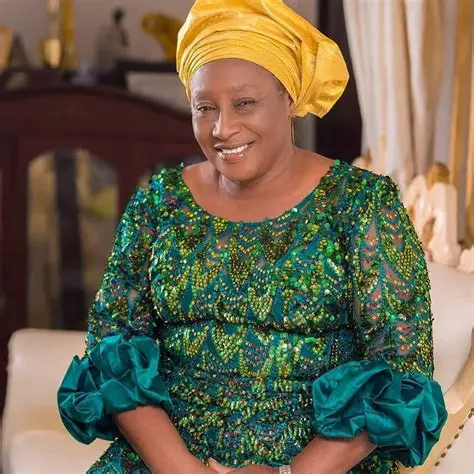
Veteran Nigerian actress Patience Ozokwor has advised parents to avoid overprotecting their children from the difficulties of life, arguing that excessive pampering could prevent them from becoming responsible and independent adults.
Ozokwor explained that although it is natural for parents to want their children to enjoy better lives than they did, completely shielding them from hardship may ultimately do more harm than good.
According to the actress, parents should not deliberately make their children suffer, but they should allow them to experience some level of struggle and understand the process through which success is achieved.
“One way, when you say, ‘I don’t want my children to suffer what I suffered when I was growing up,’ you see, that’s the best way to destroy your children,” she said.
She quickly clarified her position, saying: “I’m not saying allow them to suffer. What I’m saying is allow them to struggle. Go through the process.”
Ozokwor used wealthy parents and their properties to explain her point. She imagined a situation where a parent owns numerous houses across different cities, including Enugu, Aba and Lagos, while the children grow up without knowing the effort and sacrifices that went into acquiring the properties.
“Can you imagine you have like 20 houses, you have in Enugu, you have in Aba, you have in Lagos. Your children will just be struggling over which one belongs to me,” she said.
She noted that children who grow up surrounded by wealth without understanding how it was created may take their parents’ achievements for granted.
“They don’t know how you struggle to get those things,” she added.
The actress therefore encouraged parents to preserve what they have built while teaching their children that they must also work to acquire their own wealth.
“But when you keep the things that you have and let them know that you go get yours, this is mine,” she stated.
Ozokwor also explained why some wealthy people choose to sell portions of their properties while they are still alive rather than leaving everything behind for their children.
She observed that some parents sell a significant part of their assets, keep only a few properties for their children, enjoy the fruits of their labour and give some of their wealth to people who genuinely need assistance.
“That’s why you see some rich people at the time they start selling their things while they’re still alive,” she said.
“Maybe give out, just keep a few for the children and sell out a lot. Enjoy themselves and then give out some to those who really needed it.”
According to her, this approach can prevent children from growing up with the belief that wealth should simply be available to them without effort.
Ozokwor stressed that children should have some understanding of life’s difficulties so they can appreciate what they have.
“If you don’t do it, your children will grow up to just begin to enjoy life as it should be like this,” she warned.
“Let your children know the pains of life. Not all the pains of life.”
She explained that children do not need to experience every hardship their parents went through. Rather, exposing them to manageable difficulties can help them develop gratitude and a better understanding of the realities of life.
“The little they know will tell them that when they look back, they will see some people going through harder ones, and they will thank God for where they are,” she said.
The veteran actress further cautioned that excessive pampering could prevent children from developing the qualities needed to succeed.
“But if you pamper them, they don’t come out to be anything,” she said.
She pointed to children from wealthy families who were properly trained by their parents, arguing that such children often become successful because they were taught discipline, responsibility and the value of hard work.
“If you see rich people who train their children well, their children come out better than them,” Ozokwor stated.
However, she reiterated that her message was not for parents to force their children to endure the same hardships they experienced.
“I don’t say that your children will go through all the pains you went through. But let them go through little pains,” she said.
Ozokwor concluded by stressing that children should understand that the things they enjoy have value and are not always easy to replace.
“Let them know that it is not easy to make,” she said, using the example of a child casually breaking an item and immediately moving on without understanding its value.
She suggested that without some exposure to difficulty and responsibility, children may grow up believing that damaged or lost possessions can simply be replaced without consequence.

Ghanaian musician Mzbel has expressed concern about the future of her colleague Barosky, cautioning that returning to Ghana without a stable source of income could worsen his situation.
Speaking on UTV’s United Showbiz on September 2, 2026, Mzbel said she was unhappy with the manner in which Barosky’s personal situation became public.
She explained that people who could have offered assistance should have been approached privately rather than allowing the matter to become widely discussed.
Mzbel said Barosky could face serious financial difficulties if he returns to Ghana without a job or family support.
“What is he coming to do in Ghana? Unless he has a family or he’s looking at a job that he’s coming to do, if not, he would be super homeless when he comes to Ghana,” she said.
She further appealed to Ghanaian officials and institutions abroad, particularly Ghanaian High Commissions, to consider helping the musician secure employment.
According to Mzbel, Barosky could potentially use his musical talent at official events while working, which could help him remain financially stable.
She also used the situation to caution musicians about the importance of planning for life after their active entertainment careers.
Mzbel noted that success in the music industry does not automatically guarantee financial security in later years, urging artistes to invest wisely while they are still earning.
“No matter how much money you make and no matter how far you go, if you don’t invest well, by the time you grow old, your life would be miserable,” she cautioned.
Mzbel advised Barosky to remain abroad for now and find a job that can provide him with financial stability rather than immediately returning to Ghana.
She, however, noted that Ghanaians living abroad who have no stable source of income should also consider returning home and rebuilding their careers.
“If you don’t have anything solid to do abroad, just go and come back,” she said.
Mzbel further suggested that Barosky might have had better opportunities to revive his music career in Ghana if he had not relocated abroad permanently.
She believes he could have collaborated with other Ghanaian artistes and potentially released successful songs that would have helped revive his career.
Entertainment
Former Dancehall Star Kaakie Earns Doctorate in Nursing, Launches Mental Health Practice in US

Ghanaian dancehall artiste Kaakie has taken a major step in her healthcare career after earning a Doctor of Nursing Practice (DNP) qualification and launching her own mental health practice in the United States.
Born Grace Kaki Awo Ocansey, the former musician is now professionally known as Dr Grace Aidoo, DNP, APRN, PMHNP-BC. She is the founder of Kaylora Holistic Wellness & Recovery, a US-based practice providing psychiatric and therapeutic services.
A Doctor of Nursing Practice is a doctoral-level nursing qualification that prepares healthcare professionals for advanced clinical practice, leadership and specialised patient care.
Kaakie’s latest achievement marks a remarkable transition from Ghana’s dancehall scene to advanced mental healthcare, while also bringing her professional journey back to her original field.
Before becoming a musician, Kaakie studied nursing and midwifery at the University of Ghana. She gained public attention after competing on the television music competition Stars of the Future, where she placed fifth.
Her participation in the competition opened the door to a professional music career. She later worked with music producer JMJ and signed with Xtra Large Music, becoming one of the notable female voices in Ghana’s dancehall movement in the early 2010s.
During her music career, she released popular songs including “Ewoo,” “Too Much,” “Toffee Pon Tongue,” and “Zuuchia.” Her work earned her recognition at the 2013 Ghana Music Awards, where she won Best New Artiste of the Year and Reggae/Dancehall Song of the Year.
Despite her success in music, Kaakie maintained her connection to healthcare. In a 2014 interview with Graphic Showbiz, she discussed the challenge of balancing her career as a registered general nurse with her growing music career.
Kaakie eventually stepped away from the music industry to concentrate on healthcare and further education.
In 2019, she obtained a master’s degree from Anglia Ruskin University in the United Kingdom. A year later, she told Joy FM that her interest in contributing to healthcare, particularly maternal health, had grown stronger than her desire to continue pursuing music.

Her professional focus later shifted toward mental health.
In 2025, Kaakie announced that she had earned a Master of Science in Nursing with a Psychiatric Mental Health Nurse Practitioner specialisation from Walden University.
Her latest achievement, the Doctor of Nursing Practice, has now taken her education and professional development to the doctoral level.
Professional listings identify Dr Grace Aidoo as a board-certified Psychiatric-Mental Health Nurse Practitioner, with her work linked to Kaylora Holistic Wellness & Recovery.
The launch of her own practice represents a new chapter for the former dancehall star, whose energetic performances once made her a familiar name in Ghana’s music industry.

From nursing student to dancehall artiste and now a doctoral-level mental health practitioner and healthcare entrepreneur, Kaakie’s career has evolved across two distinct fields that have played significant roles in her life.
Source: Joy Entertainment

Entertainment
Ghana Must Look Beyond Accra to Unlock Tourism Potential Across All 16 Regions – Maureen Eduafo-Mensah
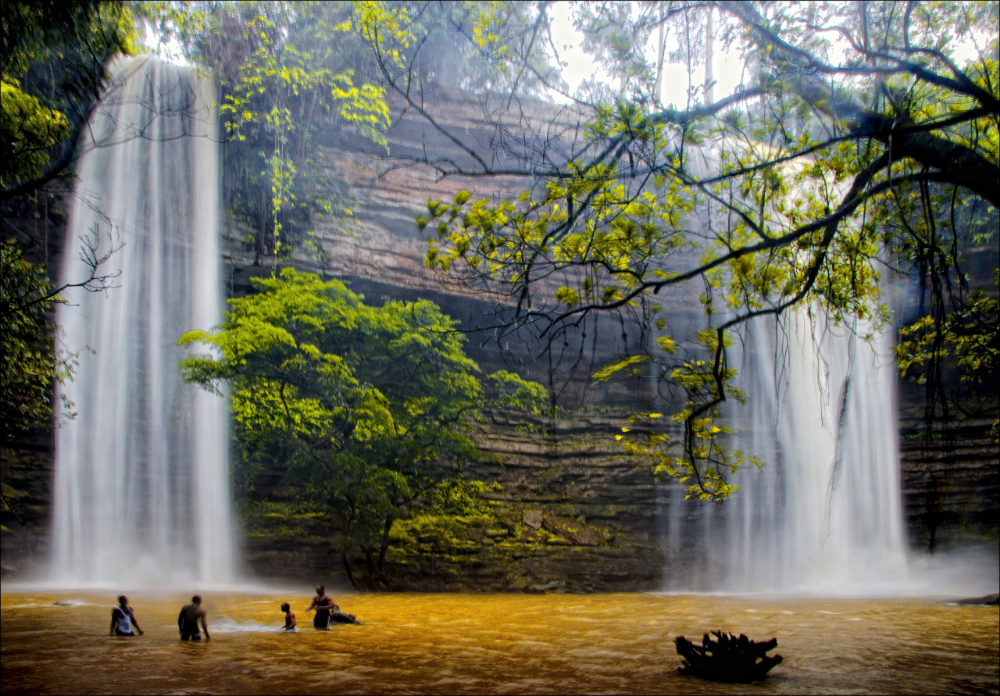
Ghana’s tourism development must move beyond Accra and other established tourism centres to ensure that all 16 regions benefit from the economic opportunities created by the sector, according to Maureen Eduafo-Mensah, an intern with the Corporate Affairs Directorate of the Ghana Tourism Authority (GTA).
BEYOND ACCRA: How Ghana Can Spread Tourism Development Across All 16 Regions. Eduafo-Mensah argued that Ghana’s tourism potential extends far beyond the capital, pointing to the country’s waterfalls, mountains, beaches, wildlife, cultural heritage, festivals and historic sites.
She noted that while destinations such as Accra, Cape Coast and Kakum continue to attract significant attention, several other parts of the country remain underdeveloped and under-promoted despite possessing attractions capable of drawing both domestic and international tourists.
“Focusing solely on Accra is like reading only the first chapter of a fascinating book,” she stated, stressing the need for tourists to experience the wider Ghanaian story.
According to Eduafo-Mensah, Ghana recorded more than 1.3 million international tourist arrivals in 2025, while domestic tourism has also continued to grow.
She said the figures demonstrate that people are travelling and spending within the tourism ecosystem, but the major challenge is ensuring that tourism-related economic activity reaches communities outside the country’s traditional tourism hubs.
She referenced former Tourism Minister Dr. Mohammed Ibrahim Awal, who previously outlined a vision to visit all 16 regions and develop at least two iconic tourism sites in each region.
Current Tourism Minister Abla Dzifa Gomashie has similarly emphasised the need to explore Ghana’s tourism potential beyond traditional destinations.
Gomashie has said Ghana’s regions each have unique attractions that can contribute to the development of the tourism industry.
“We all have unique things to offer. If we appreciate what is coming from the North, South, middle belts, and the coastal regions, we will reach far,” she said.
She further highlighted the economic potential of expanding tourism development nationwide, asking:
“Can you imagine we do this across all 16 regions of our country? We are going to pump fresh energy into the ecosystem of businesses that belong to Ghanaians.”
Eduafo-Mensah proposed that Ghana should move away from promoting individual attractions in isolation and instead develop regional and inter-regional tourism circuits.
For instance, tourists arriving in Accra could be encouraged to travel through the Eastern Region before proceeding to the Volta Region for waterfall and mountain experiences, continuing to the Oti Region for nature and cultural tourism and eventually travelling further north to explore wildlife and heritage sites.
She said similar circuits could be developed across the other regions.
The Central Region, for example, could expand its tourism offerings beyond castles and Kakum, while the Ashanti Region could combine its royal heritage with crafts, food and festivals.
The Western Region could link its beaches with cocoa and cultural experiences, while the northern regions could package wildlife, traditional architecture, festivals and local cuisine into attractive tourism products.
According to her, the objective should be to make travelling across Ghana part of the tourism experience, rather than limiting visitors to isolated attractions.
Eduafo-Mensah cautioned that advertising attractions without improving infrastructure would not be enough to attract and retain tourists.
She called for investment in roads, signage, accommodation, sanitation, internet connectivity, safety and visitor facilities around tourism destinations.
Regional and district authorities, she added, should work closely with traditional leaders and local communities to identify attractions with potential for development into sustainable tourism products.
The article also emphasised the need for local communities to become direct beneficiaries of tourism development.
Eduafo-Mensah suggested that young people could be trained and employed as tour guides, drivers, photographers, chefs, content creators and hospitality workers.
Communities could also generate income through handicrafts, local food, accommodation, cultural performances and other locally produced products.
She said such an approach could create employment opportunities outside Accra and help reduce the pressure on young people to migrate to the capital in search of jobs.
The GTA intern further identified social media as an important tool for promoting lesser-known destinations.
She suggested that the Ghana Tourism Authority, tourism businesses and content creators should make greater use of platforms such as TikTok, Instagram and YouTube to tell stories about attractions across the country.
One proposed campaign is 16 Regions, 16 Experiences, which would give each region an opportunity to showcase its food, festivals, history, culture, nature and adventure.
Eduafo-Mensah also called for stronger domestic tourism, arguing that Ghanaians themselves can play a major role in spreading tourism spending across the country.
She suggested that schools, churches, universities, companies and families could organise affordable trips to different regions.
Festivals could also be packaged into complete tourism experiences combining transportation, accommodation, food and cultural activities.
She noted that when Ghanaians travel within the country, they spend money on local businesses, helping to keep tourism revenue within communities.
To achieve balanced tourism development, Eduafo-Mensah proposed five key priorities:
Develop at least two strong tourism attractions in every region.
Improve roads and basic facilities around tourism sites.
Create regional tourism circuits instead of promoting single attractions.
Give local communities and young people a bigger role in tourism businesses.
Use strong digital marketing to promote lesser-known destinations.
She maintained that Ghana does not need to create a new tourism story because the country already possesses the attractions and cultural experiences needed to build a stronger tourism industry.
“Accra can remain the gateway to Ghana, but it should not be the end of the journey,” she stated.
She concluded that Ghana’s waterfalls, mountains, beaches, castles, forests, festivals, food, wildlife and cultures are waiting to be discovered, and that connecting, developing and promoting all 16 regions could transform tourism into a major driver of job creation, local business growth, cultural preservation and development nationwide.

GRA Clarifies Customs Rules on Travellers Carrying More Than Two Mobile Phones

Patience Ozokwor Urges Parents to Let Children Experience Life’s Struggles

Mzbel Raises Concern Over Barosky’s Future in Ghana



-

 General News1 week ago
Nana Adwoa Tutuwaa Named Global Humanitarian of the Year 2026
-
 Entertainment2 weeks ago
Interfaith Tourism World Club Calls for Faith-Based Tolerance to Strengthen National Peace
-

 General News1 week ago
Police Arrest Suspect in GH¢1.1m Fake Gold Scam at Berekum
-
 General News7 days ago
GES Urged to Review Student Sexual Misconduct Rule Over Alleged Discrimination Against Boys
-
 General News2 weeks ago
Assemblies of God Ghana Clears Headquarters Loan, Slashes Overdraft by GH¢3.2m
-

 Education2 weeks ago
Cybersecurity Education in Schools: Should Students Learn Online Safety?
-
 General News2 weeks ago
LMI Holdings: The Ghanaian Company Chosen to Revive the Saglemi Housing Project
-
 General News1 week ago
OSP Assesses Extortion Allegations Against Afenyo-Markin