General News
Africa Must Measure Wealth by Its People, Not Resources — President Mahama
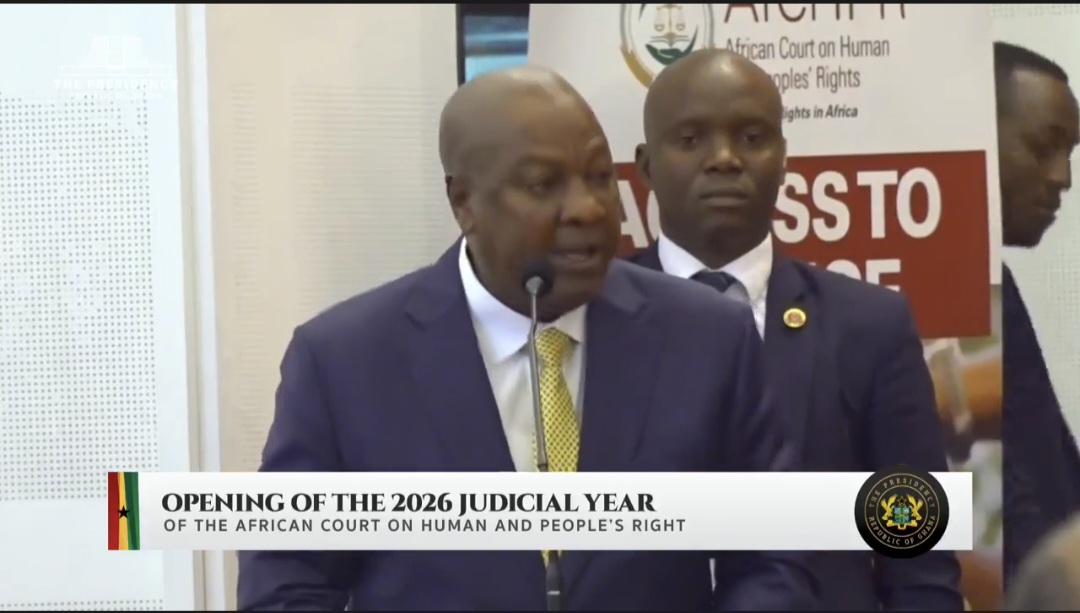
President John Dramani Mahama has called on African leaders to redefine the continent’s understanding of wealth, urging nations to prioritise human capital over natural resources as the true measure of prosperity and sovereignty.
Speaking at the official opening of the 2026 Judicial Year and the 20th Anniversary of the African Court on Human and Peoples’ Rights in Arusha, Tanzania, President Mahama stressed that Africa’s greatest inheritance is not its vast mineral deposits but its people.
“Africa has been blessed with many of the world’s natural resources, including gold, silver, diamonds, copper, cobalt, uranium, oil, lithium and more,” he said. “At times, it becomes easy to overlook that our most significant inheritance is our people and their cultural legacies.”
The Ghanaian leader urged African nations to imagine a continent where citizens are free from oppression, conflict, persecution and violence, and assured of their fundamental rights.
“Imagine if Africa measured its wealth not by natural resources, but by its people — valued individuals, free from oppression, conflict, persecution and violence, and assured of their rights to life, dignity, liberty and self-determination. What would that look like?” he asked.
A Demographic Advantage
President Mahama highlighted Africa’s growing population as a powerful asset that must be protected and empowered through strong institutions, particularly independent judicial systems.
By 2050, he noted, Africa’s population will reach 2.5 billion, representing more than a quarter of the world’s population. By the end of the century, nearly 40 per cent of the global population will be African.
“Already, the median age on the African continent is 19,” he said. “Can we imagine the power that we hold in our hands?”
He cautioned that this demographic advantage would only translate into prosperity if African states safeguard human rights, strengthen governance, and create opportunities that prevent brain drain and instability.
Linking Human Rights to Development
President Mahama tied the continent’s economic transformation to the protection of human rights, arguing that development cannot be sustained without justice, dignity and the rule of law.
“For far too long, we have compared ourselves to the West and used what we believed were their standards as benchmarks,” he said, quoting Tanzania’s founding President Julius Nyerere: “One does not judge one’s state of health by comparing it to a sick person.”
He stressed that Africa must develop its own paradigm for democracy and governance while preserving its dignity and cultural identity.
The President also called on African Union member states that have not yet ratified the Protocol establishing the African Court on Human and Peoples’ Rights to do so without delay, assuring leaders that they “have nothing to fear from this Court.”
“I humbly ask all African nations and individuals to respect and implement the Court’s judgements in good faith,” he added.
Looking Ahead
As the African Court marks 20 years of operation, President Mahama described the institution as critical to protecting the rights and dignity of African citizens beyond national borders.
“Now is the time for Africa to step into its greatness,” he declared.
The ceremony in Arusha brought together Heads of State and Government, Chief Justices, members of the diplomatic corps, civil society representatives and legal practitioners from across the continent to commemorate the Court’s milestone anniversary and officially open its 2026 Judicial Year.
General News
From tradition to trouble: The hidden dangers of fufu machines
For many Ghanaians, the sound of the pestle hitting the mortar is inseparable from the preparation of a steaming bowl of fufu.
But as technology has transformed the way the popular dish is prepared, fufu machines have increasingly replaced the traditional “tim-tim” method in homes, chop bars and commercial food joints.
The machines have brought speed and convenience. Yet experts and recent studies are raising concerns that poorly designed, poorly maintained or poorly cleaned machines could create serious food-safety and operator-safety risks.
The machine that made fufu easier
There is little doubt that mechanised fufu preparation has made life easier for many people.
Traditional pounding can be physically demanding and time-consuming, while machines can process fufu much faster and reduce the physical labour involved.
That convenience has helped the technology spread, particularly in urban areas where commercial food vendors serve large numbers of customers.
But convenience, experts say, should not come at the expense of safety.
Bacteria may be hiding inside
One of the biggest concerns is hygiene.
A 2023 study of food milling machines in Ghana found that the machines could harbour pathogenic bacteria, including Salmonella and Shigella. Researchers examined 55 food milling machines in the Asante Mampong Municipality and found that fufu pounding machines recorded the highest total number of bacterial isolates in the study.
More recent research in Somanya has reached a similar warning: fufu machines recorded particularly high bacterial contamination, with researchers pointing to food residues and inadequate cleaning as possible contributors.
The problem is partly linked to the nature of fufu itself.
Its sticky, paste-like consistency can leave residues around grinding chambers and outlets, creating places where microorganisms can survive and multiply if the equipment is not properly dismantled and cleaned.
The hidden problem inside the machine
Recent concerns from an agricultural engineering expert have added another dimension to the debate.
Ing. Prof. Francis Kumi of the University of Cape Coast has warned that some locally fabricated agro-processing machines are produced without clear standards covering food-contact materials, hygiene, performance and operator safety.
According to him, rough welds, cracks, poorly finished surfaces and difficult-to-reach areas can trap food particles and make proper cleaning difficult.
That means a machine may look clean from the outside while food residues remain hidden in internal components.
Exposed moving parts can turn dangerous
The risks are not limited to the food.
Experts have also pointed to exposed belts, pulleys, chains and rotating shafts on some locally fabricated machines as potential sources of serious injuries to operators.
This is particularly concerning in busy food-processing environments where operators work quickly and may have to handle food close to moving mechanical parts.
A machine designed to save time and energy can therefore become dangerous if basic engineering and safety standards are ignored.
What about the metal parts?
Questions have also been raised over the materials used in the construction of some machines.
Prof. Kumi has cautioned against inappropriate use of materials such as mild steel and galvanised steel on food-contact surfaces, noting that corrosion, deterioration of coatings and poor finishing can create food-contamination concerns.
However, it is important not to conclude that all fufu machines are unsafe.
The danger depends heavily on the machine’s design, the materials used, maintenance and, critically, how well it is cleaned and operated.
The real danger may be poor maintenance
A properly designed machine that is regularly dismantled, cleaned and maintained is very different from one that is allowed to accumulate food residue day after day.
Research from Ghana has found worrying gaps in hygiene practices among some food-milling operators. In one recent Somanya study, none of the operators reported washing the machines with soap after each milling session, while many did not wash their hands with soap between successive milling activities.
That creates a potential pathway for contamination from one batch of food to another.
So, should Ghanaians stop using fufu machines?
Not necessarily.
The evidence points more strongly towards the need for proper standards, safer designs, regular maintenance and strict hygiene practices rather than abandoning mechanised fufu preparation altogether.
Experts have called for stronger collaboration between institutions including the Ghana Standards Authority, Food and Drugs Authority, Ministry of Food and Agriculture, universities and professional engineering bodies to establish and enforce practical standards for agro-processing machines.
For consumers, choosing food vendors who maintain visibly clean processing environments is also important.
For operators, machines should be thoroughly cleaned, food-contact surfaces should be suitable for food processing, damaged components should be repaired or replaced, and exposed moving parts should be properly guarded.
Tradition meets technology
The fufu machine was created to solve a very Ghanaian problem: the hard work involved in preparing one of the country’s favourite meals.
But technology is only beneficial when it is safe.
The lesson is not that the old mortar and pestle are automatically safer, nor that every machine is dangerous. Instead, it is a reminder that speed and convenience must go hand in hand with food hygiene, proper engineering and responsible maintenance.
Because behind every smooth bowl of fufu is a process — and if that process is poorly managed, the very machine designed to make life easier could quietly become a source of trouble.
General News
GH¢120,000, scholarships, foreign trips await NSMQ 2026 finalists
The battle for the 2026 National Science and Maths Quiz (NSMQ) crown is not only about national pride and academic bragging rights, as the three finalists are also set to compete for an impressive package of rewards.
PRESEC-Legon, St Augustine’s College (AUGUSCO) and Accra Academy are the three schools that reached the grand finale, with several major incentives announced ahead of the highly anticipated showdown. Reports on the rewards indicate that the packages include GH¢120,000, scholarships and foreign trips.
The 2026 finale, held on September 10, brought together three of Ghana’s most celebrated second-cycle institutions in a contest that generated huge excitement among students, old students, parents and education enthusiasts.
GH¢120,000 up for grabs
Among the headline rewards is a GH¢120,000 cash package associated with the competition, adding another major incentive to an already fiercely contested academic battle.
The financial reward has further heightened interest in the contest, with old students and supporters rallying behind their respective schools as the finalists prepared to fight for national glory.
Scholarships add to the prize bonanza
The rewards go beyond cash.
Scholarship opportunities have also been lined up for students connected to the finalist schools. Accra Academy, in particular, was reported to have secured a full scholarship package, while other rewards were also announced in connection with the competing schools.
The scholarship offers mean that the benefits of the NSMQ final could extend well beyond the quiz itself, potentially supporting the academic ambitions of the students who have represented their schools on the national stage.
Foreign trips and vacation packages
The finalists also had foreign travel and vacation opportunities to look forward to, making the 2026 edition one of the most rewarding NSMQ finales in recent memory.
Starr FM reported that scholarships, GH¢120,000 and vacation opportunities were among the rewards awaiting the finalists, with old students also mobilising support for their respective schools.
The prospect of international travel adds another exciting dimension to the competition, giving the young contestants an opportunity to experience destinations and cultures beyond Ghana.
PRESEC, AUGUSCO and Accra Academy battle for glory
The three finalists entered the grand finale with different ambitions.
PRESEC-Legon was chasing another historic triumph after establishing itself as the dominant force in NSMQ history.
St Augustine’s College, popularly known as AUGUSCO, arrived with its own strong tradition and a determination to upset the favourites.
Accra Academy, meanwhile, sought to write its own chapter in the history of the competition by overcoming two highly decorated opponents.
The grand finale was therefore more than a quiz. It was a battle of academic excellence, school pride and history, with substantial rewards waiting at the finish line.
More than just a trophy
With cash, scholarships and travel opportunities on the table, the 2026 NSMQ finale offered the finalists much more than the coveted trophy.
For the students, it represented an opportunity to turn months of preparation, intense competition and academic discipline into rewards that could have a lasting impact on their educational journeys.
For the schools and their old students, it was another chance to demonstrate the strength of their academic traditions on Ghana’s biggest science and mathematics stage.
Three schools. Three brilliant teams. One coveted crown — and a remarkable package of rewards awaiting the stars of NSMQ 2026.
General News
President Mahama charges new Supreme Court justices to protect public trust
President John Dramani Mahama has charged three newly sworn-in Justices of the Supreme Court to protect public confidence in Ghana’s justice system and uphold the highest standards of judicial independence.
Speaking at their swearing-in ceremony at Jubilee House on Thursday, September 10, 2026, President Mahama stressed that the authority of the Supreme Court ultimately depends on the confidence and trust of the Ghanaian people.
The new Justices are Justice Sophia Rosetta Bernasko Essah, Justice Edward Amoako Asante and Justice Anthony Forson Jnr.
‘The authority of the Court rests on public trust’
President Mahama described the Supreme Court as a critical institution in Ghana’s constitutional democracy, noting that its decisions have far-reaching implications for the country.
He said the Court’s rulings give meaning to the Constitution, settle matters of national importance and contribute to the development of Ghanaian law.
According to him, the legitimacy of the apex court must not be derived from political power or influence, but from the confidence citizens have in its ability to administer justice fairly and independently.
“The authority of the Court does not rest on force or political power. It rests on the confidence and trust of the people.”
The President therefore urged the new justices to ensure that every case brought before them is determined independently, impartially and strictly according to the law.
Mahama demands clarity in judgments
President Mahama also emphasised the importance of clear and well-reasoned judgments, saying judicial independence must be accompanied by clarity in the delivery of decisions.
He explained that well-reasoned judgments provide dependable guidance to lower courts, public institutions, legal practitioners and citizens while strengthening respect for the judicial process.
He reminded the justices that their responsibilities go beyond legal expertise and require sound judgment, personal integrity, intellectual courage, patience and a deep commitment to justice.
Protect citizens and uphold the Constitution
The President further charged the new members of the apex court to protect citizens’ rights and uphold the principle that no individual or institution is above the law.
He stressed that judicial independence is not a privilege for judges but an important safeguard for citizens, particularly when courts are called upon to determine difficult, unpopular or politically sensitive cases.
The new appointments, he said, bring diverse judicial and professional experiences that should enrich the deliberations of the Supreme Court and contribute to the continued development of Ghanaian jurisprudence.
President Mahama’s message was ultimately a call for the new justices to see their elevation not simply as a professional achievement, but as a solemn responsibility to the Ghanaian people.
For the President, preserving public trust, defending the Constitution and delivering justice without fear or favour must remain at the heart of their new roles.
General News
Prostate Cancer: What Ghanaian men need to know
For many men, prostate health is a subject they would rather not discuss until a serious problem develops. But when it comes to prostate cancer, waiting for symptoms may mean missing an opportunity to detect the disease early.
Prostate cancer is one of the major health concerns affecting men, and men of African ancestry are considered to have a higher risk of developing the disease. Age and family history can also significantly increase the risk.
For Ghanaian men, understanding the warning signs, risk factors and screening options can therefore be an important step towards protecting their health.
What exactly is prostate cancer?
The prostate is a small gland located below the bladder and in front of the rectum. It forms part of the male reproductive system.
Prostate cancer occurs when abnormal cells in the prostate grow uncontrollably. Some prostate cancers grow slowly and may never cause serious problems, while others can be more aggressive and spread to other parts of the body.
That difference is important because an early diagnosis does not automatically mean a man needs immediate aggressive treatment. Doctors consider the type and stage of the cancer when deciding what treatment or monitoring is appropriate.
The silent danger: early prostate cancer may have no symptoms
One of the biggest challenges with prostate cancer is that early-stage disease often produces no noticeable symptoms.
A man may therefore feel perfectly healthy while cancer is developing in the prostate. This is one reason discussions about screening can be important, particularly for men at higher risk.
As the disease progresses, however, symptoms can include:
- Difficulty starting urination
- A weak or interrupted urine stream
- Frequent urination, particularly at night
- Difficulty completely emptying the bladder
- Pain or burning while urinating
- Blood in the urine or semen
- Painful ejaculation
- Persistent pain in the back, hips or pelvis
- Erectile difficulties
But these symptoms do not automatically mean a man has prostate cancer. Other prostate and urinary conditions can cause similar problems, so medical evaluation is important rather than self-diagnosis.
Why Ghanaian men should pay attention
Race and ancestry are among the factors associated with prostate cancer risk. The American Cancer Society specifically identifies Black men as being at higher risk and recommends that they discuss the potential benefits and risks of screening with a healthcare provider from an earlier age than men at average risk.
Family history matters too.
A man whose father or brother was diagnosed with prostate cancer before age 65 may have a higher risk and should discuss screening earlier with a healthcare professional. Men with more than one first-degree relative diagnosed at an early age may warrant an even earlier discussion.
What is the PSA test?
One of the most commonly used tests for prostate cancer screening is the prostate-specific antigen (PSA) blood test.
PSA is produced by the prostate. An elevated PSA level can be associated with prostate cancer, but it can also occur because of an enlarged prostate, prostate infection and other conditions. Therefore, a high PSA result does not by itself prove that a man has cancer.
Depending on the circumstances, a doctor may recommend additional tests, and a biopsy may ultimately be needed to determine whether cancer is present.
At what age should men consider screening?
There is no single screening schedule that is right for every man.
The American Cancer Society recommends that men at average risk begin a discussion with their healthcare provider about the potential benefits and risks of screening at age 50.
For men at higher risk — including Black men and men with a father or brother diagnosed with prostate cancer before age 65 — that discussion is recommended from age 45.
For men at particularly high risk because they have more than one first-degree relative diagnosed at an early age, the discussion may begin at age 40.
These are guidelines for a discussion with a healthcare professional, not a command that every man must undergo testing at exactly those ages.
Don’t wait until you have serious symptoms
A common mistake is to assume that a prostate problem will always announce itself through difficulty urinating.
That is not necessarily the case.
Early prostate cancer often has no symptoms, which means men who are concerned about their risk should speak to a qualified healthcare professional about whether screening is appropriate rather than waiting for serious symptoms to appear.
Can prostate cancer be prevented?
There is no guaranteed way to prevent prostate cancer.
However, maintaining a healthy weight, staying physically active and following a healthy eating pattern rich in fruits, vegetables and whole grains may help lower cancer risk generally and may also help reduce prostate cancer risk.
Men should also avoid tobacco and discuss their individual health risks with healthcare professionals.
The message for Ghanaian men
Prostate cancer should not be a taboo subject.
For Ghanaian men, particularly those who are older or have a family history of prostate cancer, knowing their risk and discussing screening with a healthcare professional can be an important part of taking control of their health.
Most importantly, do not interpret urinary symptoms or a PSA result on your own. A healthcare professional can determine whether further examination or testing is necessary.
Early detection can provide more options for managing prostate cancer, while informed screening decisions can help balance the potential benefits against the possible harms of unnecessary testing and treatment.
If you are concerned about prostate cancer or have symptoms, speak to a qualified healthcare professional rather than relying on self-medication or online advice.
General News
Defend the Constitution at all times – President Mahama urges Supreme Court justices
President John Dramani Mahama has charged newly appointed Supreme Court justices to make the Constitution their ultimate guide and defend it at all times as they discharge their judicial responsibilities.
The President made the call on Thursday, September 10, 2026, when he swore in three new Justices of the Supreme Court — Justice Sophia Rosetta Bernasko-Essah, Justice Edward Amoako Asante and private legal practitioner Anthony Forson Jnr.
‘Your oath is consequential, not ceremonial’
Speaking at the swearing-in ceremony at the Jubilee House, President Mahama stressed that the Supreme Court occupies a critical position in Ghana’s constitutional democracy as the country’s highest judicial authority.
He said decisions of the Court have far-reaching consequences because they give meaning to the Constitution, settle matters of national importance and contribute to the development of Ghana’s laws.
President Mahama therefore urged the new justices to approach their duties with integrity, sound judgment, intellectual courage, patience and an unwavering commitment to justice.
He emphasised that the oath taken by the justices was not merely a formality but a solemn commitment to the people of Ghana.
“The oath you have taken today is consequential, not ceremonial. It is a solemn covenant with the people of Ghana.”
He further reminded them of their responsibility to administer justice without fear or favour, affection or ill-will, while defending the Constitution at all times.
Mahama stresses judicial independence
The President also underscored the importance of judicial independence, insisting that Ghanaians must have confidence that cases brought before the Supreme Court will be determined fairly, independently and strictly according to the law.
According to him, the legitimacy and authority of the Supreme Court should derive from public confidence and trust rather than political influence or the exercise of power.
“The authority of the Court does not rest on force or political power. It rests on the confidence and trust of the people,” President Mahama said.
He said this confidence can only be sustained when citizens are assured that their cases will be handled without political interference or external influence.
Constitution must remain the compass
President Mahama’s charge is consistent with the judicial oath prescribed under Ghana’s 1992 Constitution, which requires Supreme Court justices to perform their functions without fear or favour, affection or ill-will and to uphold, preserve, protect and defend the Constitution and laws of Ghana.
He consequently urged the newly sworn-in justices to let the Constitution guide their decisions and to carry out their duties with humility, courage and fairness.
The President also called on the Judiciary to continue pursuing reforms aimed at improving efficiency, embracing appropriate technology and making justice more accessible to ordinary Ghanaians.
The appointment of the three justices comes at a time when public confidence, judicial independence and constitutional governance remain central to discussions about Ghana’s democracy.
For President Mahama, the message to the new members of the apex court is clear: the Constitution must come first, and justice must be administered without fear or favour.
-
Entertainment2 weeks agoOswald Okaitei Explains the Real Vision Behind Ghana’s Black Star Experience
-
Entertainment4 days agoMahama Is First President to Put GH¢40m Seed Money into Creative Arts Fund: Kojo Preko Dankwa
-
General News1 week agoCOCOBOD Settles GH¢2.3 Billion DDEP Bond Obligations for 2026
-
Entertainment2 weeks agoJoana Gyan Cudjoe Ends Seven-Year Professional Ties with Keche Global
-
General News7 days agoDon’t Punish Them Retrospectively – Educationist Challenges New CSSPS Placement Rule
-
Culinary2 weeks agoPalm Nut Soup: Ghana’s Rich Bowl of Tradition, Culture and Comfort
-
Entertainment1 week agoRas Caleb Appiah-Levi: Hate Me for the Truth That I Represent
-
Culinary1 week agoPineapple: The Spiky Tropical Fruit Packed With Sweetness and Nutrients