
General News
Government Evacuates 41 More Ghanaians from South Africa

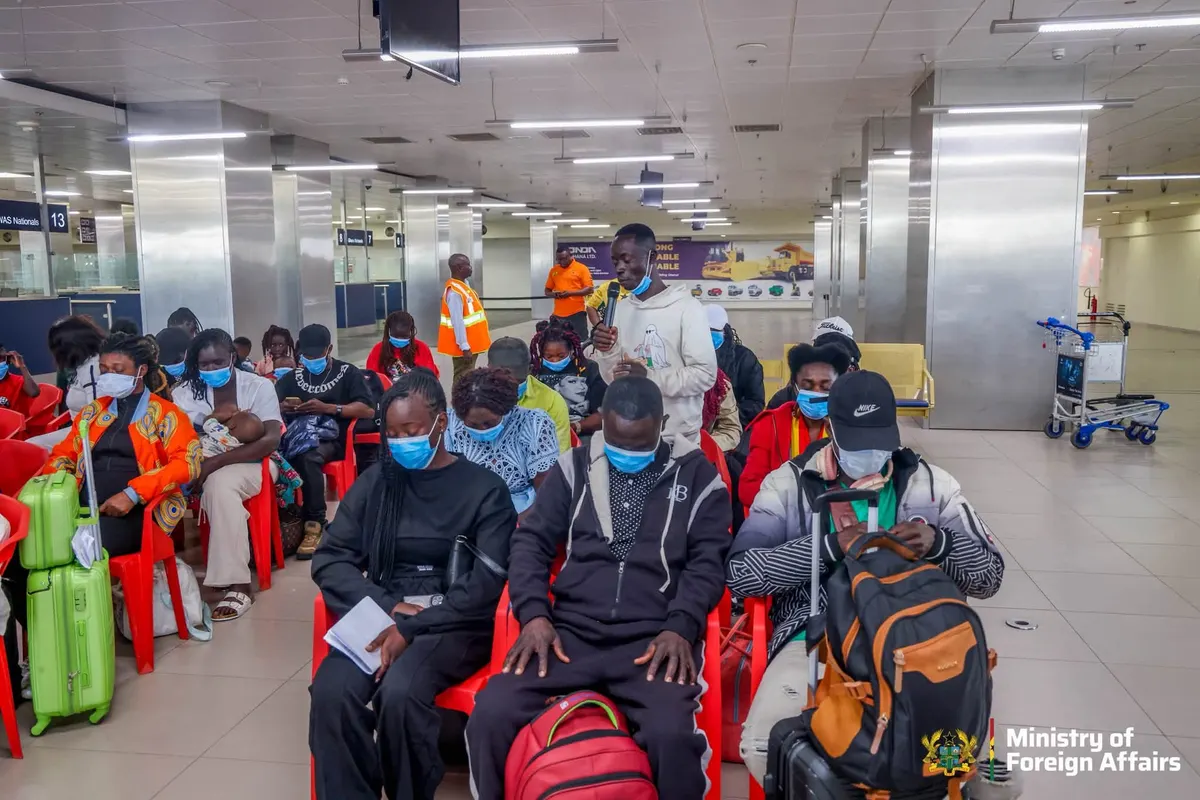
The Government of Ghana has brought home 41 more Ghanaians affected by recent xenophobic attacks in South Africa.
The evacuees arrived at the Accra International Airport on Wednesday, September 2, 2026, where they were received by Ambassador Alexander Grant Ntrakwa, Head of the Delivery Unit, and officials from the Ministry of Foreign Affairs.
Officials from the National Disaster Management Organisation (NADMO), Ghana Immigration Service, Ghana Health Service, Port Health Authority, Ghana Red Cross Society and the Ghana Armed Forces were also at the airport to welcome the returnees.
Speaking to the evacuees, Ambassador Ntrakwa assured them that the government remained committed to protecting their welfare and helping them settle back into their communities.
He urged them to stay positive and view their return as an opportunity to rebuild their lives. He also encouraged them to make good use of their skills, knowledge and experiences as they reintegrate into society and contribute to Ghana’s development.
The Ambassador said the government was collaborating with relevant agencies and other stakeholders to ensure that the returnees receive the support needed to successfully restart their lives in Ghana.
The returnees expressed gratitude to the government for facilitating their evacuation and ensuring their safe return. They also thanked the authorities for the assistance and support they received throughout the evacuation process.
General News
OSP Opens Preliminary Investigation into Alleged GH¢70,000 Payment Linked to Parliament’s Vetting
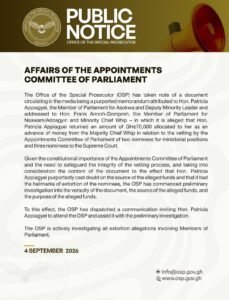
The Office of the Special Prosecutor (OSP) has commenced a preliminary investigation into an alleged GH¢70,000 payment linked to Parliament’s Appointments Committee and involving Deputy Minority Leader and Asokwa Member of Parliament, Patricia Appiagyei.
The investigation follows the circulation of a purported memorandum allegedly authored by Mrs Appiagyei and addressed to the Minority Chief Whip and Member of Parliament for Nsawam-Adoagyiri, Frank Annoh-Dompreh.
According to the OSP, the contents of the document raise questions about the authenticity of the memorandum, the source of the alleged funds and the purpose for which the money was provided.
The memorandum, dated September 2, 2026, reportedly indicates that Mrs Appiagyei returned GH¢70,000 she had allegedly received as an advance from the Majority Chief Whip of Parliament.
The money was reportedly connected to the Appointments Committee’s activities, including vetting ministerial nominees and three nominees to the Supreme Court.
Mrs Appiagyei allegedly explained that she decided to return the money because she was unaware of its source. She also reportedly expressed reservations about receiving any financial benefit associated with the vetting of members of the Majority leadership.
The memorandum reportedly made specific reference to the vetting of Majority Leader Mahama Ayariga and Deputy Majority Leader Dr Zanetor Agyeman-Rawlings.
The alleged payment has also been linked to the Minority Caucus’ decision not to participate in the vetting of three Supreme Court nominees.
The nominees are: Justice Sophia Rosetta Oduokuwa Bernasko Essah, Justice Edward Amoako Asante, Justice Anthony Forson Jnr.
Members of the Minority on the Appointments Committee walked out of the proceedings on August 27, 2026, citing concerns about the procedure adopted for the exercise.
The Minority argued, among other things, that the nominees had been scheduled for vetting without sufficient notice.
Mrs Appiagyei reportedly stated in her memorandum that, having taken a principled position against participating in the exercise, she considered it inappropriate to accept money connected to the process.
She also reportedly said she did not intend to benefit financially from, or “extort any money” from, the nominees.
The OSP said its preliminary investigation is focused on establishing three key issues:
Whether the purported memorandum is genuine;
The source of the alleged GH¢70,000; and
The purpose for which the money was provided.
The Special Prosecutor’s Office further indicated that the contents of the document could potentially raise questions about whether the alleged funds had characteristics associated with extortion of parliamentary nominees.
However, the OSP stressed that the investigation is at a preliminary stage and that the allegations contained in the circulating document have not been established as facts.
As part of its inquiries, the OSP has dispatched a communication inviting Patricia Appiagyei to appear before the office.
Her invitation is intended to enable investigators to establish the circumstances surrounding the alleged payment and the memorandum attributed to her.
Investigators are also expected to determine whether the document accurately represents her position and whether the alleged GH¢70,000 was indeed connected to Parliament’s vetting activities.
The development has triggered broader questions about the financial arrangements surrounding the work of Parliament’s Appointments Committee.
The Committee plays an important constitutional role in scrutinising presidential nominees for ministerial positions and other major public offices.
Consequently, allegations that Members of Parliament may receive money connected to the vetting of nominees have raised concerns about the integrity, transparency and independence of the parliamentary vetting process.
The Africa Centre for Parliamentary Affairs (ACEPA) has called for an independent investigation into the matter.
Its Executive Director, Dr Rasheed Draman, has reportedly urged authorities to determine whether the alleged payment was an isolated incident or indicative of a wider practice within parliamentary committees.
Anti-corruption campaigner Vitus Azeem has also called for investigations by the OSP and the Commission on Human Rights and Administrative Justice (CHRAJ).
He has urged authorities to establish who authorised the alleged payment, why it was made and whether similar payments were made to other MPs.
The purported memorandum also reportedly indicated that Mrs Appiagyei’s decision to return the GH¢70,000 was consistent with a decision by Minority Leader Alexander Afenyo-Markin to return his own share of the money.
Mrs Appiagyei consequently requested that her GH¢70,000 be returned to the Majority Chief Whip, together with an explanation for her decision to reject the funds.
The authenticity of the document remains a central issue in the controversy.
The Minority Caucus has reportedly disputed aspects of the claims surrounding the memorandum, while the OSP has specifically identified verification of the document as one of the main objectives of its preliminary investigation.
The OSP’s inquiry will therefore have to establish whether the memorandum was genuinely authored by Mrs Appiagyei before assessing the allegations contained in it.
In its September 4 public notice, the OSP also indicated that it is actively investigating extortion allegations involving Members of Parliament.
The GH¢70,000 matter therefore forms part of a wider scrutiny of allegations concerning financial transactions and parliamentary vetting.
At this stage, the OSP has not announced criminal charges against Patricia Appiagyei or any other person in connection with the alleged GH¢70,000 payment.
The immediate focus of the investigation is to authenticate the document, establish the source of the alleged funds and determine the purpose for which the money was allegedly provided.
The investigation remains ongoing.

The Ghana Gold Board (GoldBod) has emerged as a significant source of foreign exchange for commercial banks, supplying hundreds of millions of dollars to the formal banking system under a new collaborative financing model designed to strengthen liquidity and support stability in Ghana’s foreign exchange market.
In August 2026, GoldBod generated US$1.315 billion in foreign exchange, marking the first full month of implementation of the new financing arrangement. Of the total, US$668.21 million was sold directly to commercial banks through spot sales and funded forward arrangements.
A further US$646.59 million was made available to the Bank of Ghana (BoG) for the accumulation of international reserves under the Ghana Accelerated National Reserve Accumulation Policy (GANRAP).
GoldBod said the direct supply of foreign exchange to commercial banks is intended to improve access to dollars within the formal financial system.
Commercial banks serve as a major channel through which businesses and individuals obtain foreign currency for legitimate transactions, international payments and other economic activities. The additional FX supplied by GoldBod is therefore expected to strengthen banks’ ability to meet demand and improve liquidity in the foreign exchange market.
The arrangement also creates a closer link between Ghana’s gold resources and the country’s foreign exchange market. Gold generated through artisanal and small-scale mining operations is aggregated and converted into foreign exchange, which is then channelled into the formal financial system and, in part, into the country’s international reserves.
The financing model commenced on August 3, 2026, following consultations involving GoldBod, the Ministry of Finance, the Bank of Ghana, commercial banks and other stakeholders.
Its implementation followed the approval of GANRAP by Cabinet and Parliament. The model provides a framework for financing GoldBod’s gold aggregation operations while simultaneously supporting foreign exchange generation, market stability and reserve accumulation.
The August figures represent the first full month under the arrangement, with the US$668.21 million supplied to banks supporting foreign exchange market liquidity and the US$646.59 million transferred to the BoG contributing to the accumulation of national reserves.
GoldBod is expected to build on its August performance by generating US$1.4 billion in foreign exchange in September 2026.
Under the September plan, US$700 million is expected to be made available to commercial banks to support foreign exchange market stability, while up to US$700 million will be provided to the Bank of Ghana for reserve accumulation under GANRAP.
The projected September figure is about US$85 million higher than the US$1.315 billion generated in August.
The increased flow is expected to provide continued support to Ghana’s external position by simultaneously improving FX availability within commercial banks and strengthening the country’s international reserve position.
GoldBod said it remains committed to its statutory mandate of generating foreign exchange for Ghana and will continue working with the Ministry of Finance, the Bank of Ghana, commercial banks and other stakeholders to implement the financing model transparently.
The development further positions Ghana’s gold sector as an important source of foreign exchange while linking gold aggregation more directly to financial-sector liquidity, exchange-rate stability and national reserve accumulation.

The Upper East Regional Police Command, in collaboration with the Military, has recovered an AK-47 assault rifle and 28 rounds of ammunition during a joint operation targeting suspects linked to a series of shooting incidents in the Binduri District.
The intelligence-led operation was launched in response to several recent shootings and other firearm-related offences reported in the district, as security agencies intensified efforts to identify and arrest those behind the incidents.
The Police, in a statement issued on Thursday, September 3, 2026, identified one of the suspects as 32-year-old Isaka Sabani, alias “Culture.”
The Command said Sabani sustained gunshot wounds during the operation and later died.
An AK-47 assault rifle, loaded with 28 rounds of ammunition, was subsequently recovered from him.
The Police said preliminary investigations had established that Sabani was wanted over an attempted murder and unlawful discharge of firearms case reported at the Bawku Police Station on August 28, 2026.
He was also suspected of being involved in a series of shootings recorded in Binduri between August 29 and 31.
According to the Police, the incidents included shootings at Agenda 111 on August 29, Aniisi on August 30 and Gumyoko on August 31.
The latest operation forms part of an intensified security response aimed at tracking down individuals responsible for the recent attacks, recovering firearms and preventing further incidents in the district.
The recovered weapon and ammunition have been taken into custody as investigations continue into the shootings and other firearm-related offences.
The Upper East Regional Police Command has assured residents that it will continue to work with the Military, other security agencies and relevant stakeholders to apprehend other suspects and restore lasting security in the region.
“The Upper East Regional Police Command will continue to collaborate with sister security agencies and all other stakeholders to bring all other perpetrators to justice and ensure security, law and order in the region,” the statement said.
An educationist, Seth Afum A. Dankwah of J. G. Knol Technical Institute in Adukrom-Akuapem in the Eastern Region, has criticised the reported decision by the Computerised School Selection and Placement System (CSSPS) to disqualify candidates who fail either English Language or Mathematics.
His concerns follow comments by CSSPS Coordinator Sherif Sulemana on Joy FM’s Super Morning Show on September 3, 2026, that candidates would be disqualified from placement if they failed either English Language or Mathematics.
According to Mr Dankwah, the interpretation represents a significant change from what students, parents, schools and other stakeholders had understood to be the placement requirement since the introduction of Free SHS and TVET in 2017.
Under the previous understanding, a candidate who passed at least one of the two subjects could qualify for placement, while those who failed both were excluded.
Mr Dankwah cited figures from the CSSPS Secretariat indicating that 54,985 out of 620,243 candidates who sat the 2026 BECE would not be placed if the new interpretation is applied.
He argued that the situation could leave thousands of 15-year-olds without access to secondary or technical education.
He illustrated the potential impact with a candidate who scores Grade 9 in Mathematics but Grade 1 in English, Science, Social Studies, BDT, Religious and Moral Education and Ghanaian Language.
Such a candidate could obtain a best-six aggregate of 14 but, under the reported rule, would still be denied placement because of the Grade 9 in Mathematics.
Mr Dankwah said the projected number of excluded candidates represents a sharp increase compared with previous years.
According to figures he attributed to the West African Examinations Council (WAEC):
2022: 8,930 of 547,329 candidates were disqualified, representing 1.6%.
2023: 13,042 of 598,839 candidates were disqualified, representing 2.2%.
2024: 10,184 of 563,339 candidates were disqualified, representing 1.8%.
2025: 13,019 of 603,328 candidates were disqualified, representing 2.2%.
2026: 54,985 of 620,243 candidates are reportedly at risk of non-placement.
He described the 2026 figure as a “quantum leap” and urged authorities to reconsider the implementation.
Mr Dankwah questioned why the reported change was communicated through the media shortly before the placement exercise, rather than through an official circular from the Ghana Education Service (GES) or TVET Service.
He noted that some parents had already been instructed by Junior High School heads to begin selecting schools based on the previous understanding of the placement criteria.
He therefore argued that applying the new requirement to students who had already written the BECE would amount to retrospective implementation.
He referenced Article 23 of the 1992 Constitution, which requires administrative bodies to act fairly and reasonably, and Article 296, which provides safeguards on the exercise of discretionary power.
He also invoked the principle of legitimate expectation, arguing that students and parents had planned around the placement system as they understood it over several years.
Mr Dankwah acknowledged the importance of English and Mathematics in secondary education.
He said English is essential because it is the main language of instruction, while Mathematics provides fundamental skills for logical reasoning and many academic and technical disciplines.
However, he argued that a student’s weakness in one of the two subjects should not automatically end his or her educational journey.
He said some students who perform poorly in Mathematics or English may excel in practical and technical subjects.
He cited the example of a student who could score Grade 9 in Mathematics while obtaining Grade 1 in Basic Design and Technology, Technical Drawing, Woodwork, Metalwork, Biology or Creative Arts.
According to him, excluding such students could undermine Ghana’s efforts to develop artisans, technicians and skilled workers needed for industrialisation.
Mr Joseph Denteh, a contractor and Head of Department for Electrical Engineering at J. G. Knol Technical Institute, was also quoted as sharing his personal educational experience.
He said he started school late and consistently performed poorly from Class Four through JHS Three.
After obtaining poor BECE results, he was not placed in a secondary school and eventually entered SHS through protocol.
He said his subsequent progress demonstrated that poor BECE performance should not necessarily be treated as a permanent measure of a child’s potential.
Mr Dankwah proposed three measures to address the situation.
First, he wants the reported “must pass both” requirement rescinded for the 2026 placement exercise. He proposed that candidates who passed at least one of English or Mathematics should be allowed to enter second-cycle institutions this year, while the new requirement could take effect from the 2027 BECE.
Second, he proposed conditional placement. Students who fail one of the two subjects could be admitted but would be required to undertake compulsory remedial work and resit the subject while in secondary school.
Third, he called for a pre-SHS remedial year. Under the proposal, students who fail English or Mathematics would remain in the education system, receive intensive instruction in the failed subject alongside practical skills training, and resit the BECE the following year.
He argued that successful candidates could then progress to Form Two rather than being left without a clear educational pathway.
Mr Dankwah ultimately urged the GES, TVET authorities, parents, PTAs and other education stakeholders to prioritise inclusion while maintaining academic standards.
He said the debate should focus on whether Ghana wants to protect examination aggregates or provide opportunities for tens of thousands of young people to develop their academic and practical abilities.

How Can You Be a Player and Referee? — Domelevo Takes Aim at MPs on State Boards

Government Evacuates 41 More Ghanaians from South Africa

Ras Caleb Appiah-Levi: Humans Love the Dead More Than the Living



-

 General News2 weeks ago
Nana Adwoa Tutuwaa Named Global Humanitarian of the Year 2026
-
 General News2 weeks ago
Police Arrest Suspect in GH¢1.1m Fake Gold Scam at Berekum
-
 Entertainment2 weeks ago
Interfaith Tourism World Club Calls for Faith-Based Tolerance to Strengthen National Peace
-
 General News2 weeks ago
Assemblies of God Ghana Clears Headquarters Loan, Slashes Overdraft by GH¢3.2m
-
 General News1 week ago
GES Urged to Review Student Sexual Misconduct Rule Over Alleged Discrimination Against Boys
-
 General News1 week ago
OSP Assesses Extortion Allegations Against Afenyo-Markin
-

 Entertainment1 week ago
Stonebwoy Is Not My Rival — Shatta Wale Reveals They Live Minutes Apart
-
 General News2 weeks ago
GRIDCo Announces 15-Hour Power Outage in Parts of Accra as Emergency Tower Works Continue