
General News
Joana Gyan Cudjoe urges Amenfi Central residents to reject social media rumours and support long-term development


Member of Parliament for Amenfi Central, Hon. Joana Gyan Cudjoe, has urged residents of the constituency to reject unverified allegations and social media misinformation and instead focus on the development challenges facing the area.
In a detailed message to the people of Amenfi Central, the MP acknowledged concerns over poor roads, unreliable telephone and internet connectivity, electricity challenges, inadequate healthcare and educational infrastructure, water shortages, unemployment, limited government services, security and a lack of investment opportunities.
She said residents were justified in demanding better services and infrastructure, stressing that she accepted the responsibility of advocating for solutions to the challenges confronting the constituency.
However, she cautioned residents against treating allegations circulated on TikTok, Facebook, WhatsApp and other social media platforms as facts without evidence.
According to her, genuine criticism, questions and accountability were welcome, but allegations should be verified before they are believed or shared.
She encouraged residents to visit communities, speak to beneficiaries and assess projects, government approvals, interventions and results before forming opinions about her performance as MP.
“Judge Joana Gyan Cudjoe by facts, evidence and results — not social-media noise,” she said.
The MP also argued that many of the problems currently confronting Amenfi Central had existed long before she became Member of Parliament, noting that challenges involving roads, network connectivity, electricity, healthcare, education, water, unemployment, government services, staff accommodation and investment had accumulated over decades.
She said she had been MP for approximately one year, while many of the challenges had built up over about 32 years.
She acknowledged that the scale of the problems meant they could not realistically be eliminated within 12 months, but insisted that this should not be used as an excuse for inaction.
“I did not create these problems, but I accept responsibility for helping to solve them,” she said, adding that work had already started.
According to the MP, interventions during her first year in office had created or facilitated opportunities for more than 300 graduates and non-graduates. She also cited support for teachers and educational initiatives benefiting thousands of children, assistance to students with educational needs, efforts towards schools, boreholes, CHPS compounds and other community projects.
She said her office had also supported women, businesses and farmers, assisted people requiring medical treatment and surgeries and supported electricity-related interventions where possible.
She added that she had used personal resources where possible while lobbying government and other stakeholders for larger interventions that could not be financed by an individual MP.
Cudjoe identified roads, telecommunications and internet connectivity, electricity, healthcare and education as the five most urgent priorities for Amenfi Central.
On roads, she said improved road networks were essential for farmers transporting produce, children and teachers travelling to school, patients accessing healthcare, businesses operating and investors coming into the constituency.
She also described reliable telephone and internet connectivity as critical to communication, education, banking, business, healthcare, emergency services and participation in the digital economy.
On electricity, she called for attention to extensions, transformers, meters and reliable services through government and the relevant institutions, including the Electricity Company of Ghana.
Healthcare, she said, required more than buildings. She called for CHPS compounds, health centres and better hospitals equipped with doctors, nurses, midwives, pharmacists, laboratories, ambulances, medicines and other equipment.
She also stressed the importance of electricity, water, connectivity and staff accommodation to ensure health professionals could work effectively and remain in the constituency.
The MP said Amenfi Central should undertake a professional assessment of its long-term healthcare needs, including the possibility of developing or upgrading several strategically located major health facilities, with an ambition of approximately five major facilities where justified.
Education was another major priority identified by the MP. She said development should cover the entire education chain, from kindergarten, primary and junior high school through senior high school, TVET, STEM, ICT, teacher education, nursing and midwifery training, agricultural, mining, environmental, technical and business education and eventually universities, university campuses and other accredited tertiary institutions.
She stressed that education required more than classrooms, pointing to the need for qualified teachers, libraries, laboratories, computers, internet access, electricity, water, sanitation, teaching materials and technical workshops.
She also called for teachers’ quarters and appropriate staff accommodation, particularly in communities where housing difficulties make it difficult to attract and retain qualified teachers.
As secondary and tertiary education expands, she said the constituency would also require suitable student hostels and boarding facilities with safe accommodation, electricity, water, sanitation, internet access and study spaces.
Cudjoe further called for improved access to clean and reliable water through the relevant government and community-water institutions, including Ghana Water Ltd., where applicable, as well as boreholes and other appropriate solutions.
She also proposed bringing government services closer to residents through stronger institutional presence and improved facilities.
Among the institutions she mentioned were the Electricity Company of Ghana, Ghana Water Ltd., Lands Commission, Minerals Commission, Environmental Protection Authority, Ghana Revenue Authority, Forestry Commission, Ghana Geological Survey Authority, Driver and Vehicle Licensing Authority, National Road Safety Authority, Ghana Police Service, Ghana National Fire Service, National Ambulance Service and NADMO.
She also called for stronger local services in health, education, agriculture, cocoa-sector development and business support.
According to her, an institutional audit should be conducted to determine which institutions already have a presence, what is missing, which facilities require renovation or expansion and which services need to be brought closer to residents.
She suggested that government could renovate existing facilities, expand them, rent suitable premises, acquire appropriate properties or construct purpose-built facilities where necessary.
She also proposed exploring the development of an Amenfi Central Government Services and Administrative Complex in the long term.
Cudjoe stressed that establishing government offices alone would not be enough, saying institutions needed the resources required to perform their mandates effectively.
These, she said, included proper offices, qualified personnel, accommodation where necessary, vehicles, motorbikes, equipment, technology, electricity, water, internet connectivity, operational resources, maintenance and appropriate funding.
She said police officers, teachers, doctors, nurses, firefighters, ambulance personnel, engineers, regulators, agricultural officers and other essential workers needed suitable working and living conditions.
According to her, the constituency must become a place where professionals are willing to live, work, raise families and build careers rather than an area they immediately seek to leave after being posted there.
She also called for operational vehicles, motorbikes and logistics for government agencies because communities are spread across the constituency.
She said police must be able to respond to calls, ambulances must reach patients, the Fire Service must respond to emergencies, agricultural officers must reach farmers, health workers must access communities and environmental and technical officers must be able to conduct inspections.
The MP further highlighted Amenfi Central’s natural resources, including gold, cocoa, rubber and agricultural land, and said these resources should contribute to responsible investment, job creation and sustainable development while protecting communities and the environment.
She said residents needed accessible information on legal requirements, mining licences, land registration, environmental regulations, taxes and lawful fees, and where to obtain reliable government information.
She also called for stronger services from institutions such as the Minerals Commission, Lands Commission, EPA, GRA, Forestry Commission and Ghana Geological Survey Authority.
Cudjoe said road development should also be accompanied by improved road safety and emergency-response services, including appropriate DVLA services, road-safety education, policing, Fire Service, ambulance and disaster-response capacity.
She said the police also needed adequate personnel, accommodation, vehicles, motorbikes, communication equipment and other logistics to protect residents.
The MP linked infrastructure and institutional development directly to job creation, explaining that road projects would require workers, hospitals would need health professionals and support staff, schools would employ teachers and other workers, government offices would require staff and construction projects would create opportunities for masons, carpenters, electricians, plumbers, drivers and suppliers.
She also appealed to banks and regulated financial institutions to expand their services in Amenfi Central to support farmers, women, young entrepreneurs and businesses.
She said the constituency was open to responsible investment in agriculture and processing, mining-related services, healthcare, education, technology, housing, logistics, manufacturing, hospitality and other suitable industries.
However, she noted that investors would require an enabling environment, including good roads, electricity, water, internet connectivity, security, healthcare, education, skilled workers, housing, banking services and accessible government institutions.
Cudjoe stressed that the scale of the development agenda meant that one Member of Parliament could not finance the transformation alone.
She therefore called for partnerships involving the Government of Ghana, ministries and government agencies, the private sector, banks, responsible investors, contractors, telecommunications companies, mining and agricultural companies, universities, healthcare organisations, NGOs and foundations, embassies and diplomatic missions, development partners, international organisations, philanthropists and the Amenfi Central diaspora.
She urged potential partners to bring expertise, investment, connections, technology, opportunities and practical solutions to the constituency.
The MP also called for political unity, saying development should not be divided along NDC and NPP lines.
She noted that bad roads, poor network connectivity, electricity challenges and inadequate healthcare affect residents regardless of their political affiliation.
She therefore urged residents to treat poor roads, inadequate connectivity, electricity problems, healthcare challenges, poor education, water shortages, unemployment, poverty and lack of opportunities as common problems that require collective action.
Cudjoe proposed a 13-to-20-year development roadmap for Amenfi Central, arguing that the scale of the constituency’s needs required long-term planning rather than short-term political promises.
She said the roadmap should cover roads, telecommunications, electricity, healthcare, education, water, government institutions, staff accommodation, security, jobs, agriculture, responsible mining, environmental protection, land administration, banking, housing, investment, skills development and universities.
She stressed that a long-term roadmap would not mean residents would have to wait 20 years before seeing results.
Instead, she said work should begin immediately, with one-year, four-year, medium-term and long-term targets established and measured.
“Every year must show progress,” she said.
She also called for regular accountability through development scorecards that would show what the constituency inherited, what had been started, what had been approved and funded, what had been completed, what remained ongoing, what was outstanding and what would come next.
She said such assessments should be based on facts, evidence, timelines and measurable results.
Cudjoe also criticised the use of social media as a platform for political arguments that do not contribute to development.
She said TikTok arguments could not build hospitals, Facebook insults could not extend electricity and WhatsApp rumours could not construct roads or create jobs.
She therefore urged residents to stop spreading misinformation, verify claims, recognise genuine progress and focus on solutions.
She invited residents to contribute constructively by bringing ideas, connecting the constituency to investors and development partners and offering technical expertise.
“Don’t only tell us what is wrong — help us build what is right,” she said.
The MP acknowledged the importance of faith alongside planning, discipline, diplomacy, lobbying, investment, partnerships, government support and hard work.
She prayed for God’s wisdom, grace, protection and favour for Amenfi Central and asked for genuine partners and responsible investors to support the constituency’s development.
Cudjoe concluded by acknowledging that residents were tired of underdevelopment and had every right to expect progress.
She, however, appealed to them to recognise the scale of the task and work with her to turn their expectations into measurable results.
She urged residents not to expect approximately 32 years of accumulated challenges to disappear within one year, but said her performance should be measured through a clear plan and actual results.
“Our answer to rumours: FACTS. Our answer to misinformation: EVIDENCE. Our answer to division: UNITY. Our answer to political distraction: FOCUS,” she said.
She added that the response to decades of challenges must be planning; unemployment must be addressed through opportunity; while underdevelopment requires infrastructure, institutions and investment.
Cudjoe ended her message with a call for residents and stakeholders to bring ideas, partnerships, investment and solutions to Amenfi Central.
She said the development agenda was bigger than her, bigger than the NDC and NPP and ultimately about the future of Amenfi Central.
She described the vision as one people, one vision, one roadmap and a stronger Amenfi Central, stressing that the goal was not simply to prepare for the next election but to build for the next generation.
She signed the statement as Hon. Joana Gyan Cudjoe, Member of Parliament for Amenfi Central.
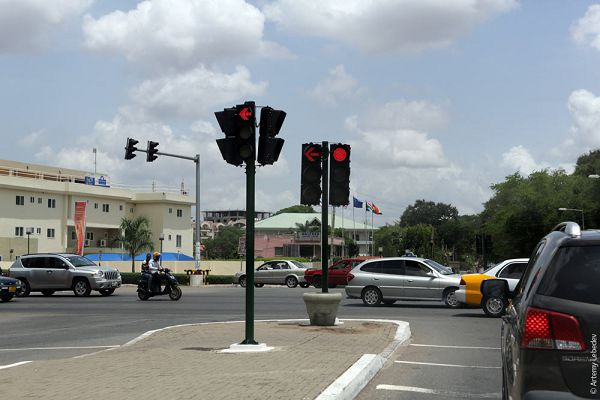
The Ghana Police Service has rescheduled the full implementation of its automated traffic law enforcement programme, TRAFFITECH-GH, from October 1 to November 1, 2026.
The Police Service, through the Motor Traffic and Transport Department (MTTD), announced the change in a press release dated September 29, 2026, signed on behalf of the Director-General of Public Affairs by Deputy Superintendent of Police Richmond Mensah, Staff Officer at the Public Affairs Directorate.
According to the Police, the decision to postpone the full rollout is intended to allow for more extensive public awareness and education on the TRAFFITECH-GH programme before its implementation.
The additional period will be used to educate motorists and other road users on how the system operates, the types of traffic offences it is designed to detect, and the Electronic Notices of Violation (ENV) that will be issued to motorists who are found to have committed offences.
TRAFFITECH-GH forms part of the Ghana Police Service’s broader efforts to address indiscipline on the country’s roads and improve compliance with road traffic laws and regulations.
The automated enforcement system is expected to support the Police in detecting traffic violations and enforcing road safety regulations through technology.
The Police Service has therefore urged motorists, drivers and vehicle owners to use the additional period before the November 1 rollout to familiarise themselves with the programme and understand its operations.
The Service said the extension would provide road users with more time to understand the offences that could be detected under the system and the procedures surrounding the issuance of Electronic Notices of Violation.
The Ghana Police Service also expressed appreciation to the media for what it described as its unflinching support throughout the introduction of the TRAFFITECH-GH project.
It reaffirmed its commitment to working with the media and other stakeholders to ensure the successful implementation of the programme as part of efforts to improve road safety in Ghana.
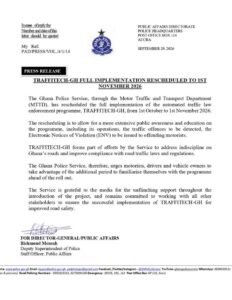
The Police Service said the full implementation of TRAFFITECH-GH will now commence on November 1, 2026, rather than the previously announced October 1 date.

A motorist who commits more than one traffic offence during the same incident could receive separate Electronic Notices of Violation under Ghana’s Traffitech-GH system.
The Ghana Police Service states that where more than one offence is recorded at the same time—for example, speeding and running a red light at the same intersection—each offence is recorded and processed separately.
The motorist would therefore receive a separate ENV and ticket number for each offence.
This means a single driving episode can potentially result in multiple enforcement records rather than one combined violation.
Traffitech-GH was developed by the Ghana Police Service as an automated road traffic enforcement system. It uses cameras and sensors to identify violations and automatically capture pictures and/or videos of offending vehicles.
The system is intended to increase compliance with road traffic laws and reduce road crashes, deaths and injuries.
The offences being monitored go beyond speeding and red-light violations.
The Police list expired roadworthiness certificates, wrongful overtaking, failure to use seatbelts, expired licences, driving uninsured vehicles and misuse of sirens among the offences that can be enforced under the system.
For insurance offences, drivers have a specific responsibility. The brochure says a driver is responsible for ensuring that the vehicle being driven has valid motor insurance, even if the driver does not own the vehicle.
Motorists can check insurance status by dialling 92057# followed by the vehicle registration number.
The system also applies broadly to vehicles using Ghana’s public roads.
The Police say Traffitech-GH covers private cars, motorcycles, tricycles such as aboboyaa, taxis, trotros, ride-hailing vehicles, haulage trucks and commercial buses.
However, the brochure says the system applies to Ghanaian-licensed drivers and locally registered vehicles, while offences involving foreign-registered vehicles are handled through separate procedures.
Company vehicles are also covered.
Where a vehicle is registered to a company, employer or organisation, the ENV is issued to the registered owner, with the company responsible for paying or contesting the violation within the stipulated period.
The enforcement process gives motorists 14 days to either settle a violation or begin a contest.
Those who choose to contest must start the process online. They cannot begin the contest procedure by simply walking into a GPS-MTTD or Judicial Service office.
After submitting the contest and selecting a preferred MTTD police station, the motorist will be contacted to arrange an appointment. Following the police-station stage, a court hearing will be scheduled.
If the motorist changes their mind during the contest process, they can pay the outstanding fine plus any accumulated late-payment penalty, which ends the contest process.
The multiple-ticket rule could therefore become particularly significant for motorists who commit several offences during a single journey, because each recorded offence is treated independently under the Traffitech-GH framework.
Motorists who assume that a traffic enforcement camera must be preceded by a warning sign before a violation can be enforced have been given a clear answer under the Traffitech-GH guidelines: the absence of a warning sign does not invalidate a traffic offence.
The Ghana Police Service’s Traffitech-GH brochure states that some road stretches and intersections have warning signs announcing enforcement activities or equipment, while others do not.
More significantly, the guidance says there is no legal obligation to announce MTTD-related traffic enforcement operations or equipment intended to improve road safety in Ghana.
This means motorists could encounter automated enforcement equipment without necessarily seeing a prior warning sign and still receive an Electronic Notice of Violation if they breach traffic regulations.
Traffitech-GH uses fixed, mobile or in-vehicle devices and laser speed-measurement equipment to detect offences. The system can capture speeding and red-light violations, with images and/or videos transmitted for validation before an ENV is issued.
The system also covers a wider range of offences, including expired roadworthiness certificates, wrongful overtaking, non-use of seatbelts, expired driving licences, driving uninsured vehicles and misuse of sirens.
Speed limits are also clearly outlined in the guidance.
The brochure states that, generally, highways have a speed limit of 90 km/h, motorways 100 km/h, urban or built-up areas 50 km/h, while a 30 km/h limit applies within areas such as schools, playgrounds, health facilities, churches, mosques, markets, shopping centres, processions and locations where human activity is predominant.
The Police guidance says licensed drivers are expected to know these limits whether or not a speed-limit sign is posted.
The red-light enforcement rule is equally strict.
According to the brochure, if the tyres of a vehicle cross the stop line after the traffic signal has turned red, the driver has committed a red-light offence.
A driver who believes the signal was still yellow at the precise moment the tyres crossed the stop line can review the video evidence and contest the violation within 14 days.
The controversial aspect is that motorists cannot rely simply on the absence of a camera-warning sign as a defence.
Instead, the Police direct drivers to use the evidence attached to their ticket. Motorists can enter their ticket number on Ghana.gov.gh and access the photo or video evidence and other violation data.
Access to the evidence is restricted to the vehicle owner or driver, authorised MTTD officers, back-office validation staff and the courts.
The enforcement system therefore places greater responsibility on drivers to know the applicable traffic rules rather than relying on warnings about enforcement equipment.

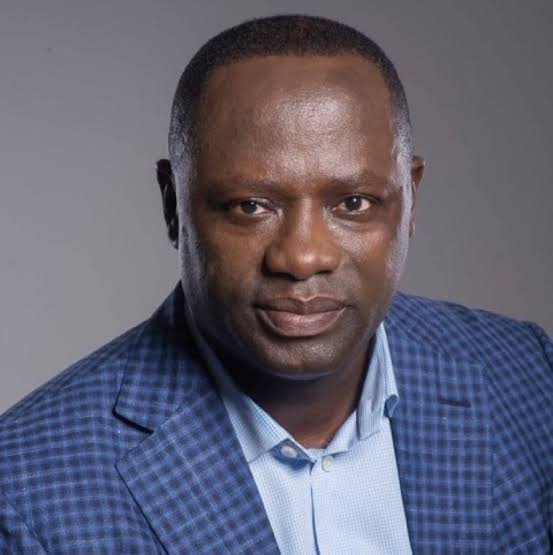
The Ministry of Lands and Natural Resources has taken note of reports and social media publications suggesting that the Minister for Lands and Natural Resources, Hon. Emmanuel Armah-Kofi Buah, MP, has resigned from the Board of the Ghana Gold Board (GoldBod).
The Ministry wishes to state categorically that the reports are false and do not reflect the facts.
Hon. Emmanuel Armah-Kofi Buah has not resigned from GoldBod, nor has there been any disagreement between him and the Ghana Gold Board.
The Minister, who initially served personally on the GoldBod Board, subsequently nominated the Chief Director of the Ministry, Mr. Marcus Haligah, to represent him on the Board in January 2026.
This decision was purely administrative and was necessitated by the Minister’s demanding schedule and the extensive responsibilities associated with his portfolio.
At the time, Hon. Armah-Kofi Buah was handling responsibilities across two Ministries, making it increasingly difficult for him to personally attend all Board meetings and engagements of GoldBod.
He therefore exercised the appropriate institutional arrangement by designating the Chief Director, a senior official of the Ministry, to represent him.
This arrangement is consistent with the governance framework of GoldBod, which permits designated representatives to serve on the Board on behalf of members where applicable.
The recent clarification by GoldBod itself confirms that the Minister initially served on the Board personally but, due to his busy schedule and inability to attend Board meetings regularly nominated the Chief Director to represent him.
The Ministry therefore urges the public, media organisations and other stakeholders to disregard reports suggesting that the Minister resigned from GoldBod or that his decision was connected to any disagreement, conflict or dissatisfaction with the institution.
The ministry enjoys a good working relationship with GoldBod.
The Ghana Geological Survey Authoriy (GGSA) has signed a Memorandum of Understanding (MoU) with GoldBod to intensify exploration of mining activities The Responsible Corporative Mining (rCOMSDEP) is equally working with the Godbod on responsible mining.
GoldBod is working with The Forestry Commission (FC) on land reclamation and has supported NAIMOS with vehicles as part of our collaborative efforts.
Hon. Emmanuel Armah-Kofi Buah therefore remains committed to the Government’s agenda of strengthening Ghana’s gold sector, increasing local value retention, promoting responsible mining and ensuring that the country’s mineral resources contribute meaningfully to national development.
The Ministry further encourages the public and the media to rely on official communications from the Ministry of Lands and Natural Resources and the Ghana Gold Board on matters concerning the governance and operations of GoldBod.
Motorists who receive Electronic Notices of Violation (ENVs) through Ghana’s new Traffitech-GH system have 14 days to pay or contest the violation, but failure to act within that period comes with an additional financial penalty.
The Ghana Police Service says a late-payment penalty of 1% of the original fine is added for every day of default after the 14-day payment period.
The rule is one of the most significant financial consequences contained in the Traffitech-GH enforcement guidelines, particularly for motorists who ignore an electronic notice or fail to resolve a disputed violation on time.
Traffitech-GH is an automated traffic enforcement system developed by the Ghana Police Service to enforce road traffic laws. Cameras and sensors capture images and/or videos of offences, including speeding and red-light violations.
Other offences covered include expired roadworthiness certificates, wrongful overtaking, failure to use seatbelts, use of an expired driving licence, driving an uninsured vehicle and misuse of sirens.
Once an offence has been reviewed, the vehicle owner receives an ENV by SMS. The notice contains important information including the ticket number, location, date and time of the offence, vehicle registration number, description of the alleged offence, amount payable and payment deadline.
Motorists have two main options after receiving the notice: pay within 14 days through an approved channel or contest the violation online within the same period.
Payments are to be made through Ghana’s official government platform, [www.ghana.gov.gh](http://www.ghana.gov.gh), using mobile money or a debit or credit card. Motorists can also dial *222#, select option 6 and follow the prompts.
The financial consequences do not end with the daily penalty.
The Traffitech-GH guidelines state that outstanding fines can also affect a motorist’s dealings with the DVLA. A person with an outstanding Traffitech-GH fine may be prevented from accessing certain DVLA services until the debt is cleared.
The Police guidance says DVLA will not renew a driver’s licence or transfer, register, re-register, lay off or inspect a vehicle for roadworthiness while an outstanding Traffitech-GH fine remains unpaid.
For motorists who receive multiple violations, each offence is treated as a separate offence record with its own ticket number, and all outstanding fines must be cleared before DVLA services are restored.
The system also allows motorists to check outstanding fines by dialling *220#.
The 1% daily penalty is therefore only one part of the enforcement mechanism. The combination of accumulating penalties and possible restrictions on DVLA transactions could create significant financial and administrative consequences for motorists who fail to resolve their cases within the stipulated period.
However, motorists who genuinely dispute a violation are given a 14-day window to begin the contest process. The Police advise drivers to first review the photographic or video evidence before deciding whether to pay or contest the notice.

Bagbin cautions against using free speech to justify online threats and misinformation

TRAFFITECH-GH Full Rollout Moved to November 1

Speeding and Running a Red Light? Traffitech-GH Can Issue Separate Tickets



-

 General News1 week ago
Two political parties, one lesson: Afuntummireku and Tikro Nkɔ Agyina for Ghana
-

 Culinary1 week ago
Kofi Brokeman: The Simple Ghanaian Snack That Has Stood the Test of Time
-

 General News7 days ago
Free Speech, False Publication and Presidential Criticism in Ghana: Where Does the Law Draw the Line?
-

 General News1 week ago
Rev. Dr. Christian Kwetey Kweitsu Set for International Recognition at 100 Most Influential Persons Awards in Kigali
-
 General News2 weeks ago
Bost Energies Made GH¢684 Million Profit: Why Use The NPA Bill, 2026 To Weaken Its Operations?
-

 Entertainment1 week ago
Can’t Anything Good Come Out of Ghana? – Ras Caleb Appiah-Levi Fires Back at Critics
-

 General News7 days ago
Don’t Expect Concerts When People Can’t Afford Food – Rex Omar on Black Star Experience
-

 General News1 week ago
Shatta Wale Urges UPSA Students to Turn Ideas into Sustainable Ventures