
Entertainment
Minister for Tourism Launches 2026 EU Film Festival Ghana

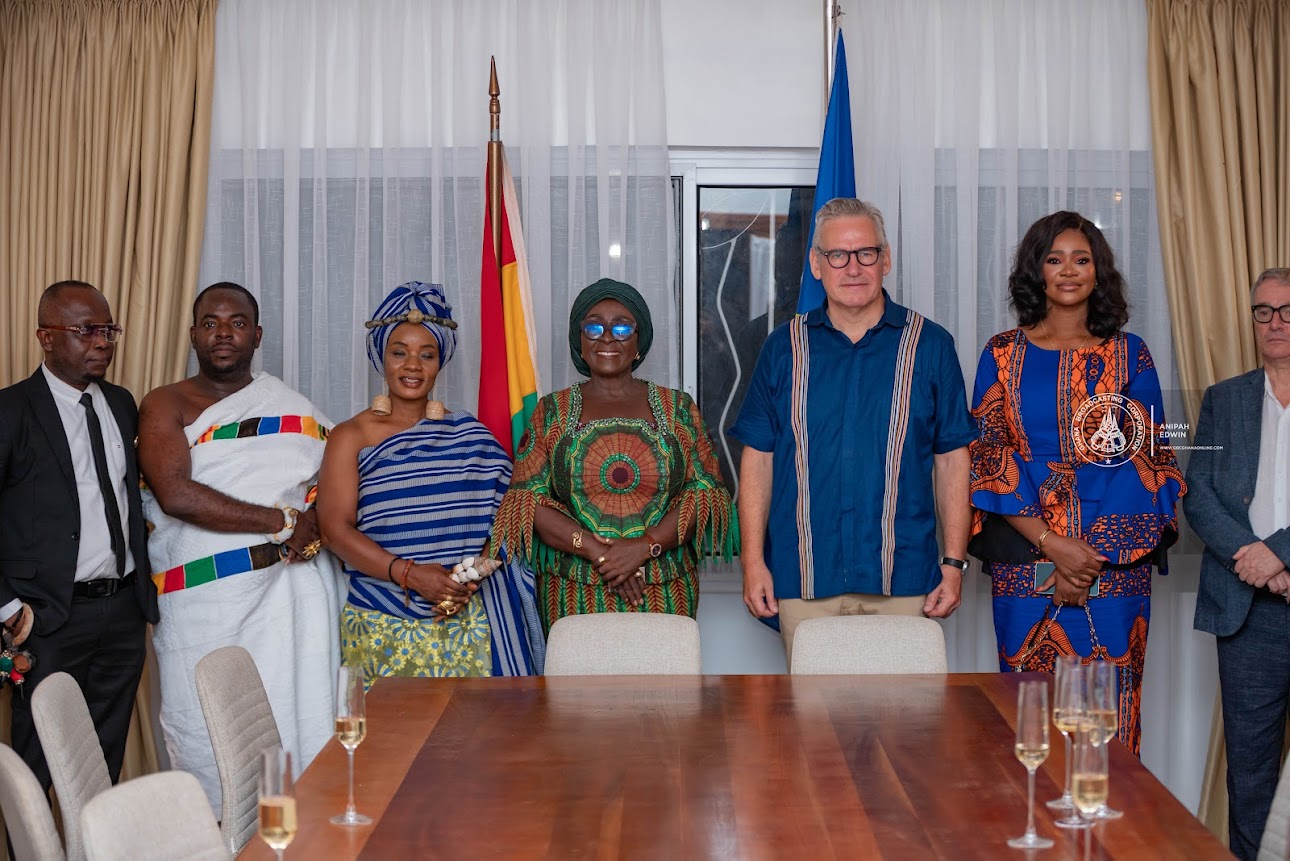
The Minister for Tourism, Culture and Creative Arts, Abla Dzifa Gomashie, has launched the European Union Film Festival Ghana 2026, describing the initiative as more than a film festival but a celebration of culture, creativity, dialogue and friendship between Ghana and the European Union.
The launch ceremony, held in Accra on Monday, October 5, 2026, brought together members of the diplomatic corps, EU Ambassador to Ghana, His Excellency Rune Skinnebach, Chief Executive Officer of the National Film Authority, Kafui Danku, filmmakers, creative industry practitioners and stakeholders in the tourism and cultural sectors.
Addressing guests at the ceremony, Abla Gomashie said the growing global recognition of the role of culture and creative industries in national development makes such partnerships particularly important for Ghana.
“Tonight’s gathering, in addition to being the opening of a film festival, is also a celebration of a beautiful culture, creativity, dialogue, and friendship between Ghana and the European Union,” she said.
According to the Minister, Ghana’s culture remains one of the country’s greatest national assets, contributing significantly to national identity, employment, entrepreneurship, tourism and international engagement.
“Our culture is one of our greatest national assets and contributes not only to our national identity, but also to employment, entrepreneurship, tourism, and international engagement. Creative industries provide opportunities for many people and especially our young people to develop their talents and participate meaningfully in the economy,” she stated.
She stressed the importance of partnerships in developing Ghana’s creative sector, particularly collaboration between government and industry, Ghana and other countries, as well as local creative communities and international partners.
The Minister said the government’s responsibility is to create an enabling environment where talent and opportunities can thrive, adding that the government, under the leadership of President John Dramani Mahama, is working towards that objective with the support of stakeholders and development partners such as the European Union.
She welcomed the growing cultural and creative cooperation between Ghana and the EU, noting that the partnership could open up opportunities for co-productions, capacity building, knowledge exchange, technology transfer, cultural dialogue and increased access to international markets for Ghanaian creative works.
“There are opportunities for co-productions, capacity building, knowledge exchanges, technology transfer, cultural dialogue, and greater access to circulation of Ghanaian creative works to international markets. We are not in short supply of talents. What we are in short supply of are opportunities for these talents to be shared with the world. And I’m grateful that the European Union is taking the lead and creating a platform,” she added.
Abla Gomashie said the EU Film Festival would bring together different cinematic traditions while demonstrating how film can serve as a bridge between societies and cultures.
She also highlighted the European Union’s support for the revision of Ghana’s Cultural Policy, which she presented during the event.
“The revised Cultural Policy of Ghana provides an important framework for strengthening Ghana’s cultural sector and positioning culture and creativity more firmly within our national development agenda,” she noted.
The Minister further expressed appreciation to the EU for its commitment under the Sankofa II project to support the national sensitisation and dissemination of the revised Cultural Policy.
“This is especially important because a policy becomes meaningful when its vision, objectives, and opportunities are understood and embraced by the people who are expected to implement and benefit from it. We therefore look forward to working closely with the European Union and other partners as we take the policy to stakeholders across the country,” she said.
Encouraging Ghanaian filmmakers to take advantage of the opportunities available to them, the Minister urged them to tell their stories boldly and authentically, reflecting Ghanaian realities while connecting with audiences across Africa, the diaspora and the wider world.
“Remember, we have the opportunity to tell the story from our perspective. I urge you to recall the adage that says, until the lion learns to tell its own story, the tale of the hunt will always glorify the hunter,” she said.
She assured creative industry practitioners that government would continue engaging stakeholders to identify barriers affecting the sector and develop practical interventions to unlock new opportunities.
The Minister thanked the European Union for the initiative and expressed hope that the films screened during the festival would remind audiences that despite differences in culture and background, the ability to dream, create, tell stories and connect remains universal.
The EU Film Festival Ghana 2026 is expected to feature a selection of European and Ghanaian films over several days, creating opportunities for cultural exchange, networking and collaboration among filmmakers and creative industry practitioners.
Source: GBC









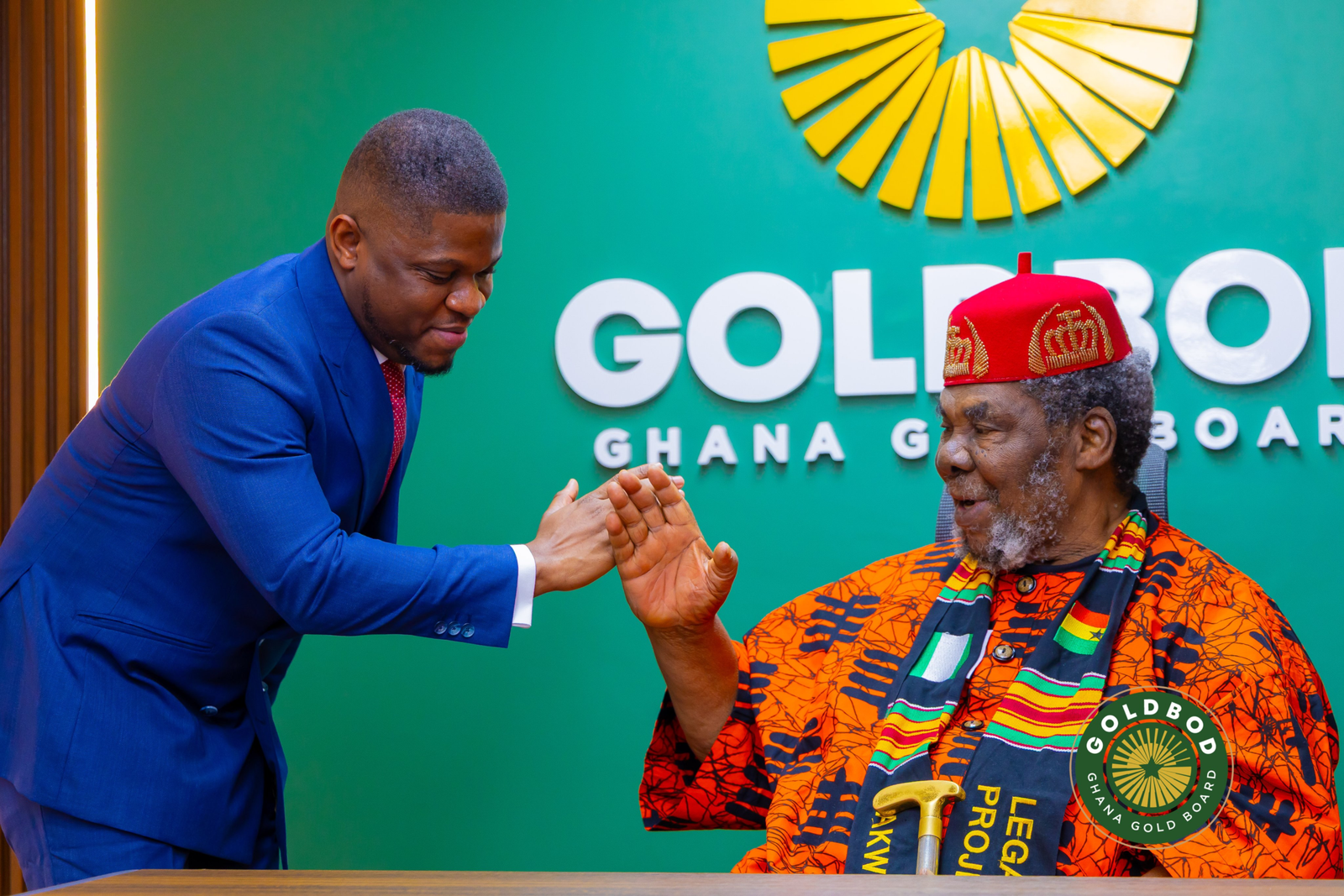
Veteran Nigerian actor and African screen legend Pete Edochie has paid a courtesy call on the Chief Executive Officer of the Ghana Gold Board (GoldBod), Sammy Gyamfi, during his visit to Ghana for the launch of his African Legacy Project.
The meeting formed part of Edochie’s engagements in Ghana as he officially introduces the project, which is designed to preserve his legacy while creating opportunities for young Africans to learn from the experiences of accomplished personalities
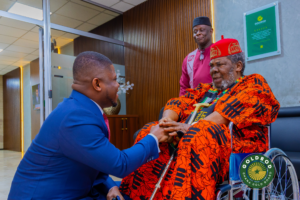
The African Legacy Project comprises a book, a documentary film and an African Youth Mentorship Initiative targeted at reaching approximately 500,000 young people across Africa.
The mentorship component is intended to expose young people to knowledge, guidance and experiences that can help them develop their potential and make meaningful contributions to society.
During the courtesy call, Sammy Gyamfi welcomed the opportunity for GoldBod to support the youth mentorship initiative, describing it as an undertaking that aligns with the Board’s broader social-impact agenda.
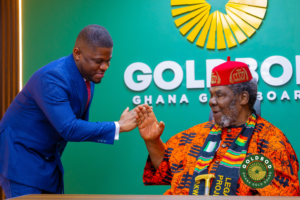
GoldBod’s Special Intervention Programme (SIP) is focused on supporting communities and individuals through interventions designed to improve livelihoods and contribute to social and economic empowerment. The Board has previously highlighted the programme as an important part of its efforts to ensure that the benefits of its operations extend beyond the gold-trading sector.
The proposed collaboration with Edochie’s mentorship initiative therefore creates an opportunity for GoldBod to extend its social-impact work into youth development and mentorship on a continental scale.
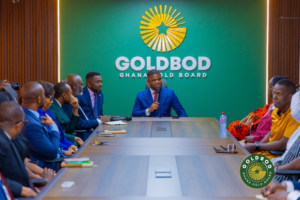
The meeting also had a strong connection to the themes explored in Edochie’s new book. GoldBod’s work is referenced in the publication, particularly in relation to Ghana’s efforts to ensure that the country derives greater value from its gold resources and uses its mineral wealth to support national development.
GoldBod has positioned itself as the institution responsible for the buying, selling, weighing, grading, assaying, valuation and export of gold and other precious minerals in Ghana. It has also placed emphasis on value addition, responsible sourcing and retaining greater value from the country’s mineral resources.
The inclusion of GoldBod in Edochie’s book reflects the wider African conversation about how countries can better manage their natural resources and ensure that mineral wealth contributes to economic transformation.
Edochie’s visit to Ghana comes as his Legacy Project brings together entertainment, culture, mentorship and African development. The project was formally unveiled in Ghana on October 4, 2026, with personalities from Ghana’s creative and public sectors participating in the celebration
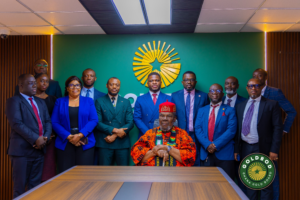
The actor, widely recognised for his decades-long contribution to African film and television, has used the project to emphasise the importance of preserving the knowledge and experiences of Africa’s pioneering figures while deliberately transferring that knowledge to younger generations.
The engagement with GoldBod consequently adds an economic and youth-development dimension to the project, linking Edochie’s legacy and mentorship vision with Ghana’s efforts to maximise the social and economic benefits of its natural resources.
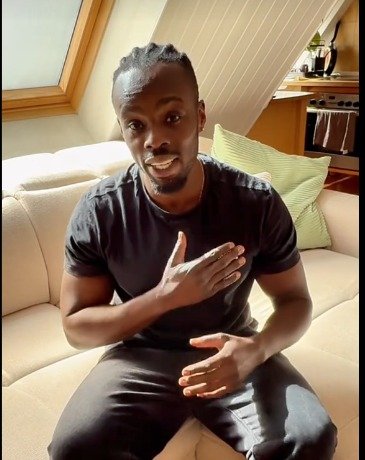
Calvin Fosu, son of the late highlife legend Daddy Lumba, has announced a special legacy concert following his father’s passing.
The concert, scheduled for December 19, 2026, will be held at the University of Professional Studies, Accra (UPSA), and will bring together family, friends and fans of the legendary musician to celebrate his life and enduring contribution to Ghanaian music.
In a video shared on his TikTok page, Calvin invited Ghanaians and Daddy Lumba’s fans to join the family for the special memorial event.
According to him, the concert will be dedicated to celebrating the life, legacy and timeless music of his father, Charles Kwadwo Fosu, popularly known as Daddy Lumba.
“On the 19th of December, I plead with you all to come and support us on behalf of our late father, Charles Kwadwo Fosu, also known as Daddy Lumba, to celebrate his one-year memorial at UPSA,” Calvin said.
He described the event as a night that will bring together music, celebration and cherished memories as the family and fans honour the highlife icon.
“This will be an unforgettable night of music, celebrations and memories as we honour the life, legacy and timeless music of our legend,” he added.
Daddy Lumba, whose career spanned several decades, remains one of Ghana’s most influential highlife musicians, with a catalogue of songs that continues to resonate with generations of music lovers.
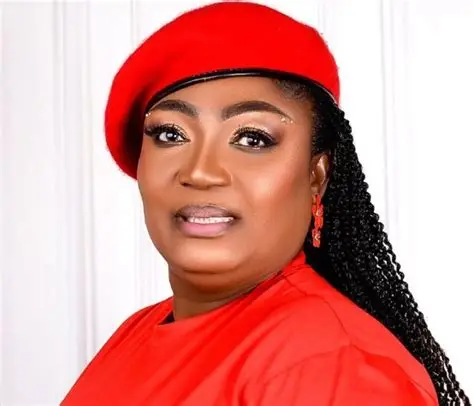
Veteran Ghanaian actress Irene Opare has appealed to parents to pay greater attention to their children’s safety, especially when work and other daily responsibilities keep them away from home.
The actress appealed in a video shared on her Instagram page after she encountered three children while driving.
According to the actress, she spotted a boy who appeared to be about seven years old walking along a busy road with two younger children, believed to be around two or three years old.
She suspected that the older boy had gone to pick up the younger children from school and was taking them home.
The sight of the children walking along the roadside without an adult reportedly concerned Irene, particularly because of the heavy traffic and the number of vehicles using the road.
She said she stopped her car and approached the children to find out where they were going.
Although she was worried about their safety, Irene explained that she could not simply put them in her vehicle and drive them home because of the risks involved in giving a lift to children whose parents she did not know.
The incident, she said, reminded her of the need for parents to remain actively involved in their children’s lives, even as they work hard to provide for their families.
Irene acknowledged that the current economic situation forces many parents to work and hustle to make ends meet. However, she stressed that parents must also make deliberate arrangements to ensure their children are properly supervised and protected.
She urged parents to check on their children before leaving for work and, where possible, arrange for younger children to be picked up from school by trusted adults.
“Please, let’s keep an eye on our children. Parents, I beg you. If you can’t pick them up, get someone older to do so. Please, let’s do this,” she appealed.
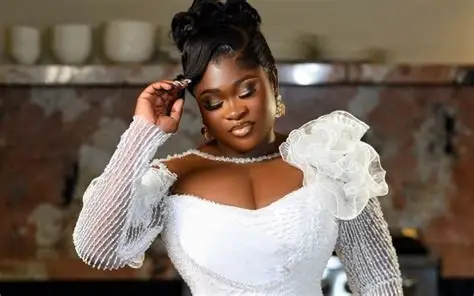
Ghanaian musician Sista Afia has expressed support for fashion icon Nana Akua Addo following reports of an alleged assault involving the model and her husband.
In a post on X on October 6, 2026, Sista Afia said she was deeply moved by the reports, noting that she could relate to the emotional pain Nana Akua Addo may be experiencing because she had also gone through a similar situation.
The musician prayed for Nana Akua Addo to find the strength and courage to rediscover herself, while assuring her that people were quietly rooting for her.
“I genuinely admire you, and seeing what you’re going through touched me deeply. I understand that kind of pain because I’ve been there too, and I know the emotional weight that comes with it,” she wrote.
“I pray God gives you the strength and courage to rediscover yourself. You deserve peace, love, and so much more. Please know that someone out here is quietly rooting for you.”
Sista Afia’s message comes amid the circulation of videos purportedly showing Nana Akua Addo involved in a heated confrontation with members of her husband’s family.
Other videos circulating online also appear to show the fashion icon being physically assaulted by her husband.
The reports have sparked conversations on social media, with several people expressing concern for Nana Akua Addo and calling for support for her amid the alleged incident.
Sista Afia, while offering her words of encouragement, appeared to draw from her own experience to empathise with Nana Akua Addo and remind her that she deserves peace and love.
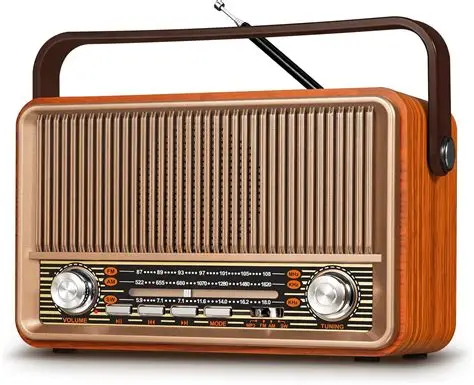
There was a time when radio was more than something playing in the background.
For many Ghanaians, radio was the first thing switched on in the morning, the companion during long journeys, the source of music at home and the place where people went for advice, entertainment, news and sometimes even romance.
Before social media notifications, podcasts and streaming platforms competed for attention, radio programmes had their own loyal communities.
People knew the presenters by voice. They knew the opening jingles. They knew the exact time their favourite programme would begin. Some listeners even organised their daily routines around particular shows.
Today, many of those programmes have disappeared, changed names, moved to different stations or simply been forgotten.
But their influence remains.
When radio programmes had identities
Older generations of Ghanaian radio listeners will remember that programmes were often identified by their presenters, opening lines, theme songs and unique styles.
A programme did not necessarily need a celebrity guest or viral controversy to attract listeners.
Sometimes, the strength was simply the relationship between the presenter and the audience.
Listeners could call into the studio, send messages or visit the station. Radio therefore created something that today’s digital platforms sometimes struggle to reproduce—a feeling that the presenter actually knew the audience.
A familiar voice could become part of someone’s everyday life.
The morning shows that started the day
Morning radio was once almost a ritual.
Families preparing for work and school, traders opening their shops, drivers beginning their journeys and workers getting ready for the day could all have the radio playing.
The presenter was not simply reading headlines.
There were discussions, phone-ins, jokes, music, announcements and conversations about issues affecting ordinary people.
For some listeners, missing the morning programme meant missing the biggest conversation of the day.
Today, morning radio remains powerful, but the way audiences consume it has changed. Many listeners now follow programmes through Facebook, YouTube, TikTok clips and podcasts rather than sitting beside a radio set for the entire programme.
The relationship programmes people secretly listened to
One category that deserves to be remembered is the old relationship and advice programme.
Before relationship content became a major social-media industry, radio was already giving Ghanaians a platform to discuss love, marriage, family problems and heartbreak.
People called in with questions they might never have asked their friends.
Some callers used aliases. Others changed details about their stories.
The presenter often became an unofficial counsellor, while listeners became a kind of invisible audience jury.
A story could generate arguments in homes, workplaces and commercial vehicles long after the programme had ended.
Music programmes were more than music.
Ghana’s old radio music programmes also played an important role in preserving musical culture.
Before Spotify, Apple Music and YouTube made almost every song searchable, radio was one of the easiest ways to discover music.
A presenter could introduce an unfamiliar musician, explain the song and give an emerging artiste an opportunity to reach thousands of listeners.
Some programmes also specialised in particular genres, eras or audiences.
Highlife, gospel, hiplife, reggae, traditional music and foreign music all had their spaces.
For young musicians, getting their song played on a popular radio programme could be a breakthrough.
The programmes that connected communities
Some radio programmes were essentially community noticeboards.
Birth announcements, funeral announcements, missing-person notices, job opportunities, community disputes, fundraising appeals and public service information could all find their way onto radio.
In areas where internet access was limited, radio could reach people who had little connection to the digital world.
This made the medium particularly important outside major cities.
A programme could become part of the social infrastructure of a community.
When presenters became household names
One of the biggest differences between old radio culture and today’s media environment was the strength of the radio personality.
Listeners sometimes recognised a presenter without seeing their face.
The voice was enough.
A presenter’s pronunciation, humour, catchphrases and interviewing style could become part of popular culture.
Some presenters were able to move between radio and television, while others remained almost entirely associated with the station and programme that made them famous.
Their departure could therefore feel personal to listeners.
When a beloved presenter left, audiences did not simply lose a programme.
They lost a familiar voice.
Where did the programmes go?
So why have so many memorable programmes disappeared?
The answer is not always that radio has become worse.
The industry itself has changed.
Radio stations now compete with social media, YouTube, podcasts, streaming services and online news platforms for the same audience.
Programmes are redesigned to generate short clips that can travel online.
Presenters are increasingly expected to become content creators.
A two-hour conversation on radio can now be broken into several TikTok, Facebook, Instagram or YouTube clips.
This has changed the structure of programming.
The old programme that depended almost entirely on people sitting beside their radios at a particular hour has become more difficult to sustain.
But should old radio programmes really disappear?
Not necessarily.
Some old programmes contained something that is difficult to measure in ratings—the memory of a generation.
Ask older Ghanaians about their favourite radio programme from 20 or 30 years ago, and many will immediately remember the presenter, the station, the time it aired and even where they were when they listened.
That is cultural memory.
Yet there is no comprehensive public archive of many of these programmes.
Some recordings have disappeared.
Old jingles are sitting on forgotten cassettes.
Programme names survive only in people’s memories.
And some presenters who once had enormous audiences have never had their work properly documented.
The radio archive Ghana may be losing
This raises an important question: What happens when a country’s broadcasting history exists mainly in people’s memories?
Ghana has produced generations of influential broadcasters, producers, DJs, newsreaders and radio personalities.
Their work helped shape how people spoke, debated politics, discovered music and understood popular culture.
But much of that history remains scattered.
Old recordings may be sitting in personal collections, station archives, cassette tapes or nowhere at all.
A young Ghanaian today can easily find international radio history online.
Finding recordings of some of Ghana’s own influential programmes can be much harder.
Perhaps it is time to bring them back
Reviving old radio programmes does not necessarily mean returning to the exact format of the past.
A station could bring back a popular programme as a weekly nostalgia show.
Former presenters could return for special editions.
Old jingles could be restored.
Listeners could submit memories and recordings.
Broadcasters could interview former producers and presenters about how the programmes were created.
And some of these programmes could be converted into podcasts so that their stories survive beyond traditional radio.
The goal would not simply be to recreate the past.
It would be to preserve Ghana’s broadcasting heritage.
Because radio was once one of the most powerful cultural forces in Ghana.
Before the era of podcasts, livestreams, and viral clips, programmes were there that millions of people quietly built their daily lives around.
Some are gone, and some have been forgotten.
But the voices that shaped those programmes—and the memories they created—are still worth finding.
The question is: which Ghanaian radio programme do you remember that you can no longer hear today?

Pete Edochie Pays Courtesy Call on GoldBod CEO Sammy Gyamfi

Calvin Fosu Announces December 19 Concert to Honour Daddy Lumba’s Legacy

Irene Opare raises alarm over children walking home without adult supervision



-
 General News2 weeks ago
Free Speech, False Publication and Presidential Criticism in Ghana: Where Does the Law Draw the Line?
-
 General News1 week ago
Fidelity Bank Chairman Named Ghana’s Topmost Transformational Board Chair 2026
-
 General News2 weeks ago
Don’t Expect Concerts When People Can’t Afford Food – Rex Omar on Black Star Experience
-
 Entertainment2 weeks ago
Ras Caleb assesses institutions under the Tourism Ministry, highlighting key roles.
-
 Entertainment2 weeks ago
Ras Caleb Appiah-Levi: The musician, Pan-Africanist and organiser whose career spans four decades
-

 Technology2 weeks ago
Rolls-Royce Expands Aviation Business with Major Philippine Airlines Engine Agreement
-

 Entertainment2 weeks ago
Kojo Preko Dankwa calls for investigation into GTA’s World Cup visa affairs
-

 Culinary2 weeks ago
Koobi: The Unsung Hero Behind the Distinctive Taste of Ghanaian Food