
General News
IMANI Questions GSA’s 15-Year Vehicle Import Ban, Calls for Safety-Based Regulation


IMANI Center for Policy & Education has raised concerns over the Ghana Standards Authority’s decision to restrict the importation of used vehicles that are more than 15 years old, arguing that vehicle safety should be determined primarily by roadworthiness and condition rather than age.
The policy, expected to take effect from October 1 under the GS 4510:2022 conformity regime, has sparked debate over its legal basis, economic impact and implications for consumers and businesses within Ghana’s automotive sector.
IMANI said it supports stronger measures to prevent dangerous vehicles from entering the country, particularly vehicles that have been severely damaged by floods, fire or accidents, as well as those with compromised structural integrity.
However, the policy think tank questioned whether a blanket age restriction is the most effective way to achieve that objective.
According to IMANI, a vehicle that is 16 years old but has been properly maintained, has a sound chassis, functioning safety systems, good brakes and meets applicable emissions requirements should not automatically be classified as unsafe simply because of its age.
It argued that a newer vehicle could equally pose a greater danger if it has been poorly maintained, improperly repaired or structurally damaged.
The organisation therefore believes the focus should be on identifying actual safety defects rather than using the age of a vehicle as the decisive factor.
“Are we regulating danger or regulating birthdays?” IMANI asked, stressing that safety regulations should distinguish between genuinely hazardous vehicles and older vehicles that remain mechanically and structurally sound.
IMANI also questioned the legal foundation for the proposed restriction, pointing to the Customs (Amendment) Act, 2020, Act 1014.
The organisation noted that Section 154(3) of the Act gives the Finance Minister, in consultation with the Trade Minister, the authority to specify by Legislative Instrument when vehicles above a particular age may no longer be imported.
IMANI argued that if the government is now operating with a 15-year threshold, the relevant Legislative Instrument and the legal connection between the legislation and the GSA’s new rule should be clearly identified.
It maintained that an administrative announcement or policy presentation cannot replace subsidiary legislation required under an Act of Parliament.
The policy think tank also warned that the restriction could have significant consequences for businesses and workers across Ghana’s used vehicle industry.
The sector involves importers, clearing agents, mechanics, spare-parts dealers, transport operators, tyre sellers, auto electricians, bodywork specialists and other businesses that depend on the movement and maintenance of used vehicles.
IMANI cited concerns raised by the Vehicle and Assets Dealers Union of Ghana, whose President General, Bernard Ntrakwah, has expressed support for efforts by the GSA to sanitise the vehicle market and prevent unsafe cars from entering Ghana.
However, the union has raised reservations about a blanket 15-year prohibition and its possible effects on dealers, consumers and businesses connected to the automotive value chain.
IMANI said these concerns should not simply be dismissed as commercial interests seeking to protect profits.
The organisation further questioned how the policy would affect ordinary Ghanaians who rely on relatively inexpensive used vehicles.
According to IMANI, removing older vehicles from the market could reduce the supply of cheaper cars and make vehicle ownership more difficult for consumers who cannot afford newer models.
It warned that consumers do not automatically become wealthier when government raises the minimum age or standard for imported vehicles.
Instead, people who cannot afford newer cars may continue using vehicles they already own for longer periods.
IMANI said this could create an unintended consequence in which a policy intended to modernise Ghana’s vehicle fleet could encourage some motorists to keep much older vehicles on the road because replacement costs have become unaffordable.
IMANI also acknowledged the importance of supporting Ghana’s domestic automotive assembly industry but argued that such support should be based on measurable economic benefits.
It called for greater transparency on the number of vehicles assembled locally, the jobs created, the level of local content in assembled vehicles and the value of tax incentives provided to vehicle assemblers.
The organisation said these benefits should be compared with the potential loss of Customs revenue, businesses and employment across the used vehicle sector.
It argued that protecting local assembly should not automatically mean weakening competition or imposing costs on consumers without clear evidence of the wider economic gains.
IMANI also raised concerns about the implementation of the Pre-Export Verification of Conformity (PVoC) system.
Under the arrangement, importers may be required to obtain certification from approved inspection companies before vehicles are shipped to Ghana.
IMANI said government should provide clarity on the companies responsible for inspections, how they were selected, the fees they charge, the mechanisms for auditing their operations and the process available to importers who want to challenge an inspection decision.
The organisation warned that mandatory certification could create additional costs for importers if the system is not sufficiently transparent and accountable.
Despite its opposition to what it considers a blanket age-based restriction, IMANI stressed that it is not against tighter vehicle safety regulations.
It said Ghana should continue to prevent the importation of flood-damaged vehicles, fire-damaged wrecks and cars with compromised chassis or fraudulent structural modifications.
It also advocated stronger verification of vehicle histories, tougher emissions requirements and rigorous roadworthiness inspections.
However, IMANI maintained that an older vehicle that passes comprehensive structural, mechanical, emissions and history checks should not automatically be rejected solely because of its age.
The organisation argued that the government should develop a regulatory framework that targets genuine safety risks while protecting consumers and legitimate businesses.
IMANI said Ghana should not be forced to choose between becoming a dumping ground for unsafe vehicles and making vehicle ownership unaffordable for ordinary citizens.
It called for a balanced approach that considers the legality of the restriction, the evidence supporting it, its economic consequences and the burden it places on consumers.
For IMANI, the fundamental principle should be straightforward: “A good vehicle policy should punish defects, not dates.”
The organisation said the government must demonstrate why age alone should determine whether an otherwise roadworthy vehicle is allowed into Ghana.
It therefore returned to its central question: if a vehicle is mechanically sound, structurally safe, emissions compliant and properly maintained, should it be rejected solely because it has crossed the 15-year threshold?
For IMANI, the answer requires government to demonstrate that the policy is not merely regulating the age of vehicles, but is genuinely addressing the safety risks associated with vehicle imports.
Source: IMANI
General News
Nkwanta South Citizen Calls for Transparency Over Distribution of Two Trucks of Fertilizer
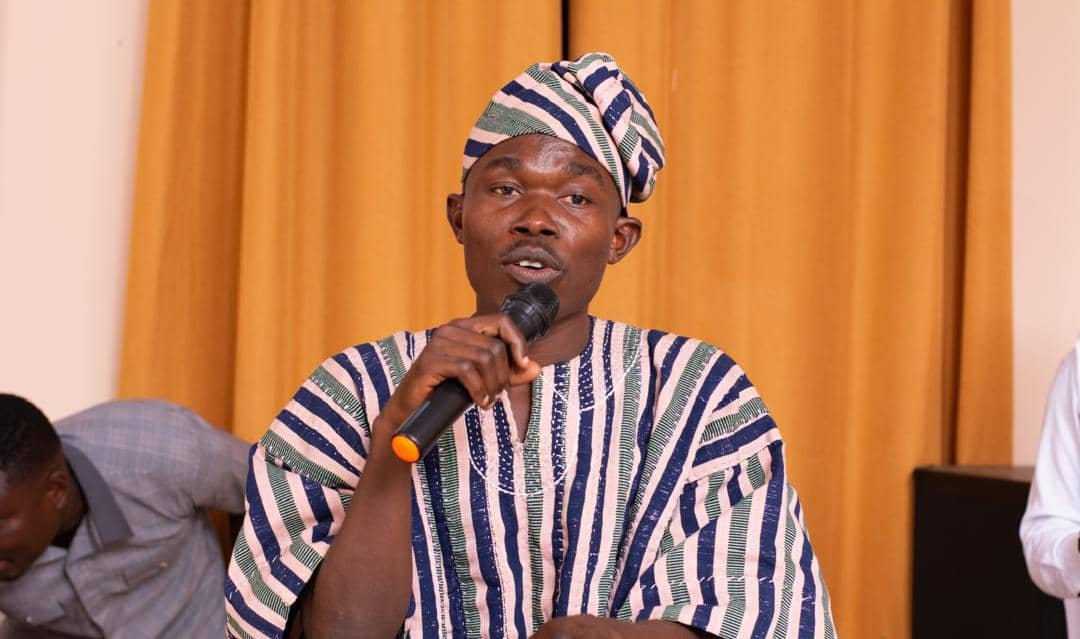
A concerned citizen of the Nkwanta South Municipality, Stephen Obikyenbi Junior, has called on the Municipal Chief Executive (MCE) and the Member of Parliament (MP) for the area to clarify the status of two trucks of fertiliser reportedly supplied for distribution to farmers.
In an open letter addressed to the two officials, Mr Obikyenbi expressed concern over reports surrounding the fertiliser consignment and urged authorities to ensure that the inputs reach the intended beneficiaries without unnecessary delay.
According to him, farmer groups in Nkwanta South have traditionally been called upon to take delivery of fertilisers whenever such agricultural inputs are supplied to support farming activities.
He noted that the timing of the consignment was particularly important because farmers are currently in the farming season and urgently require fertiliser to improve crop yields and protect their livelihoods.
Mr Obikyenbi said he had been informed that when the two trucks arrived in Nkwanta, they could not proceed to the Municipal Agriculture Office because of the condition of the bridge. As a result, the Nkwanta South Municipal Assembly reportedly took delivery of the fertiliser.
However, he raised concern over information circulating that the MP had allegedly instructed that the fertilizer should not be distributed to farmers.
He called on the MCE and MP to publicly clarify the allegation if it is untrue, and, if such an instruction had indeed been issued, explain the reasons behind it.
“These fertilisers are not party property. They are meant to support farmers whose livelihoods depend on agriculture,” Mr Obikyenbi stated.
He argued that farmers are already struggling with the high cost of agricultural inputs and other challenges affecting production, warning that delays in distributing the fertiliser could negatively affect their crops and livelihoods.
The concerned citizen also referred to allegations that the fertiliser was being withheld for possible use during internal party elections. He said he hoped the allegation was not true and stressed that agricultural inputs meant for farmers should not be used as instruments of political patronage or party competition.
Mr Obikyenbi further maintained that farmers should not suffer because of political disagreements or internal party elections.
He said the distribution should be transparent and fair, regardless of whether a farmer supports the NPP, NDC, another political party, or has no political affiliation.
He therefore called on the Municipal Chief Executive and the Member of Parliament to:
Publicly clarify the status of the two trucks of fertilizer currently in the custody of the Municipal Assembly.
Explain whether any instruction has been given to delay or prevent their distribution.
Ensure that the fertiliser is distributed to the intended farmer groups without unnecessary delay.
Guarantee transparency and fairness in the distribution process.
Keep partisan politics out of agricultural inputs intended to support farmers’ livelihoods.
Mr Obikyenbi stressed that the matter should not be viewed primarily through a political lens, but rather as an issue affecting ordinary farmers who have invested their limited resources in agriculture and are waiting for the critical input.
He warned that the timing of fertiliser application is crucial and that any unnecessary delay could affect crop performance and, ultimately, farmers’ incomes.
He concluded by appealing to both the MCE and MP to put the interests of farmers and residents of Nkwanta South above political considerations.

“Nkwanta South deserves transparency. Our farmers deserve fairness. Our farmers deserve their fertiliser,” he said.
The open letter was signed by Stephen Obikyenbi Junior as a Concerned Citizen of the Nkwanta South Municipality.

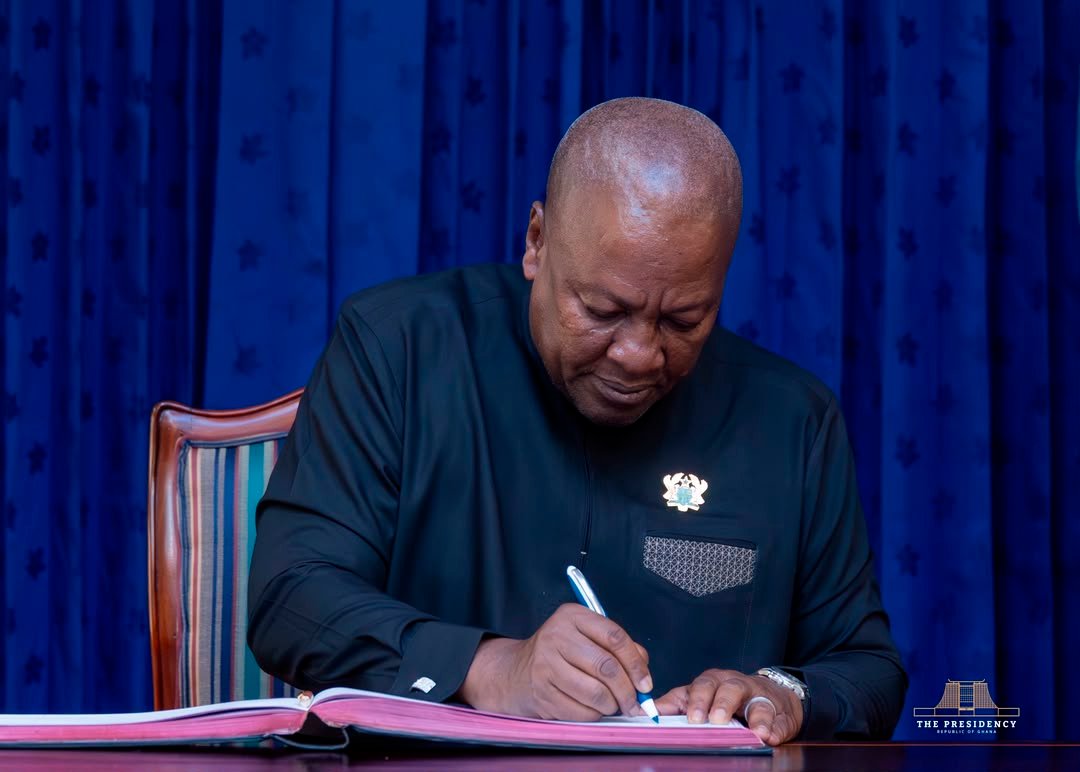
President John Dramani Mahama has announced further changes to his government, reassigning three officials to new roles with immediate effect.
Under the latest changes, the Minister for Labour, Employment and Job Creation, Hon. Abdul-Rashid Pelpuo, has been reassigned as Minister of State for Special Initiatives.
He will be replaced at the Labour Ministry by Hon. Emmanuel Kwadwo Agyekum, who will now serve as Minister for Labour, Employment and Job Creation.
The President has also reassigned the Deputy Minister for Defence, Hon. Ernest Brogya Genfi, to serve as Presidential Advisor on National Resilience and Emergency Preparedness.
The latest changes form part of President Mahama’s efforts to realign responsibilities within his administration and strengthen the delivery of government’s priorities.
The reassignments take immediate effect.
The announcement was contained in a statement issued by Felix Kwakye Ofosu, MP, Spokesperson to the President and Minister for Government Communications.
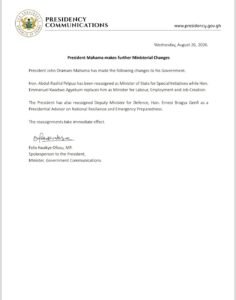
President John Dramani Mahama has assented to 10 Bills passed by Parliament during the Second Meeting of the Second Session of the Ninth Parliament, formally turning them into law.
The legislation covers key areas including taxation, revenue mobilisation, justice administration, national defence, maritime regulation and the cocoa sector.
The 10 Bills were among 12 pieces of legislation approved by Parliament during the meeting, which ended on July 31, 2026.
Following the President’s assent, the relevant institutions and agencies can now proceed with the implementation and enforcement of the new laws.
The newly enacted laws are:
Customs Act, 2026
Community Service Act, 2026
Tribunals Act, 2026
Maritime and Related Offences Act, 2026
National Defence University, Ghana Act, 2026
Income Tax (Amendment) Act, 2026
Energy Sector Levies (Amendment) Act, 2026
Ghana Cocoa Board Act, 2026
Value Added Tax (Amendment) Act, 2026
Excise Act, 2026
The new laws are expected to shape government revenue mobilisation, taxation, customs administration, trade, justice delivery, national security and the regulation of the cocoa and maritime sectors.
Changes in Taxation and Revenue
The Income Tax (Amendment) Act, 2026, Value Added Tax (Amendment) Act, 2026, Excise Act, 2026, and Energy Sector Levies (Amendment) Act, 2026 introduce changes to Ghana’s tax and revenue framework.
These measures are intended to strengthen revenue collection and provide a revised legal framework for the administration of various taxes and levies.
Customs and Trade
The Customs Act, 2026 provides a new legislative framework for customs administration and is expected to affect the management of imports, exports and related trade procedures.
Justice Administration
The Community Service Act, 2026 establishes a legal framework for community service, while the Tribunals Act, 2026 provides for the operation and administration of tribunals in Ghana.
The measures are expected to contribute to reforms in the justice system and the handling of certain categories of cases.
Maritime Regulation and National Defence
The Maritime and Related Offences Act, 2026 strengthens the legal framework for dealing with offences connected to Ghana’s maritime space.
Meanwhile, the National Defence University, Ghana Act, 2026 provides the legal basis for the establishment and operation of the National Defence University, Ghana.
Cocoa Sector
The Ghana Cocoa Board Act, 2026 introduces a new legislative framework governing the Ghana Cocoa Board and the administration of the country’s cocoa sector.
With presidential assent now granted, the 10 laws have moved from parliamentary approval to the implementation stage, giving the relevant state institutions the legal authority to operationalise the reforms.
General News
Government Declines MTN’s GH¢20 Million Donation for Ghanaian Victims of Xenophobic Attacks
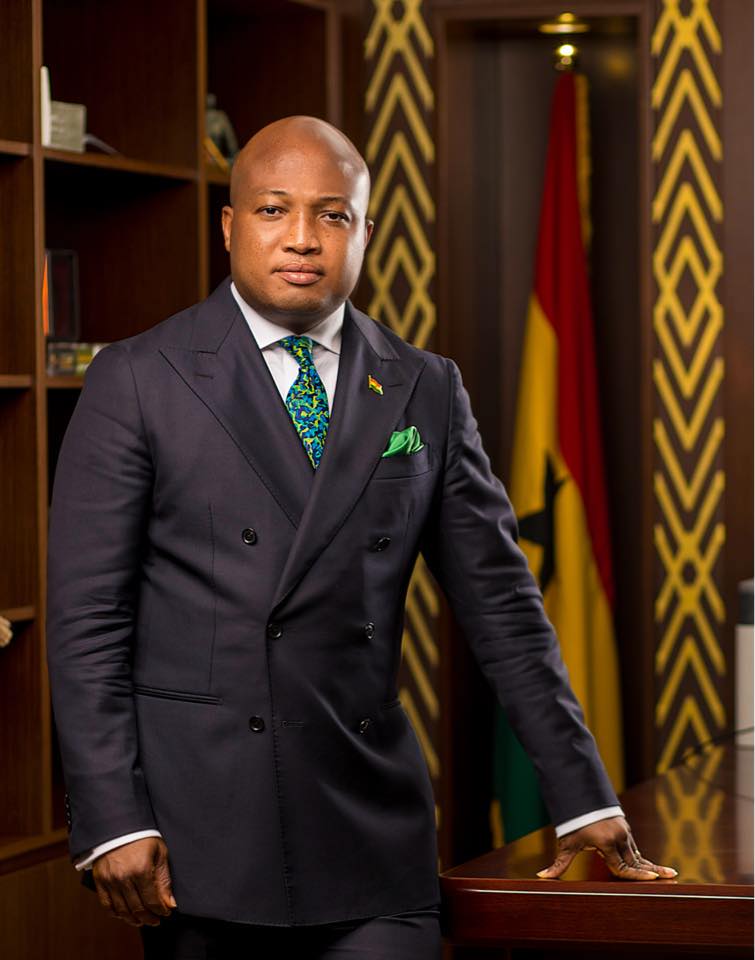
The Government of Ghana has declined a reported GH¢20 million donation from MTN Ghana intended to support Ghanaian victims of recent xenophobic attacks in South Africa.
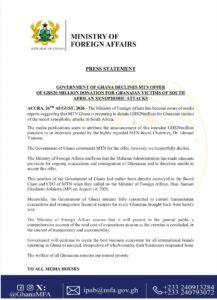
The Ministry of Foreign Affairs, in a press statement issued on Wednesday, August 26, said it had become aware of media reports suggesting that MTN Ghana was preparing to donate.
According to the Ministry, the reports attributed the intended donation to an interview granted by MTN Board Chairman, Dr Ishmael Yamson.
While commending MTN for the gesture, the Government said it had decided not to accept the offer because adequate financial provisions had already been made for the ongoing evacuation and reintegration of affected Ghanaians.
“The Government of Ghana commends MTN for the offer; however, we respectfully decline,” the Ministry stated.
The Ministry explained that the Mahama Administration had made sufficient arrangements to finance the evacuation of Ghanaians from South Africa and support their reintegration upon their return.
It further disclosed that the Government’s position had already been communicated directly to MTN’s leadership when the company’s Board Chairman and Chief Executive Officer called on the Minister for Foreign Affairs, Samuel Okudzeto Ablakwa, on August 14, 2026.
The Government nevertheless reaffirmed its commitment to providing humanitarian evacuation and reintegration support to every Ghanaian brought home from harm’s way.
The Ministry said the Government would continue to finance the exercise and provide assistance to returnees as part of measures to help them rebuild their lives in Ghana.
The Ministry of Foreign Affairs also assured the public that it would provide a comprehensive account of the total cost of the evacuation exercise once it has been completed.
It said the disclosure would be made in the interest of transparency and accountability, amid growing public interest in the government’s expenditure on bringing Ghanaians back from South Africa.
The government has previously indicated that the evacuation exercise has been funded by the state and Ghanaian partners. More than 1,600 Ghanaians had been evacuated from South Africa by August 19, with the second phase of the exercise still ongoing.
The Ministry stressed that the welfare and safety of Ghanaians remain the Government’s utmost priority.
The Foreign Affairs Ministry also sought to make clear that its decision to decline MTN’s offer would not affect the Government’s relationship with international businesses operating in Ghana.
It said the Government would continue to create a favourable business environment for all international brands operating in the country, regardless of the country from which their businesses originated.
The Government’s decision comes against the backdrop of renewed xenophobic attacks in parts of South Africa, which have prompted Ghana to undertake evacuation exercises to protect affected nationals. Ghana has also previously called for stronger continental action against xenophobic attacks.
The Ministry concluded by reiterating that the welfare of all Ghanaians remains the Government’s utmost priority.
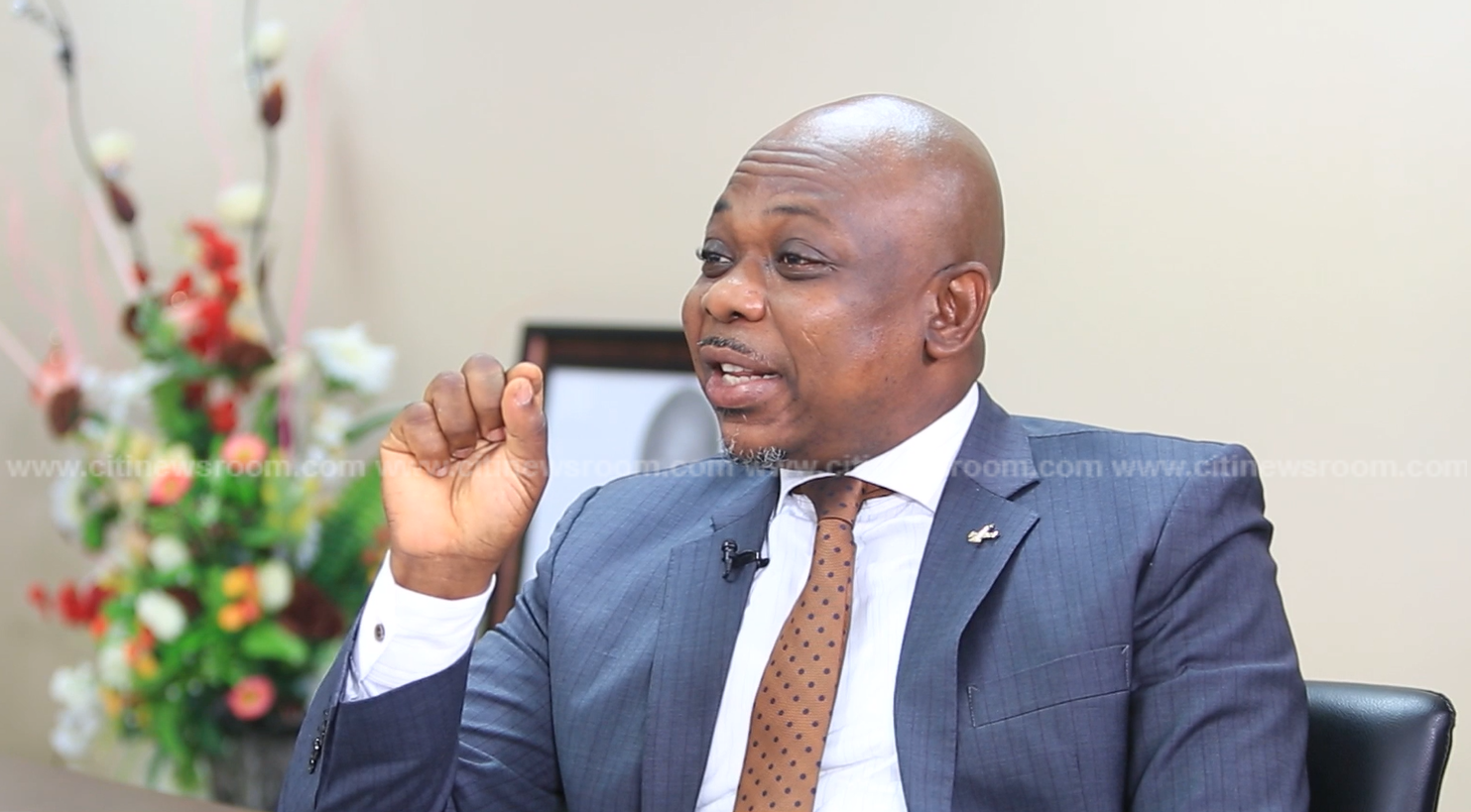
The National Democratic Congress ( NDC) has appointed the Member of Parliament for Builsa North, Hon. James Agalga, as the new Majority Leader of the Parliament of Ghana.
The appointment was formally communicated to the Rt. Hon. Speaker of Parliament in a letter dated August 24, 2026, signed by the NDC General Secretary, Hon. Fifi Fiavi Kwetey.
According to the letter, the appointment followed consultations between the leadership of the NDC and the Presidency. It takes immediate effect.
The party said the decision is aimed at providing the necessary leadership and coordination for the NDC Majority Caucus as it continues to carry out its constitutional and parliamentary responsibilities.
Hon. James Agalga, who represents the Builsa North Constituency in Parliament, is expected to lead and coordinate the NDC Majority Caucus while working with the Speaker and other Members of Parliament to advance the business of the House.
In the notification addressed to the Speaker, the NDC expressed confidence in Mr Agalga’s ability to provide the leadership required to strengthen the work of Parliament and promote the interests of the Republic.
The party also appealed for the cooperation of the Rt. Hon. Speaker and all Members of Parliament as the new Majority Leader assumes his responsibilities.
The letter was issued by the NDC National Secretariat under reference number NDC/HQ/73/045.
Hon. Fifi Fiavi Kwetey signed the notification on behalf of the leadership of the NDC and formally conveyed the party’s decision to Parliament.
NOTIFICATION OF THE APPOINTMENT OF HON. JAMES AGALGA, MP FOR BUILSA NORTH, AS MAJORITY LEADER

I knew it was going to be challenging– KiDi speaks on independent music journey

Nkwanta South Citizen Calls for Transparency Over Distribution of Two Trucks of Fertilizer

Legendary Ghanaian Actress Grace Nortey Dies at 89



-

 Education2 weeks ago
Online Classes and Education: Are They the Future of Learning?
-
 General News1 week ago
KFC Ghana Faces Legal Scrutiny Over Customer Safety During GH¢15 Anniversary Promotion
-
 General News1 week ago
BOST Makes Over GH¢10 Million From Faulty Flow Meter Charges, Tanker Drivers Claim
-

 Entertainment2 weeks ago
Tima Kumkum Confirms Marriage Has Ended After One Year, Nine Months
-

 Politics2 weeks ago
Where Is Sedina ? — Hawk Newspaper Managing Editor Charles McCarthy Questions Government
-

 Entertainment2 weeks ago
Please Wait till Next Year – Lil Win Appeals to Ghanaians Over Private Videos
-

 Entertainment2 weeks ago
Oteele’s Wife Gifty Nana Afriyie Denies Being Woman in Leaked Video, Appeals for Support for Orphanage
-

 General News1 week ago
Western North NPP Election: 27 Candidates Listed for 11 Regional Executive Positions