
General News
Israel Disappointed in Ghana’s Abstention on Iran Nuclear Vote

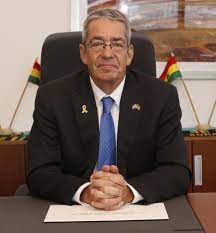
The State of Israel has expressed disappointment with the Government of Ghana for abstaining from a critical vote at the International Atomic Energy Agency (IAEA), which declared Iran to be in breach of its nuclear non-proliferation obligations.
On Thursday, June 12, 2025, the IAEA’s 35-member Board of Governors—chaired by Ghana—passed a resolution condemning Iran’s lack of cooperation regarding its nuclear program. It was the first such resolution in nearly two decades and could pave the way for Iran’s referral to the United Nations Security Council.
The resolution, seen by Reuters, states that Iran has repeatedly failed since 2019 to provide the IAEA with timely and full disclosure about undeclared nuclear material and activities at multiple locations. This, it said, constitutes a violation of Iran’s Safeguards Agreement with the agency.
Tensions between the IAEA and Iran have escalated since the collapse of the 2015 Iran nuclear deal, following the United States’ withdrawal under then-President Donald Trump in 2018. The vote comes amid renewed global concerns, with the U.S. recently evacuating personnel from parts of the Middle East and issuing warnings about growing regional threats.
The resolution—sponsored by the United States, United Kingdom, France, and Germany—passed with 19 votes in favor, 11 abstentions, and 3 votes against, cast by Russia, China, and Burkina Faso.
Israeli Ambassador Criticizes Ghana’s Position
Reacting to Ghana’s abstention, Israel’s Ambassador to Ghana, Sierra Leone, and Liberia, Mr. Roey Gilad, expressed regret, noting that Israel had counted on Ghana, a longstanding ally, to back the resolution.
“Ghana abstained from voting on Iran’s non-compliance with its nuclear program. We lobbied Ghana strongly, hoping for its support, but we were disappointed,” Ambassador Gilad told journalists during a press briefing at his residence in Accra.
He described Iran’s nuclear ambitions as a global security threat and criticized Ghana’s continued adherence to its traditional non-aligned foreign policy in such matters.
“Iran has openly called for the destruction of the Jewish State of Israel—a country Ghana has considered a friend since 1957. This vote was an opportunity for Ghana to show support, and we hoped for a different outcome,” he said.
Although Ghana’s abstention aligns with IAEA convention—where the Chair typically refrains from voting—Ambassador Gilad suggested this situation warranted an exception.
“Yes, Ghana chairs the Board, but this issue is of such vital importance to Israel that we believe it should have voted,” he added.
Call to Rethink Non-Alignment
While acknowledging Ghana’s sovereign right to make its own decisions, Ambassador Gilad encouraged a review of its long-standing non-alignment stance, especially in matters affecting global peace and security.
“We fully respect Ghana’s independent policy-making. However, as a friend, I believe it’s time to reconsider the non-aligned posture that dates back to Nkrumah’s era. In Israel, we constantly re-evaluate our policies—we believe it would be healthy for Ghana to do the same,” he said.
Relations Remain Strong
Despite the disagreement, the Ambassador emphasized that the incident would not damage the strong ties between Ghana and Israel.
“This will not overshadow our relationship, but it is a point of concern. We value mature partnerships, and mature partners must be able to discuss disagreements openly. We’ve done so in the past and will continue to do so,” Ambassador Gilad concluded.
The IAEA, established in 1957, is the United Nations’ nuclear watchdog, mandated to promote the peaceful use of nuclear energy and prevent its use for military purposes.
General News
11 Lower Primary Pupils Involved in Sprinter Bus Crash with Tipper Truck on Dzorwulu–Accra Mall Road

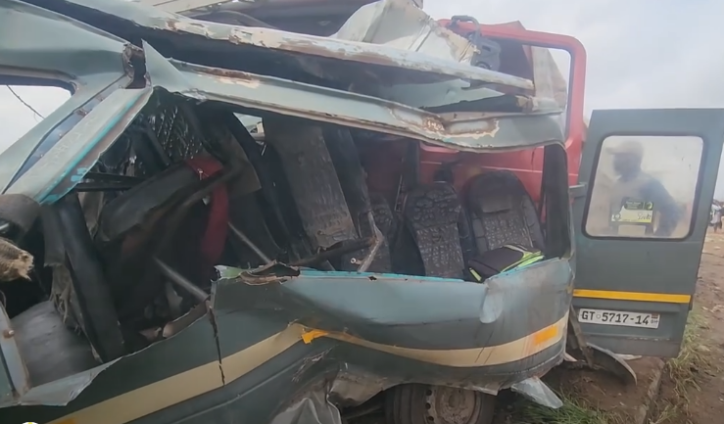
A Sprinter bus crash on the Dzorwulu–Accra Mall stretch in Accra has left emergency responders at the scene after a vehicle transporting about 11 lower primary school pupils collided with a loaded tipper truck on Thursday, July 30.
According to the Ghana National Fire Service (GNFS), firefighters were swiftly dispatched to the accident scene to conduct an initial assessment and assist with ongoing emergency operations.
The GNFS disclosed in a social media update that the Sprinter bus carrying approximately 11 lower primary pupils was involved in the collision with the tipper truck. However, authorities have not yet confirmed the number of casualties or disclosed the condition of the children and other occupants.
The cause of the Sprinter bus crash on the Dzorwulu–Accra Mall road has not yet been established. Emergency personnel continued to assess the situation while providing the necessary response at the scene.
The Ghana National Fire Service indicated that further updates will be provided as investigations continue and more information becomes available.
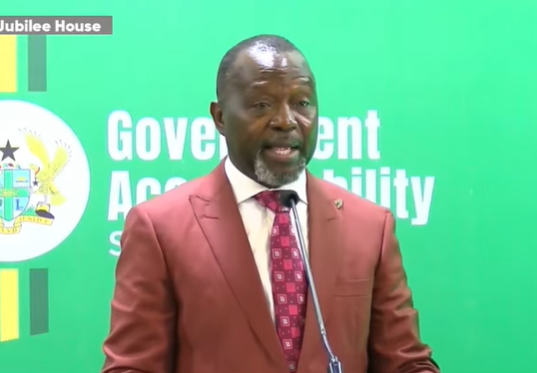
The government has accepted a key recommendation from the Constitutional Review Committee (CRC) requiring the President to pay taxes on salary and allowances while in office, marking a significant step towards promoting accountability and fairness in public office.
Attorney-General and Minister for Justice, Dr Dominic Ayine, announced the decision on Thursday, July 30, during a briefing on the government’s response to the Constitutional Review Committee’s report.
According to Dr Ayine, the government agrees with the principle that the President should no longer enjoy tax exemptions simply because of the office he occupies.
“The Government has accepted the principle that the President should not enjoy tax exemptions by virtue of office alone. The President will pay tax on salary and allowances, as well as the applicable indirect taxes on goods and services,” he stated.
Retirement Gratuity and Pension Exempt
Despite accepting the recommendation for the President to pay taxes on salary and allowances, the government rejected the proposal to tax the President’s retirement gratuity and pension.
Dr Ayine explained that retirement benefits would remain exempt from taxation, while the specific details of the President’s tax obligations would be outlined in future tax legislation.
“The Government has not, however, accepted the proposal to tax the President’s retirement gratuity and pension, and the details of the President’s tax liability will be worked out in the tax laws, where such details belong,” he added.
Constitutional Reforms Underway
The decision forms part of the government’s broader response to recommendations submitted by the Constitutional Review Committee, which was tasked with reviewing Ghana’s 1992 Constitution and proposing reforms to strengthen governance, transparency and public accountability.
The committee’s recommendations are expected to guide future constitutional amendments and legislative reforms following the nationwide constitutional review process.
The government’s acceptance of the proposal requiring the President to pay taxes on salary and allowances is seen as one of several measures aimed at reinforcing public confidence in leadership and ensuring greater equity in the country’s tax system.
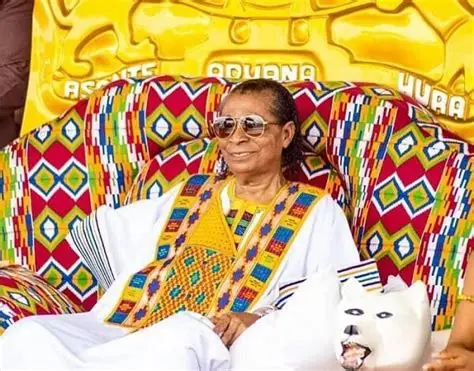
Ghana Police Service has reportedly intercepted the hearse designated to transport the body of Apostle Prof. Emeritus Ing. Kwadwo Safo Kantanka from Transitions Funeral Home following a 10-day interim injunction issued by the Accra High Court.
The reported incident occurred on Friday as thousands of mourners gathered at Gomoa Mpota in the Central Region for the scheduled funeral of the founder and leader of the Kristo Asafo Mission.
According to reports circulating on social media and shared by CDR Africa, police officers stopped the hearse from leaving the funeral home in compliance with the court order, which temporarily suspends the funeral and burial arrangements pending the resolution of an ongoing legal dispute.
CDR Africa shared footage of the incident with the caption:
“Police have stopped the hearse meant to transport the body of the late Apostle Prof. Emeritus Ing. Kwadwo Safo Kantanka from Transitions Funeral Home over a court order, while the funeral continues in Gomoa.”
The injunction, granted by the Accra High Court on July 29, 2026, restrains former Dome-Kwabenya Member of Parliament Sarah Adwoa Safo from proceeding with the funeral arrangements until the court determines who has the legal authority to organise the late religious leader’s final rites.
Despite the court order, large crowds of mourners travelled from different parts of Ghana to Gomoa Mpota to honour Apostle Kwadwo Safo Kantanka. Many supporters arrived in organised buses to participate in what had been announced as his final funeral ceremony.
Several prominent personalities were also present at the venue, including actress Mercy Asiedu, fashion entrepreneur Osebo the Zaraman, traditional leaders, members of the Kristo Asafo Mission, family members and admirers.
The High Court’s interim injunction was issued to preserve the status quo while the legal dispute over the funeral and burial arrangements is heard and determined.
As of the time of publication, the Ghana Police Service has not released an official statement regarding the reported interception of the hearse. Likewise, the parties involved in the legal proceedings have yet to publicly comment on the latest development.
General News
Government moves to revive VALCO, create jobs and restore Ghana’s aluminium industry – Armah-Kofi Buah
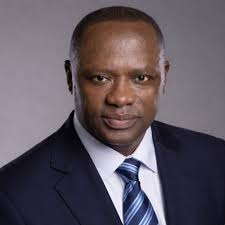
Government moves to revive VALCO: The government has clarified that it has not sold the Volta Aluminium Company Limited (VALCO), but is instead exploring strategic investment opportunities to revive the company, improve production and create more employment opportunities for Ghanaians.
The Minister for Lands and Natural Resources, Emmanuel Armah-Kofi Buah, made the clarification during a visit to VALCO, where he explained that the government’s priority is to restore the company to its former strength and ensure it contributes meaningfully to Ghana’s industrial development.
According to the Minister, several challenges have affected VALCO’s operations over the years, including outdated equipment, damaged production cells, high operational costs and financial difficulties.
He noted that many of the machines currently being used are old and frequently break down, affecting the quality and quantity of aluminium produced.
The Minister explained that if VALCO continues operating with outdated systems, the company risks losing customers due to concerns about product quality.
He added that the company’s financial situation has also affected its ability to meet obligations, including payments to power producers and suppliers who provide essential services and materials needed for operations.
“Many things have happened, and everyone is giving their own side of the story. But the reality is that the government has assessed VALCO’s situation and is taking steps to change its fortunes,” the Minister said.
He stressed that turning around VALCO requires major investment in modern equipment, improved technology and better management systems to enable the company to produce quality aluminium products that can compete on the global market.
The Minister further explained that the government has created an opportunity for investors who are willing to partner with VALCO and inject the needed capital into the business.
He said such investment will help upgrade the company’s facilities, improve productivity, protect existing jobs and open up new employment opportunities for young Ghanaians.
The Lands Minister dismissed claims that the government has sold VALCO, describing such reports as inaccurate.
He explained that the government’s approach is to find credible partners who can support the revival of the company while ensuring that Ghana continues to benefit from its aluminium resources.
The move, he said, forms part of efforts to restore VALCO’s reputation, strengthen Ghana’s industrial sector and return the company to a position where it can contribute significantly to national development.
General News
American Citizenship Does Not Shield Ken Ofori-Atta From Extradition to Ghana – Attorney General
Attorney General and Minister for Justice Dr Dominic Ayine has stated that American citizenship does not shield Ken Ofori-Atta from extradition to Ghana, dismissing claims that the former Finance Minister’s United States citizenship could prevent him from being returned to face trial if required.
Speaking to journalists at the Jubilee House on Thursday, July 30, during a briefing on the Constitution Review Committee Report, Dr Ayine explained that Ghana’s extradition laws apply irrespective of a person’s citizenship status.
“Ken Ofori-Atta was a Minister of State, our former Finance Minister. The fact that a person is an American citizen does not immunise them from extradition,” Dr Ayine said.
He further noted that while no American citizen may have previously been extradited to Ghana, the law permits such action where legal requirements are met.
“American citizens can be extradited to Ghana. The fact that it has never happened doesn’t mean that it cannot happen,” he added.
Dual Citizenship Not a Barrier to Extradition
The Attorney General emphasised that holding dual citizenship does not create a legal obstacle to extradition proceedings.
According to Dr Ayine, even individuals who are not Ghanaian citizens can be extradited to Ghana if they are required to stand trial under the country’s laws.
“The fact that somebody is a dual citizen doesn’t make it difficult, doesn’t put a roadblock on the way to extradition, even if that person is not also a citizen of Ghana. They can be extradited to Ghana to stand trial,” he stressed.
US Immigration Judge Grants Ofori-Atta Adjustment of Status
Dr Ayine’s comments follow a recent ruling by a United States immigration judge granting Ken Ofori-Atta an adjustment of status, allowing him to remain legally in the United States.
In the decision, Judge David Gardey ruled that the former Finance Minister’s positive personal circumstances outweighed concerns arising from the criminal allegations brought against him in Ghana.
The court considered Ofori-Atta’s longstanding ties to the United States, including his education, professional career with financial institutions such as Morgan Stanley and Salomon Brothers, as well as his family connections, including a son who is a US citizen.
Judge Gardey also took into account Ofori-Atta’s ongoing medical treatment, noting that his health had deteriorated following his detention in connection with the criminal allegations.
“The court finds that the positive equities far outweigh the negative equities such that the court will exercise its discretion and grant the respondent’s request for adjustment of status,” Judge Gardey ruled.
The judge further acknowledged the challenges Ofori-Atta had experienced and concluded that he had demonstrated sufficient grounds to remain in the United States under the adjustment process.
Ghana Maintains Extradition Option
Despite the US immigration ruling, the Attorney General insisted that American citizenship does not shield Ken Ofori-Atta from extradition to Ghana if the country’s legal processes require his return.
Dr Ayine maintained that Ghana remains entitled to pursue extradition in accordance with international legal procedures should the former Finance Minister be required to appear before the courts.

11 Lower Primary Pupils Involved in Sprinter Bus Crash with Tipper Truck on Dzorwulu–Accra Mall Road

President to Pay Taxes on Salary and Allowances, Retirement Benefits Remain Tax-Free

Police reportedly stop funeral vehicle carrying Apostle Kwadwo Safo Kantanka’s body



-

 General News1 week ago
Dr. Charles Dwamena Sues Hubtel for GH¢5 Million Over Alleged Campaign USSD Sabotage
-
 Entertainment1 week ago
DJ K.A Apologises Over Viral Video, Says It Was Recorded Four Years Ago
-

 General News2 weeks ago
Okatakyie Afrifa Granted GH¢100,000 Bail Over Alleged Disruption of NPP Constituency Elections
-
 Entertainment4 days ago
Ghana Secures $3.5 Million UNESCO Heritage Support During Tourism Minister’s South Korea Visit
-

 General News1 week ago
Chairman Wontumi Sentenced to 20 Years in Prison Over Illegal Mining
-

 Entertainment1 week ago
“Hits Rule Everything Now” — Perez Musik Says Legends Like Bob Marley Would Face Challenges Today
-
 General News1 day ago
CLOSSAG Elections in Dambai: Tension Mounts Over Candidate Disqualifications
-
 General News3 days ago
EOCO Declares Emmanuel Ababio Wanted Over Alleged Fraud