
General News
Teiman Resident Petitions President Over Alleged Land Dispute, Demolitions and Misuse of Public Infrastructure

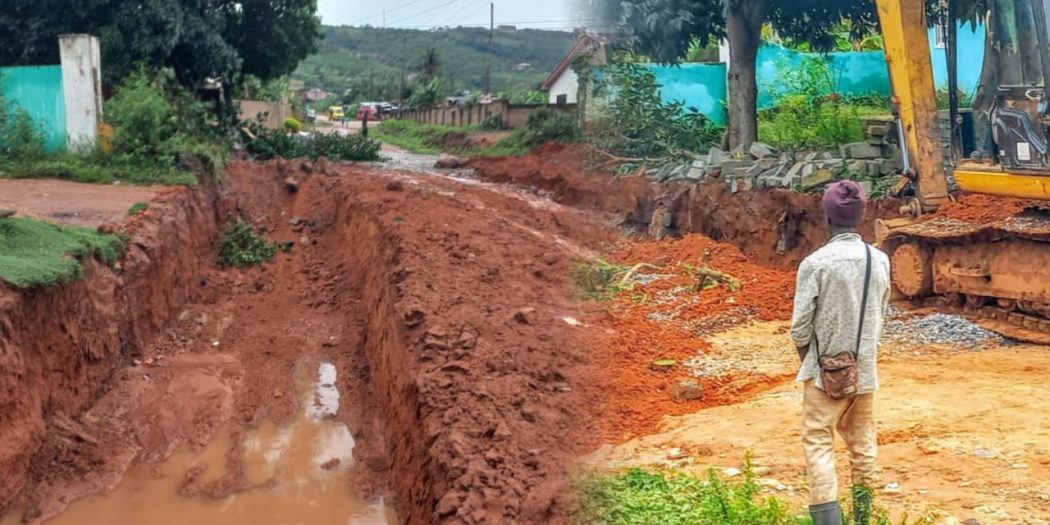
A resident of Teiman Burger Town, Mr. Kingsley Kwafo Ottopah, has petitioned the government, security agencies and the media over what he describes as a prolonged land dispute involving the Chief of Teiman, Nii Manle Dzaha I, and the Municipal Chief Executive (MCE) for the La Nkwantanang-Madina Municipal Assembly (LaNMMA), Hon. Faila Ibrahim.
In a petition circulated to various media organizations, Mr. Ottopah alleges unlawful demolitions, intimidation by alleged land guards, diversion of government-funded infrastructure projects, and disregard for police directives.
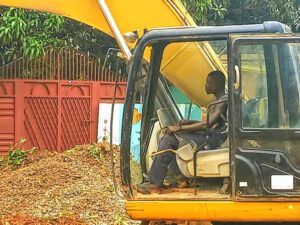
According to him, the Teiman Chief and the MCE facilitated the diversion of contractors working on government-approved urban road and drainage projects from the designated Teiman Layout area to Burger Town, an area he claims is not captured in the approved development plan. He contends that the construction activities have resulted in the destruction of private property and the creation of drainage systems in locations not originally approved, while parts of Teiman continue to experience severe flooding during the rainy season.
Mr. Ottopah further alleges that the actions have led to financial losses to the state and has called on President John Dramani Mahama to intervene by investigating the matter and taking appropriate action against all individuals found culpable.
Providing background to the dispute, Mr. Ottopah stated that he legally acquired the parcel of land in 2005 from the Kpobi We Family after conducting due diligence with the Town and Country Planning Department and the Lands Commission. He said the land was duly registered in his name and that he had occupied it peacefully for more than two decades.
He claims the dispute began following the enstoolment of Nii Manle Dzaha I, who allegedly requested that he repurchase the same parcel of land. According to Mr. Ottopah, the demand created conflicting ownership claims over the property.
Mr. Ottopah further alleged that on April 4, 2026, individuals he identified as land guards associated with the Chief destroyed building materials and a 20-foot container situated on the property. He reported the incident to the Kuotam Police Station, after which the case was transferred to the Greater Accra Regional Police Command.
The petition also references events on June 3, 2026, during which Mr. Ottopah claims excavators working on a government drainage project entered his property and caused damage despite the approved layout plan allegedly showing no road or drainage alignment through the area. He further alleges that the MCE played a role in authorizing the project activities.
According to Mr. Ottopah, the Chief later appeared before the police following a summons and was granted bail with instructions to return on June 11, 2026, accompanied by persons linked to the case. However, he alleges that further excavation and destruction of property occurred after the Chief’s release.
Describing the developments as a threat to property rights and the rule of law, Mr. Ottopah is calling for an independent investigation into the matter. He is specifically requesting the dismissal of the LaNMMA MCE if allegations of misconduct are established and for legal action to be taken against any individuals found responsible for unlawful acts.
Mr. Ottopah says he has submitted supporting documents, photographs, videos, layout plans and other materials to the relevant authorities, including the Inspector-General of Police and the Greater Accra Regional Minister, to aid investigations.
The allegations have not yet been independently verified, and the parties named in the petition have not publicly responded to the claims at the time of publication.
Note: This version follows a balanced news-reporting style by attributing all allegations to the petitioner and avoiding statements that present unverified claims as established facts.












General News
Bizarre attack at Tamale Islamic Science SHS as female students assault colleague over alleged boyfriend affair

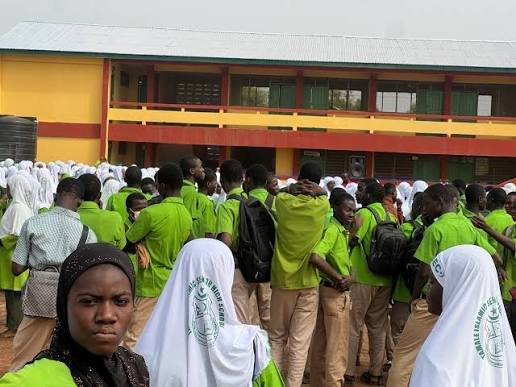
A disturbing incident at the Tamale Islamic Science Senior High School has reportedly left students and the school community stunned after a female student was allegedly assaulted by colleagues over claims involving a boyfriend.
The incident, described as a bizarre confrontation, has raised concerns about student conduct and the handling of personal disputes within the school environment.
Alleged boyfriend dispute sparks confrontation
According to a report by Rainbow Radio, the confrontation reportedly stemmed from an alleged relationship involving the victim and a boyfriend.
What may have started as a personal disagreement reportedly escalated into a physical attack involving other female students.
The circumstances surrounding the alleged relationship and what triggered the confrontation remain matters requiring further clarification.
Female student allegedly assaulted
The female student was reportedly attacked by her colleagues during the incident.
The reported assault has generated concern because of the setting in which it occurred — a senior high school where students are expected to resolve disagreements through appropriate channels rather than physical confrontation.
Questions over student safety
The incident is likely to renew discussions about student welfare, supervision and conflict resolution in Ghanaian second-cycle institutions.
Schools remain responsible for creating environments where students can report disputes and seek assistance before disagreements escalate into violence.
The reported incident also highlights the potential consequences when personal or relationship disputes are allowed to spiral into physical confrontations.
Investigation and disciplinary action
Details surrounding any disciplinary action taken by the school or other authorities were not immediately clear from the available report.
Any investigation would be expected to establish exactly what happened, identify those involved and determine the appropriate response.
For now, the reported incident has sparked concern within the school community, with the focus likely to remain on the welfare of the student involved and measures to prevent similar incidents from occurring.
The allegations remain subject to further investigation and confirmation by the relevant authorities.
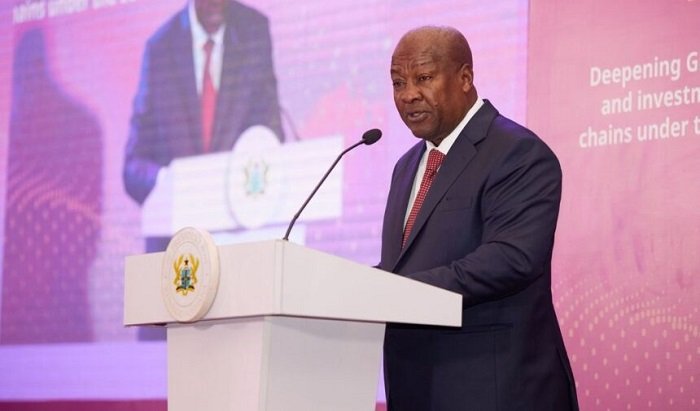
President John Dramani Mahama has announced plans to tie the salaries and other compensation of executives and board members of State-Owned Enterprises (SOEs) to the actual performance of their institutions under the proposed Independent Public Emoluments Commission (IPEC).
The proposed commission is expected to replace the Fair Wages and Salaries Commission (FWSC) and introduce a more consistent, transparent and performance-based approach to public-sector remuneration.
Pay must reflect performance
President Mahama said compensation for executives of state-owned enterprises should no longer be determined independently of how their institutions perform.
He explained that factors such as an SOE’s financial position, productivity, achievement of agreed targets, quality of services and value created for the state should all be considered when determining executive compensation.
The President also cautioned that institutional autonomy must not be used as a justification for unexplained salary disparities or compensation arrangements that have no connection to performance.
IPEC to replace Fair Wages Commission
The proposed IPEC forms part of the government’s broader public-sector compensation reforms.
The Fair Wages and Salaries Commission has already engaged organised labour on plans to establish the new body, with the proposed legislation expected to repeal the existing FWSC Act, 2007 (Act 737).
The new framework is expected to promote greater fairness, transparency and sustainability in the determination of public-sector salaries and benefits.
SOEs record GH¢19.8bn profit
Mahama’s announcement comes as State-Owned Enterprises record a significant improvement in their overall financial performance.
According to the 2025 State Ownership Report presented at the 2026 Governing Boards and CEOs’ Conference, SOEs moved from an aggregate net loss of GH¢2.26 billion in 2024 to a net profit of GH¢19.8 billion in 2025.
The President welcomed the turnaround but stressed that the gains must translate into sustained efficiency and greater value for the Ghanaian taxpayer.
‘Public money must serve Ghanaians’
Mahama also warned SOE executives and board members against using profits belonging to the state to finance excessive personal benefits.
He said public enterprises must ensure that their improved financial performance ultimately benefits the Ghanaian people rather than being absorbed through management and board perks.
Performance-based pay takes centre stage
The proposed IPEC is therefore expected to fundamentally change how compensation is determined across Ghana’s public sector.
Earlier in March, Mahama said the new commission would develop a comprehensive National Emoluments Policy aimed at addressing salary disparities, harmonising allowances and strengthening performance-based compensation.
If implemented, the reform would make institutional performance a much more important factor in determining what executives of SOEs and other public institutions earn.
For Mahama, the message is clear: public-sector salaries must be justified by performance, productivity and the value delivered to Ghana.
General News
Private schools want boarding subsidies redirected to day schools to ease SHS placement crisis
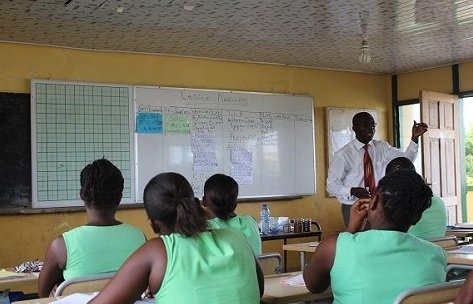
Private schools are calling for a major rethink of government’s approach to senior high school support, proposing that subsidies currently benefiting boarding students be redirected to day schools to help ease the growing pressure on the SHS placement system.
The proposal comes amid continuing concerns over congestion, limited boarding spaces and the difficulties faced by students who fail to secure places in their preferred senior high schools.
Private schools propose a new approach
The private school sector believes redirecting part of the resources used to support boarding arrangements could provide a practical way to expand access to secondary education.
Under the proposal, more emphasis would be placed on supporting day students, particularly those who could attend schools closer to their homes instead of competing for limited boarding spaces.
The approach, proponents argue, could reduce the pressure on existing boarding facilities while creating more opportunities for students affected by the placement challenges.
SHS placement crisis intensifies
Ghana’s SHS placement system has repeatedly faced pressure as demand for places in popular schools continues to exceed available capacity.
Students and parents have often been left frustrated when their preferred schools are unavailable, forcing them to consider alternative institutions or seek solutions outside the initial placement arrangements.
Private schools argue that some of this pressure could be reduced if more students were encouraged and supported to attend quality day schools within their communities.
Subsidies could ease pressure
The proposal is based on the argument that government resources should be deployed in a way that maximises the number of students who can access secondary education.
Rather than concentrating resources around boarding arrangements, private school operators believe financial support for day-school students could help absorb some of the excess demand.
Such a policy, they argue, could also give parents more options while reducing the intense competition for places in boarding schools.
Bigger debate over Ghana’s SHS system
The proposal is likely to fuel a broader conversation about how Ghana should manage the increasing demand for secondary education.
While the government continues to expand access to SHS education, stakeholders are also calling for innovative solutions to infrastructure constraints and the persistent pressure on the placement system.
For private schools, redirecting some boarding-related subsidies towards day schools could be one way of tackling the problem.
The proposal now puts the spotlight on policymakers to consider whether a shift in funding priorities could help decongest boarding schools, expand access and reduce the annual anxiety surrounding SHS placement.

President John Dramani Mahama has issued a stern warning to boards and management of State-Owned Enterprises (SOEs), cautioning them against using public funds to finance personal benefits while taxpayers carry the burden.
Speaking at the 2026 Governing Boards and CEOs Conference organised by the State Interests and Governance Authority (SIGA) on Thursday, September 10, 2026, President Mahama said profits generated by state enterprises must ultimately serve the Ghanaian people.
‘Don’t use public money for creature comforts’
President Mahama was blunt in his warning, telling SOE leaders that profits belonging to the state should not be diverted into perks and personal comforts for management and board members.
He stressed that profitable enterprises have a responsibility to meet their dividend obligations to the state because returns on public investments belong to Ghanaians.
SOEs move from GH¢2.26bn loss to GH¢19.8bn profit
The President acknowledged a significant improvement in the overall financial performance of SOEs.
According to figures presented at the conference, the sector moved from an aggregate net loss of GH¢2.26 billion in 2024 to a net profit of GH¢19.8 billion in 2025.
Combined revenue also rose from GH¢137.71 billion to GH¢176.43 billion over the same period.
However, Mahama cautioned that the improvement should not automatically be interpreted as evidence of stronger underlying operations.
He noted that about GH¢11.72 billion in net foreign exchange gains and a 42.5% reduction in aggregate finance costs contributed significantly to the improved results.
‘A one-year turnaround is not enough’
President Mahama said the real test for SOEs would be whether they could sustain the gains beyond a single year.
“A one-year turnaround is encouraging, but sustained performance is the real test,” he said.
He warned that boards and management teams would be assessed against defined financial, operational, governance and development targets.
Persistent underperformance, he added, could lead to corrective measures and, where necessary, leadership changes.
‘A board is not a ceremonial position’
The President also challenged board members to take their responsibilities seriously, stressing that their appointments were not merely ceremonial.
He said boards are responsible for strategic direction, policy, risk oversight, financial reporting and institutional performance.
At the same time, he warned boards against interfering excessively in the day-to-day operations of their institutions, stressing the distinction between governance and management.
“Boards govern and management manages,” he said.
Performance must determine pay
Mahama further argued that executive compensation in public enterprises should be tied to performance.
He said high-performing enterprises and their leaders should be appropriately rewarded, but questioned the justification for continually increasing salaries and allowances in chronically loss-making entities.
The President also highlighted the proposed Independent Public Emoluments Commission (IPEC), which is expected to strengthen consistency and transparency in public-sector remuneration and link compensation more closely to institutional performance.
‘Public ownership must produce public value’
President Mahama noted that despite the overall improvement, some SOEs continued to struggle, with five entities recording losses in every year between 2021 and 2025.
He therefore directed boards to scrutinise major expenditures and determine whether they were necessary, economical and consistent with their institutional mandates.
The President reminded SOE leaders that state assets do not belong to individual governments, boards or chief executives.
They belong to the Ghanaian people.
His message to board chairpersons, members and chief executives was therefore clear: the public expects measurable value from the assets entrusted to them.
As the government pushes for greater efficiency and accountability across the SOE sector, President Mahama’s warning signals that public resources must translate into public value — not private perks.

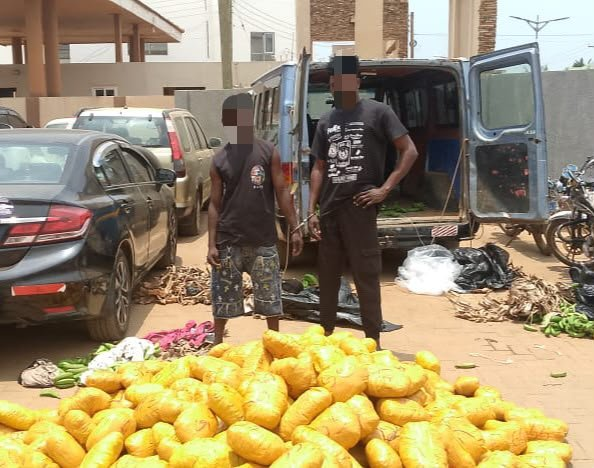
The Tema Regional Police Command has arrested two persons and seized 692 parcels of suspected Indian hemp during a snap-check operation at Dawhenya in the Prampram Division.
The suspects have been identified as Godwin Asigeh and Freeman Amedoku.
According to a press release issued by the Tema Regional Police Headquarters’ Public Affairs Unit and signed by ASP Dede Dzakpasu, Head of Public Affairs, the arrest was made in the early hours of Tuesday, September 8, 2026.
Police said officers intercepted an Accra-bound Ford Transit vehicle with registration number GT 6140-22 at about 12:45 a.m.
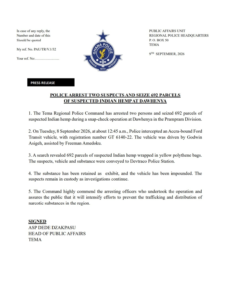
The vehicle was being driven by Godwin Asigeh, with Freeman Amedoku serving as his assistant.
A search conducted on the vehicle led to the discovery of 692 parcels of a substance suspected to be Indian hemp, wrapped in yellow polythene bags.
Following the discovery, the two suspects, together with the vehicle and the suspected narcotic substance, were conveyed to the Devtraco Police Station for further action.
The police said the suspected substance has been retained as an exhibit, while the Ford Transit vehicle has been impounded.
Both suspects remain in police custody as investigations continue.
The Tema Regional Police Command commended the officers who carried out the operation and assured the public that it would intensify efforts to prevent the trafficking and distribution of narcotic substances in the region.

Bizarre attack at Tamale Islamic Science SHS as female students assault colleague over alleged boyfriend affair

IPEC will link SOE performance to salaries — Mahama

Private schools want boarding subsidies redirected to day schools to ease SHS placement crisis



-

 Entertainment1 week ago
Oswald Okaitei Explains the Real Vision Behind Ghana’s Black Star Experience
-
 Entertainment4 days ago
Mahama Is First President to Put GH¢40m Seed Money into Creative Arts Fund: Kojo Preko Dankwa
-
 General News2 weeks ago
GES Urged to Review Student Sexual Misconduct Rule Over Alleged Discrimination Against Boys
-
 General News1 week ago
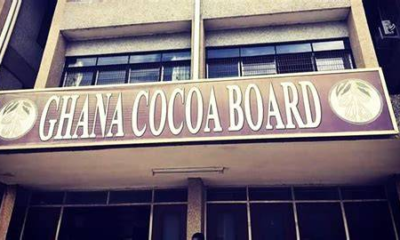
COCOBOD Settles GH¢2.3 Billion DDEP Bond Obligations for 2026
-

 Entertainment2 weeks ago
Joana Gyan Cudjoe Ends Seven-Year Professional Ties with Keche Global
-
General News7 days ago
Don’t Punish Them Retrospectively – Educationist Challenges New CSSPS Placement Rule
-

 Entertainment1 week ago
Ras Caleb Appiah-Levi: Hate Me for the Truth That I Represent
-

 Culinary2 weeks ago
Palm Nut Soup: Ghana’s Rich Bowl of Tradition, Culture and Comfort