
Politics
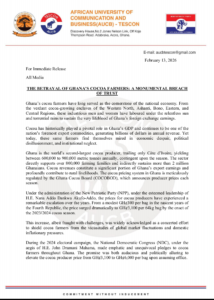
THE BETRAYAL OF GHANA’S COCOA FARMERS: A MONUMENTAL BREACH OF TRUST

Ghana’s cocoa farmers have long served as the cornerstone of the national economy. From the verdant cocoa-growing enclaves of the Western North, Ashanti, Bono, Eastern, and Central Regions, these industrious men and women have laboured under the relentless sun and torrential rains to sustain the very lifeblood of Ghana’s foreign exchange earnings.
Cocoa has historically played a pivotal role in Ghana’s GDP and continues to be one of the nation’s foremost export commodities, generating billions of dollars in annual revenue. Yet today, these same farmers find themselves mired in economic despair, political disillusionment, and institutional neglect.
Ghana is the world’s second-largest cocoa producer, trailing only Côte d’Ivoire, yielding between 600,000 to 900,000 metric tonnes annually, contingent upon the season. The sector directly supports over 800,000 farming families and indirectly sustains more than 2 million Ghanaians. Cocoa revenues constitute a significant portion of Ghana’s export earnings and profoundly contribute to rural livelihoods. The cocoa pricing system in Ghana is meticulously regulated by the Ghana Cocoa Board (COCOBOD), which announces producer prices each season.
Under the administration of the New Patriotic Party (NPP), under the esteemed leadership of H.E. Nana Addo Dankwa Akufo-Addo, the prices for cocoa producers have experienced a remarkable escalation over the years. From a modest GH¢300 per bag in the nascent years of the Fourth Republic, the price surged dramatically to GH¢3,100 per 64kg bag by the onset of the 2023/2024 cocoa season.
This increase, albeit fraught with challenges, was widely acknowledged as a concerted effort to shield cocoa farmers from the vicissitudes of global market fluctuations and domestic inflationary pressures.
During the 2024 electoral campaign, the National Democratic Congress (NDC), under the aegis of H.E. John Dramani Mahama, made emphatic and unequivocal pledges to cocoa farmers throughout Ghana. The promise was both audacious and politically alluring to elevate the cocoa producer price from GH¢3,100 to GH¢6,000 per bag upon assuming office.
AFRICAN UNIVERSITY OF COMMUNICATION AND BUSINESS (AUCB) – TESCON
E-mail: aucbtescon@gmail.com
H.E. Kwasi Ohene-Bugyei (President) – 0558200320
H.E. Stephen Boateng Osei-Bonsu (Vice President) – 0241421593
Lisa Abiana Codjoe (Secretary) – 0553706609
Justice Kwasi Forson (Communication Director) – 0241819541
Muniratu Mohammed (Nasara Coordinator) – 0552680408
Tedra Bampoe (Women’s Commissioner) – 0554750725
Ebenezer Orkoh Ayesu (Organizer) – 0559761014
Daniel Akowuah (Treasurer) – 0596055084
AFRICAN UNIVERSITY OF COMMUNICATION AND BUSINESS (AUCB) – TESCON
E-mail: aucbtescon@gmail.com
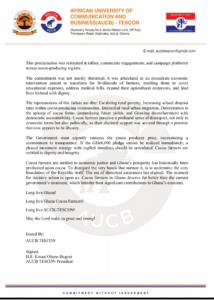
This proclamation was reiterated at rallies, community engagements, and campaign platforms across cocoa-producing regions.
The commitment was not merely rhetorical; it was articulated as an immediate economic intervention poised to transform the livelihoods of farmers, enabling them to cover educational expenses, address medical bills, expand their agricultural endeavors, and lead lives imbued with dignity..
The repercussions of this failure are dire: Escalating rural poverty, Increasing school dropout rates within cocoa-producing communities, Intensified rural-urban migration, Deterioration in the upkeep of cocoa farms, jeopardizing future yields, and Growing disenchantment with democratic accountability. Cocoa farmers perceive a profound sense of disrespect, not only in economic terms but also politically, as their electoral support was secured through a promise that now appears to be illusory.
The Government must urgently reassess the cocoa producer price, necessitating a commitment to transparency. If the GH¢6,000 pledge cannot be realized immediately, a phased increment strategy with explicit timelines should be articulated. Cocoa farmers are entitled to dignity and integrity.
Cocoa farmers are entitled to economic justice and Ghana’s prosperity has historically been predicated upon cocoa. To disregard the very hands that nurture it, is to undermine the very foundation of the Republic itself. The era of rhetorical assurances has elapsed. The moment for decisive action is upon us. Cocoa farmers in Ghana deserve far better than the current government’s treatment, which belittles their significant contributions to Ghana’s economy.
Long live Ghana!
Long live Ghana Cocoa Farmers!
Long live AUCB-TESCON!
May the Lord make us great and strong!
Issued By:
AUCB TESCON
Signed:
H.E. Kwasi Ohene-Bugyei
AUCB TESCON President
COMMITMENT WITHOUT INDUCEMENT














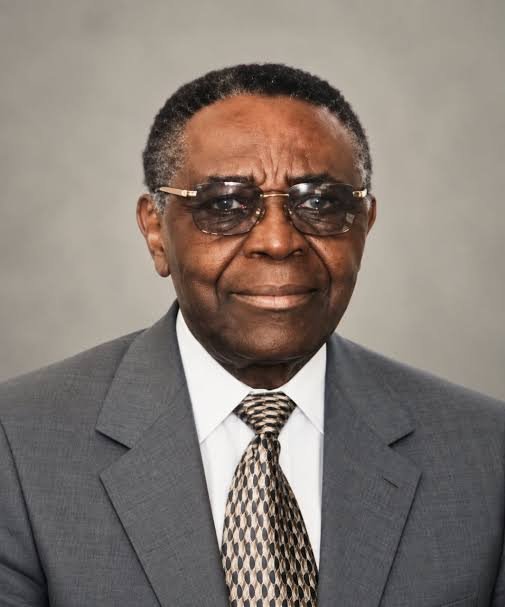
It is with profound sorrow and a deep sense of loss that we have received the news of the passing of Ambassador Samuel Arthur Odoi-Sykes, an eminent statesman, distinguished patriot, accomplished diplomat, and one of the founding pillars of the New Patriotic Party (NPP).
Ambassador Odoi-Sykes devoted several decades of his life to the service of Ghana and the cause of democratic governance. His constant dedication to public service, constitutional democracy, and principled political leadership earned him the admiration and respect of colleagues across the political divide.
His remarkable record of national and party service speaks to a life dedicated to duty and excellence.
He served as a Member of Parliament for Ashiedu Keteke (now Odododiodoo) during the Third Republic and subsequently rose to become Minority Leader of Parliament, where he distinguished himself through exemplary parliamentary leadership and advocacy for democratic ideals.
As a founding father of the New Patriotic Party, Ambassador Odoi-Sykes played a pivotal role in laying the institutional and ideological foundations of the Party.
His leadership as National Chairman of the New Patriotic Party (1998–2001) was instrumental in uniting and strengthening the Party, culminating in its historic electoral victory in the year 2000 and the first democratic transfer of power between political parties under the Fourth Republic.
Following this landmark achievement, he continued his distinguished service to the Republic as Ghana’s High Commissioner to Canada from 2001 to 2006, where he represented the nation with distinction and further enhanced Ghana’s diplomatic relations abroad.
Throughout his lifetime, Ambassador Odoi-Sykes served on numerous national and party committees, offering wise counsel, strategic leadership, and invaluable institutional memory. His integrity, humility, intellect, and constant commitment to Ghana’s democratic development will remain an enduring source of inspiration for present and future generations.
His passing marks the end of an illustrious chapter in Ghana’s political history. The nation has lost a distinguished public servant, while the New Patriotic Party has lost one of its most respected elder statesmen and steadfast architects.
On behalf of the Party, we extend our deepest condolences to his wife, children, the entire Odoi-Sykes family, friends, associates, and all who mourn this great loss. We pray that the Almighty God grants them strength, comfort, and fortitude during this difficult period.
As we mourn his passing, we also celebrate a life exceptionally lived in faithful service to God, country, and the Party. Ambassador Samuel Arthur Odoi-Sykes has indeed paid his dues, and his legacy of principled leadership, patriotism, and selfless service will forever remain etched in the annals of Ghana’s democratic history.
Politics
‘If anyone signs the constitutional amendment, I will take NPP to court’ – Smith Danquah Butey

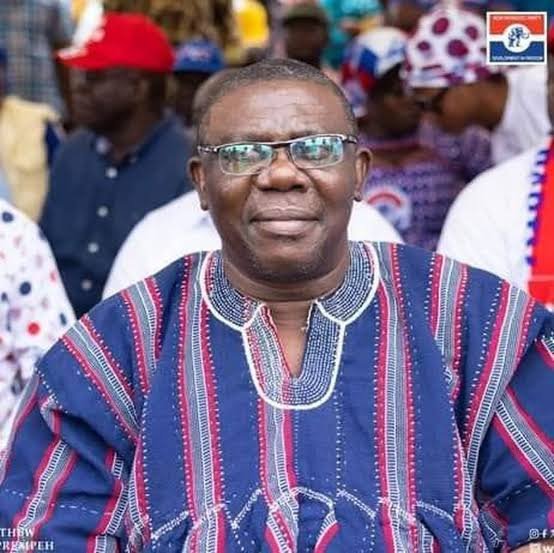
Former First Vice Chairman of the New Patriotic Party (NPP), Smith Danquah Butey, has threatened legal action against the party if any official proceeds to sign a proposed constitutional amendment.
According to him, he is prepared to challenge the move in court should the amendment be signed, signalling strong opposition to the proposed changes to the party’s constitution.
“If anyone signs the constitutional amendment, I will take the NPP party to court,” Mr Butey stated.
His comments come amid discussions within the NPP over proposed amendments to its constitution and the processes surrounding their adoption.
Mr Butey, who previously served as the party’s First Vice Chairman, has raised concerns about the proposed changes and appears determined to pursue legal avenues if the process proceeds in a manner he considers unacceptable.
The former party executive did not, in the statement, provide details on the specific provisions of the amendment he intends to challenge or the particular legal grounds on which he would base his case.
The threat of legal action could add another layer to ongoing discussions within the NPP as the party works to address internal matters and reorganise its structures.
The proposed constitutional amendments are expected to remain a subject of discussion among party members, with attention focused on the processes being followed to effect the changes.
Mr Butey’s position suggests that internal disagreements over the amendments could potentially extend beyond the party’s structures and into the courts.

Deputy National Women’s Organiser of the New Patriotic Party (NPP), Felicia Dzifa Tegah, has explained why she and some members of her team left the party’s delegates conference before proceedings began.
According to her, they were present at the venue and ready to participate in the conference but decided to leave after repeated delays and the lack of clear communication about when the programme would commence.
“We were at the NPP delegates conference, but we left because the proceedings kept getting delayed and there was no clear communication about when the event would begin,” she said.
Her comments come amid discussions surrounding the organisation of the NPP’s delegates conference, which brought together party delegates and officials for an important gathering.
Madam Tegah indicated that the decision to leave was influenced by the uncertainty surrounding the start of proceedings, rather than a deliberate attempt to boycott the event.
She stressed that they had made themselves available for the programme but became frustrated by the prolonged delays and the absence of timely information.
Her remarks are likely to fuel discussions about the organisation and communication of major party activities, particularly when such events involve delegates and senior party officials travelling from different parts of the country.
The NPP has been undertaking a series of activities aimed at strengthening its structures and repositioning the party ahead of future political contests.
Madam Tegah remains a key figure within the party’s Women’s Wing and has been involved in activities aimed at mobilising women and strengthening grassroots participation.
Politics
‘I’m not afraid’ – Felicia Tegah reacts to Hawa Koomson’s election as NPP Women’s Organiser

Deputy National Women’s Organiser of the New Patriotic Party (NPP), Felicia Dzifa Tegah, has congratulated Hawa Koomson on her election as the party’s new National Women’s Organiser.
In a statement following the election, Madam Tegah said she was not intimidated by the outcome and expressed confidence in the experience and track record of the newly elected women’s organiser.
“I’m not afraid. Hawa Koomson has been elected as the NPP Women’s Organiser. We all know her record, and I congratulate her and wish her well in her new role,” she said.
Her comments come after the former Minister for Fisheries and Aquaculture Development emerged as the winner of the contest for the position.
Madam Tegah’s remarks signal her willingness to work with the newly elected national women’s organiser as the NPP seeks to strengthen its women’s wing and prepare for its future political activities.
Hawa Koomson, who has served the NPP in various capacities, brings considerable political experience to the position.
Her election is expected to usher in a new phase for the party’s Women’s Wing, with attention likely to focus on mobilising women, strengthening grassroots structures and increasing the participation of women in the party’s activities.
Meanwhile, Felicia Dzifa Tegah has wished Madam Koomson well and expressed hope that she will succeed in her new role.
The election forms part of the NPP’s ongoing efforts to reorganise and reposition the party ahead of the 2028 general elections.
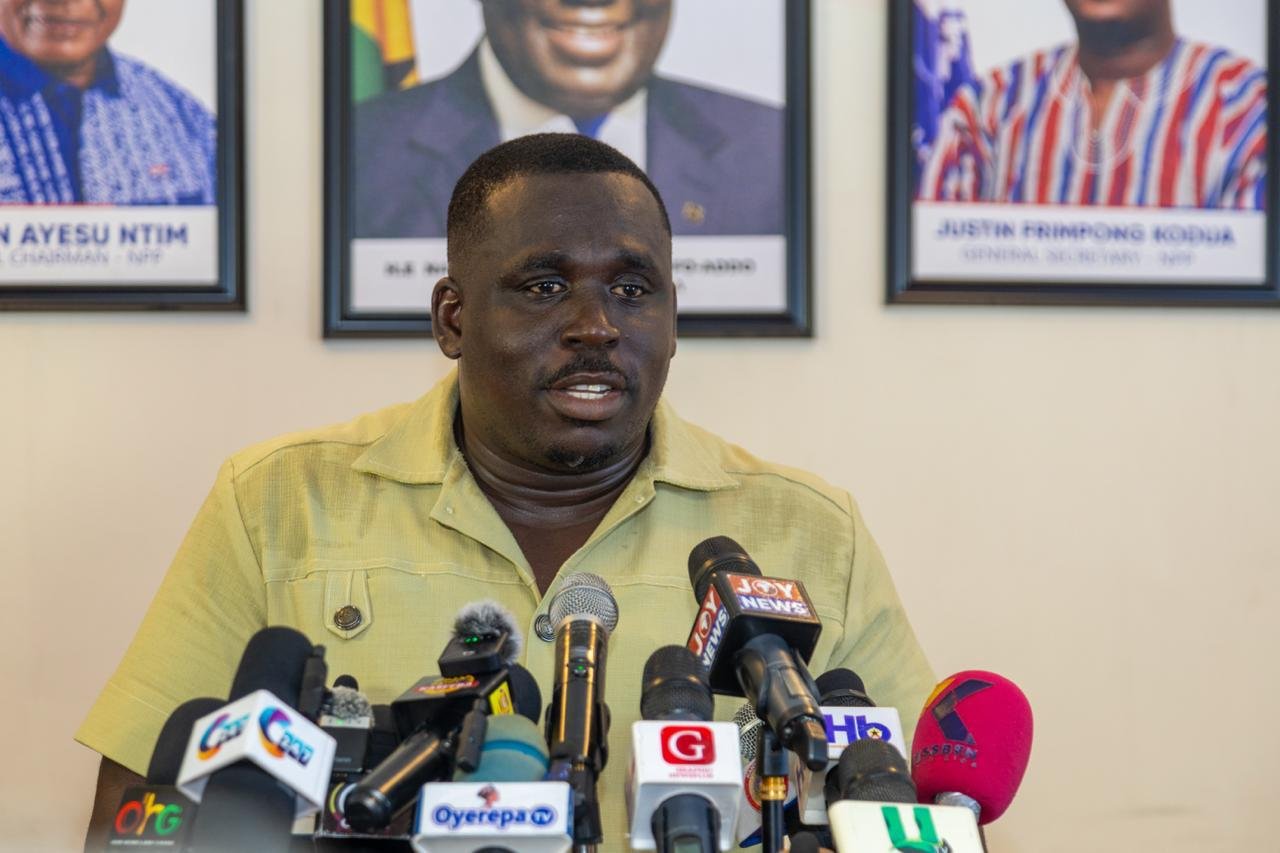
Former Deputy Communications Director of the New Patriotic Party (NPP), George Krobea Asante, has raised concerns over delays in the voting process, alleging that the situation was deliberately engineered to frustrate delegates.
In a statement, Mr. Krobea Asante said the voting process was “intentionally and artificially delayed,” describing the development as disappointing.
According to him, the delay created unnecessary difficulties for delegates who had gathered to participate in the exercise. His comments come amid concerns about the organisation and management of the voting process at the event.
“The voting process was intentionally and artificially delayed to frustrate the delegates which is so disappointing,” Mr. Krobea Asante said.
His remarks suggest concerns over whether the delays were merely administrative or formed part of a deliberate attempt to inconvenience participants. However, he did not provide specific evidence or identify individuals or groups he believes were responsible for the alleged delay.
The claim is expected to draw attention to the conduct of the voting exercise and the measures put in place to ensure an efficient process for delegates.
As of the time of publication, there was no response from the organisers addressing the allegation or providing an explanation for the reported delays.
Mr. Krobea Asante is a former Deputy Communications Director of the NPP and remains a commentator on political developments within the party.

“Mahama Is the Best in Africa” – Nollywood Actor Harry B Anyanwu Praises Ghana President

We Have an Identity Problem – Bisa Kdei Warns Highlife Is Losing Its Identity to Afrobeats

Fetu Afahye: The History, Traditions and Cultural Meaning of Cape Coast’s Famous Festival



-

 General News1 week ago
Fidelity Bank Chairman Named Ghana’s Topmost Transformational Board Chair 2026
-
 Technology2 weeks ago
Rolls-Royce Expands Aviation Business with Major Philippine Airlines Engine Agreement
-
 Entertainment2 weeks ago
Ras Caleb assesses institutions under the Tourism Ministry, highlighting key roles.
-
 Entertainment2 weeks ago
Ras Caleb Appiah-Levi: The musician, Pan-Africanist and organiser whose career spans four decades
-
 Entertainment1 week ago
Ras Caleb Appiah-Levi Reflects on Death, Wealth and Equality: “Death Neither Knows Rich Nor Poor”
-
 Business2 weeks ago
Rev. Dr. Christian Kwetey Kweitsu Honoured for Excellence in Audiology Practice in Kigali
-
 General News2 weeks ago
Sudan Chemical Weapons Allegations: UN Signals Readiness for Possible Investigation
-
 Politics6 days ago
Asiedu Nketiah to Chair Launch of Six NDC Historiographies on Ghana’s Political Journey