
General News
Traffitech-GH: Vehicle Owners Remain Liable Even When Someone Else Was Driving

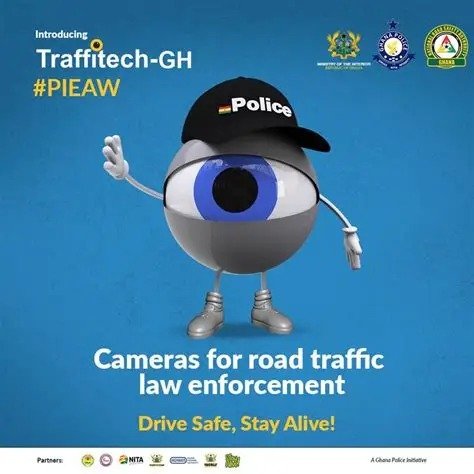
Ghana’s new automated traffic enforcement system, Traffitech-GH, has introduced a rule that could become one of the system’s most debated aspects: the registered owner of a vehicle remains legally responsible for traffic offences committed with the vehicle, regardless of who was behind the wheel.
According to the Ghana Police Service’s Traffitech-GH guidance, an Electronic Notice of Violation (ENV) generated by an automated camera is sent to the vehicle owner’s registered phone number.
The system is designed to use cameras, sensors and speed-measurement devices to automatically capture offences including speeding and running red lights. The evidence is then transmitted to a back office where the Ghana Police Service reviews the alleged offence before an ENV is issued by SMS.
The brochure makes clear that the registered owner remains liable for the offence even when another person was driving the vehicle at the time.
This means vehicle owners could receive an ENV for an offence they personally did not commit behind the wheel. The document states that the registered owner remains responsible regardless of who was driving.
The issue becomes particularly important for vehicles used by family members, employees, company drivers, commercial operators and other third parties.
The Police guidance also warns that motorists who have sold a vehicle but failed to officially update the ownership details with the Driver and Vehicle Licensing Authority (DVLA) could continue to face liability for offences committed with the vehicle.
The brochure states that a former owner remains legally responsible for violations committed with a vehicle registered in their name until the updated ownership status and telephone number are recorded with the DVLA.
For stolen vehicles, owners are advised to report the theft immediately to the Police. Where a vehicle or licence plates were stolen before an alleged offence, the owner can contest the violation if they have a written police report showing that the theft occurred before the offence.
The system nevertheless provides a mechanism for challenging an alleged offence. A motorist who disputes an ENV must begin the contest process online within 14 days of its issuance.
The person must provide the ticket number, select a preferred MTTD regional police station and attend the scheduled hearing with the ENV reference number and valid identification.
The controversy surrounding the rule is likely to centre on the question of whether responsibility should follow the vehicle or the person who actually committed the offence.
Traffitech-GH, however, places the legal responsibility on the registered vehicle owner under the framework outlined in the Road Traffic Regulations, 2026 (L.I. 2519).
The Police say the broader objective is to improve compliance with road traffic laws and reduce crashes, deaths and injuries.








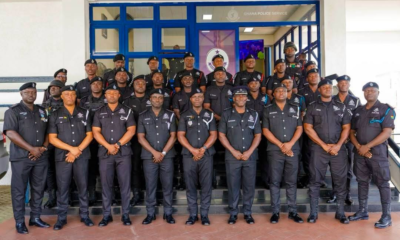


The Ghana Police Service has rescheduled the full implementation of its automated traffic law enforcement programme, TRAFFITECH-GH, from October 1 to November 1, 2026.
The Police Service, through the Motor Traffic and Transport Department (MTTD), announced the change in a press release dated September 29, 2026, signed on behalf of the Director-General of Public Affairs by Deputy Superintendent of Police Richmond Mensah, Staff Officer at the Public Affairs Directorate.
According to the Police, the decision to postpone the full rollout is intended to allow for more extensive public awareness and education on the TRAFFITECH-GH programme before its implementation.
The additional period will be used to educate motorists and other road users on how the system operates, the types of traffic offences it is designed to detect, and the Electronic Notices of Violation (ENV) that will be issued to motorists who are found to have committed offences.
TRAFFITECH-GH forms part of the Ghana Police Service’s broader efforts to address indiscipline on the country’s roads and improve compliance with road traffic laws and regulations.
The automated enforcement system is expected to support the Police in detecting traffic violations and enforcing road safety regulations through technology.
The Police Service has therefore urged motorists, drivers and vehicle owners to use the additional period before the November 1 rollout to familiarise themselves with the programme and understand its operations.
The Service said the extension would provide road users with more time to understand the offences that could be detected under the system and the procedures surrounding the issuance of Electronic Notices of Violation.
The Ghana Police Service also expressed appreciation to the media for what it described as its unflinching support throughout the introduction of the TRAFFITECH-GH project.
It reaffirmed its commitment to working with the media and other stakeholders to ensure the successful implementation of the programme as part of efforts to improve road safety in Ghana.
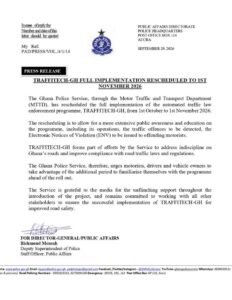
The Police Service said the full implementation of TRAFFITECH-GH will now commence on November 1, 2026, rather than the previously announced October 1 date.
A motorist who commits more than one traffic offence during the same incident could receive separate Electronic Notices of Violation under Ghana’s Traffitech-GH system.
The Ghana Police Service states that where more than one offence is recorded at the same time—for example, speeding and running a red light at the same intersection—each offence is recorded and processed separately.
The motorist would therefore receive a separate ENV and ticket number for each offence.
This means a single driving episode can potentially result in multiple enforcement records rather than one combined violation.
Traffitech-GH was developed by the Ghana Police Service as an automated road traffic enforcement system. It uses cameras and sensors to identify violations and automatically capture pictures and/or videos of offending vehicles.
The system is intended to increase compliance with road traffic laws and reduce road crashes, deaths and injuries.
The offences being monitored go beyond speeding and red-light violations.
The Police list expired roadworthiness certificates, wrongful overtaking, failure to use seatbelts, expired licences, driving uninsured vehicles and misuse of sirens among the offences that can be enforced under the system.
For insurance offences, drivers have a specific responsibility. The brochure says a driver is responsible for ensuring that the vehicle being driven has valid motor insurance, even if the driver does not own the vehicle.
Motorists can check insurance status by dialling 92057# followed by the vehicle registration number.
The system also applies broadly to vehicles using Ghana’s public roads.
The Police say Traffitech-GH covers private cars, motorcycles, tricycles such as aboboyaa, taxis, trotros, ride-hailing vehicles, haulage trucks and commercial buses.
However, the brochure says the system applies to Ghanaian-licensed drivers and locally registered vehicles, while offences involving foreign-registered vehicles are handled through separate procedures.
Company vehicles are also covered.
Where a vehicle is registered to a company, employer or organisation, the ENV is issued to the registered owner, with the company responsible for paying or contesting the violation within the stipulated period.
The enforcement process gives motorists 14 days to either settle a violation or begin a contest.
Those who choose to contest must start the process online. They cannot begin the contest procedure by simply walking into a GPS-MTTD or Judicial Service office.
After submitting the contest and selecting a preferred MTTD police station, the motorist will be contacted to arrange an appointment. Following the police-station stage, a court hearing will be scheduled.
If the motorist changes their mind during the contest process, they can pay the outstanding fine plus any accumulated late-payment penalty, which ends the contest process.
The multiple-ticket rule could therefore become particularly significant for motorists who commit several offences during a single journey, because each recorded offence is treated independently under the Traffitech-GH framework.
Motorists who assume that a traffic enforcement camera must be preceded by a warning sign before a violation can be enforced have been given a clear answer under the Traffitech-GH guidelines: the absence of a warning sign does not invalidate a traffic offence.
The Ghana Police Service’s Traffitech-GH brochure states that some road stretches and intersections have warning signs announcing enforcement activities or equipment, while others do not.
More significantly, the guidance says there is no legal obligation to announce MTTD-related traffic enforcement operations or equipment intended to improve road safety in Ghana.
This means motorists could encounter automated enforcement equipment without necessarily seeing a prior warning sign and still receive an Electronic Notice of Violation if they breach traffic regulations.
Traffitech-GH uses fixed, mobile or in-vehicle devices and laser speed-measurement equipment to detect offences. The system can capture speeding and red-light violations, with images and/or videos transmitted for validation before an ENV is issued.
The system also covers a wider range of offences, including expired roadworthiness certificates, wrongful overtaking, non-use of seatbelts, expired driving licences, driving uninsured vehicles and misuse of sirens.
Speed limits are also clearly outlined in the guidance.
The brochure states that, generally, highways have a speed limit of 90 km/h, motorways 100 km/h, urban or built-up areas 50 km/h, while a 30 km/h limit applies within areas such as schools, playgrounds, health facilities, churches, mosques, markets, shopping centres, processions and locations where human activity is predominant.
The Police guidance says licensed drivers are expected to know these limits whether or not a speed-limit sign is posted.
The red-light enforcement rule is equally strict.
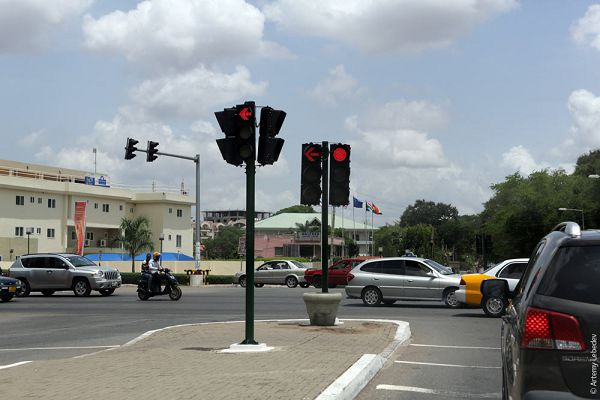
According to the brochure, if the tyres of a vehicle cross the stop line after the traffic signal has turned red, the driver has committed a red-light offence.
A driver who believes the signal was still yellow at the precise moment the tyres crossed the stop line can review the video evidence and contest the violation within 14 days.
The controversial aspect is that motorists cannot rely simply on the absence of a camera-warning sign as a defence.
Instead, the Police direct drivers to use the evidence attached to their ticket. Motorists can enter their ticket number on Ghana.gov.gh and access the photo or video evidence and other violation data.
Access to the evidence is restricted to the vehicle owner or driver, authorised MTTD officers, back-office validation staff and the courts.
The enforcement system therefore places greater responsibility on drivers to know the applicable traffic rules rather than relying on warnings about enforcement equipment.


The Ministry of Lands and Natural Resources has taken note of reports and social media publications suggesting that the Minister for Lands and Natural Resources, Hon. Emmanuel Armah-Kofi Buah, MP, has resigned from the Board of the Ghana Gold Board (GoldBod).
The Ministry wishes to state categorically that the reports are false and do not reflect the facts.
Hon. Emmanuel Armah-Kofi Buah has not resigned from GoldBod, nor has there been any disagreement between him and the Ghana Gold Board.
The Minister, who initially served personally on the GoldBod Board, subsequently nominated the Chief Director of the Ministry, Mr. Marcus Haligah, to represent him on the Board in January 2026.
This decision was purely administrative and was necessitated by the Minister’s demanding schedule and the extensive responsibilities associated with his portfolio.
At the time, Hon. Armah-Kofi Buah was handling responsibilities across two Ministries, making it increasingly difficult for him to personally attend all Board meetings and engagements of GoldBod.
He therefore exercised the appropriate institutional arrangement by designating the Chief Director, a senior official of the Ministry, to represent him.
This arrangement is consistent with the governance framework of GoldBod, which permits designated representatives to serve on the Board on behalf of members where applicable.
The recent clarification by GoldBod itself confirms that the Minister initially served on the Board personally but, due to his busy schedule and inability to attend Board meetings regularly nominated the Chief Director to represent him.
The Ministry therefore urges the public, media organisations and other stakeholders to disregard reports suggesting that the Minister resigned from GoldBod or that his decision was connected to any disagreement, conflict or dissatisfaction with the institution.
The ministry enjoys a good working relationship with GoldBod.
The Ghana Geological Survey Authoriy (GGSA) has signed a Memorandum of Understanding (MoU) with GoldBod to intensify exploration of mining activities The Responsible Corporative Mining (rCOMSDEP) is equally working with the Godbod on responsible mining.
GoldBod is working with The Forestry Commission (FC) on land reclamation and has supported NAIMOS with vehicles as part of our collaborative efforts.
Hon. Emmanuel Armah-Kofi Buah therefore remains committed to the Government’s agenda of strengthening Ghana’s gold sector, increasing local value retention, promoting responsible mining and ensuring that the country’s mineral resources contribute meaningfully to national development.
The Ministry further encourages the public and the media to rely on official communications from the Ministry of Lands and Natural Resources and the Ghana Gold Board on matters concerning the governance and operations of GoldBod.
Motorists who receive Electronic Notices of Violation (ENVs) through Ghana’s new Traffitech-GH system have 14 days to pay or contest the violation, but failure to act within that period comes with an additional financial penalty.
The Ghana Police Service says a late-payment penalty of 1% of the original fine is added for every day of default after the 14-day payment period.
The rule is one of the most significant financial consequences contained in the Traffitech-GH enforcement guidelines, particularly for motorists who ignore an electronic notice or fail to resolve a disputed violation on time.
Traffitech-GH is an automated traffic enforcement system developed by the Ghana Police Service to enforce road traffic laws. Cameras and sensors capture images and/or videos of offences, including speeding and red-light violations.
Other offences covered include expired roadworthiness certificates, wrongful overtaking, failure to use seatbelts, use of an expired driving licence, driving an uninsured vehicle and misuse of sirens.
Once an offence has been reviewed, the vehicle owner receives an ENV by SMS. The notice contains important information including the ticket number, location, date and time of the offence, vehicle registration number, description of the alleged offence, amount payable and payment deadline.
Motorists have two main options after receiving the notice: pay within 14 days through an approved channel or contest the violation online within the same period.
Payments are to be made through Ghana’s official government platform, [www.ghana.gov.gh](http://www.ghana.gov.gh), using mobile money or a debit or credit card. Motorists can also dial *222#, select option 6 and follow the prompts.
The financial consequences do not end with the daily penalty.
The Traffitech-GH guidelines state that outstanding fines can also affect a motorist’s dealings with the DVLA. A person with an outstanding Traffitech-GH fine may be prevented from accessing certain DVLA services until the debt is cleared.
The Police guidance says DVLA will not renew a driver’s licence or transfer, register, re-register, lay off or inspect a vehicle for roadworthiness while an outstanding Traffitech-GH fine remains unpaid.
For motorists who receive multiple violations, each offence is treated as a separate offence record with its own ticket number, and all outstanding fines must be cleared before DVLA services are restored.
The system also allows motorists to check outstanding fines by dialling *220#.
The 1% daily penalty is therefore only one part of the enforcement mechanism. The combination of accumulating penalties and possible restrictions on DVLA transactions could create significant financial and administrative consequences for motorists who fail to resolve their cases within the stipulated period.
However, motorists who genuinely dispute a violation are given a 14-day window to begin the contest process. The Police advise drivers to first review the photographic or video evidence before deciding whether to pay or contest the notice.

Bagbin cautions against using free speech to justify online threats and misinformation

TRAFFITECH-GH Full Rollout Moved to November 1

Speeding and Running a Red Light? Traffitech-GH Can Issue Separate Tickets



-

 General News1 week ago
Two political parties, one lesson: Afuntummireku and Tikro Nkɔ Agyina for Ghana
-

 Culinary1 week ago
Kofi Brokeman: The Simple Ghanaian Snack That Has Stood the Test of Time
-

 General News1 week ago
Rev. Dr. Christian Kwetey Kweitsu Set for International Recognition at 100 Most Influential Persons Awards in Kigali
-

 General News6 days ago
Free Speech, False Publication and Presidential Criticism in Ghana: Where Does the Law Draw the Line?
-

 General News2 weeks ago
Bost Energies Made GH¢684 Million Profit: Why Use The NPA Bill, 2026 To Weaken Its Operations?
-

 Entertainment1 week ago
Can’t Anything Good Come Out of Ghana? – Ras Caleb Appiah-Levi Fires Back at Critics
-

 General News6 days ago
Don’t Expect Concerts When People Can’t Afford Food – Rex Omar on Black Star Experience
-

 General News1 week ago
Shatta Wale Urges UPSA Students to Turn Ideas into Sustainable Ventures