
General News
Oil Prices Extend Losses as Middle East Supply Fears Ease

17 September 2026 | Energy & Markets
Oil prices fall for a second day
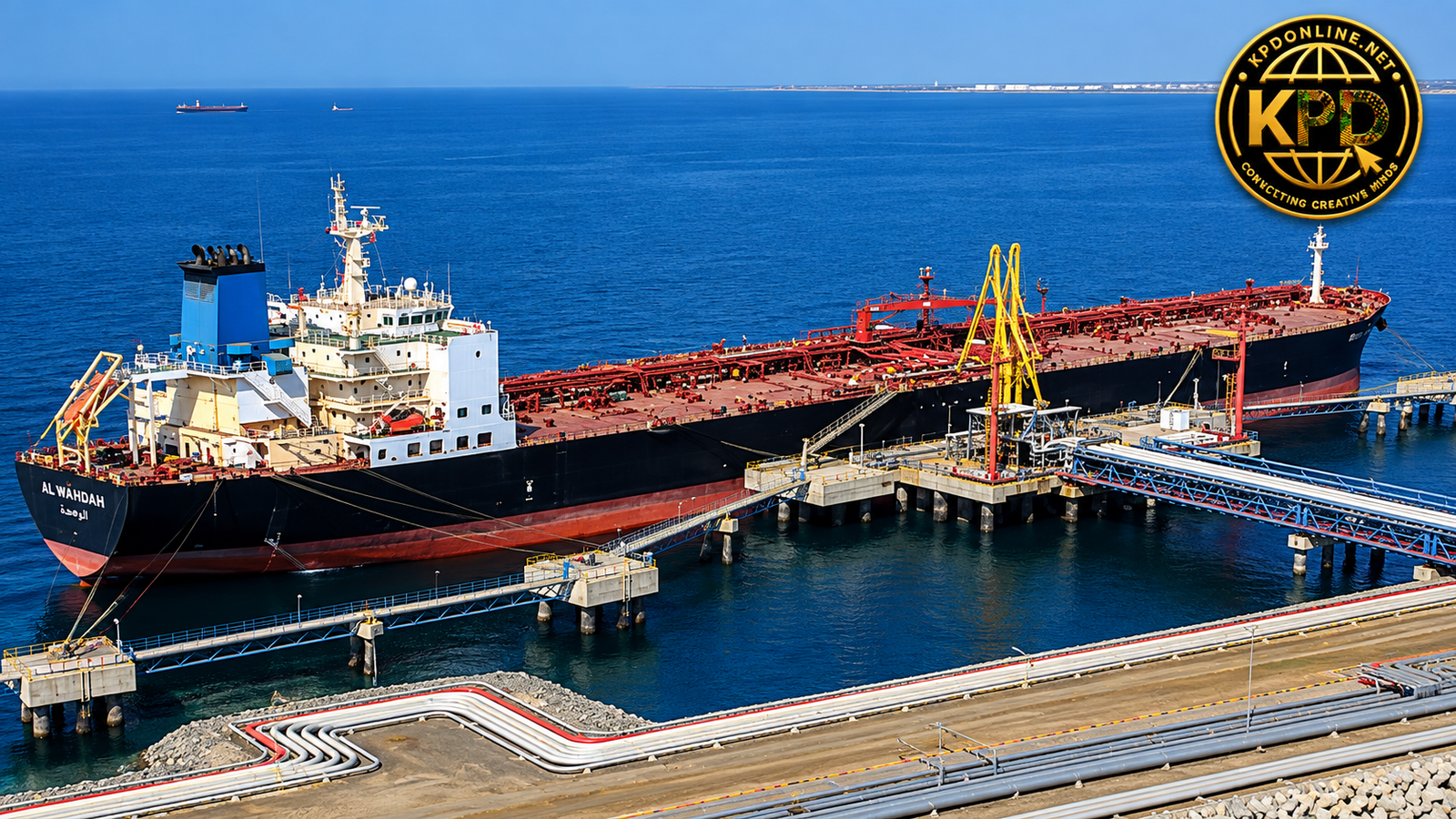
Oil prices extended their decline in Asian trading on Thursday as signs that Saudi Arabia can redirect some crude exports through Oman eased immediate concerns about shortages caused by disruptions to Middle Eastern supply routes.
Brent crude futures were down about 1.2% at $104.59 a barrel, while U.S. West Texas Intermediate (WTI) fell about 1.1% to $101.29 in early trading. Both benchmarks had dropped roughly $3 on Wednesday.
The decline represents a change in market sentiment after oil prices climbed sharply earlier in September as attacks on energy infrastructure and shipping routes raised concerns that Middle Eastern exports could be significantly curtailed.

EURODIESEL diesel fuel | Aramco Fuels Poland
Saudi Arabia finds an alternative export route
The immediate catalyst for the latest decline is Saudi Arabia’s reported decision to offer additional crude cargoes to Asian refiners through Oman.
People familiar with the arrangements told Reuters that Saudi crude is being moved through ship-to-ship transfers near Oman’s Sohar port. The alternative route is helping reduce the impact of disruptions affecting Saudi Arabia’s East-West pipeline and the Red Sea export terminal at Yanbu.
The workaround does not completely eliminate the supply problem. Reuters reports that the additional shipments are not expected to fully replace exports lost from Yanbu.
That distinction is important for the market: traders are reacting to evidence that some barrels can still reach customers, rather than concluding that Middle Eastern supply disruptions have ended.

SOHAR Port and Freezone: Pioneering growth and sustainability in logistics – Logistics Middle East
What happened to Saudi Arabia’s pipeline?
Saudi Arabia’s East-West pipeline has become particularly important because it provides a route for crude to reach the Red Sea without passing through the Strait of Hormuz.
Recent attacks damaged pumping stations along the pipeline, affecting the flow of crude toward Yanbu, one of Saudi Arabia’s important Red Sea export facilities. Saudi Arabia subsequently suspended some loadings from Yanbu and cancelled some deliveries to European customers.
The pipeline’s disruption had contributed to the rapid rise in oil prices earlier in the week.
On September 15, Brent and WTI settled more than $3 higher, reaching their highest levels since May 19, after the Yanbu disruption intensified concerns about available supply.

Oil pump in the desert
Oil remains above $100
Despite the latest decline, crude remains above the psychologically important $100-a-barrel level.
That reflects the fact that the underlying geopolitical risks have not disappeared.
Brent had settled at $105.83 on Wednesday after falling 2.7%, while WTI settled at $102.43, down 3.2%.
Earlier in September, the benchmarks had surged as attacks on shipping and energy infrastructure raised fears of prolonged supply disruptions. On September 10, Brent jumped more than 6% to settle at $107.63, while WTI rose to $102.48.

$100mln credit facility to power Advario’s liquid logistics services in Oman
The Strait of Hormuz remains a major risk
The oil market continues to watch the Strait of Hormuz, a critical energy shipping route.
Before the current conflict, approximately one-fifth of global oil supplies passed through the waterway. Recent restrictions and security concerns have significantly reduced tanker traffic. Reuters reported that only four vessels passed through the strait on Tuesday, compared with seven the previous day.
This leaves the global market vulnerable to another escalation.
Saudi Arabia’s alternative routes—including shipments through Oman and other workarounds—can partially reduce the impact, but they cannot necessarily replace all the volumes that normally move through the region.

Sohar Port pulls in $2.5bn worth petchem projects – Oman Observer
U.S. inventories also weigh on prices
Another factor pushing prices lower is the latest U.S. inventory data.
U.S. crude stocks fell by only 640,000 barrels last week, according to the Energy Information Administration, compared with analysts’ expectations for a decline of about 1.62 million barrels.
A smaller-than-expected decline suggests that the U.S. market currently has somewhat more supply available than traders had anticipated.
The inventory picture therefore provides another reason for traders to reduce the amount of geopolitical risk being priced into crude.

Oman deaths: Three Indian workers die in ‘accident’ on board ship in Sohar port | The National
But fuel markets remain under pressure
The fall in crude prices should not be confused with an easing of all energy-market pressures.
Diesel markets remain particularly tight.
Reuters reported that Asian refining margins for low-sulfur diesel recently climbed above $87 a barrel, an all-time high based on LSEG pricing data. European diesel prices have also remained close to record levels.
This creates a significant distinction:
Crude oil prices are falling, while refined fuel markets remain exceptionally tight.
For consumers and businesses, that means lower crude prices may not immediately translate into significantly cheaper diesel or other petroleum products.

Aramco reroutes crude shipments to Yanbu port: Report – Latest News from Saudi Arabia and the World
Saudi production has already been severely affected
The current price decline also comes against a backdrop of substantial disruption to Saudi oil production and exports.
The International Energy Agency estimated that Saudi crude supply fell to around 6 million barrels per day in August, its lowest level in more than three decades. The IEA attributed the decline to attacks affecting oil infrastructure and shipping around the region.
The agency subsequently revised down its 2026 Saudi crude-supply forecast.
The U.S. Energy Information Administration likewise estimates that Middle Eastern crude production shut-ins averaged 6.7 million barrels per day in August, up from approximately 5 million barrels per day in July.
These figures illustrate why the market remains sensitive to any new attack or disruption even when prices are temporarily declining.

With 4 Million Barrels Daily: Saudi Arabia Surpasses Hormuz as Yanbu Changes the Game — Sabq
Market picture
| Factor | Current effect on oil |
|---|---|
| Saudi crude offered through Oman | Reduces immediate supply fears |
| Damage to East-West pipeline | Continues to constrain exports |
| Yanbu loading disruption | Negative for available supply |
| Lower-than-expected U.S. inventory draw | Puts downward pressure on prices |
| Low Strait of Hormuz traffic | Maintains geopolitical risk premium |
| Tight diesel supplies | Supports refined-fuel prices |
| Continuing Middle East conflict | Creates risk of renewed price increases |

Major Global Energy Lifeline Struck This Week – Caspianpost.com
What could happen next?
The direction of oil prices will depend heavily on whether alternative supply routes remain available and whether further attacks disrupt additional infrastructure.
For now, the market appears to be responding to evidence that Saudi Arabia can partially compensate for lost Red Sea exports.
However, this is not the same as a return to normal supply conditions.
The IEA has warned that disruptions in the Gulf and wider Middle East could keep global oil markets tight. The EIA’s September outlook also assumes that Middle Eastern oil flows will remain constrained through the fourth quarter of 2026, although it expects flows to gradually increase as shipping companies develop alternative routes.
That leaves the market particularly sensitive to three developments:
- Whether Saudi Arabia can sustain alternative shipments through Oman.
- How quickly the East-West pipeline can be repaired.
- Whether fighting around the Strait of Hormuz and Red Sea intensifies or eases.
Independent assessment
The latest decline in oil prices is primarily a supply-logistics story rather than evidence that the Middle East crisis has ended.
Saudi Arabia’s ability to redirect crude through Oman has reassured traders that at least some displaced barrels can still reach Asian buyers. Lower-than-expected U.S. inventory withdrawals have provided another bearish signal.
At the same time, oil remains above $100, tanker traffic through the Strait of Hormuz remains severely affected, Saudi production has been disrupted and diesel markets are experiencing extraordinary tightness.
The immediate supply panic has eased, but the underlying risk to global energy flows remains significant.
For consumers, refiners and governments, the key issue in the coming days will therefore be whether these alternative shipping arrangements develop into a sustained supply solution—or whether another disruption causes the risk premium in oil prices to rise again.
Sources
Reuters, Oil prices extend losses as fears of Middle East supply disruptions ease, 17 September 2026.
Reuters, Oil slips as Saudi Arabia offers more crude via Oman, 16 September 2026.
U.S. Energy Information Administration, Short-Term Energy Outlook, September 2026.
Reuters, reporting on Saudi supply, Asian diesel markets and Middle East disruptions.



















The Students Loan Trust Fund (SLTF) has revealed that it has spent about GH¢600 million this year on a range of programmes aimed at supporting Ghanaian students and expanding access to tertiary education.
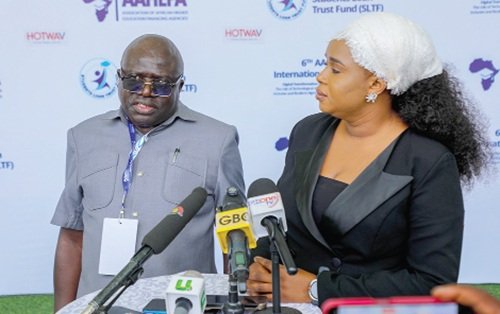
Chief Executive Officer of the SLTF, Dr Saajida Shiraz, disclosed that the amount covered several major interventions, including the Students’ Loan, Students Loan Plus, allowances for teacher trainees, the No Academic Fees policy and free tertiary education support for persons with disabilities.
GH¢600m committed to student support
According to Dr Shiraz, the Fund has had to deploy significant financial resources this year to meet the growing demand for tertiary education financing.
She explained that the approximately GH¢600 million represents spending across the Fund’s various portfolios rather than only the traditional student loan programme.
The programmes are designed to provide financial support to students facing different educational expenses and barriers.
Spending expected to rise to GH¢800m
Dr Shiraz also disclosed that expenditure is expected to increase significantly in the next academic year.
She projected that the Fund could spend close to GH¢800 million as demand for its various interventions continues to grow.
“So this year, we have spent quite some money. In the next academic year it is going to be a little significantly higher than that; we are looking at close to GH¢800 million,” she said.
The projection reflects the Fund’s expanding role in financing tertiary education and implementing government-backed student support programmes.
No Academic Fees support reaches 169,000 students
Dr Shiraz further disclosed that the SLTF had so far disbursed support to 169,000 students under the No Academic Fees policy.
The Fund is targeting approximately 175,000 students under the initiative for the year.
The No Academic Fees policy forms part of efforts to reduce financial barriers for students entering public tertiary institutions.
Earlier figures released by the Fund showed that its interventions had already reached hundreds of thousands of students, with significant government funding channelled through the SLTF.
Technology being deployed to speed up payments
The SLTF CEO said the Fund is also relying increasingly on technology to improve its operations and make the disbursement process more efficient.
However, she noted that some applicants continue to encounter problems involving mismatched names and data during the verification process.
Students affected by such discrepancies have been advised to upload their affidavits through the SLTF portal to enable the Fund to verify their identity and confirm their student status before processing their applications.
Student Loan Plus expands access
The Fund’s support extends beyond the regular student loan programme.
Through Students Loan Plus, eligible students can access larger loans to cover their educational needs. Earlier in 2026, the SLTF said the initiative had benefited more than 1,400 students, including hundreds of law students, with payments made directly to their institutions.
The programme has also been expanded to support students at the Ghana School of Law.
Bigger financial commitment ahead
The latest disclosure points to a growing financial commitment to tertiary education financing in Ghana.
With expenditure projected to rise from about GH¢600 million this year to nearly GH¢800 million next academic year, the SLTF is preparing for a higher level of demand from students and institutions.
The Fund says its focus remains on using technology and expanded financing mechanisms to ensure that eligible students can access the support they need.
As the next academic year approaches, the big question will be how effectively the projected GH¢800 million can be deployed to reach more students while keeping the application, verification and disbursement process smooth.
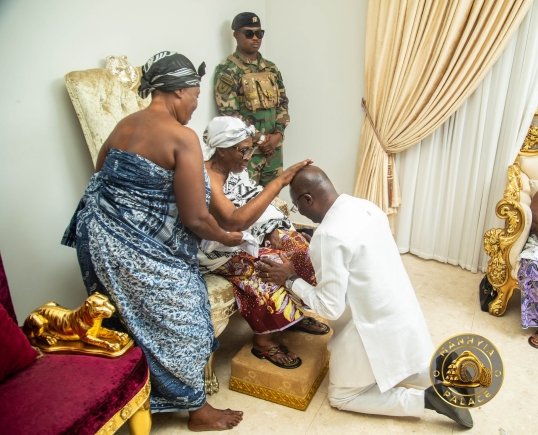
NPP flagbearer Dr Mahamudu Bawumia has paid a courtesy call on the newly enstooled Asantehemaa, Nana Yaa Akyaa II, at the Manhyia Palace in Kumasi, seeking her blessings as he prepares for the 2028 presidential race.
The visit took place on Thursday, September 17, 2026, with Dr Bawumia using the occasion to congratulate Nana Yaa Akyaa II on her enstoolment and formally engage the traditional leadership of the Asante Kingdom.
Bawumia arrives at Manhyia
Dr Bawumia, who is the NPP’s flagbearer for the 2028 presidential election, was accompanied by several senior party figures and supporters during the visit.
Among those who accompanied him were former Suame MP Osei Kyei-Mensah-Bonsu, Bantama MP Francis Asenso-Boakye, Deputy Minority Leader Patricia Appiagyei and other NPP executives and party stalwarts.
The visit was primarily to congratulate the Asantehemaa on assuming the revered traditional position and to seek her prayers and blessings.
‘Please remember me in your prayers’
During the meeting, Dr Bawumia presented his presidential ambition to the Asantehemaa and appealed to her to remember him in her prayers.
According to reports from the meeting, he told Nana Yaa Akyaa II that Asanteman and the NPP had entrusted him with the mandate to lead the party into the 2028 elections.
He subsequently asked for her prayers as he pursues his ambition of becoming President of Ghana.
Asantehemaa responds with prayers
Nana Yaa Akyaa II responded to the request and assured Dr Bawumia of her prayerful support.
She is reported to have told him that she would support him with prayers to guide his endeavours.
The interaction adds another significant moment to Dr Bawumia’s engagements with traditional leaders as political activities gradually build towards the 2028 general election.
Bawumia describes Queenmother as ‘blessed’
Dr Bawumia also congratulated Nana Yaa Akyaa II and described her ascension to the Asantehemaa stool as a blessing to Asanteman and Ghana.
He prayed for her long life, good health and continued guidance in her new role.
According to reports, he said God had placed her in the position and described her as blessed.
A significant traditional engagement
Nana Yaa Akyaa II is the newly enstooled Asantehemaa and succeeds the late Nana Ama Konadu Yiadom III.
Her official introduction followed her enstoolment by Asantehene Otumfuo Osei Tutu II, in accordance with Asante customs and traditions.
Her installation has attracted visits from political leaders, government officials and other groups seeking to congratulate her and pay homage.
Earlier in September, a delegation of female government appointees led by Deputy Chief of Staff Nana Oye Bampoe Addo also visited the Manhyia Palace to congratulate the Asantehemaa and seek stronger collaboration between traditional leadership and government.
Bawumia’s 2028 journey gathers momentum
The Manhyia visit comes as Ghana’s political landscape begins to take shape ahead of the 2028 presidential election.
Dr Bawumia has already secured the NPP’s presidential nomination, and his engagement with traditional authorities forms part of his broader political activities ahead of the next national contest.
For now, his visit to the Manhyia Palace has ended with a message of congratulations to the new Asantehemaa and a request for prayers as he pursues his presidential ambition.
At Manhyia, the NPP flagbearer sought the blessings of Nana Yaa Akyaa II — adding another notable chapter to his journey towards the 2028 election.



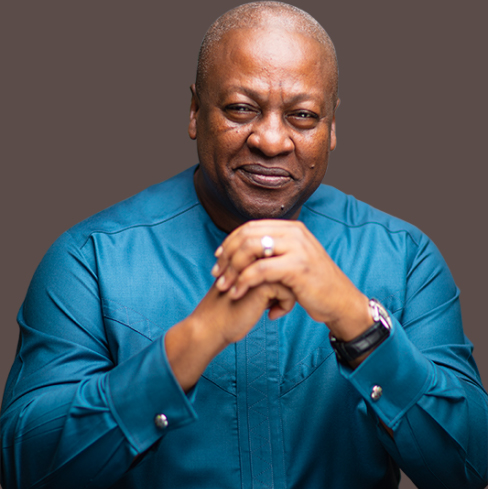
President John Dramani Mahama has ordered the formation of an inter-agency task force to develop a detailed roadmap to strengthen Ghana’s efforts to prevent narcotic drugs from being trafficked through the country’s borders.
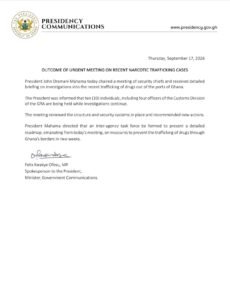
The directive followed an urgent meeting between the President and security chiefs on Thursday, September 17, over recent drug-trafficking cases involving Ghana’s ports.
The meeting reviewed ongoing investigations into the movement of narcotics through the ports, as well as the security structures and systems currently in place at Ghana’s borders.
According to the Presidency, President Mahama was informed that 10 people are currently being held in connection with the investigations.
Four of those in custody are officers of the Customs Division of the Ghana Revenue Authority (GRA).
The identities of the 10 individuals and the specific allegations against them were not disclosed.
Following the briefing, the meeting considered additional measures to strengthen Ghana’s systems for detecting and preventing narcotics trafficking.
President Mahama subsequently directed the establishment of an inter-agency task force to translate the recommendations from the meeting into a detailed roadmap.
The task force has been given two weeks to complete and submit the roadmap.
The move is intended to strengthen coordination among the institutions responsible for Ghana’s ports, borders, customs, intelligence and law-enforcement systems.
The meeting comes amid heightened attention to drug-trafficking cases linked to Ghana, including the seizure of nearly 3.9 tonnes of cocaine by French customs authorities from a container that had departed Ghana.
The Presidency has not indicated that the 10 people being held have been found guilty of any offence.
Their detention forms part of ongoing investigations into the recent narcotic-trafficking cases.
The urgent meeting was attended by security chiefs who briefed the President on the investigations and the existing security arrangements at Ghana’s ports and borders.
The Presidency said the discussions identified the need for additional measures to address vulnerabilities within the current system.
The statement on the outcome of the meeting was issued by Felix Kwakye Ofosu, MP, Spokesperson to the President and Minister for Government Communications.
The Presidency Communications statement was dated Thursday, September 17, 2026, and titled “Outcome of Urgent Meeting on Recent Narcotic Trafficking Cases.”

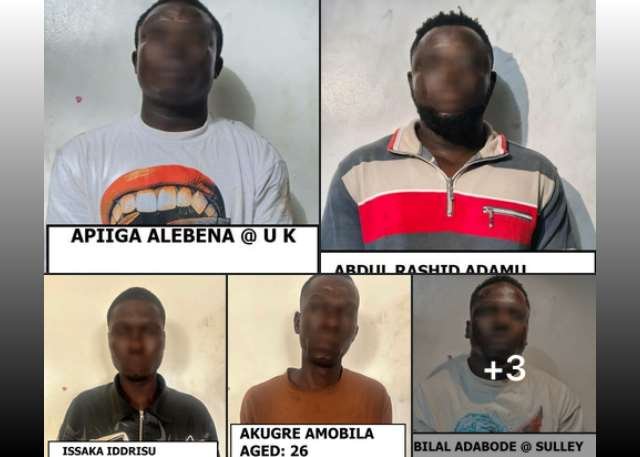
The Upper East Regional Police Command has arrested seven suspects allegedly linked to a robbery network operating across Zebilla, Garu and Binduri, following an intelligence-led operation in the region.
The suspects, aged between 20 and 41, are Issaka Iddrisu, 20; Ali Tamimu, 21; Akugre Amobila, 26; Banabas Apiiga, 41; Abdul-Rashid Adamu, 38; Apiiga Alebena, 21; and Bilal Adabodee, 31.
According to the Police, the arrests were carried out through a joint intelligence operation involving the Police Intelligence and Professional Standards Bureau (PID), the newly formed Black Cobra Unit and the Zebilla Neighbourhood Watch Community.
Suspects allegedly linked to wider robbery network
The Police said the suspects have reportedly confessed to being members of a wider network of gangs involved in armed robbery activities within the three communities.
Investigators are also pursuing information provided by the suspects about an alleged weapons supplier believed to be operating from Bawku.
The Police said the identity of the alleged supplier has been withheld as efforts continue to locate and arrest the person.
Victims identify two suspects
The case took a significant turn after two victims reported to the Police following the arrests.
The victims allegedly identified two of the suspects as members of a three-man armed robbery gang that attacked them at gunpoint.
According to the Police, the robbers made away with two Yamaha scooter motorbikes valued at GH¢30,000 and GH¢32,000 respectively.
The victims also told investigators that the attackers threatened to kill them if they reported the incident to the authorities.
The Police said the two suspects subsequently admitted to taking part in the robbery and provided information about the alleged source of the weapons used during the operation.
Police raid houses, recover cash and motorbikes
Searches conducted at the residences of Abdul-Rashid Adamu, Apiiga Alebena and Bilal Adabodee reportedly yielded several items of interest to investigators.
The Police said they recovered two unregistered motorbikes, quantities of suspected hard drugs and GH¢29,550 in cash.
The cash is believed by investigators to be proceeds from criminal activities, although the circumstances surrounding the items will form part of the ongoing investigation.
Seven suspects remanded
Following their arrests, all seven suspects were brought before the Bolgatanga Circuit Court.
The court has since remanded them into Police custody.
They are expected to reappear on September 23, 2026, as investigations continue.
Police intensify hunt for alleged weapons supplier
With the seven suspects now in custody, the Police have intensified efforts to identify and apprehend the person they allegedly named as their source of weapons.
The development is expected to help investigators determine whether the arrests have uncovered a broader organised robbery network operating across communities in the Upper East Region.
The Police Command says the operation forms part of ongoing efforts to clamp down on robbery activities and improve security in Zebilla, Garu, Binduri and surrounding areas.
For now, seven suspects are behind bars, while investigators continue the hunt for other persons allegedly connected to the robbery network.

Students Loan Trust disburses GH¢600m this year — CEO

Bawumia visits Asantehemaa, seeks blessings for presidential vision

Minority demands full account of GH¢58m World Cup expenditure



-

 Entertainment2 weeks ago
Mahama Is First President to Put GH¢40m Seed Money into Creative Arts Fund: Kojo Preko Dankwa
-

 Culinary2 weeks ago
The Green Heart of Ghanaian Cuisine: Celebrating Nkontomire and the Art of Abom
-
 General News2 weeks ago
Don’t Punish Them Retrospectively – Educationist Challenges New CSSPS Placement Rule
-
 General News2 weeks ago
OSP Opens Preliminary Investigation into Alleged GH¢70,000 Payment Linked to Parliament’s Vetting
-

 Entertainment1 week ago
Government Repatriates Musician Barosky from UK
-

 General News4 days ago
GTA’s Financial Strength Weakens Despite 2025 Tourism Activities
-

 Entertainment1 week ago
Keche Supports Street Vendor with GH¢3,000 After She Struggles to Make Sales
-

 General News1 week ago
TVET is not for the academically weak – Advocate calls for change in Ghana’s mindset