
General News
GBA condemns alleged EOCO attempt to arrest Manhyia South MP at High Court

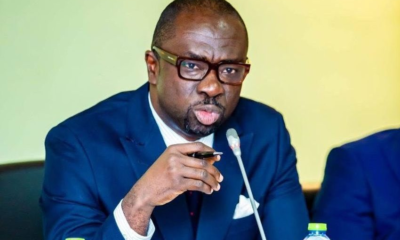
The Ghana Bar Association (GBA) has condemned what it describes as an improper attempt by the Economic and Organised Crime Office (EOCO) to arrest Manhyia South Member of Parliament and lawyer Nana Agyei Baffour Awuah at the Accra High Court Complex.
In a statement dated Thursday, September 24, 2026, the GBA said the incident occurred on Wednesday, September 23, while Baffour Awuah was at the court premises in his capacity as a lawyer representing a client.
The statement was signed by GBA President Mrs Efua Ghartey and National Secretary Kwaku Gyau Baffour.
The Association said it had taken note of the incident with grave concern, particularly the circumstances surrounding the alleged attempt by EOCO officers to effect the arrest.
According to the GBA, videos of the incident circulating publicly appeared to show a lawyer complaining about being assaulted by a woman after he allegedly refused to allow officers to carry out the arrest.
While stressing that neither being a lawyer nor a Member of Parliament places anyone above the law, the Association said law enforcement actions involving lawyers must be carried out within the framework of the Constitution and applicable laws.
It said lawyers must also be able to carry out their professional responsibilities without intimidation or unnecessary interference.
The GBA warned that attempts to circumvent the safeguards surrounding the legal profession could create a perception of intimidation and potentially have a chilling effect on lawyers who represent clients in sensitive cases.
The Association said lawyers occupy a critical position in Ghana’s justice system and play an important role in protecting the rights of citizens.
It argued that interference with a lawyer’s ability to represent a client, particularly through what it described as arbitrary or irregular measures, could undermine confidence in the administration of justice and the rule of law.
The GBA therefore stressed that lawyers should be allowed to represent clients of their choice without being subjected to undue influence or intimidation.
The Association recalled comments made by its President, Mrs Efua Ghartey, during the 2025 annual GBA conference in Wa, where she raised concerns about incidents affecting lawyers while performing their professional duties.
She stated:
“The Bar must never be silent in its role as the voice of the profession. Unfortunately, recent incidents affecting lawyers in the performance of their duties have left much to be desired. Lawyers should be at liberty to defend clients of their choice without being unduly influenced.”
Mrs Ghartey also warned that such conduct could affect the willingness of lawyers to take up pro bono cases.
The Association also referred to an earlier incident involving Justice Minka Premo, a former Vice-President of the Ghana Bar Association, and a young female lawyer who was working with him.
According to the GBA, the two lawyers had gone to the former Bureau of National Investigations (BNI) to defend a client when they were subjected to what the Association described as “regrettable treatment.”
The GBA said both lawyers were arrested and detained overnight.
It further noted that the female lawyer was a nursing mother and was separated from her baby as a result of the detention, initially preventing her from breastfeeding the child.
The Association questioned why the lawyers could not have been invited earlier if they had already come under the attention of security agencies before appearing at the BNI in their professional capacity.
The GBA said it continued to trust that security agencies would uphold Ghana’s constitutional principles of freedom and justice, while allowing lawyers to provide professional services to citizens without unnecessary obstruction.
The Bar has consequently called on EOCO and all relevant state institutions and agencies to ensure that their actions are consistent with due process, fairness and respect for the rights of persons involved in investigations and enforcement proceedings.
It emphasised that the principle of the rule of law requires not only that justice be done, but also that it be seen to be done.
“The independence of the legal profession is a cornerstone of every democratic society and must be protected at all times,” the Association said.
The GBA’s position, however, does not amount to a call for lawyers or MPs to be exempt from lawful investigations or arrests.
Rather, the Association said enforcement actions must be conducted through proper legal procedures and in a manner that does not interfere with a lawyer’s professional responsibility to represent a client.
The latest statement comes amid previous concerns raised by Baffour Awuah himself over the conduct of state institutions during arrests and investigations.
In July 2026, the Manhyia South MP criticised aspects of the arrest of NPP communications figure Dennis Miracles Aboagye by EOCO.
While acknowledging the authority and responsibility of state institutions to investigate allegations of wrongdoing, Baffour Awuah questioned aspects of the manner in which the arrest was handled.
The GBA’s latest statement focuses specifically on the broader issue of protecting lawyers while they are carrying out their professional duties.
The Association’s intervention therefore draws a distinction between a lawyer’s accountability under the law and the need to ensure that enforcement action does not improperly obstruct the lawyer’s representation of a client.
The statement was issued in Accra on September 24, 2026, and signed by Mrs Efua Ghartey, National President of the Ghana Bar Association, and Kwaku Gyau Baffour, National Secretary.











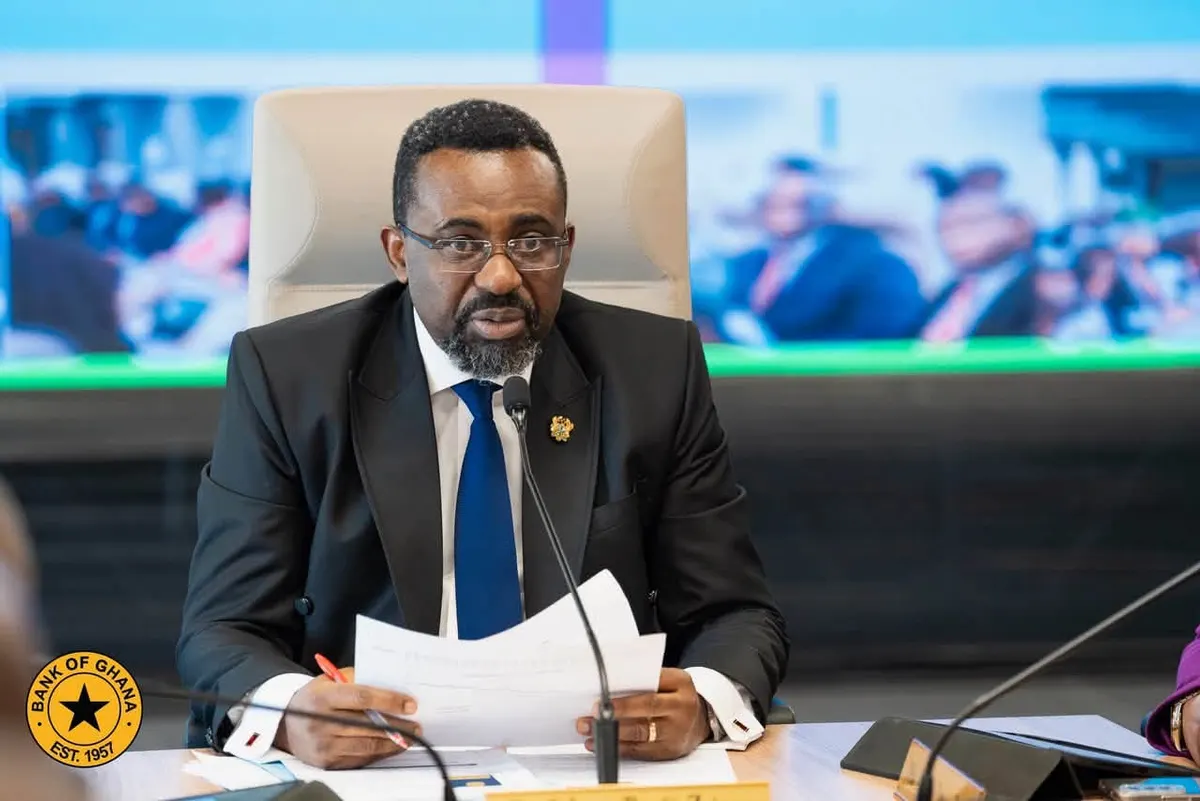
The Monetary Policy Committee (MPC) held its 132nd regular meeting from 23 to 24 September 2026 to review recent economic developments and assess risks to the outlook for inflation and economic growth.
This statement summarises the key discussions and the Committee’s decision on the Monetary Policy Rate.
Global economic activity remained resilient during the first half of 2026, despite persistent geopolitical tensions and heightened uncertainty.
The resilience was supported mainly by strong investment in artificial intelligence and the less severe impact of energy shocks than earlier anticipated.
Against this backdrop, the IMF global growth projection for 2026 has remained largely unchanged at 3.0 percent.
However, the tendency for geopolitical tensions to reignite or intensify could weaken global growth prospects in the medium-term.
Global inflationary pressures have heightened significantly since the last MPC meeting, driven largely by elevated energy costs with crude oil prices, currently slightly above US$100 per barrel.
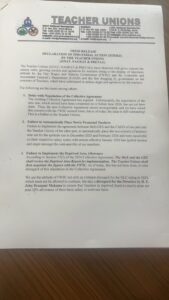
The National Association of Graduate Teachers (NAGRAT), Ghana National Association of Teachers (GNAT) and Pre-Tertiary Teachers Association of Ghana (PRETAG) have declared an immediate strike, citing prolonged delays in resolving key concerns affecting teachers’ conditions of service.
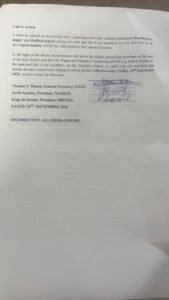
The three teacher unions announced the industrial action in a press statement on Friday, September 25, 2026, directing all pre-tertiary teachers across the country to withdraw their services until further notice.
Among the issues cited by the unions are the expired conditions of service, promotion-related concerns, the proposed adjustment of the digital allowance and the delayed implementation of a deprived-area allowance for teachers working in underserved communities.
President of PRETAG, King Ali Awudu, said the unions’ existing conditions of service expired in June, but attempts to negotiate a new agreement have failed to produce an outcome.
He explained that discussions over a new agreement had been ongoing since last year, but the unions had yet to reach an acceptable resolution with the relevant authorities.
“You will recall that we have once engaged the media and informed you that our conditions of service have expired since June. All efforts to get a new one negotiated since last year have yielded no fruits,” he said.
Digital allowance increase
The unions have also raised concerns about a proposed 10% increase in the digital allowance, which currently stands at GH¢800 per year.
According to Mr Awudu, the proposed adjustment does not address the broader concerns of teachers regarding their conditions of service and related benefits.
Promotion and salary placement
Another major issue highlighted by the unions is the failure to implement an agreement concerning approximately 80,000 teachers who took aptitude tests in December 2025 and February 2026.
Mr Awudu said there was an agreement for the affected teachers to be automatically placed on the appropriate salary scale after completing the required aptitude tests.
However, he said that commitment had still not been fulfilled, despite the fact that September salaries had already been processed.
The unions say the delay has further increased frustration among affected teachers who have been waiting for the implementation of the agreed arrangement.
Deprived-area allowance
The unions also expressed concern over the long-standing issue of an allowance for teachers working in deprived areas.
Mr Awudu said discussions on the matter had been ongoing since 2009, yet the issue remains unresolved.
He said a commitment had been made to introduce a 20% allowance for teachers posted to deprived areas, but the promised benefit had not been implemented.
According to him, the failure to resolve the matter over the years has added to the concerns of teachers serving in communities where working conditions can be particularly challenging.
Teachers directed to leave classrooms
Mr Awudu said the continued lack of progress on the outstanding issues had left the unions with little option but to withdraw their services.
He therefore directed all pre-tertiary teachers to immediately stop teaching and leave their classrooms until further instructions are issued by the leadership of the unions.
“We are asking all teachers that with immediate effect, as soon as this information goes out, they should put all their tools down, leave the classroom, go home and have a very good rest and wait until they hear from leadership again,” he said.
The strike will remain in effect until further notice, with the unions expected to communicate their next steps following engagements with the relevant authorities.
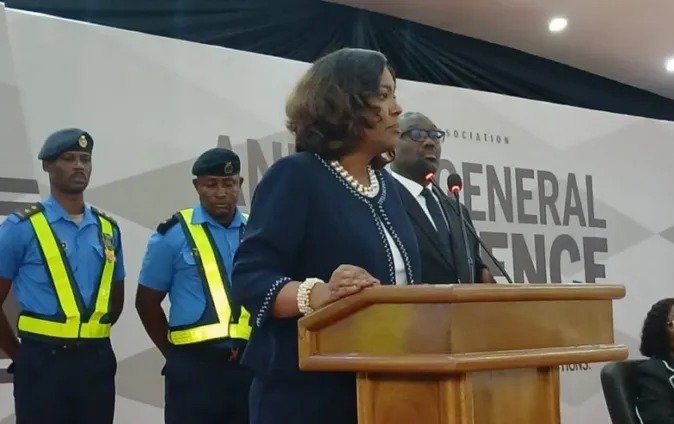
The Ghana Bar Association (GBA) has raised serious concerns over an alleged attempt to arrest a lawyer at a court premises while he was representing a client.
The incident has triggered concern within the legal fraternity, with the GBA questioning the circumstances under which the lawyer was allegedly targeted while carrying out his professional duties.
According to the Association, the lawyer was at the court premises in connection with the representation of a client when the alleged attempt to arrest him occurred.
The development has brought renewed attention to the delicate relationship between law enforcement and the legal profession, particularly the need to ensure that lawyers are able to represent their clients without undue interference.
The GBA has expressed concern over what it considers an inappropriate attempt to arrest a lawyer in the course of his professional responsibilities.
The Association is expected to seek further clarity on the circumstances surrounding the incident and the conduct of the officers involved.
The matter is likely to attract significant attention within legal circles, given the importance of protecting the independence of lawyers and ensuring that court proceedings are conducted without unnecessary disruption.
For members of the legal profession, the incident raises broader questions about the extent to which law enforcement agencies can intervene against a lawyer who is present at court while performing his professional duties.
The GBA’s intervention comes as calls continue for stronger respect for due process and the rule of law in dealings involving lawyers, litigants and law enforcement agencies.
Further developments are expected as the Association gathers more information about the incident and determines the appropriate steps to take.
General News
“She May Delete the Evidence” — High Court Refuses Salomey Awity Bail in Ghana Jollof Case


The Accra High Court has refused to grant bail to Salomey Awity Baffoe, the senior nursing officer detained in connection with the ongoing “Ghana Jollof” case.
The court, presided over by Justice Halima El-Alawa Abdul-Baasit, ruled on Thursday, September 24, that releasing Baffoe at this stage could create a risk of interference with electronic evidence and hamper ongoing investigations.
Court Raises Concern Over Digital Evidence
The case involves allegations of abetment of crime, to wit publication of false news, linked to the “Ghana Jollof” TikTok account.
The prosecution argued that investigations were still ongoing and that Baffoe’s presence remained necessary as authorities continued investigating the case and efforts to locate the second accused, whom police identify as Barbara Asantewaa Kodua.
The court noted that the investigation was cyber-related and involved electronic devices and digital evidence that could potentially be altered, deleted or concealed.
It consequently found that there was a real risk that Baffoe’s release could interfere with the evidence or otherwise hamper the investigation.
Her lawyer, Nana Agyei Baffour Awuah, subsequently said the judge had indicated that releasing his client could result in the deletion of information that investigators considered evidence.
Lawyer Had Pleaded for Her Release
Baffoe’s defence had urged the court to grant bail, arguing that she was presumed innocent and that the prosecution had not provided sufficient grounds to justify continued detention.
Her lawyer also drew attention to her status as a mother of three children and reportedly raised concerns about her health.
The defence had maintained that the police investigation had effectively been completed and questioned why she should remain in custody.
The prosecution, however, maintained that investigations were still active and that there were concerns about possible interference with witnesses and other persons connected to the case.
Court Stresses She Has Not Been Found Guilty
Importantly, the High Court made clear that its refusal to grant bail does not amount to a finding of guilt.
The court said it remained mindful of Baffoe’s constitutional presumption of innocence and stressed that the decision to keep her in custody was based on concerns surrounding the ongoing investigation and preservation of evidence, rather than punishment.
The court also indicated that Baffoe could renew her bail application if there was a material change in circumstances or new facts that altered the basis of the ruling.
Allegations Remain Contested
Police have alleged that Baffoe assisted Kodua in distributing videos and recruiting others to circulate the content, and have cited forensic examinations of her phone and mobile-money records in support of their investigation.
Her lawyer has rejected key aspects of the allegations, including the claim that Baffoe received money from the operator of the “Ghana Jollof” account to support the publication and distribution of content. He has also said the information released by police about his client is questionable.
For now, Baffoe remains in custody as the investigation continues, while the legal battle over her detention is expected to continue.
The High Court’s decision has therefore added another dramatic chapter to the increasingly controversial Ghana Jollof case, with the preservation of digital evidence now at the centre of the dispute over her freedom.

By Angel No Lie | KPD Online | 25 September 2026
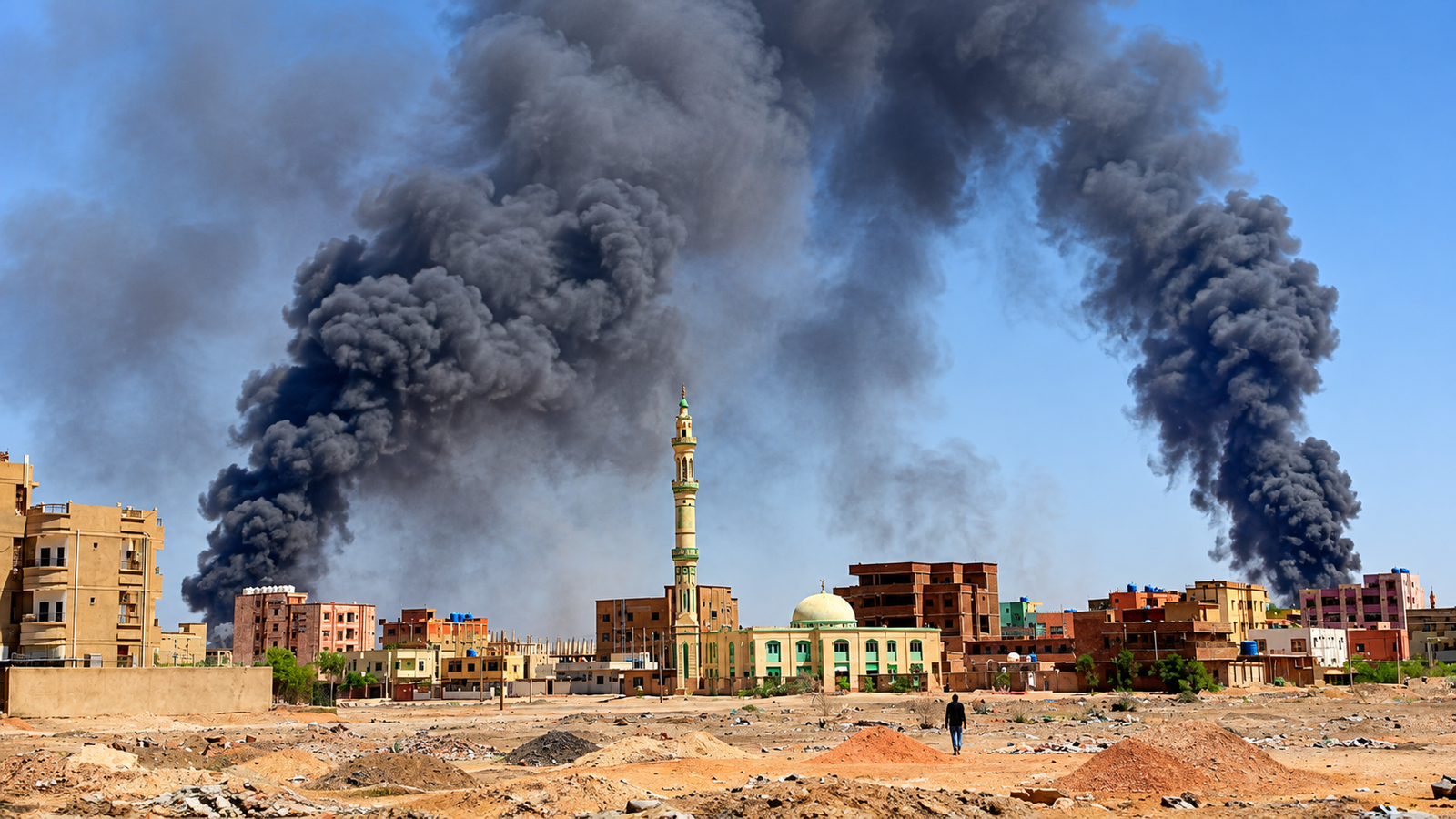
The United Nations has indicated that it could investigate allegations of chemical weapons use in Sudan if it receives the necessary mandate and authorization, as international concern grows over possible violations during the country’s ongoing civil war.
The potential investigation comes amid allegations involving forces aligned with Sudan’s military and reports of chemical agents allegedly being used in the conflict. UN officials have said they are prepared to examine the claims, but the scope of any investigation would depend on the mandate provided and the access granted to investigators.

Civilians Caught in Sudan’s Ongoing War
UN mission says it is prepared to examine allegations
The chair of the UN Independent International Fact-Finding Mission for Sudan has indicated that the mission is ready to examine allegations involving a possible chemical weapons programme linked to forces aligned with Sudan’s armed forces.
However, an investigation would require an appropriate mandate and the practical conditions necessary to gather evidence. These may include access to affected locations, interviews with witnesses and survivors, and the collection of medical and environmental samples.
The allegations have not been treated in this report as a final, independently established finding of chemical weapons use. Verification would require a formal investigative process and reliable evidence.

Evidence Challenges in a War-Damaged Country
Allegations emerge amid Sudan’s prolonged war
Sudan has been engulfed in conflict since April 2023, when fighting erupted between the Sudanese Armed Forces (SAF) and the Rapid Support Forces (RSF).
The war has caused extensive civilian displacement, damage to infrastructure and a severe humanitarian crisis. Both sides have faced allegations of violations of international humanitarian law, although the chemical weapons allegations represent a particularly serious area of concern because the use of chemical agents as weapons is prohibited under international law.
Reports and investigations cited in recent coverage have raised questions about possible chemical agents, including chlorine, being used in attacks. The available allegations require further examination to establish the substances involved, the circumstances of their use and responsibility for any confirmed incidents.

UN Considers Response to Chemical Weapons Allegations
Why chemical weapons investigations matter
Chemical weapons are prohibited under the Chemical Weapons Convention (CWC), which bans the development, production, stockpiling and use of chemical weapons.
The Organisation for the Prohibition of Chemical Weapons (OPCW) is the principal international body responsible for implementing the convention. The UN also has a Secretary-General’s Mechanism for investigating alleged uses of chemical and biological weapons, which can be activated through a request and appropriate authorization.
An investigation could potentially examine:
-
The substances allegedly used: Whether the materials qualify as chemical warfare agents.
-
The location and timing of attacks: Where and when the alleged incidents occurred.
-
The effects on civilians: Medical symptoms, injuries and potential environmental contamination.
-
Responsibility: Which individuals or forces may have ordered, carried out or facilitated any prohibited use.
-
Evidence preservation: Whether samples, witness accounts and other documentation can be independently verified.
The existence of an allegation does not, by itself, establish that a chemical weapons attack occurred or determine who was responsible.
Access and evidence remain major challenges
Investigating alleged chemical weapons use in an active war zone presents substantial practical difficulties.
Investigators may face restricted access to affected communities, damaged medical facilities, displaced witnesses and the deterioration or disappearance of physical evidence. Chemical substances can also be difficult to identify after an incident, making the collection and preservation of samples especially important.
The UN fact-finding mission has previously raised concerns about access and cooperation in its work on Sudan. A formal mandate would therefore need to be accompanied by arrangements allowing investigators to operate independently and safely.
Sudan’s government and international accountability
The Sudanese government has faced international scrutiny over allegations of abuses committed during the conflict. Reports about chemical weapons have added another layer to wider accountability efforts involving attacks on civilians, forced displacement and other alleged violations.
Any future investigation would need to distinguish between:
-
Allegations and preliminary evidence gathered by rights groups, journalists or other organizations.
-
Investigative findings based on documented evidence and expert analysis.
-
Legal conclusions concerning responsibility and potential violations of international law.
These stages are separate. A credible allegation may justify an investigation without constituting proof of criminal responsibility.
What could happen next?
The next steps would depend on whether the UN mission receives a mandate broad enough to examine the allegations and whether investigators can obtain access to relevant sites and witnesses.
Possible developments include:
-
A formal decision authorizing an investigation.
-
Requests for information and evidence from parties to the conflict.
-
Cooperation with specialist chemical weapons experts and relevant international institutions.
-
A report outlining verified evidence, limitations and any findings on responsibility.
At present, the UN’s reported willingness to investigate should be understood as an indication of preparedness, not confirmation that a full investigation has already been authorized or completed.
Independent assessment
The allegations warrant careful international scrutiny because chemical weapons use, if confirmed, would raise serious concerns under international law. At the same time, credible reporting must distinguish documented evidence from unverified claims and avoid assigning responsibility before an investigation establishes the facts.
An effective investigation would depend on independence, access, scientific testing and protection for witnesses. Its findings could contribute to future accountability efforts, but the available public information does not yet establish the complete circumstances of the alleged incidents.
Sources
-
The National — UN fact-finding mission and chemical weapons allegations
-
The National — UN readiness to investigate alleged chemical weapons use
-
Emirates 24/7 — Evidence and calls for an OPCW investigation
-
United Nations — Secretary-General’s Mechanism for investigating alleged chemical and biological weapons use
.

Kelvyn Boy admits loyalty made him attack ‘the other camp’ during Stonebwoy era

Education Ministry tells teacher unions: The government is addressing issues and calling off strikes.

BANK OF GHANA MONETARY POLICY COMMITTEE PRESS RELEASE 24 September 2026



-

 General News2 weeks ago
GTA Cash Reserves Halve to GH¢640,000 Despite Improved Liquidity Ratio
-

 General News2 weeks ago
GTA’s Financial Strength Weakens Despite 2025 Tourism Activities
-
 General News2 weeks ago
Creative Arts Agency Records GH¢2.01m Revenue in FY2025 Despite Financial Reporting Gaps
-

 Culinary2 weeks ago
Oranges: More Than Just Juice — The Nutritious Fruit Adding Flavour to Ghanaian Life
-
 General News4 days ago
Two political parties, one lesson: Afuntummireku and Tikro Nkɔ Agyina for Ghana
-
Culinary4 days ago
Kofi Brokeman: The Simple Ghanaian Snack That Has Stood the Test of Time
-
 General News1 week ago
Bost Energies Made GH¢684 Million Profit: Why Use The NPA Bill, 2026 To Weaken Its Operations?
-
 General News2 weeks ago
National Theatre balances cultural mandate with commercial survival