
Uncategorized
Manchester City Sign AC Milan Midfielder Tijjani Reijnders in £46.5m Deal


Manchester City have confirmed the signing of Dutch international Tijjani Reijnders from AC Milan for an initial fee of £46.5 million. The 26-year-old has signed a five-year contract and becomes Pep Guardiola’s fourth signing of the summer, following Rayan Ait-Nouri, Marcus Bettinelli, and Rayan Cherki.
Reijnders’ arrival comes just in time for the FIFA Club World Cup in the United States, with the midfielder eligible to make his debut on June 18 against Wydad AC.
“I’m ecstatic to be joining Manchester City,” said Reijnders. “This is one of the biggest clubs in the world, with the best manager, world-class players, and fantastic facilities. I want to contribute to more success in the years ahead.”
The Netherlands international, capped 23 times, had an impressive campaign with AC Milan last season, scoring 15 goals in 54 appearances across all competitions. His performances earned him the Serie A Midfielder of the Season award. Despite being left on the bench during the Netherlands’ recent 8–0 win over Malta, Reijnders’ form remains undeniable.
With Kevin De Bruyne departing the club, Reijnders is expected to provide much-needed strength and creativity in the middle of the park, as City look to bounce back from their third-place finish in the Premier League last season.
City Gear Up for Club World Cup with Major Reinforcements
Manchester City have made a clear statement of intent ahead of the expanded Club World Cup in the U.S., reinforcing their squad amid concerns over depth and key departures.
While initially linked with Bayer Leverkusen’s Florian Wirtz, the club opted instead for a trio of signings—Reijnders, Cherki, and Ait-Nouri—at a combined cost of around £108 million, notably less than Wirtz’s reported €150m (£127m) asking price.
All three new additions, along with goalkeeper Marcus Bettinelli, will be available for selection as City begin their campaign against Moroccan side Wydad AC on June 18 in Philadelphia.
Reijnders Seen as Key Piece in Guardiola’s Evolving Midfield
Reijnders joins City during a period of transition, with several senior players likely to leave. Kalvin Phillips, James McAtee, Jack Grealish, and Kyle Walker have all been linked with exits, while the futures of Ederson, Ortega, Ake, and Stones remain uncertain.
Guardiola’s midfield is undergoing a reshuffle, especially with long-serving players like Ilkay Gundogan gone, Bernardo Silva potentially departing, and Mateo Kovacic out injured. Despite the £50m acquisition of Nico Gonzalez in February, City’s midfield lacked dynamism and physical presence last season—areas Reijnders is expected to improve.
Turning 27 in July, Reijnders brings power and versatility to City’s midfield. Last season, he registered 10 goals and 4 assists in Serie A, with only Napoli’s Scott McTominay producing more goal contributions among midfielders (16).
He also ranked highly across key passing and ball-carrying metrics:
-
9th in Serie A for forward passes
-
5th for through balls and ball carries
-
7th for carries over 10 meters
Crucially, Reijnders led the league in sequences that led to a shot (205) and was second in secondary chances created (49), underlining his ability to orchestrate attacks and link up play in advanced areas.
“He’s the kind of player who’ll thrive under Guardiola,” said Italian football journalist Daniele Verri. “He covers a lot of ground, has improved significantly, and is eager to keep learning.”
Tactical Fit: A Perfect Match for Rodri
Former Premier League coach Edu Rubio believes Reijnders is a strong complement to Rodri in midfield.
“His energy, willingness to stretch defenses, and ability to operate in tight spaces make him a great fit for Guardiola’s system,” said Rubio. “His receiving skills and running power will bring a new dynamic to City’s midfield.”
However, Rubio noted that adapting to the Premier League’s fast-paced transitions will be key: “In a team that dominates possession, he’ll need to quickly learn when to push forward and when to hold his position.”





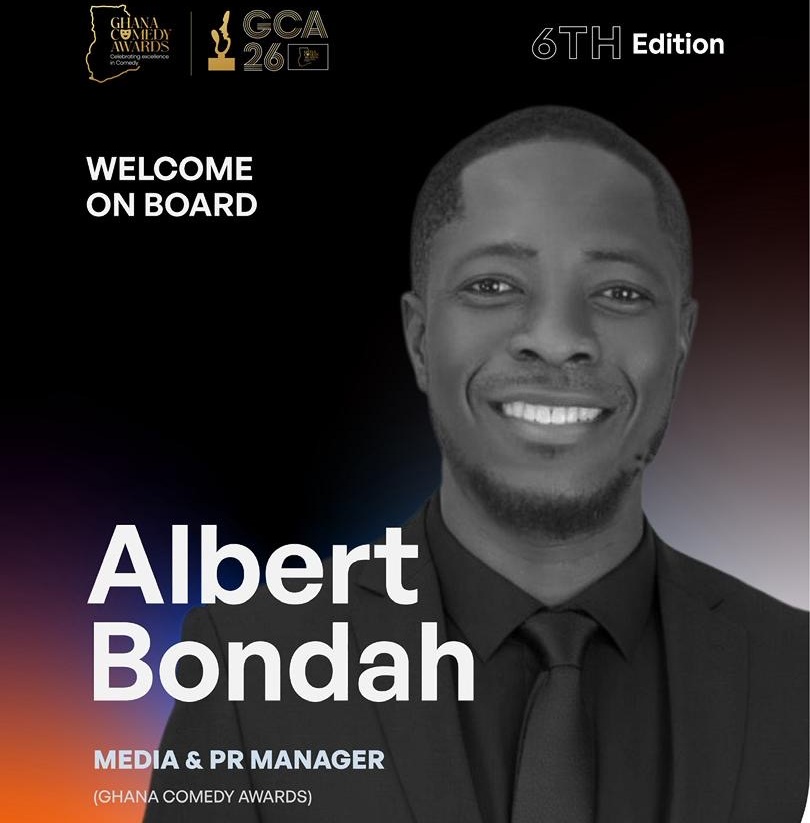
The organisers of the Ghana Comedy Awards 2026 have officially unveiled Albert Bondah as the new Media and Public Relations Manager for the highly anticipated sixth edition of the awards ceremony.
The announcement, which has already generated excitement within Ghana’s entertainment industry, forms part of the organisers’ broader efforts to strengthen the awards brand and expand its visibility ahead of this year’s event.

A graduate of the University of Cape Coast, Albert Bondah brings on board a wealth of experience in entertainment publicity, media relations, and strategic communications. His impressive portfolio includes serving as Road Manager for the Central Music Awards, as well as Media Relations Officer for organisations and brands such as African Arts Network, 2Cute Entertainment, Parrot Mouth Productions, PB Entertainment, Keche Global, and Fiifi Coleman Productions, among several other notable institutions within the creative industry.
With his extensive background in entertainment communications, Albert Bondah is expected to play a major role in promoting the awards scheme while strengthening engagement with audiences, stakeholders, media partners, and industry players. Many within the entertainment space see his appointment as a strategic move aimed at elevating the profile of the Ghana Comedy Awards both locally and internationally.
Over the years, the Ghana Comedy Awards has grown into one of the country’s leading entertainment platforms dedicated to celebrating comedians, comic actors, and creatives who continue to shape Ghana’s comedy landscape. The scheme has consistently recognised excellence, creativity, and innovation within the rapidly growing comedy industry.

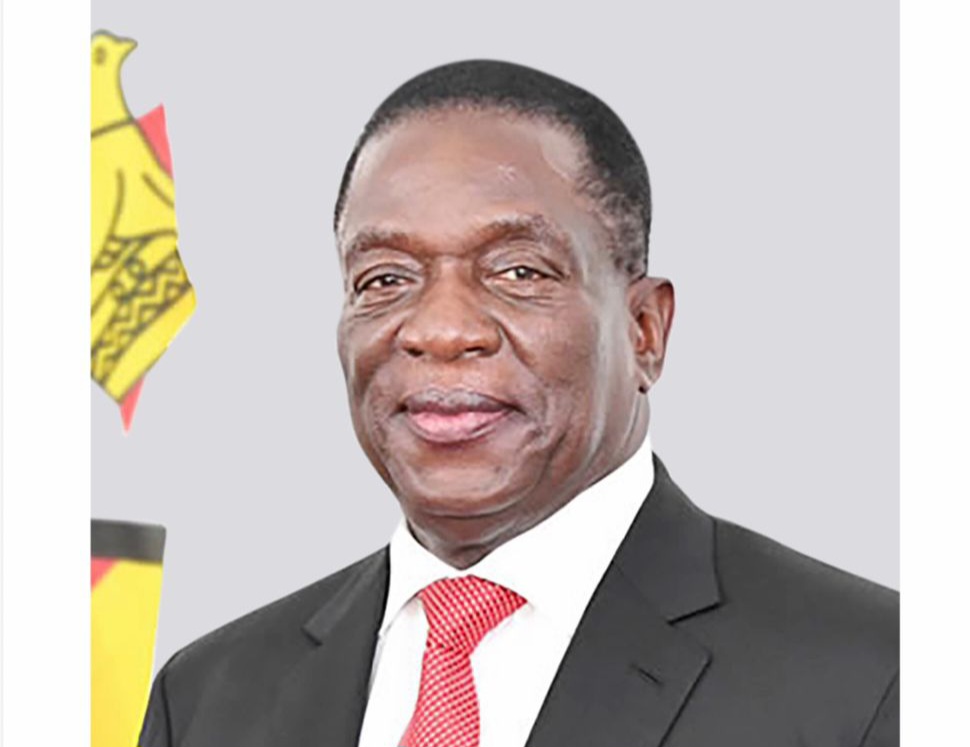
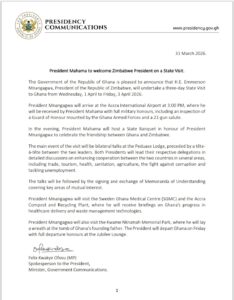
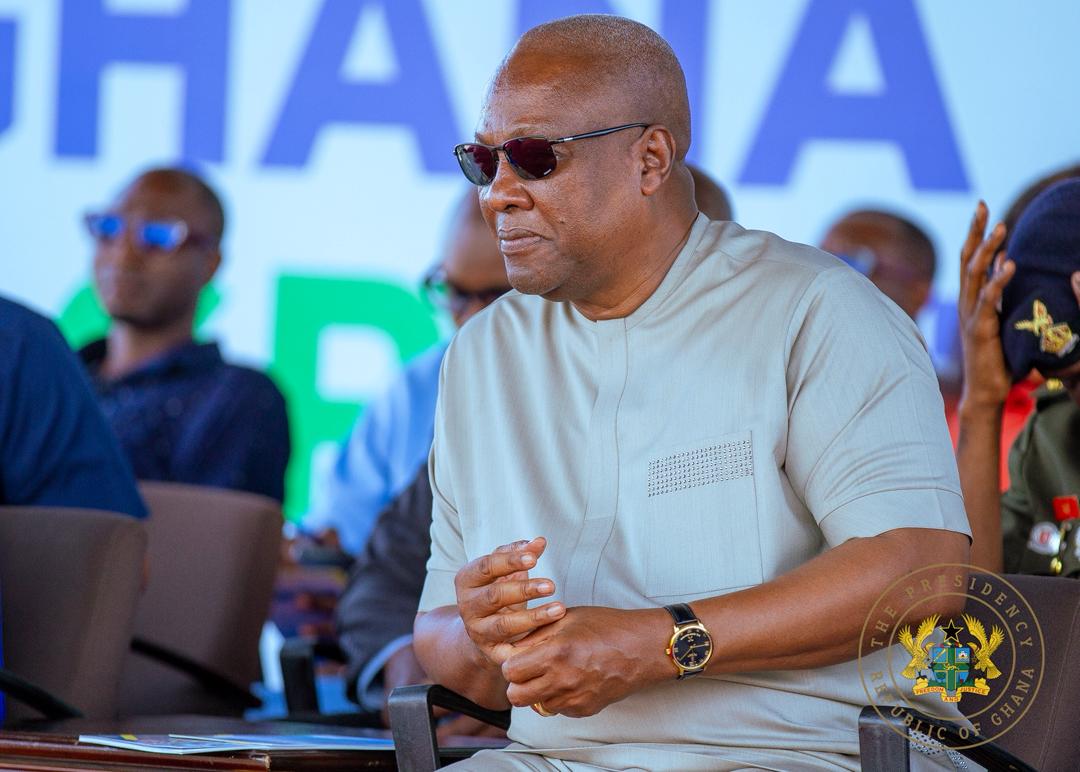
President John Dramani Mahama is set to host Zimbabwean President Emmerson Mnangagwa on a three-day State Visit to Ghana from Wednesday, April 1 to Friday, April 3, 2026.
According to a statement from the Presidency, President Mnangagwa will arrive at the Accra International Airport at 3:00 PM on Wednesday, where he will be received with full military honours by President Mahama. The ceremony will feature an inspection of a Guard of Honour mounted by the Ghana Armed Forces, followed by a 21-gun salute.
Later in the evening, President Mahama will host a State Banquet in honour of his Zimbabwean counterpart, in celebration of the long-standing relations between the two countries.
The highlight of the visit will be bilateral talks between the two leaders at the Peduase Lodge. The discussions, which will begin with a tête-à-tête, are expected to focus on strengthening cooperation in key sectors including trade, tourism, health, sanitation, agriculture, anti-corruption efforts, and job creation.
Both leaders are also expected to preside over the signing and exchange of several Memoranda of Understanding aimed at deepening diplomatic and economic ties between Ghana and Zimbabwe.
As part of his itinerary, President Mnangagwa will visit the Sweden Ghana Medical Centre and the Accra Compost and Recycling Plant to gain insight into Ghana’s advancements in healthcare delivery and sustainable waste management.
He will also pay homage to Ghana’s founding father, Dr Kwame Nkrumah, by laying a wreath at the Kwame Nkrumah Memorial Park.
President Mnangagwa is expected to depart Ghana on Friday, April 3, with full departure honours at the Jubilee Lounge.
The visit is anticipated to further strengthen bilateral relations and expand cooperation between Accra and Harare.
Read the statement below;
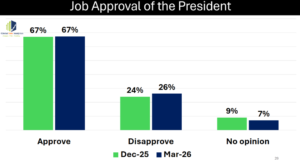
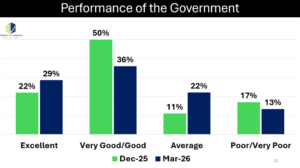
President John Dramani Mahama continues to enjoy strong public support, maintaining a 67% approval rating, according to a new poll by Global InfoAnalytics.
The survey released on March 25, 2026, showed that only 26% of voters disapprove of his performance, though it was a slight increase from 24% recorded in December 2025, while approval remains unchanged.
Support for President Mahama, according to the survey, spans all regions, including traditional opposition strongholds.
In the Ashanti Region, which is the stronghold of the opposition, New Patriotic Party (NPP), the poll showed that 56% of voters approve of his performance, while approval stands at 64% in the Eastern Region and 65% in the North East Region.
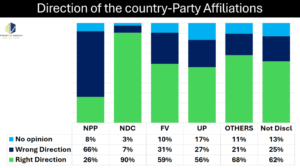
The poll also indicates that a majority of party affiliates back the president’s performance, except for supporters of the NPP.
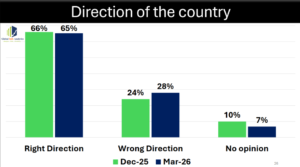
In the direction of the country, 65% of respondents in the survey noted that Ghana is headed in the right direction, though there was a marginal drop from 66% in the previous quarter.
Meanwhile, 28% believe the country is on the wrong path, up from 24%, while those with no opinion declined from 10% to 7%.
Living standards appear to have improved for many Ghanaians, with 58% of voters saying their conditions are better than a year ago, compared to 16% who report a decline.
However, optimism about the future has dipped slightly. The poll found that 68% of voters expect their standard of living to improve over the next 12 months, down from 70% in the previous quarter, suggesting growing unease over potential inflationary pressures linked to the Middle East conflict.

Government reveals 76.4 Million Ghana cedis to back Black Stars World Cup campaign

2026 FIFA World Cup: Thomas Partey ruled out of Ghana group opener after denial of Canadian Visa

The Energy Man Londona Nie Set for Comeback After Successful Recovery Journey



-

 Sports1 week ago
GFA Boss Kurt Okraku Rejects National Team Players Selection Interference allegations
-
 Education2 weeks ago
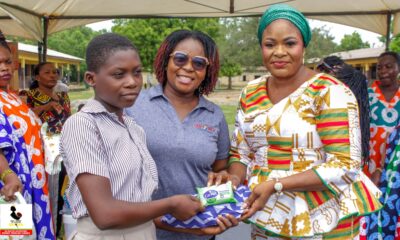
Royal Women In Cinema Ghana, Empower Playgrounds Equip Young Girls on World Menstrual Hygiene Day
-
 Politics1 week ago
Abronye DC Remanded Into Custody After Court Rejects Bid to Vary Bail Conditions
-
 Sports2 weeks ago
IFAB Approves Major Rule Changes Ahead of 2026 FIFA World Cup
-
 Sports1 week ago
2026 FIFA World Cup: Ghana group opponent England defeats New Zealand in a warm up Friendly
-
 Sports1 week ago
2026 FIFA World Cup: Ivory Coast defeats France in Pre-World Cup Friendly
-
 General News1 week ago
Sam George Pushes Mandatory National ID Verification for Access to Adult Websites
-
 Culture2 weeks ago
Christian Council Backs Mahama’s Decision to Review Anti-LGBTQ+ Bill