
Entertainment
Rest Well, Your Legacy Lives On– Selassie Ibrahim Mourns Ibrahim Adam

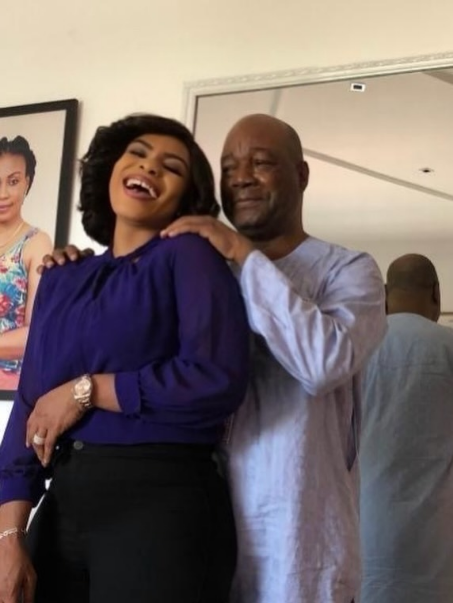
Veteran Ghanaian actress and filmmaker Selassie Ibrahim has mourned her late husband, former Minister for Food and Agriculture Ibrahim Issaka Adam, in an emotional tribute following his death.
Selassie took to Instagram on Tuesday, September 1, 2026, to share a series of photographs capturing memorable moments from their life together. The collection featured family pictures as well as an image from Ibrahim Adam’s recent birthday celebration. Accompanying the photographs was a brief but touching message in which Selassie expressed the depth of her grief.
“Rest well. Our hearts are broken beyond words. Your legacy lives on.”
Her post has since attracted numerous messages of condolence and sympathy from family, friends, colleagues in the entertainment industry, political figures and members of the public.

Who Was Ibrahim Issaka Adam?
Ibrahim Issaka Adam, also known as Adam Issaka Ibrahim, was an animal scientist, politician and public servant who made significant contributions to Ghana’s agricultural and political sectors.
He earned a Bachelor of Science (Honours) degree in Agriculture and began his career in the agricultural sector before entering public service and politics.
During the administration of former President Jerry John Rawlings, Ibrahim Adam served as Agriculture Secretary before being appointed Minister for Food and Agriculture. He occupied the ministerial position from 1993 to 1996, during which he was involved in matters concerning Ghana’s agricultural development.
His political career continued after leaving government. He contested the Choggu/Tishigu parliamentary seat on the ticket of the National Democratic Congress (NDC) and won the constituency in the 1996 elections.
He subsequently served in Parliament from 1997 to 2001, becoming a member of the Majority in the Second Parliament of the Fourth Republic.
Beyond his political career, Ibrahim Adam remained active in Ghana’s agricultural and financial sectors. He later served as Board Chairman of the Agricultural Development Bank (ADB), a major financial institution with a long-standing focus on supporting agriculture and related businesses.

Ibrahim Adam Dies at 75
Ibrahim Adam reportedly passed away on August 30, 2026, at the age of 75 at the University of Ghana Medical Centre (UGMC) in Accra.
He was said to have been receiving medical treatment at the facility before his death. However, the specific medical condition for which he was receiving treatment has not been publicly disclosed.
His death has prompted an outpouring of tributes from individuals and institutions connected to politics, agriculture, public service and the entertainment industry.
Ibrahim Adam and Selassie Ibrahim were married and had two children, a son and a daughter.
Following his death, arrangements were made for his remains to be transported from Accra to Tamale, where funeral and burial rites were to be conducted in accordance with Islamic traditions.
Reports indicate that Ibrahim Adam was subsequently laid to rest in Tamale.
Ibrahim Adam leaves behind a career that spanned agriculture, politics, public administration, Parliament and financial-sector governance.
From his early work as an animal scientist to his service as Agriculture Secretary, Minister for Food and Agriculture, Member of Parliament and Board Chairman of ADB, he occupied several positions through which he contributed to Ghana’s public and agricultural development.

Ghanaian media personality Nana Aba Anamoah has criticised the adults featured in a viral video involving 12-year-old content creator Adobhea, who was seen holding a bottle of Smirnoff Ice.
Reacting to the video on X, Nana Aba expressed disappointment that the adults around the child chose to record the incident rather than intervene and take the alcoholic drink away from her.
She questioned the judgment of those present, particularly the woman sitting beside the child, who appeared to allow the situation to continue while another person recorded it.
“Some people have really lost the plot. A grown woman (clearly without a functioning brain) is sitting right beside a child drinking Smirnoff Ice, while another fool is busy filming the whole thing instead of stopping it,” she wrote.
Nana Aba further condemned what she described as a failure by the adults to act responsibly around a child.
“Not only did nobody have the sense to take the drink away; someone actually thought, ‘Let me record this.’ What kind of spectacular adult stupidity is this? Imagine being old enough to know better and still being this useless around a child,” she added.
The video has since generated significant reactions on social media, with many users expressing concern over the child’s exposure to alcohol and calling for greater responsibility from adults when children are involved.
The incident has also renewed discussions about child protection, responsible parenting and the need for adults to safeguard minors from harmful or inappropriate situations, particularly when such moments are being shared online.

President John Dramani Mahama has ordered the immediate dissolution of the governing boards of nine state-owned institutions, the Presidency has announced.
The decision, communicated on Wednesday, September 2, 2026, affects institutions operating in several strategic areas of Ghana’s economy, including petroleum, mining, banking, housing, infrastructure, postal services and sports.
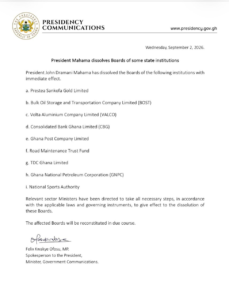
The institutions whose boards have been dissolved are:
Prestea Sankofa Gold Limited
Bulk Oil Storage and Transportation Company Limited (BOST)
Volta Aluminium Company Limited (VALCO)
Consolidated Bank Ghana Limited (CBG)
Ghana Post Company Limited
Road Maintenance Trust Fund
TDC Ghana Limited
Ghana National Petroleum Corporation (GNPC)
National Sports Authority (NSA)
In a statement, the Presidency directed the respective sector ministers to take all necessary measures to implement the decision.
The ministers are required to carry out the process in line with the applicable laws and the governing instruments of each institution.
The Presidency, however, clarified that the dissolution of the boards should not be interpreted as the permanent removal of the governing structures of the affected institutions.
According to the statement, the boards will be reconstituted at a later date, after which new members will be appointed to provide oversight and governance for the institutions.
The move is expected to pave the way for fresh leadership and new board compositions across the nine state-owned entities.

Ghanaian veteran actress Irene Opare has revealed that dancehall star Shatta Wale is her favourite male artiste, praising his personality, music and exceptional charisma.
Speaking in an interview captured by Seancity TV, the actress said she admires Shatta Wale because of what she described as his authenticity and ability to command attention.
“My favourite male artiste is Shatta Wale. I like everything about Shatta Wale, and he is a real guy,” she said.
Irene Opare explained that while acting remains one of her greatest passions, music plays a major role in her daily life. She said she regularly listens to music and dances whenever she is at home.
“I love doing movies, but I love music. Movies are my passion, but music is my thing. On a regular day, if you find me at home, you will see me playing music and dancing,” she stated.
The veteran actress also drew a comparison between Shatta Wale and Ghana’s late former President Jerry John Rawlings, particularly when it comes to charisma.
According to Irene, both personalities possess a rare ability to attract people’s attention, even from individuals who may not necessarily like them.
“Shatta is like the late JJ Rawlings for me, and they have charisma,” she explained.
She argued that Shatta Wale’s charisma is so powerful that even someone who dislikes him could become excited upon seeing him in person.
Irene illustrated her point by saying that a person who strongly dislikes the musician could still rush to meet him if they saw him approaching, simply because of the excitement surrounding his presence.
“If you hate Shatta, whether maybe he has insulted your mother or father and you hear that he is coming down the road, you will run to go and see him. You will go and shake his hand, and that’s the charisma I’m talking about. Take it or leave it,” she noted.
Beyond his personality, Irene Opare also praised Shatta Wale’s music, revealing that she enjoys his songs generally but has a particular favourite.
She named “On God” as the Shatta Wale song she loves the most, describing it as a spiritually powerful song.
“I love all his songs, but ‘On God’ is my favourite. That song feels like a spirit when you’re singing it. It’s gospel music, and it’s like you’re talking to God,” she added.


Gospel musician Ohemaa Mercy has opened up about a painful chapter in her life that inspired her hit song, “Se Abotare Twen Me.”
Speaking in an interview on Joy Prime, the award-winning singer revealed that the song was born out of a difficult period characterised by humiliation, disappointment and financial struggles.
According to Ohemaa Mercy, the experience remains deeply emotional for her, and performing the song often takes her back to the difficult moments that inspired its message.
She recalled an incident when she was in a classroom, and a creditor arrived to demand money she owed.
“I remember when I was in a classroom. I was owing someone, and the person came around to collect the money. I had to leave the classroom, and while leaving, one of my shoes got torn, so I had to carry one of them,” she recounted.
Ohemaa Mercy said the situation became even more embarrassing when a man intervened and pleaded with the woman demanding the money to spare her further humiliation.
The man, she said, promised to settle the debt, allowing her to leave the situation.
After the incident, Ohemaa Mercy returned to her office in tears, overwhelmed by the experience.
She said it was during that emotional moment that she heard what she described as a loud, divine voice giving her a message of hope.
“I heard this loud voice that said, ‘Be calm and wait on me because I don’t break my promises like they assume I do,’” she recalled.
The gospel singer said the experience was one of the most difficult seasons of her life and remains unforgettable.
“It is something I will remember for the rest of my life. It wasn’t easy. It was a season of disgrace and disappointment, but this is a message God gave me, and honestly, it has transformed many lives,” she stated.
Ohemaa Mercy explained that the message became her source of strength as she navigated the difficult period.
She said she continued to encourage herself and held on to the message until she eventually received further direction.
“I had to encourage myself because that message really spoke to me. Until God unveiled me, that was the only message I carried to the studio,” she said.
She further disclosed that renowned Ghanaian musician and producer Nacee later helped transform the message and experience into powerful songs.
“Lo and behold, Nacee helped me write all those powerful songs,” she added.
For Ohemaa Mercy, “Se Abotare Twen Me” is therefore more than just a gospel song. It represents a personal testimony of hardship, faith, perseverance and hope, which she believes has continued to touch and transform the lives of many people.

Police Arrest Six Suspects Over Deadly Attack at New Winneba

Rest Well, Your Legacy Lives On– Selassie Ibrahim Mourns Ibrahim Adam

Nana Aba Anamoah Condemns Adults Over Viral Video Involving 12-Year-Old



-

 General News1 week ago
Nana Adwoa Tutuwaa Named Global Humanitarian of the Year 2026
-

 Entertainment2 weeks ago
Interfaith Tourism World Club Calls for Faith-Based Tolerance to Strengthen National Peace
-
 General News5 days ago
GES Urged to Review Student Sexual Misconduct Rule Over Alleged Discrimination Against Boys
-

 Education2 weeks ago
Cybersecurity Education in Schools: Should Students Learn Online Safety?
-
 General News1 week ago
Police Arrest Suspect in GH¢1.1m Fake Gold Scam at Berekum
-

 General News2 weeks ago
Assemblies of God Ghana Clears Headquarters Loan, Slashes Overdraft by GH¢3.2m
-

 General News2 weeks ago
LMI Holdings: The Ghanaian Company Chosen to Revive the Saglemi Housing Project
-

 General News1 week ago
OSP Assesses Extortion Allegations Against Afenyo-Markin