
General News
UESD Pro Vice-Chancellor Calls for Urgent Biodiversity Protection to Safeguard Africa’s Future

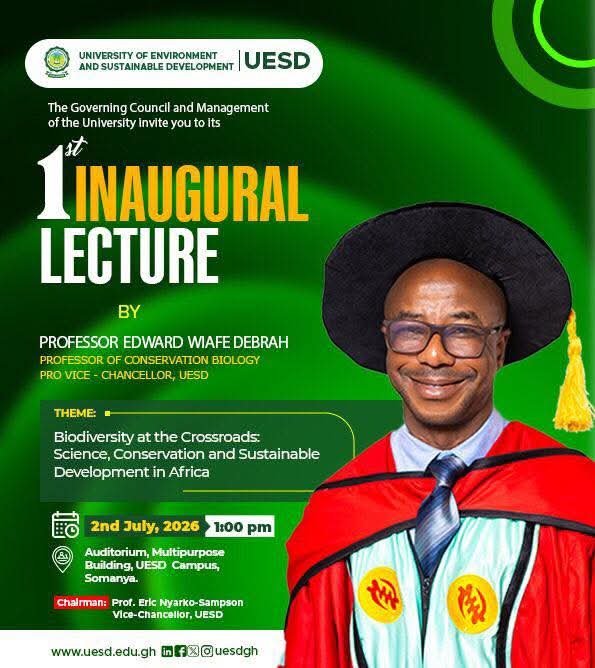
Professor Edward Wiafe Debrah, Pro Vice-Chancellor of the University of Environment and Sustainable Development (UESD), has called for urgent, science-based biodiversity conservation measures to protect Africa’s natural resources and secure sustainable development for future generations.
He made the call during his inaugural lecture held on Thursday, July 2, 2026, at UESD in Somanya, Eastern Region, under the theme “Biodiversity at the Crossroads: Science, Conservation and Sustainable Development in Africa.”
The event attracted members of the University Council, academics, government officials, conservation experts, development partners, students, traditional leaders, and members of the public, all of whom gathered to discuss the importance of biodiversity conservation in advancing Africa’s sustainable development agenda.
Drawing on more than 30 years of research, conservation practice, and academic leadership, Professor Wiafe Debrah outlined the growing threats confronting Africa’s biodiversity. He identified habitat destruction, climate change, illegal mining, deforestation, pollution, land degradation, and the unsustainable exploitation of natural resources as major challenges undermining ecosystems across the continent.
According to him, biodiversity should not be viewed solely as an environmental issue but as a critical pillar of development that supports food security, water resources, climate resilience, public health, tourism, livelihoods, and economic growth.
“Biodiversity is not a luxury. It is the foundation of sustainable development. When biodiversity declines, development itself becomes more fragile,” Professor Wiafe Debrah said.
Throughout the lecture, he explored a central question that has shaped much of his academic and professional work: “How can development proceed without destroying the ecological systems that sustain life?”
Using evidence from decades of research in primate conservation, wildlife management, forest ecology, environmental governance, ecosystem restoration, human-wildlife conflict, and community-based conservation, he demonstrated how scientific research can provide practical solutions to pressing environmental challenges.
A major highlight of the lecture focused on his internationally acclaimed work on endangered primates within the Upper Guinea Forest ecosystem. His research has contributed significantly to the conservation of species including the critically endangered Roloway Monkey, Lowe’s Monkey, White-thighed Colobus, and Olive Colobus.
His work has also informed conservation policies, International Union for Conservation of Nature (IUCN) Red List assessments, protected area management strategies, and international species recovery programmes.
Professor Wiafe Debrah stressed that conservation efforts should go beyond law enforcement and the establishment of protected areas. Instead, he advocated integrated approaches that combine scientific research, community participation, sustainable livelihoods, environmental education, and accountable governance.
He noted that local communities must be recognised as active partners and direct beneficiaries of conservation initiatives rather than passive observers.
“Conservation succeeds when science informs action, when communities are partners, and when future generations remain at the centre of our decisions,” he stated.
The inaugural lecture also highlighted Professor Wiafe Debrah’s extensive contributions to environmental impact assessment, biodiversity management planning, ecosystem restoration, climate adaptation research, and international conservation policy development. His work has influenced conservation efforts not only in Ghana but across Africa and beyond.
Speaking at the event, the Vice-Chancellor of UESD praised Professor Wiafe Debrah for his outstanding achievements in research, conservation practice, mentorship, and university leadership.
The Vice-Chancellor described him as an accomplished scholar whose work reflects the University’s commitment to environmental sustainability, innovation, and societal transformation.
The lecture concluded with a strong appeal for governments, universities, civil society organisations, development partners, local communities, and the private sector to work together in protecting biodiversity as a foundation for sustainable development across Africa.
Professor Edward Wiafe Debrah currently serves as the Pro Vice-Chancellor of UESD and is widely regarded as one of Ghana’s leading experts in biodiversity conservation, primatology, forestry, wildlife ecology, environmental governance, and sustainable development.
With more than three decades of experience in research, consultancy, higher education, and conservation management, he has authored numerous scholarly publications and contributed to global conservation initiatives, including IUCN Red List assessments and international primate conservation action plans.
The University of Environment and Sustainable Development (UESD), based in Somanya in the Eastern Region, is Ghana’s premier public university dedicated to environmental sustainability. The institution focuses on teaching, research, innovation, and community engagement aimed at producing environmentally conscious leaders and practical solutions for national and global sustainable development.



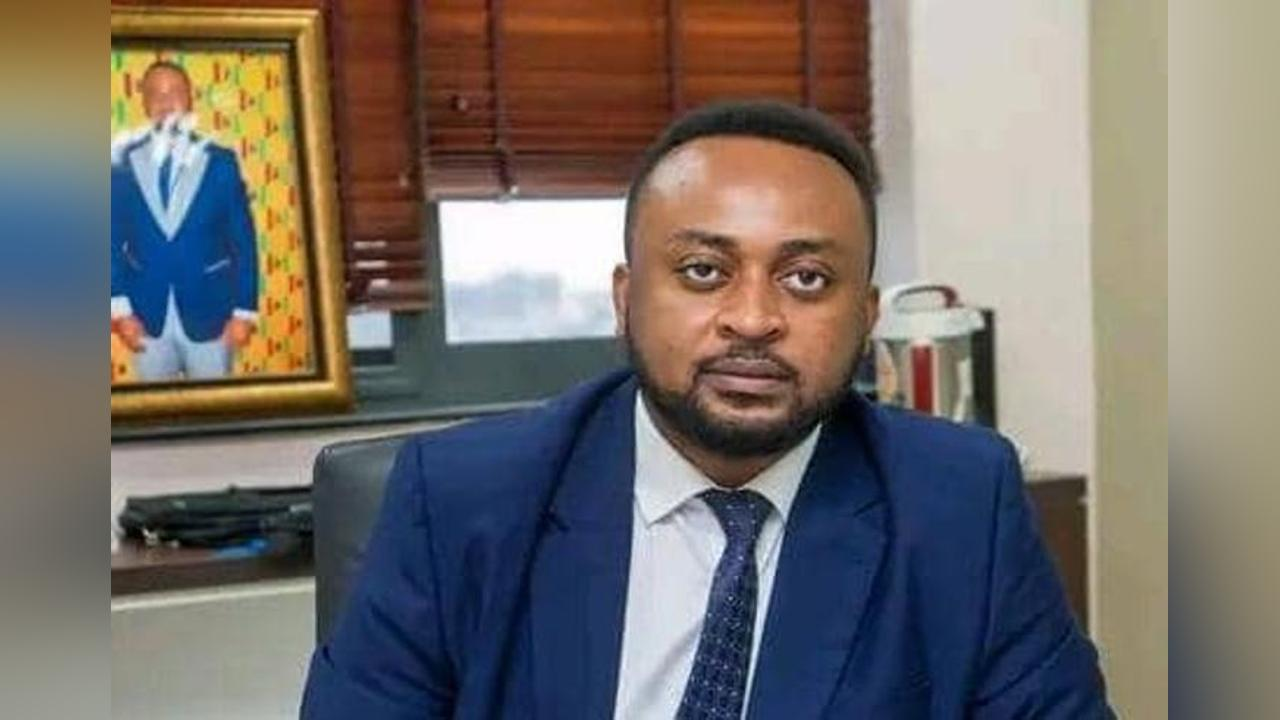
Old Tafo Member of Parliament and Ranking Member of Parliament’s Youth and Sports Committee, Vincent Ekow Assafuah, has raised fresh questions over the list of media personnel reportedly submitted as part of Ghana’s arrangements for the 2026 FIFA World Cup.
Speaking on Asempa FM, Assafuah alleged that the United States and Canadian embassies had agreed to facilitate arrangements for about 50 media personnel, but claimed that his investigations found only two people on the list whom he identified as genuine media practitioners.
He named broadcaster Andy Dosty and Philip Narh as the two people he said were identified as genuine media personnel.
According to the Old Tafo MP, the findings raised questions about the identities and status of the remaining people who were included in the list.
Assafuah further alleged that some individuals connected to the arrangements were paid thousands of dollars, with figures ranging between US$9,000 and US$10,000.
He claimed that he had evidence relating to some of the alleged payments and activities of people who travelled under the arrangements.
The MP said the matter was particularly concerning because, in his view, Ghanaian public institutions should not be used to present people who are not employees of those institutions as though they were official staff or representatives.
He said such practices could damage Ghana’s reputation when Ghanaian officials engage foreign diplomatic missions.
Assafuah argued that the issue should not be reduced to the role of a private travel or event organisation, insisting that attention must be placed on how public institutions participated in the process.
He also questioned attempts to shift attention towards TRIBE, arguing that if people who were not staff of the **National Sports Authority (NSA)** or other public institutions were presented as such, responsibility should be investigated within the institutions that provided the information.
The MP’s comments form part of broader concerns he and the Minority in Parliament have raised about Ghana’s World Cup visa arrangements involving the NSA, Ghana Tourism Authority (GTA), Ministry of Sports and Recreation and TRIBE Culture Fest.
The Minority has alleged that some individuals were presented to foreign missions under institutional identities that they did not actually hold. These allegations remain subject to investigation and responses from the institutions involved.
Assafuah also linked the matter to the removal of former NSA Director-General Yaw Ampofo Ankrah, arguing that the decision should not end investigations into the broader arrangements.
He said the Minority would continue to pursue the matter to establish what happened and ensure that the Ghanaian public receives answers.
The controversy over Ghana’s preparations and travel arrangements for the 2026 FIFA World Cup has taken a new turn, with Ranking Member of Parliament’s Youth and Sports Committee, Vincent Ekow Assafuah, making fresh allegations involving the National Sports Authority (NSA), Ghana Tourism Authority (GTA), TRIBE Culture Fest and officials of the Ministry of Sports and Recreation.
Mr Assafuah made the allegations at a press conference on Wednesday, October 7, 2026, where he claimed that newly obtained documents raised concerns about how public institutions may have been represented in dealings with foreign missions over visa arrangements for Ghanaians planning to travel to the tournament.
His claims come shortly after the removal of NSA Director-General Yaw Ampofo Ankrah amid controversy over an alleged visa facilitation arrangement.
The Minority had earlier demanded that Mr Ankrah step aside to allow investigations into the matter.
However, Mr Assafuah argued that his removal should not be considered the end of the issue, insisting that responsibility must be traced beyond one individual.
“The dismissal of Yaw Ampofo Ankrah does not, by itself, resolve the issues before us. Accountability cannot end with one individual.”
Claims of Visa Allocation to GTA and NSA
According to documents referenced by the Minority, discussions surrounding the visa arrangements allegedly involved the United States Embassy, TRIBE Culture Fest, the NSA and the GTA.
The Minority claims that after the engagement, the US and Canadian missions allocated 600 and 400 visa slots respectively to the GTA and NSA.
The slots were reportedly intended for staff and affiliates who were expected to travel in connection with promotional, cultural and World Cup-related activities.
However, the claims presented at the press conference have not been independently verified.
Questions Over NSA and TRIBE Agreement
Mr Assafuah also drew attention to a Memorandum of Understanding reportedly signed between the NSA and TRIBE Culture Fest on June 2, 2025.
According to the Minority, the agreement gave TRIBE Culture Fest access to NSA facilities to carry out approved activities linked to Ghana’s participation in the 2026 World Cup.
The arrangement has raised questions about the extent of access granted to the private organisation and the terms under which it was allowed to operate within public sports facilities.
The Minority is seeking clarification on the authority under which the agreement was entered into and the responsibilities of each party.
Allegations Over Visa and Accommodation Charges
Another major concern raised by the Minority relates to alleged fees paid by individuals seeking assistance with their World Cup travel arrangements.
Mr Assafuah claimed that TRIBE Culture Fest had a separate arrangement with the GTA under which the organisation was expected to assist with visa processing and accommodation for GTA personnel travelling to the United States and Canada.
Under the alleged arrangement, GTA was reportedly expected to pay about US$3,000 per person for US visa-related arrangements and approximately US$2,000 for Canadian arrangements.
However, Mr Assafuah alleged that some people who were not employees of either the GTA or NSA were charged significantly higher amounts.
According to him, the amounts allegedly demanded from some individuals ranged between US$7,000 and US$14,000 per person.
Previous reports had also alleged that some prospective travellers paid as much as US$8,000, with more than US$600,000 reportedly collected in connection with the arrangements.
The allegations have not been conclusively established and remain subject to investigation.
Concerns Over GTA Media List
The Minority also questioned the authenticity and composition of a list of 50 people reportedly submitted by the GTA to the US Embassy as media personnel travelling for World Cup-related activities.
Mr Assafuah alleged that checks by the US Embassy’s Fraud Prevention Unit identified only two people on the list—Philip Narh and Andy Dosty, both associated with Multimedia—as identifiable media practitioners.
The Minority further claimed that some of the individuals included on the list had paid significant sums in relation to the World Cup travel arrangements.
These claims are yet to be independently verified.
Alleged Misrepresentation of NSA Officials
The press conference also brought fresh scrutiny to documents allegedly submitted to foreign missions in which certain individuals were described as officials of the NSA.
Mr Assafuah said an email dated January 28, 2026, and sent to the US Embassy presented 22 people as NSA personnel.
He claimed that a review of the names and positions revealed that some of the designations did not correspond with positions contained in the NSA’s organisational structure.
Among the examples cited was Comfort Ahiadome, who was allegedly presented as Board Secretary.
The Minority said other individuals were also assigned positions it claimed did not exist within the NSA’s official structure.
The Minority further alleged that on March 18, 2026, the US Embassy’s Fraud Prevention Unit raised concerns about four applicants whose stated positions required clarification.
They were identified as Ralph Egyir Quianoo, Belinda Tsey, Francis Frimpong Agyemang and Beryl Joycelyn Baabe Duut.
According to the Minority, the Embassy subsequently requested documentation proving their employment status, after which the NSA reportedly provided a letter confirming their appointments.
Questions Over Canadian Embassy Submission
Mr Assafuah also raised concerns over another list reportedly submitted by the NSA to the Canadian Embassy on June 8, 2026.
The list was said to contain the names of 102 individuals.
However, the Minority claimed that only 15 of those listed could be verified as NSA employees, raising questions about the institutional status of the remaining 87 people.
The Minority also pointed to alleged inconsistencies concerning individuals identified as Sports Development Officers, Security and Protocol Officers and Procurement Officers.
Mr Assafuah said the discrepancies require further investigation to establish who the individuals were, who authorised their inclusion and the basis on which they were presented as NSA personnel.
Minority Demands Answers
The Minority is demanding answers from the institutions involved and has outlined several questions it wants addressed.
Among them are:
- How many GTA employees eventually secured visas through the reported arrangement?
- How many of the 400 US and 600 Canadian visa slots were actually used?
- How many applications were approved and how many were rejected?
- Who authorised the engagement between the public institutions and TRIBE Culture Fest?
- What were the contractual responsibilities of each party, and what services were ultimately delivered?
- Who are the individuals known as “Chase” and “Diesel”, who were allegedly involved in the visa-processing arrangements?
- Was any visa-processing operation established at or near NSA facilities?
- What steps were taken after concerns were reportedly raised by GTA directors regarding accountability?
Calls for Broader Investigation
Mr Assafuah maintained that the removal of Yaw Ampofo Ankrah should not bring the matter to a close.
He argued that any official found to have violated administrative procedures should face the appropriate sanctions.
Where investigations uncover evidence of criminal wrongdoing, he said the matter should be referred to the relevant law-enforcement and prosecutorial authorities.
The Minority is therefore calling for a broader examination of the roles played by officials of the NSA, GTA, Ministry of Sports and Recreation and TRIBE Culture Fest.
The development comes as scrutiny continues over Ghana’s wider arrangements for the 2026 FIFA World Cup.
The NSA has previously denied authorising any visa facilitation or money-collection scheme and has indicated that it would cooperate with lawful investigations.

Former Dome-Kwabenya Member of Parliament Sarah Adwoa Safo has publicly called for reconciliation within the family of the late Apostle Dr Kwadwo Safo, pledging her support for her brother, Israel Kwadwo Safo, as the leader of the Kantanka Family and the Kristo Asafu Church.
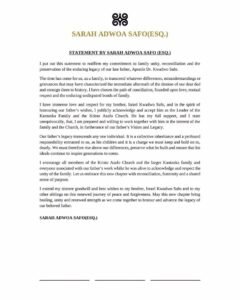
In a statement, Sarah Adwoa Safo said she had chosen reconciliation in the interest of family unity, peace and the preservation of their late father’s legacy.
She acknowledged that differences, misunderstandings and grievances had emerged within the family following their father’s death but said the time had come for the family to move beyond those challenges.
According to her, her decision to pursue reconciliation is rooted in love, mutual respect and the enduring bond shared by the siblings.
A major aspect of her statement was her public recognition of Israel Kwadwo Safo as the leader of the Kantanka Family and the Kristo Asafu Church.
Sarah Adwoa Safo said she has immense love and respect for her brother and, in honour of their late father’s wishes, accepts him in that capacity.
“I have immense love and respect for my brother, Israel Kwadwo Safo, and in the spirit of honouring our father’s wishes, I publicly acknowledge and accept him as the Leader of the Kantanka Family and the Kristo Asafu Church,” she stated.
She further declared her support for Israel Kwadwo Safo and expressed her willingness to work with him for the benefit of the family and the church.
She said such cooperation would help advance the vision and legacy of their late father.
Sarah Adwoa Safo also emphasised that the legacy left behind by Apostle Dr Kwadwo Safo should be treated as a collective inheritance and responsibility.
She urged the siblings to put their differences aside and work together to protect what their father built during his lifetime.
For her, preserving his legacy requires unity among his children and a shared commitment to ensuring that his values and achievements continue to inspire future generations.
She therefore appealed to the family to focus on what unites them rather than the issues that have divided them.
The former MP extended her call for reconciliation to members of the Kristo Asafu Church, the wider Kantanka family, and others who were associated with their late father and his work.
She appealed to them to respect the unity of the family and support efforts aimed at creating a peaceful new chapter.
Sarah Adwoa Safo said the family must embrace reconciliation, fraternity and a shared sense of purpose as they seek to protect and advance the legacy of Apostle Dr Kwadwo Safo.
Her statement signals a renewed call for an end to divisions and a stronger collaboration among the siblings.
Concluding her statement, Sarah Adwoa Safo extended her goodwill to Israel Kwadwo Safo and her other siblings.
She expressed hope that the family would move forward with peace, forgiveness, healing and renewed strength.
She reaffirmed her commitment to reconciliation and family unity, saying the siblings have a shared responsibility to honour and preserve the legacy their late father left behind.
The statement was signed by Sarah Adwoa Safo.


NEW YORK — October 8, 2026: Jaguar has unveiled its new all-electric Type 01, marking the British luxury carmaker’s most significant step yet in its plan to reinvent the brand around high-end electric vehicles.
The four-door grand tourer was revealed in New York on October 6, nearly two years after Jaguar’s controversial brand relaunch and the unveiling of the futuristic Type 00 concept. The earlier campaign generated widespread criticism online, with some commentators describing the rebrand as “woke” and mocking the concept’s unconventional styling.

Jaguar Type 01 Makes Its World Premiere in New York
The Type 01 represents a more production-ready interpretation of that design direction. Jaguar says the vehicle combines its heritage with a new approach to luxury, technology and electric performance. The long bonnet is intended to echo the proportions of the legendary E-Type, while the overall design remains markedly different from previous Jaguar models.

Jaguar’s New Type 01 Electric GT Signals a New Era
A powerful electric flagship
The Type 01 is expected to produce roughly 1,000 horsepower, with three electric motors enabling acceleration from 0 to 62 mph in about 3.2 seconds. Reports put its electric range at around 400 miles, while rapid charging is designed to add substantial range in a short period.

Inside Jaguar’s High-Tech Type 01 Luxury EV
The vehicle is also packed with technology, including a large digital driver’s display, camera-based rear visibility and a minimalist luxury interior.
Jaguar has positioned the car at the premium end of the market. The starting price is expected to be around $130,500 in the United States, while the UK price is about £130,000. Orders are scheduled to open in early 2027, with customer deliveries expected during the second half of the year.

The Type 00 Concept That Sparked Jaguar’s Controversial Rebrand
From controversy to commercial test
The launch gives Jaguar an opportunity to move the conversation away from its controversial 2024 marketing campaign and toward the products underpinning its new strategy.
However, the company faces a difficult market. Electric-vehicle demand has softened in some markets, while Chinese manufacturers are intensifying competition in the global EV sector. Jaguar Land Rover is also undertaking wider restructuring following significant operational and financial pressures.

Jaguar Type 01 Brings High-Performance Electric Power to the Luxury Market
JLR says production of the Type 01 will begin in 2027 at its Solihull operations, with electric drive units and battery packs produced in Wolverhampton and body panels manufactured at Halewood.

Jaguar stelt elektrische auto voor, en doet wenkbrauwen fronsen
The Type 01 therefore represents more than a new electric car. It is a test of whether Jaguar can turn a highly debated rebranding exercise into a commercially successful luxury-car revival.
Source context: Jaguar’s official announcement confirms the Type 01 is designed, engineered and built in Britain and describes it as the first production Jaguar based on the company’s dedicated Jaguar Electric Architecture.

By KPD News Online Business Desk | October 8, 2026
Gold prices recovered on Thursday after touching a two-month low, as a pullback in the U.S. dollar provided some support to the precious metal.
Spot gold rose about 0.5% to $4,132.66 per ounce by 0140 GMT, while U.S. gold futures for December delivery gained 0.4% to $4,157.60. The rebound followed Wednesday’s decline, when bullion fell to its lowest level since August 5.
The recovery came as the dollar eased from an 18-month peak. Because gold is priced in dollars, a weaker greenback can make the metal less expensive for buyers using other currencies, potentially supporting demand.
Dollar and interest rates remain key
Despite Thursday’s recovery, analysts say the outlook for gold remains uncertain. Higher U.S. Treasury yields and expectations that the Federal Reserve could raise interest rates again have continued to weigh on bullion.
Higher interest rates can reduce the appeal of gold because the metal does not generate interest income.
Market pricing currently points to a relatively low probability of a U.S. rate increase in October, while expectations for a December hike remain considerably higher.
Chris Weston, head of research at Pepperstone, said gold would need to break above $4,275 an ounce for the short-term outlook to become more constructive.
The World Gold Council has also highlighted the influence of rising U.S. yields and the stronger dollar on gold’s recent weakness. At the same time, global gold exchange-traded funds recorded significant inflows in September despite the fall in prices, pointing to continued investor interest in the metal.
Precious metals also move higher
Other precious metals also recorded gains. Silver was around $60.18 an ounce, while platinum climbed about 2.1% to $1,665 and palladium gained roughly 1.6% to $1,142.86.
For gold traders, attention now remains firmly on the U.S. dollar, Treasury yields and signals from the Federal Reserve as investors assess whether Thursday’s rebound marks the beginning of a broader recovery or simply a temporary pause in the recent decline.

We Have an Identity Problem – Bisa Kdei Warns Highlife Is Losing Its Identity to Afrobeats

Fetu Afahye: The History, Traditions and Cultural Meaning of Cape Coast’s Famous Festival

Ghana’s Forgotten Tourist Assets: Is the Tourism Ministry Doing Enough to Save Them?



-

 General News1 week ago
Fidelity Bank Chairman Named Ghana’s Topmost Transformational Board Chair 2026
-
 Technology2 weeks ago
Rolls-Royce Expands Aviation Business with Major Philippine Airlines Engine Agreement
-
 Entertainment2 weeks ago
Ras Caleb assesses institutions under the Tourism Ministry, highlighting key roles.
-
 Entertainment2 weeks ago
Ras Caleb Appiah-Levi: The musician, Pan-Africanist and organiser whose career spans four decades
-
 Entertainment1 week ago
Ras Caleb Appiah-Levi Reflects on Death, Wealth and Equality: “Death Neither Knows Rich Nor Poor”
-
 Business2 weeks ago
Rev. Dr. Christian Kwetey Kweitsu Honoured for Excellence in Audiology Practice in Kigali
-
 General News2 weeks ago
Sudan Chemical Weapons Allegations: UN Signals Readiness for Possible Investigation
-
 Politics6 days ago
Asiedu Nketiah to Chair Launch of Six NDC Historiographies on Ghana’s Political Journey
Edward
July 4, 2026 at 6:32 am
This is impressive and important issues to consider. How can I contribute similar articles to support this in subsequent days?
KPD ADMIN
July 12, 2026 at 7:57 pm
Send articles to kpdonline.net@gmail.com or kpdonlineeditor@gmail.com. Thank you.