
General News
Ghana to Take Accra Reset Agenda into AU Policy Framework in 2027 – Mahama

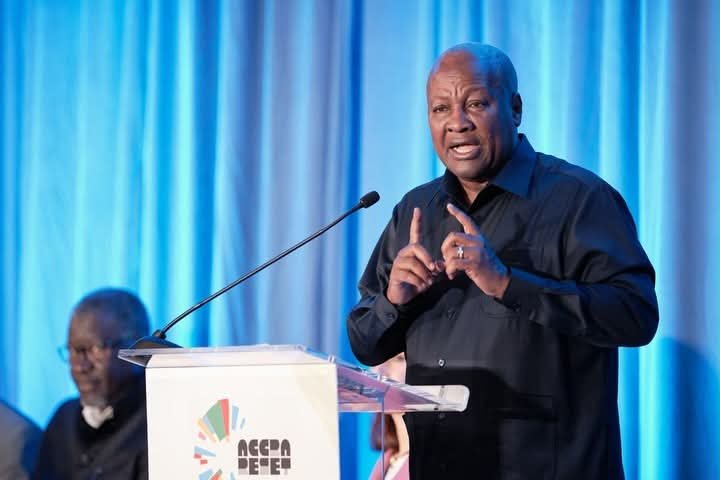
President John Dramani Mahama has said Ghana will use its upcoming chairmanship of the African Union (AU) to advance the Accra Reset agenda within wider continental policy discussions.
Ghana is scheduled to assume the chair of the African Union in January 2027, providing an opportunity for the country to place issues around health sovereignty, self-reliance and reforms in global development cooperation higher on the continental agenda.
Speaking at the “Full Circle: Making Global Development Work Again” side event of the 81st United Nations General Assembly in New York, President Mahama said Ghana would carry the principles of the Accra Reset into Africa’s collective policy framework.
“As Ghana prepares to assume the chair of the African Union next year in January 2027, I assure you we will carry this Accra Reset agenda into the heart of Africa’s collective policy framework,” he said.
President Mahama said Ghana would work closely with the Non-Aligned Movement and the G77 Plus in pursuing the initiative and promoting reforms that give developing countries greater capacity to shape their own development priorities.
The Accra Reset was launched in New York a year ago as a platform for addressing challenges facing the Global South, including geopolitical vulnerability, geostrategic marginalisation and dependence on external development financing.
According to President Mahama, the initiative seeks to promote stronger domestic productive capacity, financial resilience and greater control over critical sectors, while maintaining international cooperation based on equality.
He said the agenda was not intended to encourage countries to isolate themselves from the global system, but rather to build what he described as “pragmatic interdependence”—partnerships in which countries engage each other as equals.
“Stronger, self-reliant southern partners are not a threat to the global North. On the contrary, resilient health systems in Africa, Asia, and South America make the entire world safer for all of us,” he said.
The President said health had been chosen as an initial area for the Accra Reset because of its importance to human development and the vulnerability of health systems to external shocks and financing pressures.
He said the recently launched A Sovereign Future for Health report, which contains 10 recommendations for reforming global health governance, would provide a framework for advancing the initiative.
President Mahama also linked the Accra Reset to Ghana’s domestic Resetting Ghana Agenda, which focuses on strengthening fiscal management, governance, industrial capacity, local value addition and public health systems.
He argued that continental and global reforms must be matched by stronger domestic accountability.
“There can be no ownership without control,” he said, while adding that greater control must also be accompanied by accountability to citizens.
As Ghana prepares to take up the AU chairmanship, the President said the country would seek to move the Accra Reset from international discussions into practical continental action, with a focus on building stronger and more resilient systems across Africa.
General News
We Are Bringing Public Policy and Corporate Responsibility Together to Safeguard Mothers and Children – Mahama
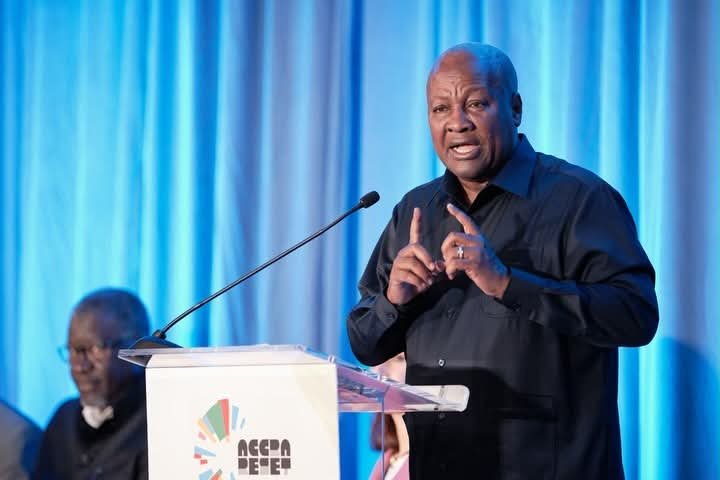
President John Dramani Mahama has called for stronger collaboration between governments and the private sector to improve maternal and child health, saying public policy must be matched by corporate responsibility to protect the lives of mothers and children.
Speaking at the “Full Circle: Making Global Development Work Again” side event of the 81st United Nations General Assembly in New York, President Mahama identified maternal and child health as one of the key areas through which the Accra Reset agenda would be tested.
He said health was chosen as an initial focus of the global reset because it remains one of the most important areas of human development and because weaknesses in health systems continue to have serious consequences, particularly for women and children.
“Globally, nearly seven out of 10 maternal deaths occur in sub-Saharan Africa every year, and my own country, Ghana, is not an exception,” President Mahama said.
He noted that Ghana’s maternal mortality rate remains above the recommended Sustainable Development Goal target, describing the situation as one that requires urgent and sustained action.
President Mahama said the government could not address the challenge alone and highlighted initiatives designed to bring together public policy and private-sector support.
He cited the Mother Africa Initiative, championed by Tanzanian President Samia Suluhu Hassan, and the Business United for Mothers, Babies, and Youth (BUMBY) campaign as examples of efforts seeking to mobilise broader support for maternal, child and youth health.
«“We are bringing public policy and corporate responsibility together to safeguard the lives of mothers and children,” he said.»
According to President Mahama, such initiatives would provide an opportunity to test the proposed financial and governance architecture of the Accra Reset in practical terms.
He said the focus should not only be on developing policies but also on ensuring that those policies produce measurable improvements in people’s lives.
The President linked the maternal and child health agenda to the broader objective of strengthening health sovereignty across the Global South.
He argued that countries must build stronger domestic health systems, develop local production capacity and reduce excessive dependence on external sources for essential health products.
President Mahama also launched the report “A Sovereign Future for Health” at the New York event. The report contains 10 recommendations aimed at reforming global health governance and strengthening the capacity of countries to shape their own health priorities.
He said Ghana would work with governments, international health organisations, development finance institutions, philanthropies and the private sector to translate the recommendations into practical programmes.
President Mahama said the ultimate measure of the Accra Reset should be its ability to deliver tangible improvements for ordinary people.
He stressed that the global development system must ultimately work for individuals whose lives depend on functioning health systems, including mothers and children.
“The reality must be for that baby girl born tonight, whether in Kathmandu, in Arusha, or Damango,” he said.
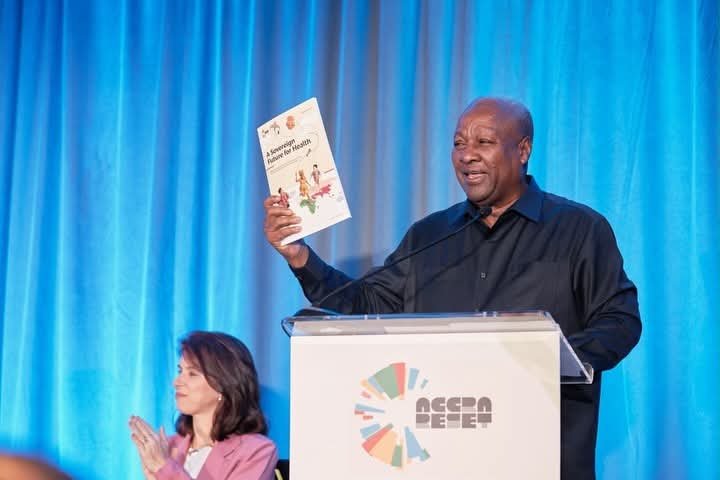
President John Dramani Mahama has officially launched a new report under the Accra Reset initiative, calling for greater control, accountability and self-reliance in global health and development.
The report, titled “A Sovereign Future for Health,” was launched during the Full Circle: Making Global Development Work Again side event held on the sidelines of the 81st United Nations General Assembly (UNGA) in New York.
The report is the product of a high-level panel established to examine reforms to the global health architecture and governance system.
Addressing the gathering, President Mahama said the Accra Reset was created to respond to what he described as growing vulnerabilities within the global development system, particularly the dependence of countries in the Global South on external financing and decisions made outside their borders.
He identified geostrategic marginalisation, geopolitical vulnerability and donor dependence as three interconnected challenges facing developing countries.
“These are not three separate misfortunes; they are interconnected threats of a broken global system,” he said.
President Mahama argued that countries must strengthen their political authority, productive capacity and financial resilience if they are to take greater responsibility for their development.
He drew a connection between the Accra Reset and Ghana’s Resetting Ghana Agenda, saying his administration was pursuing similar principles through reforms in the economy, fiscal management, governance, industrialisation and public health.
«“A national reset without a global reset leaves us building on shifting sands. Likewise, a global reset without domestic discipline is unfeasible. They are two sides of the same coin,” he said.»
‘No ownership without control’
A major theme of the report and President Mahama’s address was the relationship between ownership and control.
He questioned the effectiveness of development programmes that expect countries to take ownership of outcomes while critical resources and decisions remain largely outside their control.
«“There can be no ownership without control,” he said.»
However, President Mahama stressed that greater national control must also be accompanied by strong accountability.
He said governments seeking greater authority over development resources must be prepared to account to their citizens for how those resources are used.
“If we demand control, we must end it through uncompromising domestic accountability,” he said.
Health sovereignty
President Mahama said health was deliberately chosen as the first major area of focus for the Accra Reset because of its importance to human wellbeing.
He called for stronger local capacity to manufacture essential medicines and other health products, using Ghana’s pharmaceutical sector as an example.
He said Ghana should not simply build health facilities while relying on foreign suppliers for essential medicines and medical supplies.
Instead, he advocated domestic production supported by government procurement and access to regional markets.
The President also highlighted maternal and child health as an important test of the proposed reforms, noting that sub-Saharan Africa continues to account for a significant share of global maternal deaths.
He said initiatives such as the Mother Africa Initiative and the Business United for Mothers, Babies, and Youth (BUMBY) campaign would help bring public policy and corporate responsibility together to protect mothers and children.
From report to action
President Mahama said the launch of A Sovereign Future for Health should mark the beginning of implementation rather than the end of another international discussion.
He said Ghana would work with governments, global health organisations, development finance institutions, philanthropies and private-sector partners to translate the report’s recommendations into country-level programmes.
The proposed partnerships, he said, should strengthen links between research, regulation, local manufacturing and reliable distribution systems.
President Mahama stressed that the Accra Reset was not intended to promote isolationism.
“We are seeking pragmatic interdependence, a mature equal partnership where we see one another as equals,” he said.
As Ghana prepares to assume the chairmanship of the African Union in January 2027, President Mahama said the country would take the Accra Reset agenda into wider African policy discussions.
He also said Ghana would work with the Non-Aligned Movement and the G77 Plus to advance reforms in global development cooperation.
Lecturer at the University of Media, Arts and Communication-Institute of Journalism (UniMAC-IJ), Zakaria Tanko Musah, has cautioned against pressuring Ghana’s security agencies to disclose operational details of ongoing narcotics investigations.
Speaking on GTV Breakfast, Musah said excessive disclosure of investigative strategies could alert drug trafficking networks and allow them to change their methods.
He urged the public and commentators to exercise restraint, particularly as the recent investigations involve international cooperation between several countries.
“Let’s not, because we want to satisfy our human interest curiosity, be pushing the national security people to divulge almost all the strategy, because this is an ongoing exercise,” he said.
Musah noted that the investigations extend beyond Ghana, pointing to the involvement of France, the Netherlands and Belgium in the broader narcotics operation.
His comments come amid heightened scrutiny of drug shipments linked to Ghana and ongoing investigations into recent narcotics cases involving the country’s ports.
Following an urgent meeting with security chiefs on September 17, President John Dramani Mahama directed the formation of an inter-agency task force to develop a roadmap for preventing narcotics trafficking through Ghana’s borders. The task force was given two weeks to submit its recommendations.
Authorities have said 10 individuals, including four Customs Division officers of the Ghana Revenue Authority, were being held as investigations continued.
Musah also questioned the wisdom of allowing suspected drug shipments to proceed to their final destination simply to identify more members of a trafficking network, arguing that such operations involve significant risks given the quantity and value of narcotics involved.
He therefore urged stakeholders to allow security agencies to conduct their investigations without unnecessarily exposing sensitive operational information.
General News
Addicted to social media? ‘I struggle to put down my phone’ — 62-year-old woman cries out


A 62-year-old woman has opened up about her growing dependence on social media, admitting that she struggles to put down her phone even when she knows she should.
The woman described how spending long periods on her phone has become part of her daily routine, with social media constantly competing for her attention.
Her experience highlights concerns about the increasing amount of time people of all ages spend on social media platforms and the difficulty some users face in controlling their usage.
For the 62-year-old, what may have started as a simple way to stay connected and entertained has gradually become a habit she finds difficult to break.
“I struggle to put down my phone,” she reportedly said, expressing concern about how deeply social media has become embedded in her everyday life.
Experts have increasingly discussed problematic social-media use in terms of compulsive or difficult-to-control behaviour, although heavy use alone does not necessarily mean someone has a clinical addiction.
The woman’s candid admission has sparked conversation about the need for people to develop healthier relationships with their phones and social media, regardless of age.
General News
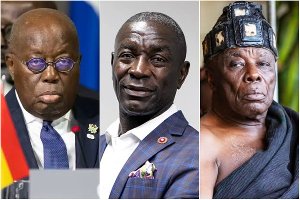
Kofi Amoabeng narrates how dancing in front of Akufo-Addo, Okyehene landed him in trouble

Ghana to Take Accra Reset Agenda into AU Policy Framework in 2027 – Mahama

We Are Bringing Public Policy and Corporate Responsibility Together to Safeguard Mothers and Children – Mahama

President Mahama Launches Accra Reset Report at 81st UN General Assembly



-

 General News1 week ago
GTA’s Financial Strength Weakens Despite 2025 Tourism Activities
-

 General News1 week ago
GTA Cash Reserves Halve to GH¢640,000 Despite Improved Liquidity Ratio
-

 Entertainment2 weeks ago
Keche Supports Street Vendor with GH¢3,000 After She Struggles to Make Sales
-
 Entertainment2 weeks ago
Government Repatriates Musician Barosky from UK
-
 General News2 weeks ago
TVET is not for the academically weak – Advocate calls for change in Ghana’s mindset
-
 General News2 weeks ago
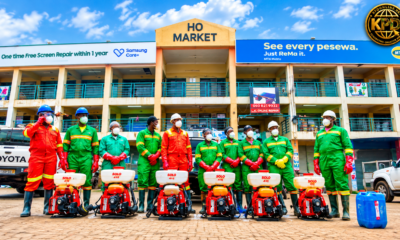
Techiman Assembly, Zoomlion Undertake Fumigation Exercise to Prevent Disease Outbreaks
-
 General News2 weeks ago
Police Launch Manhunt for Missing Assin Fosu Man as Captors Demand GH¢49,500 Ransom
-

 General News1 week ago
Creative Arts Agency Records GH¢2.01m Revenue in FY2025 Despite Financial Reporting Gaps