
General News
Government Receives First Batch of 100 Buses to Ease Public Transport Strain

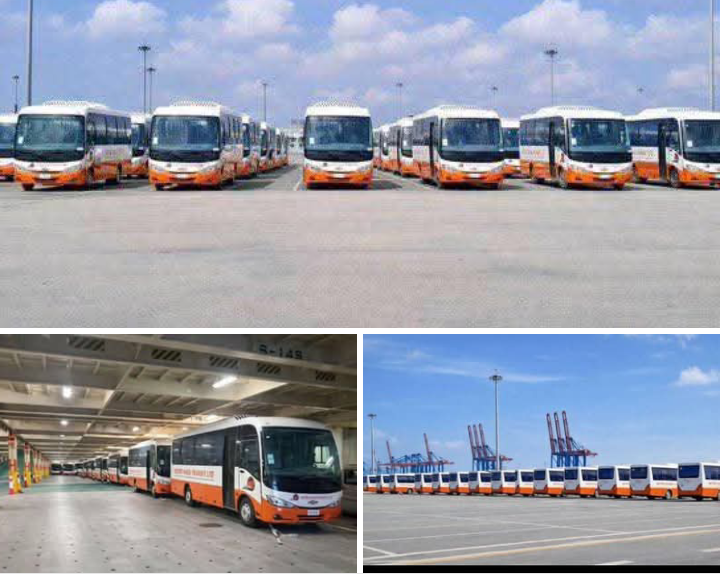
The government has taken delivery of 100 new buses as part of efforts to address growing pressure on Ghana’s public transport system following recent commuter disruptions across the country.
Minister for Government Communications, Felix Kwakye Ofosu, announced the development in a Facebook post on Sunday, April 5, 2026. He indicated that the buses form part of a broader nationwide initiative to expand transport capacity and improve mobility.
According to the Minister, the newly arrived 29-seater buses are the first tranche of a 300-vehicle procurement programme. “In the meantime, 100 29-seater buses have arrived in the country to ease recent road transport challenges. They form part of 300 procured for the purpose. Another batch of 100 will arrive in August, with the final batch expected in November,” he stated.
The intervention follows recent shortages of commercial vehicles in several parts of the country, which left commuters stranded at bus stops and transport terminals, particularly during peak hours.
Government officials have acknowledged the disruptions and assured the public of ongoing measures to stabilise the sector. Vice-President Jane Naana Opoku-Agyemang has previously indicated that steps are being taken to improve transport services and ease the burden on daily commuters.
The phased delivery of the buses is expected to gradually improve conditions, especially in urban centres where overcrowding, long waiting times and limited vehicle availability have become persistent challenges.
Authorities say the initiative will provide much-needed relief for workers, students and other commuters who rely heavily on public transport, as efforts continue to restore efficiency and stability within the sector.

















The Ghana Revenue Authority (GRA) has clarified that travellers entering Ghana are not automatically required to pay customs duty simply because they are carrying more than two mobile phones.
The clarification follows recent public discussions and concerns over the Customs treatment of mobile phones brought into the country by passengers.
In a press release issued on Thursday, September 3, 2026, the GRA explained that Customs officers assess travellers’ baggage and personal effects based on the circumstances of each case.
According to the GRA, there is no automatic rule requiring a traveller carrying more than two mobile phones to pay customs duty.
The Authority said the key consideration is whether the phones and other items being carried are genuinely intended for the traveller’s personal use or are being brought into Ghana for another person, for sale, distribution or other commercial purposes.
Customs officers may therefore consider several factors when assessing the items, including:
The nature and quantity of the items being carried.
Whether the phones are already in use.
Whether the devices are new and commercially packaged.
The number of similar items being carried.
Whether the circumstances suggest that the items are intended for sale or distribution.
The GRA explained that its earlier reference to some mobile phones was intended only to illustrate circumstances in which Customs officers might need to make further enquiries.
It stressed that the number of phones carried does not, on its own, determine whether customs duty is payable.
The Authority said a traveller may legitimately carry more than one mobile phone for personal reasons.
For instance, a passenger may be travelling with a work device and a personal phone, or may be carrying a replacement handset. In such circumstances, the phones would not necessarily be treated as commercial imports.
However, the situation may be different where a passenger is carrying several new or similarly packaged devices, particularly where the phones are intended for other people.
In such cases, Customs may need to establish whether the items qualify as personal effects or should be treated as imports subject to the applicable customs procedures.
The GRA said Ghana’s Customs system distinguishes between personal effects and goods imported for sale, supply or other commercial purposes.
The distinction, it noted, is important to ensure fairness between travellers bringing personal belongings into Ghana and individuals or businesses importing goods commercially.
Where goods are determined to be commercial imports and are subject to duty, the applicable duties and taxes will be assessed in accordance with Ghana’s Customs laws and procedures.
The GRA has encouraged travellers to observe the appropriate procedures when entering the country.
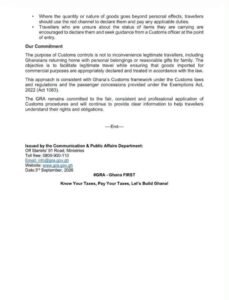
Goods that are genuinely for personal use may be brought into Ghana through the green channel.
However, where the quantity or nature of goods goes beyond what would reasonably be considered personal effects, travellers should use the red channel, declare the items and pay any applicable duties.
The Authority also advised travellers who are uncertain about the status of items in their possession to declare them and seek guidance from a Customs officer at the point of entry.
The GRA said the purpose of Customs controls is not to inconvenience legitimate travellers, including Ghanaians returning home with their personal belongings or reasonable gifts for family members.
Instead, the objective is to facilitate legitimate travel while ensuring that goods imported for commercial purposes are properly declared and treated according to the law.
The Authority said its approach is consistent with Ghana’s Customs framework, including the Customs laws and regulations and passenger concessions provided under the Exemptions Act, 2022 (Act 1083).
The GRA reaffirmed its commitment to the fair, consistent and professional application of Customs procedures and said it would continue providing information to help travellers understand their rights and obligations.
The statement was issued by the Communication & Public Affairs Department of the Ghana Revenue Authority, located at Off Starlets 91 Road, Ministries.

About 55,000 candidates who sat the 2026 Basic Education Certificate Examination (BECE) are expected to miss out on placement into second-cycle institutions after failing either English Language or Mathematics.
The Coordinator of the Computerised School Selection and Placement System (CSSPS), Sherif Sulemana, disclosed that approximately 565,000 of the 620,000 candidates who wrote the examination have qualified for placement.
Speaking on Joy FM’s Super Morning Show on Thursday, September 3, Mr Sulemana explained that candidates must pass both English Language and Mathematics to qualify for placement.
“You are disqualified from placement if you have failed either English or Mathematics,” he stated.
This means about 55,000 candidates will be excluded from the 2026 school placement exercise based on the figures provided.
Mr Sulemana, however, clarified that receiving Grade 9 under the standardised grading system does not automatically mean a candidate has failed a subject.
According to him, the raw scores obtained by candidates are also taken into account when determining whether a candidate has passed or failed.
He explained that some candidates who received Grade 9 recorded extremely low raw scores, including marks such as 1, 10, 12 or 20 out of 100, which qualified as failures.
The CSSPS Coordinator also disclosed that only about 17 per cent of the candidates, representing approximately 107,000 students, obtained aggregates between 6 and 18.
He said the figures reflected the overall performance of candidates in the 2026 BECE.
Mr Sulemana further revealed that about 252,000 candidates, representing roughly 35 per cent of the total candidates, obtained aggregates between 6 and 24.
Meanwhile, the CSSPS has activated its call centres to assist candidates and parents with complaints and challenges arising from the placement process.
Mr Sulemana said the arrangement was particularly important for parents and candidates who live far from regional resolution centres.
He urged affected individuals to contact the call centres with their concerns instead of travelling long distances to seek assistance.
According to him, the system will allow complaints to be received and addressed remotely, helping to make the placement resolution process more accessible to candidates and their families.
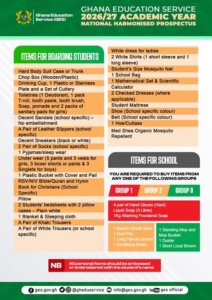
The Ghana Education Service (GES) has released the National Harmonised Prospectus for the 2026/2027 academic year to guide admissions into Senior High Schools (SHS) and Senior High Technical Schools (SHTS) across Ghana.
The prospectus was released on Thursday, September 3, 2026, ahead of the 2026/2027 school placement exercise. It applies to students enrolling under both boarding and day programmes.
The document is intended to provide parents, guardians and prospective students with clear guidance on the essential items required for enrolment and help them prepare adequately before the start of the new academic year.
The announcement was contained in a statement signed by Daniel Fenyi, Head of Public Relations at the Ghana Education Service.
According to the GES, the release of the National Harmonised Prospectus is part of efforts to streamline the admission process and promote fairness, consistency and standardisation across SHS and SHTS institutions nationwide.
The Service explained that making the prospectus available ahead of the placement exercise would give newly admitted students and their parents sufficient time to make the necessary preparations before reporting to their respective schools.
The GES urged parents and students to carefully review the prospectus and begin preparations early to ensure that all required items are available when students commence the academic year.
The Service also directed schools and other relevant stakeholders to strictly adhere to the requirements contained in the National Harmonised Prospectus.
It said compliance with the document would contribute to a smooth, consistent and standardised admission process nationwide.
The prospectus covers students entering both Senior High Schools and Senior High Technical Schools, whether they are enrolled as boarding or day students.
The GES further emphasised the importance of early preparation as parents and students await the release of the 2026/2027 school placements, which will determine the institutions where students will continue their secondary education.
The National Harmonised Prospectus is therefore expected to serve as a common guide for enrolment requirements and help reduce inconsistencies in the items requested from newly admitted students.
Parents, guardians and prospective students have been encouraged to familiarise themselves with the requirements and make the necessary preparations ahead of the commencement of the 2026/2027 academic year.
The GES expects schools and stakeholders to follow the harmonised requirements to ensure that the admission process is fair, organised and consistent across the country.

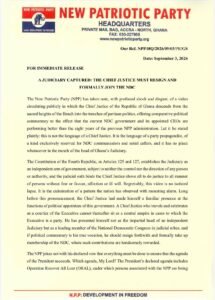
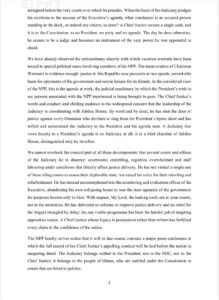
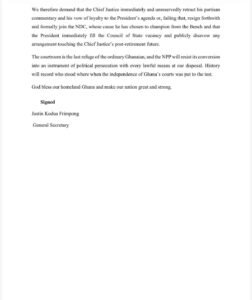
Ghana’s opposition New Patriotic Party (NPP) has called on Chief Justice Paul Baffoe-Bonnie to immediately retract what it describes as partisan comments or resign from office and formally join the governing National Democratic Congress (NDC).
The demand was contained in a strongly worded statement issued on Thursday, September 3, 2026, and signed by NPP General Secretary Justin Kodua Frimpong.
The party’s reaction follows the circulation of a video in which it claims the Chief Justice made political comparisons between the performance of the current NDC administration and the previous NPP government.
The NPP said the remarks were inconsistent with the constitutional responsibility of the head of Ghana’s Judiciary, arguing that the Chief Justice must remain politically neutral and independent.
The party took particular exception to what it described as the Chief Justice’s reported vow that “everything must be done to ensure that the agenda of the President succeeds.”
Questioning the statement, the NPP asked: “Which agenda, My Lord?” and linked the concern to the government’s Operation Recover All Loot (ORAL) initiative and ongoing prosecutions involving some persons associated with the NPP.
The opposition party cited Articles 125 and 127 of the 1992 Constitution, arguing that they guarantee the independence of the Judiciary and protect judicial officers from political control or direction.
It further referenced the judicial oath, insisting that the Chief Justice’s loyalty must be to the Constitution and not to any President, political party or government programme.
According to the NPP, public alignment with an Executive agenda could undermine public confidence in the impartiality of the courts, particularly in cases involving political actors.
The party warned that such conduct could make accused persons and ordinary citizens question whether they would receive fair and independent justice.
The NPP also accused the Chief Justice of developing a pattern of close association with political appointees and activities of the current administration.
It argued that his frequent presence at government-related functions could create the perception that the Judiciary is becoming politically aligned with the Executive.
The party further revived its concerns about criminal proceedings involving some of its members, alleging that Ghana was operating what it described as a two-speed justice system.
It cited the incarceration of Ashanti Regional NPP Chairman Bernard Antwi Boasiako, popularly known as Chairman Wontumi, as an example of what it considers selective application of judicial processes.
The NPP also questioned the speed with which vacation warrants had allegedly been issued in politically sensitive cases involving its members.
The party also turned its attention to the state of Ghana’s court infrastructure.
It accused the Chief Justice of failing to sufficiently address deteriorating court facilities, overwhelmed registries and difficult working conditions for judicial staff.
The NPP contrasted the situation with what it described as the Chief Justice’s visible engagement with state institutions under the Executive.
In a pointed statement, the party said: “With respect, My Lord, the leaking roofs are in your courts, not in the ministries.”
The NPP accused the Chief Justice of appearing more focused on monitoring the Executive’s activities and pursuing cases involving opposition figures than on reforms aimed at improving justice delivery.
The party is demanding that the Chief Justice:
Immediately and unreservedly retract the comments it considers partisan.
Withdraw his reported pledge to support the President’s agenda.
Resign as Chief Justice if he refuses to retract the remarks.
Formally join the NDC if he intends to continue pursuing what the NPP considers a political agenda.
Have President John Dramani Mahama fill the vacant position on the Council of State.
Have the President publicly clarify any alleged arrangement concerning the Chief Justice’s post-retirement future.
The NPP also announced plans for a major press conference, where it says it will present what it calls the full record of the Chief Justice’s conduct to the Ghanaian public.
The party maintained that the Judiciary belongs to the people of Ghana and must remain independent of both the governing NDC and opposition NPP.
As of Thursday, September 3, there had been no public response from Chief Justice Paul Baffoe-Bonnie or the Judicial Service to the allegations contained in the NPP statement.
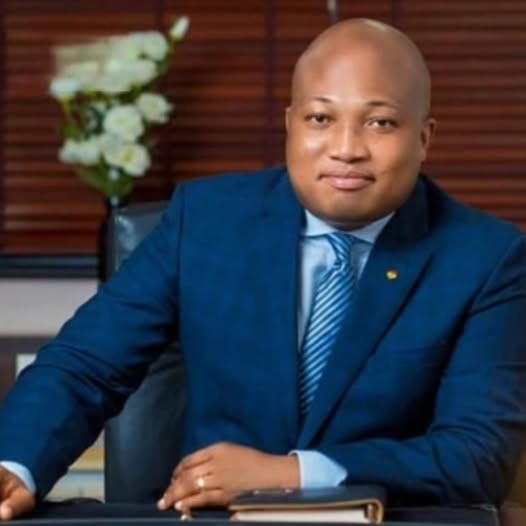
The Minister of Foreign Affairs, Samuel Okudzeto Ablakwa, has responded to an undercover investigation by The Fourth Estate into alleged irregularities surrounding attestation services at state institutions.
In a press statement issued in Accra on Thursday, September 3, 2026, the Ministry said it had taken note of an online report published by The Fourth Estate on September 2, 2026, and commended the media organisation for its investigative work and contribution to good governance, public accountability and operational efficiency.
The Ministry stressed that it operates a zero-tolerance policy towards middlemen and third-party facilitators involved in the acquisition of attestation documents.
According to the Ministry, management strongly condemns the activities of unscrupulous individuals who, despite having no official link to the Ministry, exploit vulnerable members of the public.
The Ministry disclosed that following a report received about the undercover investigation, the man implicated in the report, who it said is not a staff member of the Ministry of Foreign Affairs, had been sanctioned by his respective institution.
He has also been reported to law enforcement authorities for further investigation and possible prosecution.
Additionally, the Ministry said the individual has been prohibited from entering the premises of the Ministry of Foreign Affairs.
The Ministry explained that the attestation process involves multiple institutions across different arms of government, making coordination among the institutions essential to maintaining the integrity and credibility of the process.
It said efforts to strengthen multi-institutional coordination, integrity and credibility have been ongoing for several months, a development it noted was also confirmed in The Fourth Estate’s investigative report.
The Ministry further revealed that it had already begun comprehensive reforms of its consular and attestation services before the investigation was conducted.
Among the reforms is a plan to make the payment process cashless, while digital platforms are also being developed to anchor the entire attestation process.
The Ministry said the digitalisation is intended to drastically reduce human interface and minimise opportunities for abuse.
It expressed confidence that the reforms would deliver positive results similar to those achieved through the Passport Administration system in Ghana.
The Ministry reminded the public that the Parliament-approved fee for attestation is GH¢200.
It explained that the fee is collected by officials of the Controller and Accountant-General’s Department, who issue the appropriate official receipts.
The Ministry therefore warned members of the public not to engage the services of middlemen, stressing that doing so is strictly illegal.
The Ministry encouraged citizens who have relevant information, enquiries or complaints concerning attestation services to contact the Ministry through:
Phone: +233 240 913 284 / +233 240 793 072
Email: info@mfa.gov.gh
The Ministry reiterated its commitment to integrity, transparency and ethical service delivery, while assuring the public that ongoing reforms are aimed at improving the efficiency and credibility of its consular and attestation services.

GTA PARTNERS AFRICA’S BRAIN BANK TO ADVANCE HEALTHCARE, INVESTMENT AND MEDICAL TOURISM IN GHANA

Kelvin Kenneth Expands Professional Portfolio with New Appointment at Africa-Middle East Trade Investment Corporation

GRA Clarifies Customs Rules on Travellers Carrying More Than Two Mobile Phones



-

 General News2 weeks ago
Nana Adwoa Tutuwaa Named Global Humanitarian of the Year 2026
-

 General News2 weeks ago
Police Arrest Suspect in GH¢1.1m Fake Gold Scam at Berekum
-

 Entertainment2 weeks ago
Interfaith Tourism World Club Calls for Faith-Based Tolerance to Strengthen National Peace
-

 General News2 weeks ago
Assemblies of God Ghana Clears Headquarters Loan, Slashes Overdraft by GH¢3.2m
-
 General News1 week ago
GES Urged to Review Student Sexual Misconduct Rule Over Alleged Discrimination Against Boys
-

 General News2 weeks ago
LMI Holdings: The Ghanaian Company Chosen to Revive the Saglemi Housing Project
-

 Entertainment2 weeks ago
Tiwa Savage Reveals Why Cheating Has Never Been a Deal Breaker for Her
-
 General News1 week ago
OSP Assesses Extortion Allegations Against Afenyo-Markin