
General News
Mahama orders GH¢2 per litre diesel price reduction

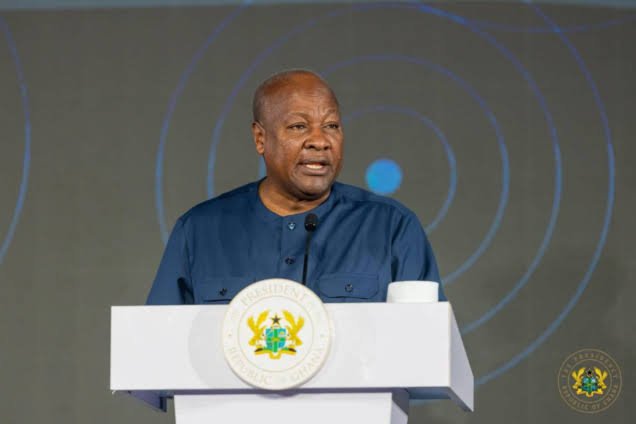
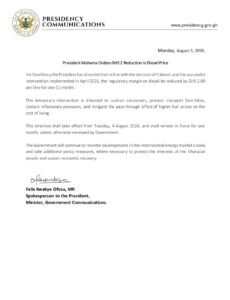
President John Dramani Mahama has directed a temporary reduction of GH¢2.00 per litre in the regulatory margin on diesel to ease the burden of rising fuel costs on Ghanaians.
The directive, announced by the Spokesperson to the President and Minister for Government Communications, Felix Kwakye Ofosu, follows a Cabinet decision and builds on a similar intervention introduced in April 2026.
The one-month measure is aimed at cushioning consumers, preventing increases in transport fares, containing inflationary pressures, and reducing the impact of higher fuel prices on the overall cost of living.
According to the statement, the reduction will take effect from Tuesday, 4 August 2026, and will remain in force for one month unless the government decides to review the policy.
The Presidency said the government will continue to closely monitor developments in the international energy market and implement additional policy measures where necessary to safeguard the interests of Ghanaians and sustain the country’s economic recovery

An Assin Fosu District Court Judge has recounted an extraordinary incident in which suspected MoMo fraudsters allegedly attempted to scam him shortly after he had sentenced a person for a similar offence.
His Worship Abdul Majid Iliasu said the attempted fraud happened as he was leaving the court premises after proceedings.
The incident, according to the judge, involved the familiar tactic of claiming that money had been mistakenly transferred into a person’s account and asking the recipient to return it.
Fraudsters allegedly targeted judge after court
According to the judge, an unknown caller contacted him and claimed that he had accidentally sent money into the judge’s account.
The caller allegedly asked the judge to return the supposed funds.
Shortly after the call, the judge said he received a text message purportedly from a telecommunications service provider, apparently confirming that the alleged transfer had been made.
However, rather than acting immediately, the judge checked the information more carefully.
His further checks, he said, revealed that the message was fake.
“I realised they were fraudsters”
Recounting the incident, Judge Iliasu said the approach immediately raised suspicion because it matched a common method used by MoMo fraudsters.
“After further checks, I realised they were fraudsters because that was their modus operandi,” he said.
The judge’s experience highlighted how fraudsters can attempt to exploit the trust of mobile money users by creating the impression that a genuine transaction has taken place.
The irony after sentencing a MoMo fraudster
What made the incident particularly striking was its timing.
The suspected scam attempt occurred shortly after the judge had sentenced Prince Mensah, who had been convicted of defrauding mobile money vendor Alice Fofie of GH¢37,000.
The court imposed a fine of GH¢9,000, with the judge indicating that the punishment was intended to deter others from engaging in similar offences.
Moments later, the judge himself became the target of what he believed was an attempted MoMo scam.
“No respect to anybody”
The judge appeared amused by the irony of the situation but used the incident to highlight the growing threat posed by electronic transaction-related crimes.
He remarked that suspected fraudsters appeared willing to target anyone, regardless of their position in society.
“These guys show no respect to anybody, no matter your status in society,” he said.
Judge calls for tougher action
Judge Iliasu also expressed concern about the increasing incidence of electronic transaction-related crimes in the Assin Fosu area.
He called on the Ghana Police Service and relevant cybersecurity authorities to intensify efforts to identify, investigate and prosecute perpetrators of MoMo fraud and other electronic transaction-related offences.
The judge’s comments came while he was presiding over a separate kidnapping case involving four suspects accused of abducting 30-year-old Bismark Amoh.
Amoh was reportedly held in Kumasi from September 6 to September 11, with one of the suspects also linked to a separate allegation involving MoMo fraud.
A warning to MoMo users
The incident serves as another reminder of the need for mobile money users to verify transactions directly through their accounts before responding to claims of mistaken transfers.
A text message appearing to come from a telecommunications provider should not, on its own, be treated as proof that money has been received.
For the Assin Fosu judge, the attempted scam provided a striking real-life example of the very offence he had just been dealing with in court—and a reminder that MoMo fraudsters can target anyone, regardless of status.

President John Dramani Mahama has announced that the major haulage of waste from Agbogloshie in Accra to the Adepa Engineered Landfill Site near Nsawam will take place at night, as government begins a massive operation to clear an estimated one million tonnes of accumulated garbage.
The President made the announcement on Friday, September 18, 2026, when he officially commissioned the evacuation exercise at Agbogloshie.
The operation is expected to last about 90 days and forms part of government’s broader efforts to tackle Ghana’s longstanding sanitation challenges.
Full-capacity operation to happen at night
President Mahama explained that the decision to undertake the major haulage at night is intended to minimise disruption while allowing large volumes of waste to be transported efficiently.
According to him, some waste evacuation will continue during the day, but on a smaller scale.
At night, however, the operation will move into full capacity.
“In the daytime, there will be some evacuation of garbage but at the lower scale, and then in the night we go to full capacity,” President Mahama said.
He linked the arrangement to the government’s 24-Hour Economy Initiative, while stressing that the safety of residents, road users and communities along the haulage routes must remain a priority.
One million tonnes of waste to be removed
The scale of the operation is significant.
A drone-assisted artificial intelligence assessment has estimated that the accumulated waste at Agbogloshie amounts to approximately one million tonnes.
The waste will be excavated, loaded and transported to the Adepa Engineered Landfill Site near Nsawam in the Eastern Region, where it will undergo controlled disposal, compaction and covering.
The evacuation is expected to address years of accumulated waste, including plastics, discarded electronic equipment and other refuse.
Heavy machinery deployed
Government is deploying heavy-duty equipment acquired under the District Road Improvement Programme (DRIP) for the exercise.
The equipment includes:
- Tipper trucks
- Excavators
- Bulldozers
- Wheel loaders
The Ghana Armed Forces, particularly the 48 Engineers Regiment, is also providing operational and engineering support.
Mahama said the exercise demonstrates how existing state resources and institutions can be brought together to tackle major national challenges.
Agbogloshie to make way for industrial park
The waste evacuation is not only about cleaning the area.
President Mahama said the cleared land will form part of the proposed Agbogloshie Urban Land Renewal Project, with plans to transform the reclaimed area into an industrial park.
He further announced plans for a major textile factory to be established there as part of efforts to create employment opportunities for young people.
The President said the transformation would follow the removal of the longstanding public health and environmental hazards associated with open dumping and burning.
Mahama warns against renewed dumping
The President also stressed the importance of ensuring that Agbogloshie does not return to its previous condition after the evacuation.
He has called for measures to protect the reclaimed land and prevent renewed dumping once the exercise is completed.
The Accra Metropolitan Assembly and the Ablekuma Central Municipal Assembly are expected to enforce sanitation by-laws to support the effort.
Appeal to residents
President Mahama appealed to residents of Agbogloshie and Old Fadama to cooperate with the military personnel, DRIP operators and assembly teams during the exercise.
He said the project was ultimately aimed at improving the health, dignity and living conditions of people in the surrounding communities.
The operation therefore marks the beginning of a major clean-up exercise, with government hoping that the removal of the massive waste heaps will pave the way for a long-term transformation of the area.
With approximately one million tonnes of waste expected to be evacuated within 90 days, the scale of the Agbogloshie operation is set to make it one of the country’s most significant waste-management exercises in recent years.
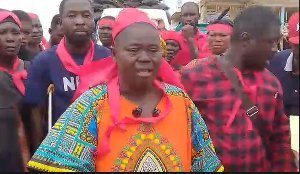
Tension is growing in Jema in the Kintampo South District of the Bono East Region as chiefs and residents rally behind 40-year-old nurse Salomey Awiti Bafoh, demanding her release following her arrest and subsequent remand by the Adenta Circuit Court.
The community has mounted pressure on the authorities to intervene, appealing to the government and First Lady Lordina Mahama to help secure bail for the nurse, whom they describe as a responsible and well-respected member of the community.
Chiefs and residents raise alarm
Residents and chiefs of Jema held a press briefing to express their concerns over Bafoh’s arrest and continued detention.
Bafoh, a principal nursing officer, was arrested during a midnight operation on Sunday, September 13, at her residence in Hansua in the Techiman Municipality.
According to her brother, Antwi Francis, three people—two men and a woman—arrived at the residence at about 11:30 p.m., allegedly identifying themselves as National Security operatives.
He claimed that the individuals did not show the family an arrest warrant or explain the grounds for the arrest before taking his sister away.
Community questions why she was arrested
One of the major concerns raised by the residents is what they describe as conflicting explanations surrounding Bafoh’s arrest.
The residents said they initially understood that she had been arrested over allegations involving mobile money fraud.
They subsequently sought legal assistance to intervene.
However, they said they were surprised when the matter eventually came before the court and the case concerned alleged links to the TikTok account known as “Ghana Jollof.”
The residents insisted that Bafoh had no connection with the account or its operator and called for authorities to clarify the circumstances surrounding her arrest and prosecution.
Elder appeals: “Release her to us”
Community elder James Kofi Owusu described Bafoh as respectful and well-behaved, saying he had known and helped raise her from a young age.
He appealed to the government and relevant authorities to intervene, arguing that the community was struggling to understand the circumstances surrounding her detention.
The elder also called for bail, assuring authorities that Bafoh would honour any court appearance required of her.
“We need bail. Release her to us, and whenever she is needed in court, she will be present,” he said.
What the Police say
The community’s concerns come as the Police have provided details of their investigation into the case.
According to the prosecution, Bafoh allegedly acted as a liaison for UK-based TikTok user Barbara Asantewaa Kodua, popularly known as “Ghana Jollof.”
Police allege that Bafoh helped disseminate videos produced by Kodua by recruiting other people to redistribute the content across social media platforms.
The prosecution further alleges that financial transactions were identified between the two women and that money was transferred to Bafoh to support the dissemination of the videos.
Kodua has been declared wanted by the Police and is currently at large.
Nurse pleads not guilty
Bafoh has been charged with abetment of crime, specifically the alleged publication and circulation of false news, under Sections 20(1) and 208 of the Criminal Offences Act, 1960 (Act 29).
She has pleaded not guilty to the charge.
The Adenta Circuit Court denied her bail after prosecutors argued that investigations were still ongoing and that the case involved national security concerns.
She was remanded into police custody and is expected to reappear before the court on September 30, 2026.
Community demands release
Despite the prosecution’s allegations, the chiefs and residents of Jema maintain that their intervention is not intended to obstruct the judicial process.
Rather, they want Bafoh to be allowed to return to her family and community while the case proceeds.
Their appeal adds to growing calls from other quarters for the nurse’s release or bail. The NPP has also called for a review of her continued detention, while the Member of Parliament for Techiman South, Martin Adjei-Mensah Korsah, has appealed for her release.
For now, the case remains before the court, with the prosecution’s allegations yet to be tested at trial. Bafoh remains presumed innocent unless and until proven guilty by a court of competent jurisdiction.
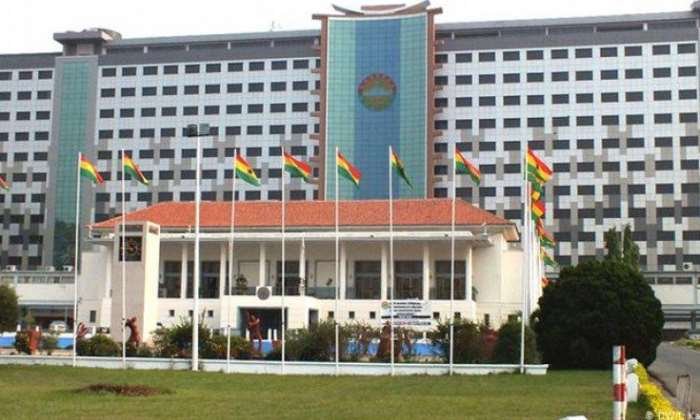
Ghana is set to open its first-ever Parliamentary Museum to the public on Tuesday, September 22, 2026, offering visitors a new opportunity to explore the country’s legislative history, constitutional development and democratic journey.
The museum, located within Parliament House in Accra, has been established to preserve Parliament’s institutional memory while giving the public, students, researchers and tourists a closer look at the evolution of Ghana’s legislature.
A new window into Ghana’s parliamentary history
The museum will bring together a collection of historical materials documenting the development of Parliament and Ghana’s constitutional institutions.
Among the exhibits will be historical photographs, parliamentary documents, records of past proceedings, artefacts and memorabilia associated with former Speakers of Parliament.
Visitors will also encounter archival materials relating to the former Legislative Council and significant milestones in Ghana’s constitutional development.
Interactive exhibits to tell Ghana’s legislative story
Beyond traditional documents and artefacts, the museum will feature interactive multimedia exhibits designed to help visitors understand how Ghana’s law-making process has evolved.
The facility is expected to provide a more accessible way for the public to learn about Parliament, governance and the institutions that have shaped Ghana’s democratic development.
For students and researchers, the museum is also expected to serve as a valuable source of primary material on Ghana’s parliamentary and constitutional history.
When will the museum be open?
The Parliamentary Museum will officially open to the public on Tuesday, September 22, 2026.
According to the Parliamentary Service, visiting hours will be:
- Monday to Friday
- 9:00 a.m. to 4:30 p.m.
The museum is expected to welcome members of the public, students, researchers, tourists, cultural visitors, Members of Parliament and parliamentary staff.
How to visit the Parliamentary Museum
Visitors cannot simply walk in for a museum visit without booking.
According to Parliament’s official visitor information, anyone wishing to visit the museum must book online in advance.
The process is:
- Go to the official Parliament of Ghana website.
- Select “Visit.”
- Choose “Museum.”
- Complete and submit the online booking form.
- Wait for notification confirming that the request has been approved.
Parliament’s official visitor page also provides a dedicated “Book Museum Visit” option for individuals, families and small groups.
Where is it located?
The museum is located at Parliament House in Accra, within the parliamentary precinct.
Parliament says adequate vehicle parking is available for visitors in front of the main entrance.
More than just a museum
The Parliamentary Service says the project is intended to promote openness and public education while preserving Ghana’s legislative history for future generations.
It will also provide a space where international partners and other legislatures can engage with Ghana’s parliamentary heritage and democratic development.
With its opening on September 22, the Parliamentary Museum is set to add a new public-facing dimension to Parliament House, allowing visitors to move beyond watching parliamentary proceedings and explore the historical records, objects and milestones behind Ghana’s legislative journey.
General News
Ex-convict arrested in Ashaiman for allegedly posing as soldier and extorting residents

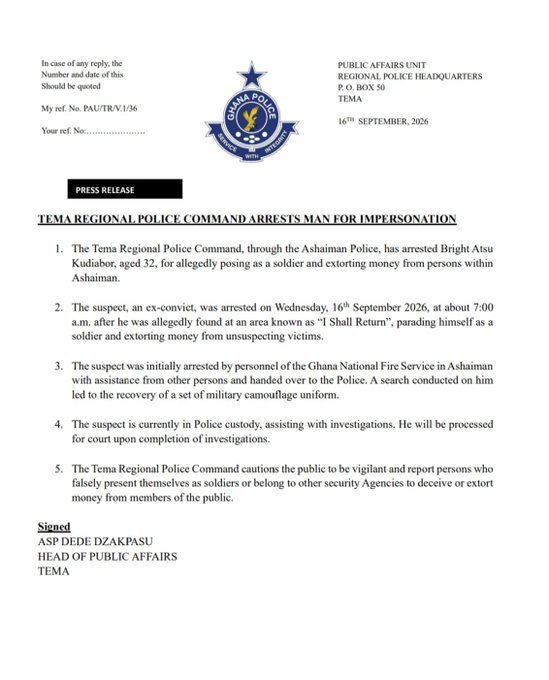
The Tema Regional Police Command has arrested a 32-year-old ex-convict who allegedly posed as a soldier and collected money from unsuspecting members of the public in Ashaiman.
The suspect, identified as Bright Atsu Kudiabor, was arrested by the Ashaiman Police on Wednesday, September 16, 2026, at about 7:00 a.m. at an area popularly known as “I Shall Return.”
Suspect allegedly paraded himself as soldier
According to the Police, Kudiabor was allegedly presenting himself as a member of the Ghana Armed Forces and using the false identity to obtain money from people in the area.
The Police said the suspect was allegedly extorting money from unsuspecting residents while parading himself as a soldier.
His activities reportedly attracted the attention of personnel of the Ghana National Fire Service, who, with assistance from members of the public, apprehended him before handing him over to the Police.
Military camouflage uniform recovered
Following his arrest, Police conducted a search on the suspect.
The search allegedly led to the recovery of a set of military camouflage uniform, which has since been taken into custody as part of the ongoing investigation.
The recovery has become a key part of the Police investigation into how the suspect allegedly presented himself as a military officer.
Police investigations underway
Kudiabor is currently in Police custody and is assisting investigators with inquiries into the allegations.
The Police have indicated that he will be processed for court after investigations are completed.
The suspect’s arrest does not amount to a conviction, and the allegations against him will have to be tested through the appropriate legal process.
Police issue warning to public
The Tema Regional Police Command has meanwhile cautioned members of the public to remain vigilant and report individuals who falsely present themselves as soldiers or members of other security agencies.
The Command said such persons may use false identities to deceive or extort money from unsuspecting members of the public.
The Police are therefore urging residents to promptly report suspicious persons and activities to the nearest Police station.
Case heads to court
With the suspect remaining in custody, investigators are expected to complete their work before the case is sent to court.
The development has also renewed the Police’s warning against individuals who allegedly exploit the identity or appearance of security personnel to gain money or influence over members of the public.
For now, Bright Atsu Kudiabor remains an accused person, not a convicted offender, as investigations continue.



Judge recounts attempted MoMo scam after jailing scammer

Agbogloshie waste evacuation: Full-capacity haulage to take place at night – Mahama

Jema chiefs and residents protest remand of Techiman nurse, demand her release



-

 Entertainment2 weeks ago
Mahama Is First President to Put GH¢40m Seed Money into Creative Arts Fund: Kojo Preko Dankwa
-

 Culinary2 weeks ago
The Green Heart of Ghanaian Cuisine: Celebrating Nkontomire and the Art of Abom
-

 General News5 days ago
GTA’s Financial Strength Weakens Despite 2025 Tourism Activities
-

 Entertainment2 weeks ago
Government Repatriates Musician Barosky from UK
-

 Entertainment1 week ago
Keche Supports Street Vendor with GH¢3,000 After She Struggles to Make Sales
-

 General News1 week ago
TVET is not for the academically weak – Advocate calls for change in Ghana’s mindset
-

 General News5 days ago
GTA Cash Reserves Halve to GH¢640,000 Despite Improved Liquidity Ratio
-

 General News1 week ago
Police Launch Manhunt for Missing Assin Fosu Man as Captors Demand GH¢49,500 Ransom