
General News
Nearly Two Million Ghanaian Youth Are Out of School, Work or Training – GSS Raises Alarm


The Ghana Statistical Service (GSS) has expressed concern over rising youth unemployment and the growing number of young people who are neither in education, employment nor training (NEET), warning that urgent investment is needed to secure Ghana’s future.
According to the Service’s World Population Day 2026 press release, the Quarterly Labour Force Survey for the first three quarters of 2025 recorded an average national unemployment rate of 12.8 per cent, while unemployment among young people aged 15 to 35 stood at 21.9 percent, nearly twice the national average.
The report further identified Greater Accra (31.9%), Central (27.4%), and Ashanti (27.2%) as the regions with youth unemployment rates consistently above the national youth average.
GSS also disclosed that nearly two million young people, representing 19.5 percent of the youth population by the third quarter of 2025, were classified as Not in Education, Employment or Training (NEET), meaning they were neither gaining skills through education nor participating in productive employment.
The report highlighted additional concerns over teenage pregnancy, noting that the 2022 Ghana Demographic and Health Survey found that 15 percent of girls aged 15–19 had ever been pregnant, while 11 per cent had already given birth. GSS said early pregnancy often disrupts education, limits skills development and reduces long-term economic participation, particularly among young women.
To reverse the trend, the Service called for sustained investment in technical and vocational education, entrepreneurship, stronger school-to-work transition programmes and the expansion of productive sectors capable of creating decent jobs for Ghana’s growing youth population.


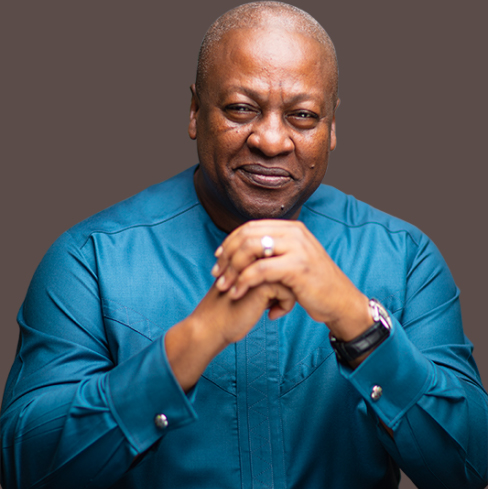
President John Dramani Mahama has ordered the formation of an inter-agency task force to develop a detailed roadmap to strengthen Ghana’s efforts to prevent narcotic drugs from being trafficked through the country’s borders.
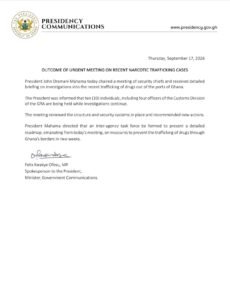
The directive followed an urgent meeting between the President and security chiefs on Thursday, September 17, over recent drug-trafficking cases involving Ghana’s ports.
The meeting reviewed ongoing investigations into the movement of narcotics through the ports, as well as the security structures and systems currently in place at Ghana’s borders.
According to the Presidency, President Mahama was informed that 10 people are currently being held in connection with the investigations.
Four of those in custody are officers of the Customs Division of the Ghana Revenue Authority (GRA).
The identities of the 10 individuals and the specific allegations against them were not disclosed.
Following the briefing, the meeting considered additional measures to strengthen Ghana’s systems for detecting and preventing narcotics trafficking.
President Mahama subsequently directed the establishment of an inter-agency task force to translate the recommendations from the meeting into a detailed roadmap.
The task force has been given two weeks to complete and submit the roadmap.
The move is intended to strengthen coordination among the institutions responsible for Ghana’s ports, borders, customs, intelligence and law-enforcement systems.
The meeting comes amid heightened attention to drug-trafficking cases linked to Ghana, including the seizure of nearly 3.9 tonnes of cocaine by French customs authorities from a container that had departed Ghana.
The Presidency has not indicated that the 10 people being held have been found guilty of any offence.
Their detention forms part of ongoing investigations into the recent narcotic-trafficking cases.
The urgent meeting was attended by security chiefs who briefed the President on the investigations and the existing security arrangements at Ghana’s ports and borders.
The Presidency said the discussions identified the need for additional measures to address vulnerabilities within the current system.
The statement on the outcome of the meeting was issued by Felix Kwakye Ofosu, MP, Spokesperson to the President and Minister for Government Communications.
The Presidency Communications statement was dated Thursday, September 17, 2026, and titled “Outcome of Urgent Meeting on Recent Narcotic Trafficking Cases.”

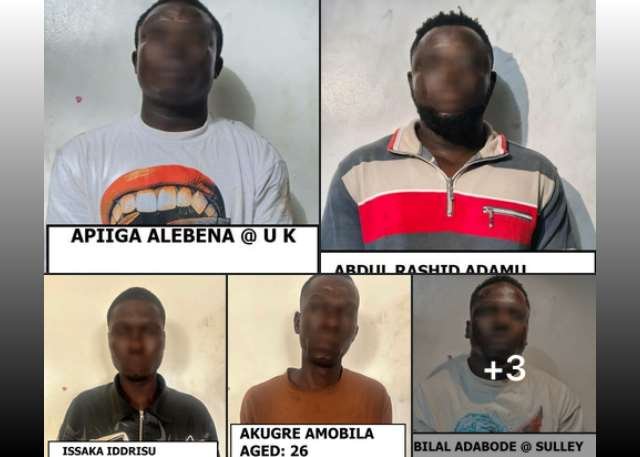
The Upper East Regional Police Command has arrested seven suspects allegedly linked to a robbery network operating across Zebilla, Garu and Binduri, following an intelligence-led operation in the region.
The suspects, aged between 20 and 41, are Issaka Iddrisu, 20; Ali Tamimu, 21; Akugre Amobila, 26; Banabas Apiiga, 41; Abdul-Rashid Adamu, 38; Apiiga Alebena, 21; and Bilal Adabodee, 31.
According to the Police, the arrests were carried out through a joint intelligence operation involving the Police Intelligence and Professional Standards Bureau (PID), the newly formed Black Cobra Unit and the Zebilla Neighbourhood Watch Community.
Suspects allegedly linked to wider robbery network
The Police said the suspects have reportedly confessed to being members of a wider network of gangs involved in armed robbery activities within the three communities.
Investigators are also pursuing information provided by the suspects about an alleged weapons supplier believed to be operating from Bawku.
The Police said the identity of the alleged supplier has been withheld as efforts continue to locate and arrest the person.
Victims identify two suspects
The case took a significant turn after two victims reported to the Police following the arrests.
The victims allegedly identified two of the suspects as members of a three-man armed robbery gang that attacked them at gunpoint.
According to the Police, the robbers made away with two Yamaha scooter motorbikes valued at GH¢30,000 and GH¢32,000 respectively.
The victims also told investigators that the attackers threatened to kill them if they reported the incident to the authorities.
The Police said the two suspects subsequently admitted to taking part in the robbery and provided information about the alleged source of the weapons used during the operation.
Police raid houses, recover cash and motorbikes
Searches conducted at the residences of Abdul-Rashid Adamu, Apiiga Alebena and Bilal Adabodee reportedly yielded several items of interest to investigators.
The Police said they recovered two unregistered motorbikes, quantities of suspected hard drugs and GH¢29,550 in cash.
The cash is believed by investigators to be proceeds from criminal activities, although the circumstances surrounding the items will form part of the ongoing investigation.
Seven suspects remanded
Following their arrests, all seven suspects were brought before the Bolgatanga Circuit Court.
The court has since remanded them into Police custody.
They are expected to reappear on September 23, 2026, as investigations continue.
Police intensify hunt for alleged weapons supplier
With the seven suspects now in custody, the Police have intensified efforts to identify and apprehend the person they allegedly named as their source of weapons.
The development is expected to help investigators determine whether the arrests have uncovered a broader organised robbery network operating across communities in the Upper East Region.
The Police Command says the operation forms part of ongoing efforts to clamp down on robbery activities and improve security in Zebilla, Garu, Binduri and surrounding areas.
For now, seven suspects are behind bars, while investigators continue the hunt for other persons allegedly connected to the robbery network.
General News
Graphic Business/Stanbic Bank breakfast meeting to tackle cross-border payment challenges


Businesses, regulators and financial sector players are set to converge in Accra as the Graphic Business/Stanbic Bank Breakfast Meeting turns the spotlight on one of the biggest challenges facing companies engaged in international trade — moving money across borders efficiently.
The upcoming breakfast meeting, scheduled for Tuesday, September 22, 2026, at the Labadi Beach Hotel in Accra, will bring together regulators, financial institutions, traders and business leaders to explore practical solutions to the challenges surrounding cross-border payments.
The meeting is being held under the theme: “Moving Money. Moving Trade. Moving Ghana. – Making It Easier to Buy, Sell and Pay Across Borders.”
High payment costs, delays put businesses under pressure
Head of Brand and Marketing at Stanbic Bank Ghana, Chidinma Braye-Yankee, said efficient cross-border payment systems have become increasingly important as Ghanaian businesses expand their trading relationships across Africa, China and other international markets.
She identified delays, high transaction costs, multiple intermediaries, foreign exchange challenges and limited payment transparency as some of the difficulties confronting businesses involved in international trade.
According to her, businesses need payment systems that can move funds faster, more cheaply and more reliably.
She stressed that efficient cross-border payments should no longer be viewed merely as a banking concern, but as an important part of supporting trade and economic growth.
China-Ghana trade takes centre stage
A major focus of the discussions will be how Ghanaian businesses can make payments to Chinese suppliers more efficiently.
Stanbic Bank Ghana recently introduced direct access to China’s Cross-Border Interbank Payment System (CIPS), allowing eligible customers to settle transactions denominated in Chinese Yuan directly through the bank.
The service is expected to reduce reliance on intermediary banks and help address some of the delays associated with traditional international payment channels.
The development is particularly relevant to Ghanaian importers, given China’s importance as a trading partner.
PAPSS, SWIFT and CIPS in the spotlight
The breakfast meeting will also examine payment infrastructure supporting international and regional transactions.
Among the systems expected to feature in the conversation are the Pan-African Payment and Settlement System (PAPSS), SWIFT, and Stanbic Bank’s capabilities under CIPS.
PAPSS was developed to facilitate faster and more efficient cross-border payments for intra-African trade, while CIPS provides infrastructure for cross-border transactions denominated in Renminbi.
For businesses, the broader objective is to make international transactions less complicated while improving transparency, security and reliability.
Top business voices to join the discussion
The meeting will feature a panel involving key players from the banking and business sectors.
The panellists include Mush Abdallah, Head of Corporate and Investment Banking at Stanbic Bank Ghana; Dr Paa Kwesi Eduaful Abaidoo, Sustainability Manager at Miniplast Ltd; and Dr Nana Kwesi Amoako, Sales Director, Business to Business West Africa at Kasapreko PLC.
Their discussions are expected to provide practical perspectives on the challenges businesses face when buying, selling and making payments across international borders.
Security cannot be ignored
While faster payment systems can make international trade easier, Stanbic Bank has stressed that efficiency must go hand in hand with security.
According to Braye-Yankee, the growing reliance on digital payment channels makes it increasingly important for businesses to have systems that are not only fast but also secure and trusted.
The issue of digital fraud has featured prominently in previous Graphic Business/Stanbic Bank Breakfast Meetings, with stakeholders highlighting the need for stronger public awareness and vigilance alongside investments in technology and security systems.
Making cross-border trade easier
The September 22 meeting comes at a time when Ghanaian businesses are increasingly looking beyond the domestic market for suppliers, customers and investment opportunities.
For importers and exporters, the ability to move money quickly and securely can directly affect transaction costs, delivery timelines and overall competitiveness.
Stanbic Bank’s Africa-China trade solutions also include trade financing and payment and collection services aimed at helping businesses manage the risks associated with cross-border transactions.
The upcoming Graphic Business/Stanbic Bank Breakfast Meeting is therefore expected to provide a platform for stakeholders to examine how Ghana can strengthen its payment infrastructure and make cross-border commerce more efficient.
At the heart of the discussion will be a simple but increasingly important question: how can Ghana make it easier for businesses to buy, sell and pay across borders while keeping transactions affordable, secure and reliable?
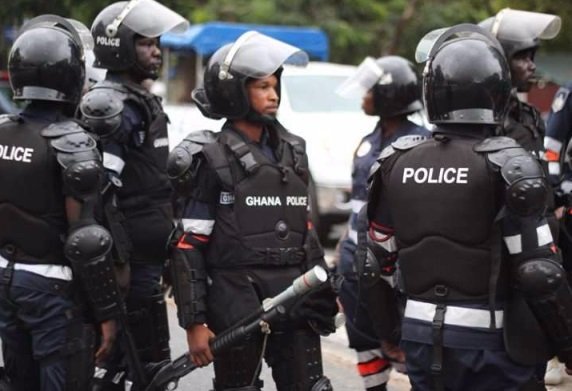
The Ghana Police Service has arrested 36 suspects following the mob attack that resulted in the death of General Constable Redeemer Owusu at Gindabour in the Savannah Region.
The arrests come barely a day after the deadly incident, which occurred on Wednesday, September 16, 2026, along the Gindabour-Kenkyen community road in the Sawla District.
According to the Police, General Constable Owusu and his colleagues were conducting highway patrol duties when they encountered a motorbike rider who allegedly diverted into the bush after spotting their patrol vehicle.
How the incident unfolded
Preliminary investigations indicate that the officers became suspicious of the rider’s actions and decided to follow up from another direction.
They subsequently found the rider unconscious on a bush road.
The officers reportedly picked him up and began transporting him to a hospital for medical attention. However, the rider died while being conveyed to the facility.
It was after news of the rider’s death spread through the community that tensions reportedly escalated.
Mob attack turns deadly
The Police said a mob from the community subsequently attacked the officers.
During the attack, General Constable Redeemer Owusu was killed, while other members of the patrol team sustained injuries of varying degrees.
The Police vehicle was also damaged during the incident.
The circumstances surrounding the rider’s death and the subsequent attack remain subject to ongoing investigations.
36 suspects in custody
In the aftermath of the incident, the Ghana Police Service launched an operation to identify and apprehend persons suspected of being involved.
A total of 36 suspects have so far been arrested and are currently in Police custody assisting with investigations.
The suspects are expected to be put before the court once the investigations are completed.
The arrests represent a major step in the Police response to the incident, as investigators work to establish exactly what happened and identify those responsible for the attack on the officers.
IGP deploys investigators, intelligence officers
The Inspector-General of Police has deployed a team of investigators and intelligence officers to Gindabour to assist with the probe.
Additional reinforcement teams from Damongo, Bole, Sawla, Tuna and Kalba, together with the Regional Intelligence Team, have also been deployed to the area.
The Police said the deployment is intended to strengthen security, maintain law and order and support efforts to bring those responsible to justice.
Two bodies sent for autopsy
The remains of General Constable Owusu and the motorbike rider have both been conveyed to the Damongo Morgue for preservation and autopsy.
The post-mortem examinations are expected to form part of efforts to establish the circumstances surrounding the deaths.
Police vow to pursue perpetrators
The Savannah Regional Police Command has strongly condemned the attack on its officers and assured the public that persons found culpable will face the law.
The Command said it would ensure that the perpetrators are made to face the “full rigours of the law.”
With 36 suspects already in custody and security personnel deployed to the area, attention is now focused on the ongoing investigation and the circumstances that led from the discovery of an unconscious motorbike rider to the fatal mob attack on the police patrol team.
The Police have urged calm as investigations continue.

Mahama Orders Two-Week Roadmap as 10 Held Over Ghana Drug Trafficking Cases

World Tourism Day to Highlight Tourism’s Role in Ghana’s Development

They Destroyed My Business Without Letting Me Pack My Things: Itz Tiffany



-

 Entertainment2 weeks ago
Mahama Is First President to Put GH¢40m Seed Money into Creative Arts Fund: Kojo Preko Dankwa
-

 Culinary2 weeks ago
The Green Heart of Ghanaian Cuisine: Celebrating Nkontomire and the Art of Abom
-
 General News2 weeks ago
Don’t Punish Them Retrospectively – Educationist Challenges New CSSPS Placement Rule
-
 General News2 weeks ago
OSP Opens Preliminary Investigation into Alleged GH¢70,000 Payment Linked to Parliament’s Vetting
-

 Entertainment1 week ago
Government Repatriates Musician Barosky from UK
-

 General News4 days ago
GTA’s Financial Strength Weakens Despite 2025 Tourism Activities
-

 Entertainment1 week ago
Keche Supports Street Vendor with GH¢3,000 After She Struggles to Make Sales
-

 General News1 week ago
TVET is not for the academically weak – Advocate calls for change in Ghana’s mindset