
Entertainment
[EDITORIAL] Why Ayisi is not Getting the Expected Mileage in Ghana’s Music Industry


Ayisi stands out as one of Ghana’s most gifted contemporary musicians, technically sound, lyrically introspective, sonically refined, and artistically intentional. His music reflects depth, vulnerability, and a clear artistic identity that aligns with global alternative and neo-soul sensibilities. Yet, despite these strengths, Ayisi has not enjoyed the level of mainstream traction or industry mileage his talent seemingly deserves. This situation is not unique to Ayisi alone but reflects broader structural and cultural realities within Ghana’s music ecosystem.
- Misalignment with Ghana’s Mainstream Music Appetite
Ghana’s mainstream music market is largely driven by danceability, immediacy, and viral appeal. High-energy Afrobeats, street-oriented sounds, and party anthems dominate radio rotations, club playlists, and digital trends.
Ayisi’s music, however, leans toward:
- Emotional depth
- Alternative R&B / soul textures
- Slower tempos and reflective themes
While artistically rich, this style does not easily fit into mainstream commercial programming, especially in a market where DJs, presenters, and promoters prioritise instant crowd reaction over long-form appreciation.
In essence, Ayisi’s music asks listeners to feel and reflect, while the mainstream often wants to move and escape.
- Industry Bias Against Alternative and Non-Formula Artists
Ghana’s music industry still operates within narrow success templates. Artists who do not conform to popular formulas sonically or aesthetically often struggle for institutional support.
Ayisi’s alternative positioning places him:
- Outside heavy radio rotation
- Outside dominant label investment priorities
- Outside event promoters’ “sure crowd pull” calculations
As a result, his music thrives more in critical circles than in commercial pipelines. The industry has not yet fully matured to support multiple successful lanes simultaneously.
- Weak Industry Structures for Artist Development
One of the biggest challenges facing Ayisi and many artists like him is the absence of strong artist development systems in Ghana.
There is little to no structured support for:
- Long-term brand building
- Audience education for alternative music
- Strategic international positioning
- Consistent touring circuits for niche artists
Without these systems, artists who rely on gradual audience growth rather than instant hits are often left to fend for themselves.
- Limited Radio and Media Risk Appetite
Radio remains influential in Ghana, but many stations operate on risk-avoidance logic. Presenters often prefer songs that are already popular or “tested” rather than nurturing new or unconventional sounds.
Ayisi’s music:
- Does not scream for attention
- Requires repeated listening
- Is better suited to curated listening spaces
Unfortunately, such qualities do not always align with commercial radio programming, which thrives on repetition of familiar hits.
- Branding Perception and Market Expectation
Ayisi’s artistic branding is subtle, minimalist, and introspective. While globally appealing, this approach can be misinterpreted locally as:
- Being “too laid-back”
- Lacking aggression or hype
- Not pushing hard enough for visibility
In Ghana’s attention-driven entertainment space, silence and subtlety are often mistaken for weakness—even when they are deliberate artistic choices.
- Niche Audience Without Strong Monetisation Pathways
Ayisi has a loyal and appreciative audience, especially among:
- Young professionals
- Creative communities
- Alternative music lovers
However, Ghana lacks robust monetisation systems for niche audiences. Streaming revenues are low, live venues for alternative music are limited, and brand partnerships often favor mass-appeal artists.
Thus, even when the audience exists, the ecosystem does not convert appreciation into sustainable career growth.
- Better Suited for Global Than Local Market Dynamics
Ironically, Ayisi’s sound aligns more naturally with international alternative and neo-soul markets than Ghana’s domestic mainstream. Without deliberate international marketing, sync placements, or touring support, this advantage remains untapped.
Many Ghanaian artists only gain local respect after international validation, something Ayisi has not yet been institutionally positioned to leverage fully.
Talent Is Not the Problem – Structure Is
Ayisi’s limited mileage is not a reflection of artistic inadequacy but a systemic mismatch between creativity and industry infrastructure. His journey exposes the uncomfortable truth that Ghana’s music industry still struggles to nurture diversity beyond hit-making.
Until the industry:
- Embraces multiple success models
- Invests in artist development
- Builds spaces for alternative sounds
- Redefines what “success” truly means
Artists like Ayisi will continue to be celebrated for talent but denied full industry momentum.
Ayisi’s story is not just about one musician, it is a mirror held up to Ghana’s creative ecosystem, asking whether it is ready to evolve.



Ghanaian dancehall star Shatta Wale has opened up about the possibility of venturing into politics, revealing that he may consider running for office as an independent parliamentary candidate if there is significant public demand ahead of the 2028 elections.
He said this during an interview on Asempa FM’s Ekosii Sen talk show with OB. Government name, Charles Nii Armah Jnr., said he does not intend to affiliate with any political party should he decide to enter the political arena.
According to him, his interest in politics would be driven by a desire to serve the people rather than by personal wealth. He disclosed that if the opportunity arises, he would consider contesting the parliamentary seat for Ablekuma South as an independent candidate.
“If the people push me to go into politics, I will consider it. I won’t do it because I’m rich, but because I want to serve the people. I would contest the Ablekuma South seat, but I won’t join any political party. I would prefer to run as an independent candidate if the calls become stronger by 2028,” he said.
Shatta Wale also spoke about his strong attachment to Ghana, explaining that his love for the country is one of the reasons he continues to live here despite opportunities to travel or relocate abroad.
He noted that traveling outside the country can be quite costly for him, which makes him more comfortable staying in Ghana.
“I love Ghana so much. Anytime someone asks me to travel abroad, I feel a bit uneasy because I end up spending more money there. Life outside is expensive,” he explained.
The musician added that living in Ghana allows him to enjoy a level of freedom that he values.
“In Ghana, I feel free. Sometimes I go to certain places and I’m able to walk around without any problem,” he said.
He also urged Ghanaians to cultivate a positive mindset, emphasizing that a constructive outlook can drive meaningful change in society.
“If you keep a positive mindset, you can influence change in many ways,” he added.
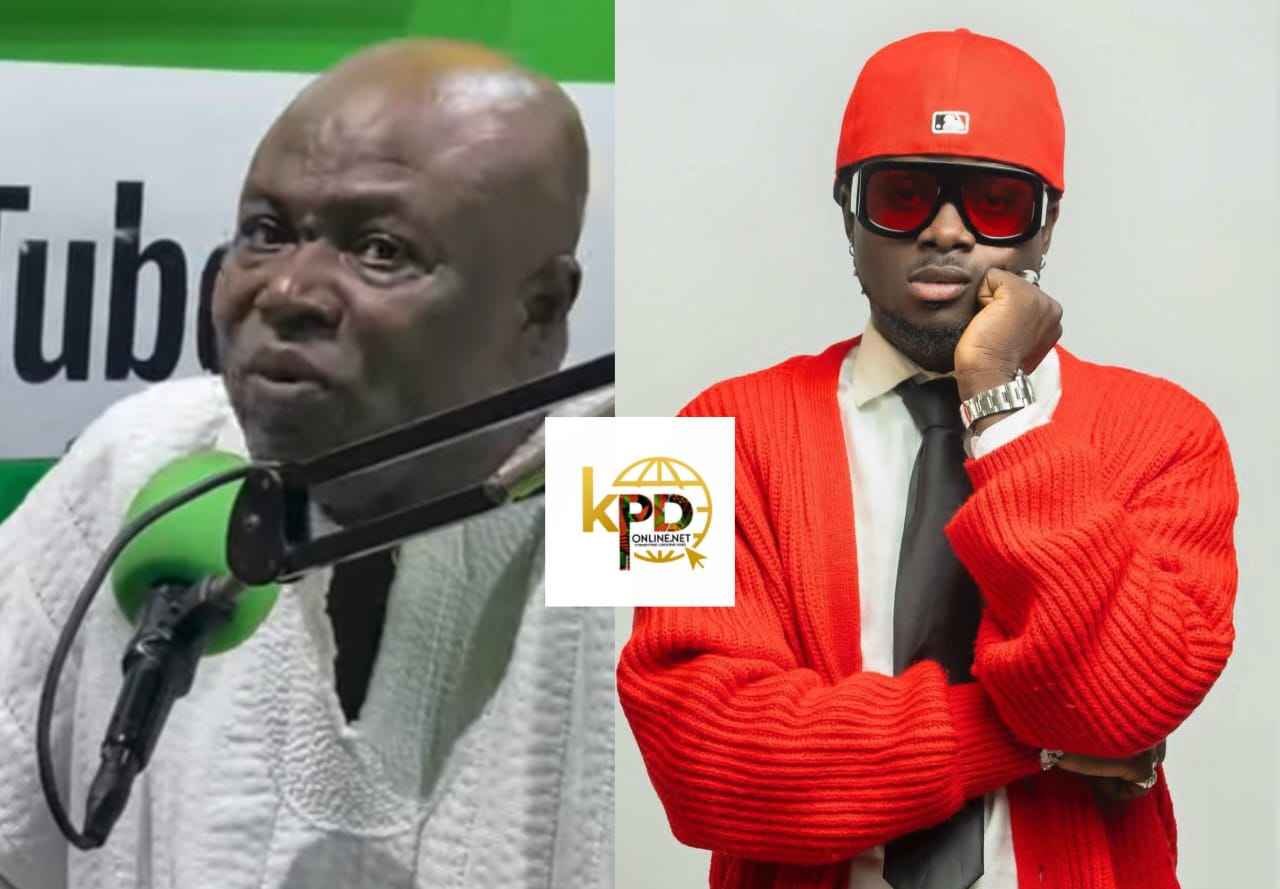
Legendary Highlife musician Sloppy Mike Gyamfi has accused fellow Highlife artiste Kuami Eugene of using his song without authorization.
According to the veteran musician, Kuami Eugene performed his song word for word and uploaded it on YouTube without seeking permission from him. He explained that although the younger artiste sang the song well and added some flavour to it, he did not contact him beforehand to seek clearance.
Speaking on the flagship Ekwanso Dwoodwoo drive time show on Okay FM with host Nana Romeo, Sloppy Mike Gyamfi said he was surprised when he heard the rendition of his song Asem Kakra Bi online.
“Kuami Eugene has taken my song. Visit his YouTube platform; he did it very well.
He sang the song so nicely, and I was awed when I heard it. Just Google Asem Kakra Bi and you’ll find it. He did a very good job on the song though. But Kuami never spoke to me about the song. It’s not like he sampled it or took some parts of it; he sang it word for word,” he said.
When asked by Nana Romeo whether Kuami Eugene was supposed to seek permission before using the song, the veteran musician responded that the right procedure would have been to request clearance.
However, Sloppy Mike Gyamfi indicated that he does not hold any personal grudge against the Angela hitmaker, describing him as someone he sees as a son.
“I won’t fault him that much. He’s like my son, so if he admires my work and uses it, I have no problem with it,” he noted.
Despite his forgiving stance, the veteran musician maintained that proper respect and due process should have been followed.
He added that although Kuami Eugene may know his work, the artiste has never personally introduced himself to him.
“I have forgiven him, but if someday he introduces himself to me, I will be happy. He should bring me my portion of the earnings. Not giving me even a penny is not right,” he added.
Entertainment
Police Arrest Counsellor Lutterodt Over Alleged Incitement in Viral Video About Late Highlife Star Daddy Lumba

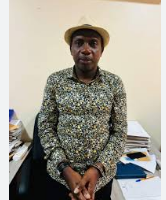
Marriage counsellor and public commentator Cyril George Carstensen Lutterodt, popularly known as Counsellor Lutterodt, has been arrested by the Ghana Police Service over remarks made in a viral video that allegedly incited youth to storm the residence of late highlife legend Daddy Lumba.
The arrest was carried out by the Criminal Investigations Department (CID) following investigations into comments authorities say were offensive and capable of disturbing public peace.
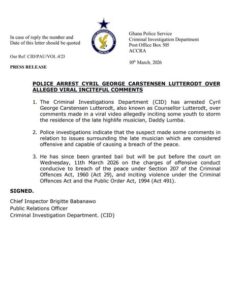
In a press release issued on March 10, 2026, and signed by Chief Inspector Brigitte Babanawoo, Public Relations Officer of the CID, police indicated that Lutterodt’s remarks were linked to issues surrounding the late musician.
“Police investigations indicate that the suspect made some comments in relation to issues surrounding the late musician which are considered offensive and capable of causing a breach of the peace,” the statement said.
Although the police did not disclose the exact content of the viral video, reports suggest the remarks targeted the memory of Daddy Lumba and circulated widely on social media, sparking public outrage. Lutterodt is alleged to have encouraged some youth to exhume the musician’s body from his residence in East Legon.
Counsellor Lutterodt is a well-known figure in Ghana’s media landscape, frequently appearing on radio and television programmes to provide relationship advice and commentary on social issues. His outspoken style has often generated both support and controversy.
Police confirmed that he has since been granted bail but will be arraigned before court on Wednesday, March 11, 2026.
According to the CID, Lutterodt will face charges of offensive conduct conducive to the breach of the peace under Section 207 of the Criminal Offences Act, 1960 (Act 29), as well as inciting violence under provisions of the Public Order Act, 1994 (Act 491).
The offences relate to behaviour or speech that could provoke violence, public disorder, or actions likely to disturb societal peace.
Daddy Lumba, widely regarded as one of Ghana’s most influential highlife musicians, died on July 26, 2025, leaving behind a celebrated musical legacy and a large fan base across the country and beyond.
Lutterodt is expected to appear before an Accra court on Wednesday, where the charges will be formally read and his legal team will respond.

First Atlantic Bank to Hold First AGM as Listed Company on April 7

Fuel Prices Set for Sharp Increase From March 16 as Global Oil Prices Surge

Yonsei University Honors President Mahama with Honorary PhD for Leadership and Ghana–Korea Partnership



-

 Entertainment2 weeks ago
THE INSIDE STORY: Why President Mahama Revoked Gideon Nii Aryeequaye’s Appointment as Executive Secretary of the Creative Arts Agency
-

 Entertainment5 days ago
“Go to Lumba’s house and exhume his body” — Counsellor George Lutterodt incites Ga youth
-

 General News2 weeks ago
Christian Council Urges Prophets to Tackle Corruption, Avoid Fear-Inducing Political Prophecies
-
 General News1 week ago
Ghana Marks 69th Independence Day Under Theme ‘Building Prosperity, Inspiring Hope’
-

 Entertainment3 days ago
Legendary musician Sloppy Mike Gyamfi Accuses Kuami Eugene of Song Theft
-

 Entertainment3 days ago
Shatta Wale hints at contesting Ablekuma South seat as independent candidate in 2028
-
 General News2 weeks ago
President Mahama Appoints Baba Sadiq Abdulai Abu as Ghana’s High Commissioner-Designate to Nigeria
-

 General News2 weeks ago
COCOA FARMERS, MASSES and INVESTORS and Left Behind in Mahama’s February 2026 SONA