
Entertainment
Entertainment Journalist Albert Mensah Blankson (BETOS) Writes: LONG FOR THE RICH, SHORT FOR THE POOR


Read with an open mind.
In Ghana, the rich can keep it long, while the poor must keep it short. This, in summary, is what I deduced from the recent public debate about haircuts in Senior High Schools. Not many have taken the time to learn about the origins of the age-old directive on haircuts in second-cycle institutions in Ghana.
Before the trans-Atlantic slave trade, hair grooming and styling were deeply rooted in African life and were a great source of pride, especially for women. As the Holy Book of Christians states, “a woman’s hair is her crown and glory”, forming part of her self-esteem and beauty.
1 Corinthians 11:15 (KJV) says:
“But if a woman has long hair, it is a glory to her: for her hair is given her for a covering.”
This verse is part of Apostle Paul’s teaching on head coverings and the symbolic significance of hair in worship and cultural expression. It emphasises that a woman’s hair is a natural adornment, a mark of beauty and honour.
The Europeans observed how Africans expressed identity through hairstyling and introduced haircuts as a means to diminish that identity, subjecting them to cruelty by shaving their hair. That’s how it all began.
As a colonial control mechanism, it was designed to make Black people feel less confident in their identity and sense of pride. I will explain this further.
In the early days of education in Ghana, students completed school with their natural hair, neatly kept in cornrows and beautiful braids. It neither hindered behaviour nor affected academic performance.
The rule of compulsory haircuts was historically used as a tool to subdue and punish rebellious slaves. Beneath that, however, lay a scheme to suppress what Europeans described as the “wild” appearance of people of African descent, those who wore braids, twists, or locs.
To “tame” this so-called wildness, Black people were forced to adopt colonial hairstyles that left their scalps bare for easier identification.
Fast forward to 2025, and we are still confronted with the remnants of that colonial system. The tools of segregation against African cultural identity and freedom remain deeply embedded within our regulations, behavioural codes, and educational standards.
Did you know that this politics of hair is not limited to education in Ghana? It is also a global issue, one that Black people continue to battle in the diaspora. Many have faced discrimination in various professional fields because of the colour or texture of their hair. They were not denied opportunities for appearing unkempt, but simply because they appeared “wild”, a European label for the confidence and authenticity of Blackness.
Some employers have even established arbitrary regulations prohibiting braids, twists, locs, and dyed hair. These bans clearly restrict freedom and autonomy in ways that uniquely affect Black women, rendering them invisible. Yet, Black women have not been silenced. Their battles in the workplace have sometimes led to legal action. Although not always successful, these cases demonstrate how Black women’s hair, its style or colour, has been both a symbol of their marginalisation and their liberation.
My research uncovered several such cases documented in The Journal of Pan African Studies, Vol. 12. One of the earliest, in 1981, involved Renee Rogers, who sued American Airlines over a policy banning all-braided hairstyles. This was followed by several others, including Mitchell vs. Marriott Hotel and Santee v. Windsor Court Hotel.
Mitchell was threatened with termination unless she changed her cornrows and was forced to take a one-month leave to “fix” her hair or purchase a wig. Santee, who applied for a housekeeping job at Windsor Court Hotel, was denied employment after refusing to change her blonde hair colour.
In 2008, Patricia Pitts sued her employer, Wild Adventures, after being chastised for her hairstyle. When she switched from braids to two-strand twists to please her supervisor, she was again told that her twists looked too much like locs.
In Burchette vs. Abercrombie & Fitch, an employee in the Fifth Avenue store was told to remove her blonde highlights or face termination. Even UPS and FedEx faced lawsuits over their bans on braided or loced hairstyles.
More recently, in 2016, Chastity Jones filed a claim with the U.S. Equal Employment Opportunity Commission (EEOC) against Catastrophe Management Solutions after her job offer was rescinded because of her locs. The Circuit Court of Appeals ruled that banning locs during hiring was legal. When Jones and the NAACP appealed to the U.S. Supreme Court, the Court refused to review the case (May 2018).
These rulings opened the door for more school and workplace policies prohibiting hairstyles and colours associated with specific racial and ethnic identities, in essence, legalising misogynoir.
Back in Ghana, the case of Tyrone Marhguy vs. Achimota School exemplifies the depth of this battle over hair politics. Sadly, such discriminatory practices persist within institutions that preach rules, ethics, and discipline. Ironically, these same rules, flimsy in justification, often spare foreign students, mostly white or Caucasian.
Private and so-called “international” schools impose no such laws forcing girls to cut their hair. Parents with deep pockets do not demand that their daughters shave their heads to become better-behaved. There is no evidence that long hair hinders learning or discipline.
Remain rich, and you have a choice: your daughters will never suffer haircut trauma. In some cases, boys with locs or twists go unquestioned. There is no empirical evidence showing that students with long hair are less disciplined.
On the contrary, most new entrants, children from low-income families, have no choice but to obey the haircut rule.
Where, then, is the equality? Doesn’t forced conformity through deprivation of one’s natural identity defeat the very idea of equality? How does natural hair determine the quality of tuition or learning?
Until we come to a deeper understanding of our identity as a people, it will remain “long hair for the rich, short hair for the poor.”
It shocks me how some Ghanaian women, who have yet to rediscover their African identity, resist embracing their natural crown. It is uncomfortable to note that many of these women, who have found consolation in wigs, lack curiosity about the deeper meaning of Blackness.
The young girls who are forced to lose their crowns of beauty will later chase Brazilian and Chinese hair after high school. Where, then, lies the sense of pride, self-worth, and identity? Are we empowering children to understand themselves through education, or are we producing batches of conformists whose self-esteem depends on societal dictates?
How did schools in old Ghana handle discipline without haircuts? How do neighbouring countries, where long hair is allowed, fare in behavioural rankings, and does Ghana outperform them?
As I walk through the cities and towns, I worry about the moral character of Ghanaians, the product of this long-held haircut policy.
After decades of compulsory short hair, we remain a nation that lacks seriousness about basic civic duties. A person who neglects discipline in all aspects of life is reckless in nearly everything. A country that cannot fix roads, provide clean water, or maintain infrastructure seeks to solve discipline through forceful haircuts.
A country drowning in filth believes it can purify minds with scissors.
Conformity is not a cure for behaviour. It only breeds pretenders, people who look disciplined but are hollow inside. It subtly trains citizens to value appearances over integrity, a culture of hypocrisy.
Is it any wonder, then, that we are among the most corrupt? The answer is simple: we have focused too much on appearances and succeeded in destroying honesty from within.
The so-called “right” people, those with clean haircuts, pious looks, and quiet demeanours, are often the same who loot the state and pollute the environment while pretending to fix it.
We have mastered the art of pretence, not the truth of self.
Unless we wake up from this self-destruction, even in the next hundred years, it will still be: Long hair for the rich, short hair for the poor.
By Albert Mensah Blankson
#BetosIsHere



Ghanaian dancehall star Shatta Wale has opened up about the possibility of venturing into politics, revealing that he may consider running for office as an independent parliamentary candidate if there is significant public demand ahead of the 2028 elections.
He said this during an interview on Asempa FM’s Ekosii Sen talk show with OB. Government name, Charles Nii Armah Jnr., said he does not intend to affiliate with any political party should he decide to enter the political arena.
According to him, his interest in politics would be driven by a desire to serve the people rather than by personal wealth. He disclosed that if the opportunity arises, he would consider contesting the parliamentary seat for Ablekuma South as an independent candidate.
“If the people push me to go into politics, I will consider it. I won’t do it because I’m rich, but because I want to serve the people. I would contest the Ablekuma South seat, but I won’t join any political party. I would prefer to run as an independent candidate if the calls become stronger by 2028,” he said.
Shatta Wale also spoke about his strong attachment to Ghana, explaining that his love for the country is one of the reasons he continues to live here despite opportunities to travel or relocate abroad.
He noted that traveling outside the country can be quite costly for him, which makes him more comfortable staying in Ghana.
“I love Ghana so much. Anytime someone asks me to travel abroad, I feel a bit uneasy because I end up spending more money there. Life outside is expensive,” he explained.
The musician added that living in Ghana allows him to enjoy a level of freedom that he values.
“In Ghana, I feel free. Sometimes I go to certain places and I’m able to walk around without any problem,” he said.
He also urged Ghanaians to cultivate a positive mindset, emphasizing that a constructive outlook can drive meaningful change in society.
“If you keep a positive mindset, you can influence change in many ways,” he added.
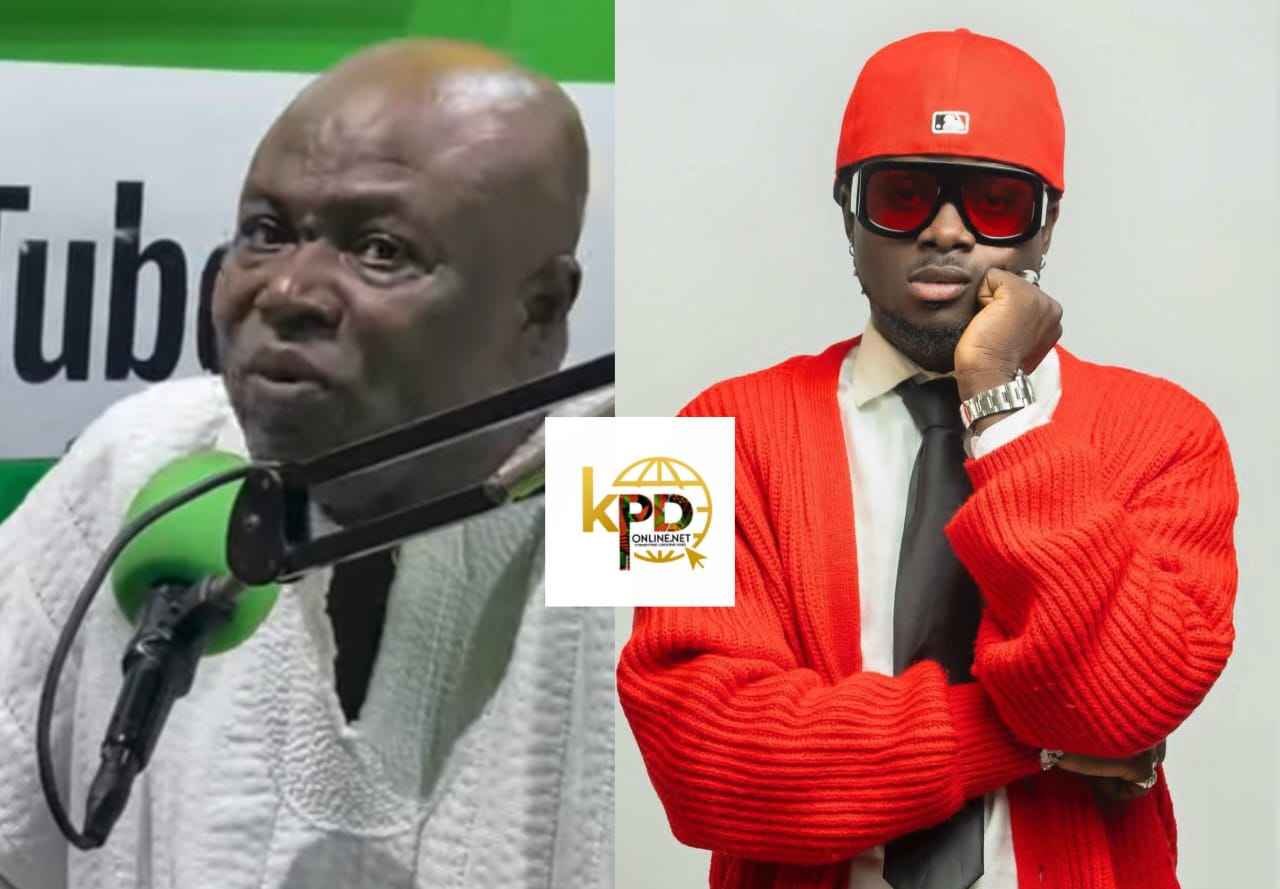
Legendary Highlife musician Sloppy Mike Gyamfi has accused fellow Highlife artiste Kuami Eugene of using his song without authorization.
According to the veteran musician, Kuami Eugene performed his song word for word and uploaded it on YouTube without seeking permission from him. He explained that although the younger artiste sang the song well and added some flavour to it, he did not contact him beforehand to seek clearance.
Speaking on the flagship Ekwanso Dwoodwoo drive time show on Okay FM with host Nana Romeo, Sloppy Mike Gyamfi said he was surprised when he heard the rendition of his song Asem Kakra Bi online.
“Kuami Eugene has taken my song. Visit his YouTube platform; he did it very well.
He sang the song so nicely, and I was awed when I heard it. Just Google Asem Kakra Bi and you’ll find it. He did a very good job on the song though. But Kuami never spoke to me about the song. It’s not like he sampled it or took some parts of it; he sang it word for word,” he said.
When asked by Nana Romeo whether Kuami Eugene was supposed to seek permission before using the song, the veteran musician responded that the right procedure would have been to request clearance.
However, Sloppy Mike Gyamfi indicated that he does not hold any personal grudge against the Angela hitmaker, describing him as someone he sees as a son.
“I won’t fault him that much. He’s like my son, so if he admires my work and uses it, I have no problem with it,” he noted.
Despite his forgiving stance, the veteran musician maintained that proper respect and due process should have been followed.
He added that although Kuami Eugene may know his work, the artiste has never personally introduced himself to him.
“I have forgiven him, but if someday he introduces himself to me, I will be happy. He should bring me my portion of the earnings. Not giving me even a penny is not right,” he added.
Entertainment
Police Arrest Counsellor Lutterodt Over Alleged Incitement in Viral Video About Late Highlife Star Daddy Lumba

Marriage counsellor and public commentator Cyril George Carstensen Lutterodt, popularly known as Counsellor Lutterodt, has been arrested by the Ghana Police Service over remarks made in a viral video that allegedly incited youth to storm the residence of late highlife legend Daddy Lumba.
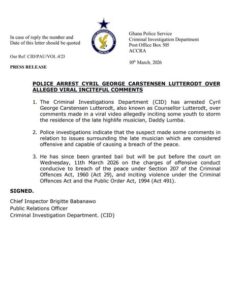
The arrest was carried out by the Criminal Investigations Department (CID) following investigations into comments authorities say were offensive and capable of disturbing public peace.
In a press release issued on March 10, 2026, and signed by Chief Inspector Brigitte Babanawoo, Public Relations Officer of the CID, police indicated that Lutterodt’s remarks were linked to issues surrounding the late musician.
“Police investigations indicate that the suspect made some comments in relation to issues surrounding the late musician which are considered offensive and capable of causing a breach of the peace,” the statement said.
Although the police did not disclose the exact content of the viral video, reports suggest the remarks targeted the memory of Daddy Lumba and circulated widely on social media, sparking public outrage. Lutterodt is alleged to have encouraged some youth to exhume the musician’s body from his residence in East Legon.
Counsellor Lutterodt is a well-known figure in Ghana’s media landscape, frequently appearing on radio and television programmes to provide relationship advice and commentary on social issues. His outspoken style has often generated both support and controversy.
Police confirmed that he has since been granted bail but will be arraigned before court on Wednesday, March 11, 2026.
According to the CID, Lutterodt will face charges of offensive conduct conducive to the breach of the peace under Section 207 of the Criminal Offences Act, 1960 (Act 29), as well as inciting violence under provisions of the Public Order Act, 1994 (Act 491).
The offences relate to behaviour or speech that could provoke violence, public disorder, or actions likely to disturb societal peace.
Daddy Lumba, widely regarded as one of Ghana’s most influential highlife musicians, died on July 26, 2025, leaving behind a celebrated musical legacy and a large fan base across the country and beyond.
Lutterodt is expected to appear before an Accra court on Wednesday, where the charges will be formally read and his legal team will respond.

First Atlantic Bank to Hold First AGM as Listed Company on April 7

Fuel Prices Set for Sharp Increase From March 16 as Global Oil Prices Surge

Yonsei University Honors President Mahama with Honorary PhD for Leadership and Ghana–Korea Partnership



-

 Entertainment2 weeks ago
THE INSIDE STORY: Why President Mahama Revoked Gideon Nii Aryeequaye’s Appointment as Executive Secretary of the Creative Arts Agency
-
 Entertainment5 days ago
“Go to Lumba’s house and exhume his body” — Counsellor George Lutterodt incites Ga youth
-
 General News2 weeks ago
Christian Council Urges Prophets to Tackle Corruption, Avoid Fear-Inducing Political Prophecies
-
 General News1 week ago
Ghana Marks 69th Independence Day Under Theme ‘Building Prosperity, Inspiring Hope’
-

 Entertainment3 days ago
Legendary musician Sloppy Mike Gyamfi Accuses Kuami Eugene of Song Theft
-

 Entertainment2 days ago
Shatta Wale hints at contesting Ablekuma South seat as independent candidate in 2028
-
 General News2 weeks ago
President Mahama Appoints Baba Sadiq Abdulai Abu as Ghana’s High Commissioner-Designate to Nigeria
-

 General News2 weeks ago
COCOA FARMERS, MASSES and INVESTORS and Left Behind in Mahama’s February 2026 SONA