
General News
First Batch of Ghanaian Evacuees Return Home Amid Renewed Xenophobic Attacks in South Africa


The first group of Ghanaians evacuated from South Africa following renewed xenophobic tensions has safely arrived in Accra, as government intensifies efforts to protect citizens caught up in the growing unrest.
The evacuees touched down at the Kotoka International Airport on Wednesday, May 27, where they were officially received by a government delegation led by the Chief of Staff and the Minister for Foreign Affairs.
The evacuation exercise was coordinated by Ghana’s diplomatic mission in South Africa in collaboration with the Ministry of Foreign Affairs after increasing reports of intimidation, attacks and hostility against foreign nationals heightened fears among migrant communities.
Several of the returnees are believed to have fled areas where tensions have escalated in recent weeks, with reports indicating that some migrants suffered harassment, threats and destruction of property.
Government officials disclosed that temporary support measures, including counselling services and reintegration assistance, have been arranged for affected individuals and families returning to Ghana.
Authorities explained that the evacuation operation was initially scheduled to commence on May 21, but had to be postponed following a sharp increase in the number of Ghanaians requesting evacuation support.
According to officials, the unexpected rise in applications placed pressure on logistical arrangements such as travel documentation, accommodation, transportation and flight coordination, as efforts were made to ensure the safe return of all affected persons.
The latest development has once again drawn attention to the persistent challenge of xenophobic violence in South Africa, where foreign nationals have repeatedly come under attack during periods of economic hardship and social tension.
Over the years, migrants from several African countries, including Ghana, Nigeria, Zimbabwe, Mozambique, Somalia, Ethiopia and Malawi, have been victims of violent outbreaks linked to frustrations over unemployment, crime and competition for jobs and business opportunities.
Some of the deadliest xenophobic attacks in South Africa occurred in 2008, leaving dozens dead and thousands displaced. Similar incidents resurfaced in 2015 and 2019, triggering widespread condemnation across Africa and renewed calls for stronger protection of migrants on the continent.
Although South African authorities have consistently condemned xenophobic violence and pledged to protect all residents regardless of nationality, many migrant communities continue to express concerns over their safety during periods of unrest.
The arrival of the evacuees in Accra has further heightened concerns about the welfare and security of Ghanaians living abroad, particularly in countries facing social instability and anti-foreigner sentiments.
Government officials say further evacuations may be carried out as authorities continue to monitor the situation in South Africa and engage Ghanaian communities through diplomatic channels.











General News
FRIMPONG-BOATENG SPEAKS ON GALAMSEY — ‘ENFORCING ENVIRONMENTAL LAWS CARRIES POLITICAL COST’

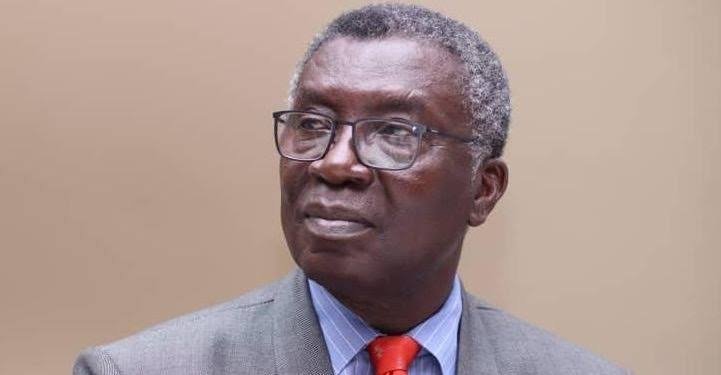

Chief Justice Paul Baffoe-Bonnie has come under intense public scrutiny after remarks about the performance of state institutions triggered concerns over the perceived political neutrality of Ghana’s Judiciary.


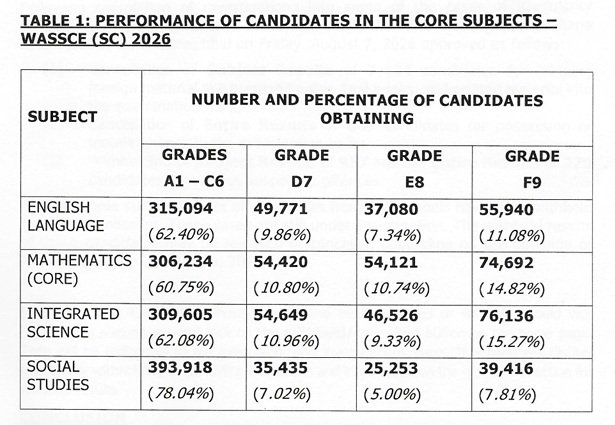
The West African Examinations Council (WAEC) has officially released the provisional results of the 2026 WASSCE for School Candidates, with Social Studies recording the strongest performance among the four core subjects.
WAEC announced the release on September 5, 2026, following the examination which saw 512,862 candidates from 1,022 schools registered to participate. The figure represents an 11.07% increase over the 461,736 candidates who entered for the 2025 examination.
SOCIAL STUDIES LEADS THE CORE SUBJECTS
Social Studies emerged as the best-performing core subject.
A total of 393,918 candidates, representing 78.04%, obtained grades between A1 and C6.
English Language followed with 62.40%, while Integrated Science recorded 62.08%. Core Mathematics saw 60.75% of candidates obtaining A1-C6.
ENGLISH PERFORMANCE CONTINUES TO DROP
One of the major talking points from the results is the continued decline in English Language performance.
WAEC’s four-year analysis shows the proportion of candidates obtaining A1-C6 in English falling from 73.11% in 2023 to 69.42% in 2024, 69.00% in 2025 and 62.30% in 2026.
Meanwhile, Mathematics and Social Studies recorded significant improvement compared with 2025, while Integrated Science also improved.
8,295 CANDIDATES FACE SANCTIONS
The release has also been accompanied by serious examination-malpractice concerns.
WAEC cancelled the entire results of 861 candidates after they were found with mobile phones in examination halls. The Council also cancelled the subject results of 7,434 candidates for bringing foreign materials, including prepared notes and textbooks, into examination halls.
In addition, the subject results of 957 candidates and the entire results of 270 candidates have been withheld over suspected offences.
Results involving candidates from 169 schools have also been withheld over alleged collusion, with investigations ongoing. WAEC says decisions on those cases may be made by October 30, 2026.
HOW CANDIDATES CAN CHECK
WAEC says the results have been hosted online, with school heads receiving login details to access their candidates’ results.
Candidates can also check their individual results through the Council’s official results-checking platform. WAEC has warned the public against fraudsters who claim they can upgrade examination results for money.

FRIMPONG-BOATENG SPEAKS ON GALAMSEY — ‘ENFORCING ENVIRONMENTAL LAWS CARRIES POLITICAL COST’

CHIEF JUSTICE COMMENTS STIR DEBATE — QUESTIONS RAISED OVER JUDICIAL IMPARTIALITY

ACCRA–KUMASI EXPRESSWAY HITS MAJOR MILESTONE — GAF COMPLETES 175.6KM CORRIDOR CLEARING



-

 General News2 weeks ago
Nana Adwoa Tutuwaa Named Global Humanitarian of the Year 2026
-

 General News2 weeks ago
Police Arrest Suspect in GH¢1.1m Fake Gold Scam at Berekum
-
 General News1 week ago
GES Urged to Review Student Sexual Misconduct Rule Over Alleged Discrimination Against Boys
-

 Entertainment6 days ago
Oswald Okaitei Explains the Real Vision Behind Ghana’s Black Star Experience
-

 General News2 weeks ago
OSP Assesses Extortion Allegations Against Afenyo-Markin
-

 Entertainment2 weeks ago
Stonebwoy Is Not My Rival — Shatta Wale Reveals They Live Minutes Apart
-
 Politics2 weeks ago
Stop The Personal Attacks!” — Vitus Azeem Demands Probe Into Sammy Gyamfi–Afenyo-Markin Feud
-

 Entertainment2 weeks ago
Mzbel Says Age Gap Is No Barrier as She Opens Up About 19-Year-Old Admirer