
Crime and Investigation
Gender Ministry Hands Over Case of Abused Teen Footballer ‘Ransford’ to CID Homicide Unit


The Ministry of Gender, Children and Social Protection has confirmed that the case involving the alleged sexual abuse and death of 16-year-old footballer Ransford Owusu Ansah of Siano Soccer Academy has been referred to the Homicide Unit of the CID Headquarters for further investigation.
In a statement released on November 7, 2025, the Ministry expressed deep sympathy to the victim’s family and reaffirmed its commitment to ensuring justice.
“We empathise deeply with the bereaved family. The Ministry emphasizes that crime has no expiration and remains committed to pursuing justice for the victim and his family,” the statement read.
Ransford was allegedly sodomised by his coach, Ibrahim Anyass, while under his care at the Siano Soccer Academy in Amasaman. Preliminary findings indicated that the teenager had lived with the coach for about three years, during which the abuse allegedly took place without his mother’s knowledge.
The victim reportedly began receiving treatment in December 2024 and was later admitted to the Komfo Anokye Teaching Hospital (KATH), where he sadly passed away.
Following the incident, the Siano Soccer Academy management suspended the coach and pledged full cooperation with police investigators.
The Ministry said it had taken a keen interest in the case, and through the Ashanti Regional Directorate of Gender, it initiated follow-up investigations and engaged the family and relevant stakeholders.
Since February 2025, the Ministry has also engaged the Ghana Football Association (GFA) to strengthen child protection systems within football institutions. The academy has since been temporarily closed pending the outcome of investigations.
The statement added that the Ministry, through its Orange Support Centre (OSC) and the Departments of Gender, Children and Social Welfare, continues to collaborate with law enforcement agencies to ensure justice for all children.
The Ministry urged the public to report any suspected cases of child abuse or violence to the Domestic Violence Call Centre (0800-111-222) or at the nearest DOVVSU or Social Welfare office.



Crime and Investigation
Police Arrest Five Suspected Kidnappers, Rescue Two Victims in Nsawam Operation
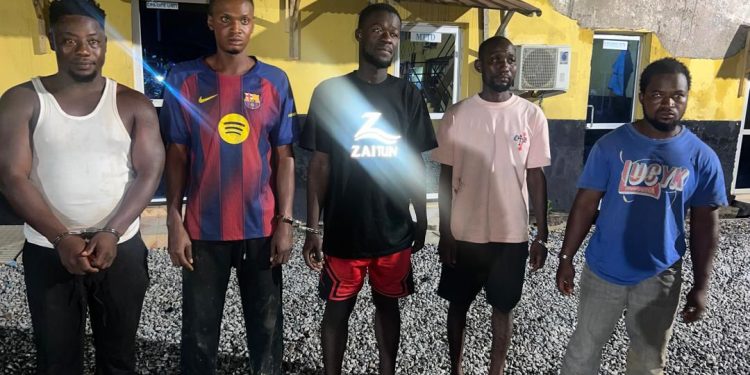
Police Arrest Five Suspected Kidnappers, Rescue Two Victims in Nsawam Operation
The Nsawam District Police Command has arrested five individuals in connection with the kidnapping of two men travelling from Accra to Anyinam, following a coordinated intelligence-led operation. The victims were rescued safely and are in stable condition.
Police reports indicate that on January 10, 2026, the Command received credible intelligence that the two men had been abducted and moved to an undisclosed location. The suspects allegedly demanded a ransom of GH¢400,000 from the victims’ family and later instructed them to make an initial payment of GH¢5,000.
Acting on the information, officers from the Nsawam District Police, with support from the Suhum Police Command, mounted an operation that led to the arrest of the suspects at a drinking spot near the Suhum Roundabout.
The suspects have been identified as Suleman Salifu, 24; Godfred Owusu, 26; Antwi Bismark, 27; Anas Salis, 38; and Gyamfi Isaac, 33. The victims, Seidu Sambiane, 28, and Ibrahim Alhassan, 42, were rescued during the operation without harm.
A search of an unregistered Acura 4×4 vehicle allegedly used by the suspects resulted in the recovery of several items, including forged GH¢100 and GH¢200 notes, specimen papers cut to the size of currency notes, and an amount of GH¢4,600 in cash. Police also retrieved a pistol, a cutlass, talismans and amulets, as well as five mobile phones.
The suspects are currently in police custody and are assisting with ongoing investigations as police prepare to take further legal action.
Crime and Investigation
Police Arrest 120 Suspects in Major Crackdown on Drug Dealers and Criminal Gangs in East Legon

A major police operation aimed at curbing illicit drug activities and criminal gangs in the East Legon area has resulted in the arrest of 120 suspects, including six women.
After the arrests, all suspects were taken to the East Legon Police Station, where screening is ongoing to identify individuals linked to specific criminal activities and those suspected of dealing in illegal drugs.
According to a police report, the operation was led by ACP Saviour Ahiamadi and supported by several senior officers from Police Headquarters. These included DSP Malaika-Jibril Alhassan, DSP Richard Beriko, ASP Afram, ASP Sarpong, and ASP Imoro from the Accra Region.
The exercise was a joint effort involving officers from the Police Intelligence Directorate, the Criminal Investigations Department, the National Operations Directorate, as well as the Accra and East Legon Regional Commands. The operation forms part of ongoing efforts by the police to enhance security and maintain law and order in the area.
Crime and Investigation
Three Suspected Robbers Killed in Christmas Eve Gun Battle with Police in Ashanti Region

Three suspected armed robbers were shot dead during a gun battle with police on Christmas Eve in a bush between Anwiankwanta and the Jacobu Junction in the Ashanti Region.
The suspects were part of a five-member gang that reportedly opened fire on police officers after encountering them during an intelligence-led operation. Two other members of the gang escaped and are currently on the run.
The injured suspects were rushed to the Bekwai Municipal Hospital following the exchange of gunfire but were pronounced dead on arrival. They have been identified as Seidu Issah, 29; Musah Yakubu, 35; and Yahaya Munkaila, also known as Tijani, 25. Their bodies have since been deposited at the hospital’s morgue for preservation and autopsy.
A police situational report (SITREP), sighted by Graphic Online, said investigations are ongoing to arrest the remaining suspects and recover additional weapons. The report noted that the deceased suspects and their accomplices were wanted in connection with several robberies and killings in Manso, Jacobu, and the Anwiankwanta area.
According to the SITREP, on December 24, 2025, police received intelligence that the gang had assembled in a bush between Anwiankwanta and the Jacobu Junction and were planning to launch an attack along the Anwiankwanta–Obuasi road.
Acting on the information, police carried out an operation using four service vehicles to raid the area. Upon arrival, officers spotted about five young men armed with guns. The suspects allegedly opened fire and attempted to flee through the bush, prompting police to return fire. Three suspects were shot, while the remaining two escaped, reportedly with gunshot wounds.
A search of the area led to the recovery of two pump-action guns loaded with six rounds of ammunition each, one unbranded pistol, and a sack containing 25 live cartridges and six spent cartridges.

Africa must stop raw material exports – President Mahama

President Mahama highlights ‘GoldBod’ Gains as Ghana reclaims resource control

Alcohol Brand Ban Threatens Livelihoods of Ghanaian Musicians, Says FOCAP President


-

 Entertainment2 weeks ago
[EDITORIAL] Why Ayisi is not Getting the Expected Mileage in Ghana’s Music Industry
-

 Entertainment1 week ago
The Exposé that Redefined the Creative Vote: Inside Kojo Preko Dankwa’s Deep Dive into the Creative Arts Agency
-

 Entertainment2 weeks ago
Comedians are Chasing MC Roles: What Should Professional MCs Do?
-

 Entertainment1 week ago
8 Events that Ignited Detty December in Ghana
-

 Entertainment1 week ago
Creative Diplomacy in Limbo as PanAfrica–Ghana Awaits Government Response on Healing Africa Tour
-

 Lifestyle1 week ago
Most People Aren’t Afraid of Failure. They’re Afraid of Knowing Themselves
-
Culture13 hours ago
“We Entertain Stupidity in This Country” — GHOne’s Lilly Mohammed Slams Foreign Affairs Minister Ablakwa Over IShowSpeed Passport Saga
-
 Entertainment5 days ago
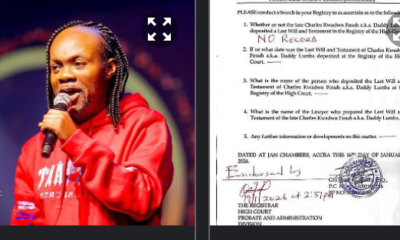
High Court Confirms No Will on Record for Late Highlife Icon Daddy Lumba