
Business
Gov’t working with IMF, World Bank to review VAT and make it simple for businesses – Ato Forson

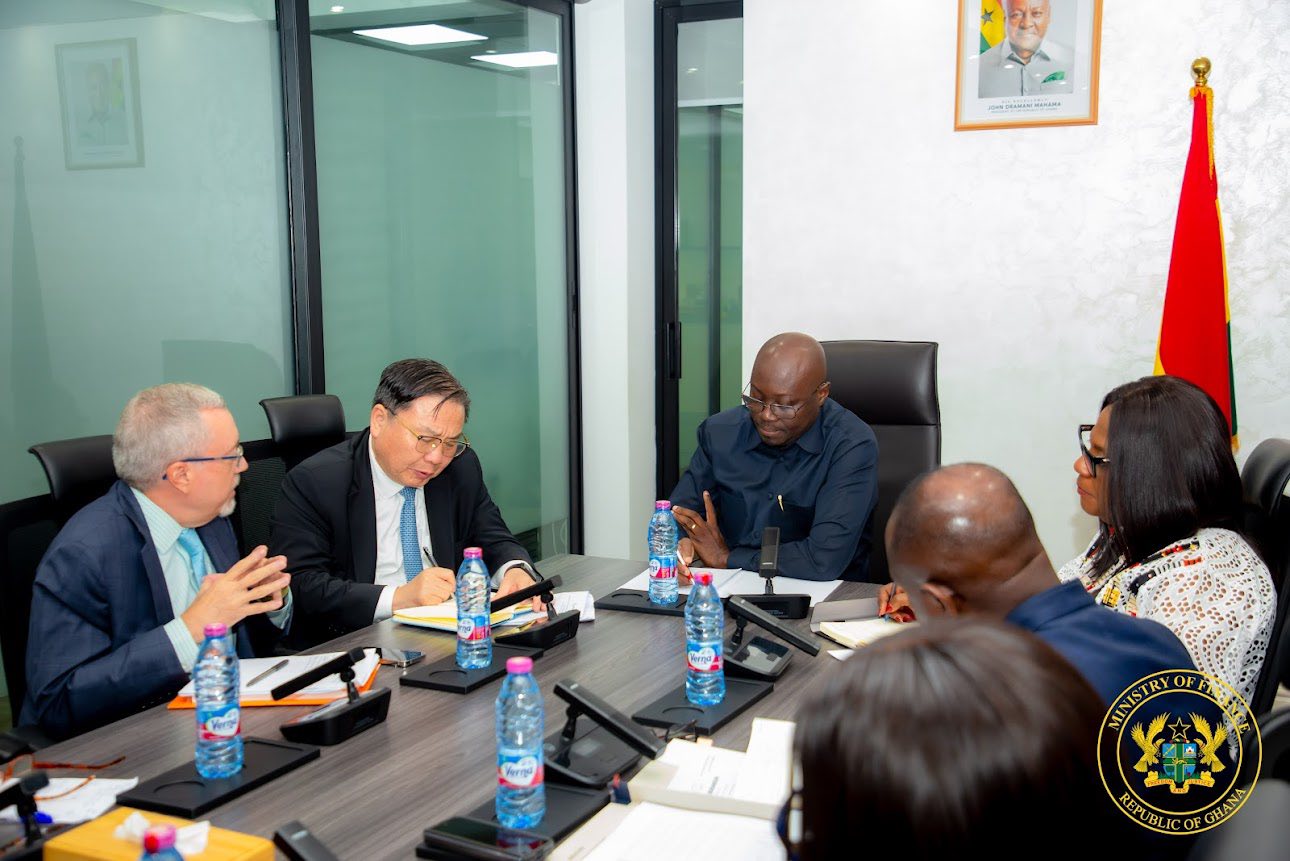
The government has started a review of Ghana’s Value Added Tax (VAT) system to help address the challenges businesses face under its current structure, the Ministry of Finance has said.
The Minister of Finance, Dr Cassiel Ato Forson made this known in a Facebook post on Monday, [April 14, 2025.]
He said the process is already underway, with support from a Technical Assistance Mission of the International Monetary Fund (IMF) currently in the country.
According to him, the existing VAT regime is creating difficulties for businesses nationwide.
With an effective rate of 21.9 percent, considered one of the highest in Africa, compliance has become a major concern for many firms.
Dr Forson said the government is working with the IMF and the World Bank Group to carry out the review.
The goal, he noted, is to simplify the system and make it less difficult for businesses ahead of the presentation of the next national budget in November 2025.
At a recent meeting with the Managing Director and Chief Administrative Officer of the World Bank Group, Mr Wencai Zhang, Dr Forson gave an update on the ongoing work and said steps are being taken to complete the process before the budget is laid.
“A complete overhaul of the VAT system is actively under consideration,” he said. “The problem is known, and it is being addressed.”
The review is expected to help improve tax compliance, increase revenue collection, and reduce the strain on businesses, particularly small and medium-sized enterprises.
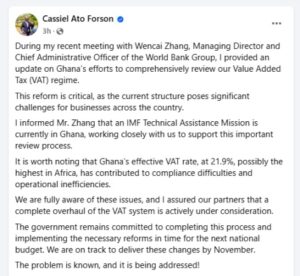
During my recent meeting with Wencai Zhang, Managing Director and Chief Administrative Officer of the World Bank Group, I provided an update on Ghana’s efforts to comprehensively review our Value Added Tax (VAT) regime.
This reform is critical, as the current structure poses significant challenges for businesses across the country.
I informed Mr. Zhang that an IMF Technical Assistance Mission is currently in Ghana, working closely with us to support this important review process.
It is worth noting that Ghana’s effective VAT rate, at 21.9%, possibly the highest in Africa, has contributed to compliance difficulties and operational inefficiencies.
We are fully aware of these issues, and I assured our partners that a complete overhaul of the VAT system is actively under consideration.
The government remains committed to completing this process and implementing the necessary reforms in time for the next national budget.
We are on track to deliver these changes by November.
The problem is known, and it is being addressed!
Source: Graphic online











First Atlantic Bank PLC has announced that it will hold its 2026 Annual General Meeting (AGM) on Tuesday, April 7, 2026, marking the bank’s first shareholder meeting since listing on the Ghana Stock Exchange.
In a formal notice to shareholders, the bank said the meeting will take place in person at the Omanye Hall of Labadi Beach Hotel in Accra at 10:00 a.m.
The AGM will give shareholders the opportunity to review the bank’s performance for the 2025 financial year and take decisions on several key corporate and governance matters.
Key agenda items
At the meeting, shareholders will consider the Directors’ Report together with the bank’s audited financial statements for the year ended December 31, 2025, as well as the report of the external auditors.
The board will also present a proposal for the declaration of a final dividend for the 2025 financial year, subject to regulatory approval from the Bank of Ghana.
Another major item on the agenda is the appointment of four Independent Non Executive Directors to the board. Three of the appointments will replace retiring independent directors, while the fourth will expand the board to strengthen minority shareholder representation and ensure compliance with regulatory requirements. These appointments will also require approval from the Bank of Ghana.
Shareholders will further be asked to authorise the board to determine the remuneration of the bank’s external auditors for the 2026 financial year and to approve directors’ remuneration for the same period.
The notice announcing the meeting was issued by the Company Secretary, Mark Ofori Kwafo, on behalf of the board.
Voting and participation
Shareholders who are unable to attend the meeting in person may appoint a proxy to attend and vote on their behalf. The proxy does not need to be a shareholder of the bank.
Voting at the AGM will generally be conducted by a show of hands unless a poll is demanded in line with the company’s constitution and the Companies Act, 2019 (Act 992). Under a poll, each shareholder present in person or by proxy will be entitled to one vote for every share held.
All shareholders and proxies attending the meeting will be required to present valid identification for entry.
Proxy forms can be downloaded from the bank’s website and submitted to the registrar, Central Securities Depository (GH) Limited, by email, post, or by depositing them at the registrar’s office in Accra.
Completed proxy forms must be submitted no later than 10:00 a.m. GMT on March 31, 2026.
First AGM since stock market listing
The upcoming AGM comes months after First Atlantic Bank transitioned into a public company and successfully listed on the Ghana Stock Exchange.
Trading in the bank’s shares began on December 19, 2025, following an oversubscribed Initial Public Offering that offered about 101.7 million shares at GH¢7.30 each.
The public offer attracted strong participation from institutional and retail investors and raised approximately GH¢786 million, surpassing the bank’s initial fundraising target.
The listing was considered a significant milestone for Ghana’s capital market as it ended more than seven years without a new primary listing on the main board of the exchange.
According to the bank, funds raised from the public offering will be used to strengthen its capital base, support expansion across West Africa, and improve working capital while providing liquidity for existing shareholders.
With the listing completed, the April AGM will give shareholders their first formal opportunity to engage with the bank’s leadership as a publicly traded financial institution.
Business
Ghana Stock Exchange Surges Past 15,000 Points for First Time as Investor Demand Fuels Historic Rally
The Ghana Stock Exchange (GSE) reached a historic milestone on Tuesday, with its benchmark GSE Composite Index (GSE-CI) surpassing the 15,000-point mark for the first time, highlighting strong investor confidence and sustained momentum in the equities market.
At the close of trading on March 10, 2026, during the exchange’s 7,169th session, the GSE-CI climbed 598.32 points to finish at 15,185.49. The rally also lifted the GSE Financial Stocks Index (GSE-FSI) by 252.74 points, ending the session at 9,538.68.
The market’s strong performance pushed total market capitalisation to a record GH¢277.97 billion, up significantly from GH¢267.45 billion recorded on Monday, as investors continued to channel funds into equities.
Trading activity also improved markedly. A total of 2,503,371 shares were traded during the session, with a combined value of GH¢24,014,498.26, reflecting increased market participation compared with the previous trading day.
Banking Stocks Lead Market Momentum
Banking stocks were among the strongest performers, led by Standard Chartered Bank Ghana PLC (SCB), which recorded the largest price gain of the day. The stock surged GH¢6.28 to close at GH¢69.14, extending its strong run and reinforcing its status as one of the market’s best-performing equities this year.
Meanwhile, GCB Bank PLC (GCB) closed unchanged at GH¢52.00 despite heavy trading. A total of 154,831 shares exchanged hands, contributing GH¢8.05 million to the overall market value.
Similarly, Access Bank Ghana PLC (ACCESS) ended the session flat at GH¢46.64.
GOIL and MTN Ghana Support Market Rally
Energy and telecommunications stocks also played a key role in the market’s rally.
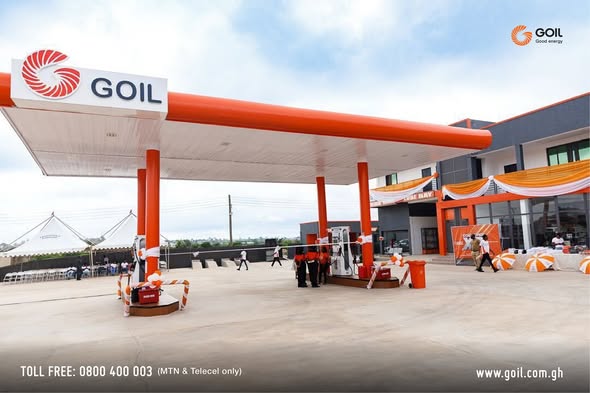
Ghana Oil Company Limited (GOIL) rose GH¢0.21 to close at GH¢6.60, with 756,136 shares traded—the second-highest volume of the session—valued at approximately GH¢4.99 million.
The most actively traded stock was Scancom PLC (MTN Ghana). The telecom giant gained GH¢0.39 to close at GH¢6.33, with 1,187,562 shares changing hands and contributing GH¢7.51 million to the market’s total value.
Insurance and Financial Stocks Record Gains
Insurance and financial services stocks also posted gains during the session.
SIC Insurance Company PLC (SIC) rose GH¢0.54 to close at GH¢5.98, while Republic Bank (Ghana) PLC (RBGH) advanced GH¢0.29 to end the day at GH¢3.26.
Regional banking group Ecobank Transnational Incorporated (ETI) gained GH¢0.17, closing at GH¢1.91.
In the pharmaceutical sector, Dannex Ayrton Starwin PLC (DASPHARMA) added GH¢0.03 to finish at GH¢0.41, while Atlantic Lithium Ltd (ALLGH) ended the session unchanged at GH¢6.52 despite active trading.
Societe Generale Records Only Decline
The only stock to record a price decline during the session was Societe Generale Ghana PLC (SOGEGH), which slipped GH¢0.02 to close at GH¢11.37.
Several Stocks End Session Unchanged
A number of listed equities recorded no price movement, including Agricultural Development Bank PLC, AngloGold Ashanti PLC, Enterprise Group PLC, Fan Milk PLC, Guinness Ghana Breweries PLC, TotalEnergies Marketing Ghana PLC, Unilever Ghana PLC, and several others.
Market Performance Since Start of Year
The latest rally has significantly boosted the exchange’s year-to-date performance. The GSE Composite Index has now gained 73.15 percent since the start of 2026, while the financial stocks index has surged 105.26 percent, effectively more than doubling investor capital within just over two months.
Market analysts note that the benchmark index has been on a steady upward trajectory since late February, with investors closely watching the 16,000-point level as the next major psychological milestone.
Business
Oil Marketing Firms Accuse Fuel Distributors of Premature Price Hikes Amid Middle East Tensions
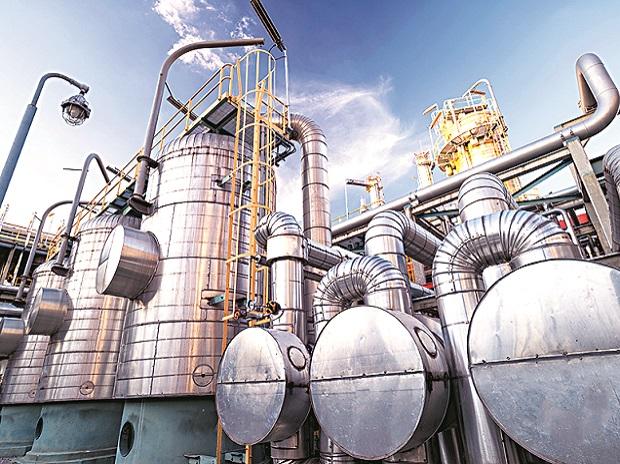
Oil marketing companies in Ghana have accused bulk fuel distributors of increasing petroleum prices prematurely, insisting that the ongoing conflict in the Middle East should not yet be influencing fuel costs in the country.
The Chief Executive Officer of the Chamber of Oil Marketing Companies, Riverson Oppong, said petroleum products currently on the Ghanaian market were imported before the conflict began and therefore should not reflect any war related price adjustments.
Speaking in a radio interview on Citi FM on Monday, March 9, Dr Oppong explained that the industry’s pricing system operates within a structured cycle, meaning any impact from global developments would only be reflected in the next pricing window.
He noted that although oil marketing companies pass on the cost of products they purchase from Bulk Distribution Companies to consumers, the current situation raises serious concerns.
“In all this, we do have a pass-through cost, no doubt. Whatever price we buy from the BDCs, we will surely sell it at the pumps,” he said.
Dr Oppong said the chamber had received complaints from several members about sharp increases in the prices quoted by bulk distributors during the current selling window.
“What is worrying, and I will say it authentically, is when you have huge price thresholds at the trading level,” he stated.
He explained that Ghana’s petroleum pricing framework follows a bi weekly cycle, with the present window running until March 15. According to him, the fuel currently being sold was priced and imported before the Middle East conflict escalated.
“For this window from March 1 to the 15th, the products had been priced prior to entering this particular bi weekly window. Even if there should be any effect of pricing, it should take effect from the 15th of March,” he explained.
Dr Oppong said some suppliers were already quoting significantly higher prices to oil marketing companies, a move he described as unacceptable.
“This morning I have some of my members complaining that seven is selling at ten,” he said, referring to the price changes being reported within the ongoing selling window.
“We are in a selling window. That is not acceptable. Nobody imported crude oil products at the time when this war started.”
He warned that such price increases contradict Ghana’s petroleum pricing policy and could undermine efforts to shield consumers from unnecessary fuel cost hikes.
“That artificial increase or professional selling by the BDCs is what we are discussing now because it is not organic. It is against the pricing policy we have in this country,” he added.
Dr Oppong also commended the National Petroleum Authority for quickly engaging industry players on the matter, urging the regulator to prevent attempts by some suppliers to take advantage of global tensions.
“Otherwise, we at the OMC level would be forced to increase our prices this week, which is not the right thing to do,” he cautioned.
Meanwhile, an energy analyst at Ghana’s Ministry of Energy, Yussif Sulemana, said the country was not facing an immediate threat to fuel availability despite the tensions in the global oil market.
Speaking in the same interview on March 9, Dr Sulemana said Ghana currently has about five to six weeks of petroleum product stocks nationwide, with additional shipments expected to boost supply levels.
“We are already aware that we have between five to six weeks of stock available nationwide,” he said.
He added that incoming shipments could significantly extend the supply period.
“If these ships are discharged, we can have maybe like 10 weeks,” he explained.
According to him, the immediate concern for policymakers is not supply shortages but the potential rise in fuel prices if global crude oil prices continue to climb.
“We are not immediately threatened by supply availability. What we are immediately threatened with will be the price,” he said.
Global oil prices have recently crossed the 100 dollar mark, raising concerns among analysts that sustained increases could push domestic fuel prices higher.
Dr Sulemana said the government was closely monitoring the situation and could adopt several policy responses, including allowing market forces to determine prices, introducing subsidies to cushion consumers, or strengthening local refining capacity.
“All the three options are available and the government is ready to reactivate all the options,” he said.
He added that in the long term, authorities are working to strengthen Ghana’s refining and storage capacity, including efforts to revive the Tema Oil Refinery and expand national fuel storage infrastructure.
“We want to be able to link the upstream to the downstream,” he noted, referring to plans to integrate crude oil production with domestic refining and fuel distribution.
For now, he said the government’s priority remains maintaining stable fuel supplies while managing rising price pressures.

First Atlantic Bank to Hold First AGM as Listed Company on April 7

Fuel Prices Set for Sharp Increase From March 16 as Global Oil Prices Surge

Yonsei University Honors President Mahama with Honorary PhD for Leadership and Ghana–Korea Partnership



-

 Entertainment2 weeks ago
THE INSIDE STORY: Why President Mahama Revoked Gideon Nii Aryeequaye’s Appointment as Executive Secretary of the Creative Arts Agency
-

 Entertainment6 days ago
“Go to Lumba’s house and exhume his body” — Counsellor George Lutterodt incites Ga youth
-

 General News1 week ago
Ghana Marks 69th Independence Day Under Theme ‘Building Prosperity, Inspiring Hope’
-
 General News2 weeks ago
Christian Council Urges Prophets to Tackle Corruption, Avoid Fear-Inducing Political Prophecies
-

 Entertainment4 days ago
Legendary musician Sloppy Mike Gyamfi Accuses Kuami Eugene of Song Theft
-

 Entertainment4 days ago
Shatta Wale hints at contesting Ablekuma South seat as independent candidate in 2028
-

 General News2 weeks ago
President Mahama Appoints Baba Sadiq Abdulai Abu as Ghana’s High Commissioner-Designate to Nigeria
-

 General News2 weeks ago
COCOA FARMERS, MASSES and INVESTORS and Left Behind in Mahama’s February 2026 SONA