
General News
“We Are Each Other’s Keepers” — Mahama Calls for Stronger Judicial Independence in Africa

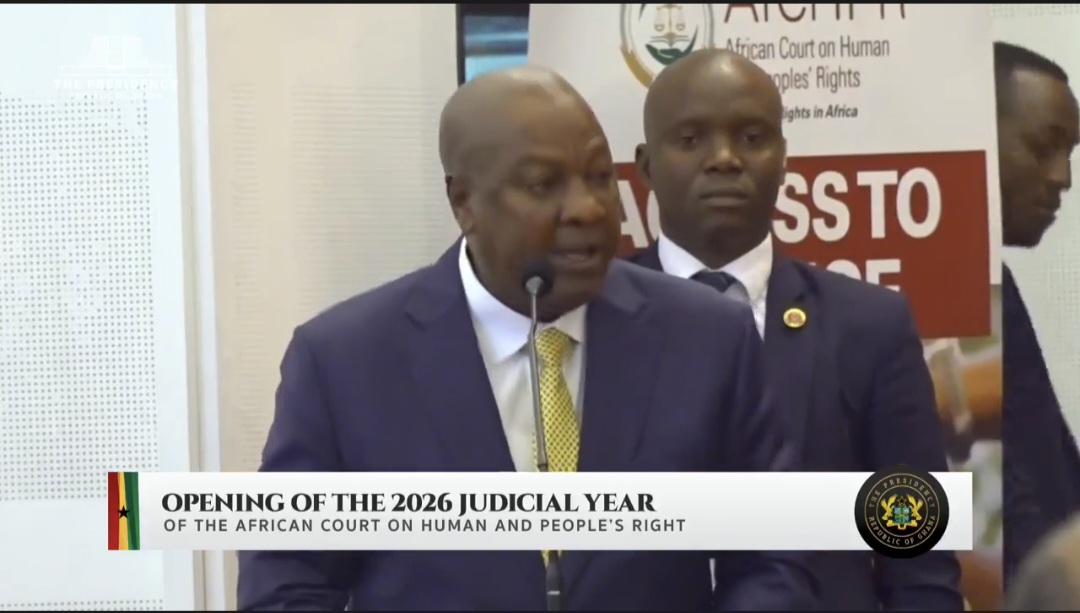
President John Dramani Mahama has called for stronger judicial independence across Africa, declaring that the continent’s shared history and interconnected future demand robust institutions capable of defending human rights and upholding the rule of law.
Addressing Heads of State, jurists and diplomats at the official opening of the 2026 Judicial Year and the 20th Anniversary of the African Court on Human and Peoples’ Rights in Arusha, Tanzania, President Mahama emphasised that African nations bear collective responsibility for one another’s democratic health.
“We are each other’s keepers,” he declared. “This is why we need an institution that serves all but is beholden to none: the African Court on Human and Peoples’ Rights.”
A Shared Destiny
President Mahama reflected on Africa’s history, noting how both liberation movements and military coups spread rapidly across the continent in different eras.
“Although our continent comprises 55 sovereign nations, our destinies are closely linked,” he said. “One nation after another declared freedom from colonial rule. Then again, when coup d’états became common, that tendency spread like a contagion.”
He argued that such historical patterns highlight the need for strong continental safeguards to prevent abuses of power and protect citizens beyond national borders.
Personal Lessons on Justice
In a deeply personal moment, President Mahama recounted the detention and exile of his father following Ghana’s 1966 coup and subsequent political upheavals. He said those early experiences shaped his lifelong respect for due process and judicial independence.
“I am still the boy who learned how dangerous it can be to challenge those in power, who may act with impunity and assume the roles of judge, jury and executioner,” he said.
According to him, the existence of an independent continental court today provides reassurance that future generations may not have to endure similar injustices.
“For the past 20 years, we have had a court that can protect the rights and dignity of African people beyond the borders of our individual nations,” he noted.
Call for Ratification and Compliance
President Mahama urged African Union member states that have not yet ratified the Protocol establishing the African Court to do so without delay. He also encouraged governments to allow individuals and non-governmental organisations direct access to the Court.
“To my colleagues in those countries, I assure you that you have nothing to fear from this Court,” he said. “I humbly ask all African nations to respect and implement the Court’s judgements in good faith.”
He praised the Court’s two decades of operation, saying it has demonstrated “fortitude and courage” in upholding the principles of the African Charter on Human and Peoples’ Rights.
A Moment of Opportunity
Highlighting Africa’s youthful population and growing global significance, President Mahama said strong judicial systems would be essential to securing the continent’s future.
“Now is the time to deepen our commitment to the Court,” he stated. “Now is the time for Africa to step into its greatness.”

President John Dramani Mahama has called on African nations to prioritize the strengthening of democratic institutions as a fundamental strategy for protecting human rights, maintaining constitutional order, and ensuring sustainable political stability across the continent.
Speaking at the opening of the 2026 Judicial Year and the 20th Anniversary celebrations of the African Court on Human and Peoples’ Rights in Arusha, Tanzania, President Mahama emphasized that Africa’s historical experiences with political instability, coups, and constitutional disruptions underscore the urgent need for resilient institutions capable of safeguarding citizens’ freedoms.
According to him, the protection of human rights cannot be guaranteed through political rhetoric alone but must be anchored in strong, independent, and impartial institutions that operate above partisan influence.
“Our continent’s history teaches us that justice cannot be left to chance,” President Mahama stated. “Justice must be deliberately constructed, carefully protected, and firmly rooted in institutions that are independent, impartial, and resilient to political interference.”
The Ghanaian leader used his keynote address to draw a connection between personal history and broader continental governance challenges. He recounted how the detention of his father following Ghana’s 1966 military coup shaped his lifelong commitment to justice, due process, and democratic accountability.
“I remain the child whose father was detained for serving his country and advising its leader,” he said, describing how early exposure to political instability deepened his appreciation for the fragility of fundamental rights in environments where institutional safeguards are weak.
He further noted that violations of justice against individuals have far-reaching social consequences.
“When injustice is visited upon one person, it does not end with that individual,” Mahama said. “It reverberates through families, communities, and sometimes across generations.”
President Mahama stressed that Africa’s future development is intrinsically linked to the strength of its democratic governance architecture. He urged African governments to invest in judicial independence, strengthen constitutional courts, and empower continental institutions tasked with monitoring human rights compliance.
He particularly praised the African Court on Human and Peoples’ Rights, describing it as a critical continental mechanism for protecting citizens from abuses of power and ensuring that states remain accountable to the principles of the Banjul Charter.
“For me, this is not an abstract legal discussion,” he said. “It is about ensuring that no African child grows up witnessing injustice without access to remedy or protection under the law.”
Civil society observers and legal scholars present at the event described the address as a strong reaffirmation of Africa’s commitment to democratic governance and human rights protection. Analysts noted that Mahama’s remarks reflected a broader continental debate about balancing sovereignty with supranational judicial accountability.
The event brought together African heads of state, senior judges, international diplomats, and human rights advocates who gathered to commemorate two decades of the African Court’s contribution to the advancement of justice on the continent.
General News
Mahama Reflects on Father’s Detention, Reaffirms Lifelong Dedication to Justice and Human Rights
President John Dramani Mahama delivered a profoundly introspective and emotionally resonant keynote address during the opening ceremony of the 2026 Judicial Year and the 20th Anniversary celebrations of the African Court on Human and Peoples’ Rights in Arusha, Tanzania, where he recounted how the detention of his father in the aftermath of Ghana’s 1966 military coup indelibly shaped his philosophical commitment to justice, constitutionalism, and the sanctity of human dignity.
Addressing an august gathering of African Heads of State, eminent jurists, diplomatic envoys, and representatives of civil society, President Mahama situated his remarks within both personal history and continental political experience, arguing that Africa’s democratic trajectory must be fortified by resilient institutions capable of safeguarding civil liberties against arbitrary exercises of power.
“I remain the child whose father was detained for serving his country and advising its leader,” he remarked, invoking his family’s experience as a symbolic representation of the human consequences of political instability and constitutional ruptures that characterized many post-independence African states.
The President observed that early exposure to the ramifications of political upheaval profoundly influenced his appreciation of institutional accountability and the fragility of fundamental rights in environments where judicial safeguards are weakened. He emphasized that the denial of justice to any individual inevitably produces cascading social consequences that extend beyond the immediate victim.
“When injustice is visited upon one person, it does not terminate with that individual,” he stated solemnly. “Rather, it reverberates through families, communities, and sometimes across successive generations.”
Mahama underscored that his political and humanitarian convictions were largely forged by these formative experiences, which reinforced his steadfast advocacy for judicial independence, procedural fairness, and the protection of constitutionally guaranteed freedoms. He stressed that governance systems must be designed to guarantee the right to fair hearing and equitable treatment under the law.
“It is precisely because of such lived experiences that I hold such strong conviction in due process, in the inviolability of the right to be heard, and in the protection of fundamental human rights,” he affirmed. “No citizen should be compelled to endure injustice simply because the institutions entrusted with safeguarding them have failed in their duty.”
Turning his attention to the broader African political landscape, President Mahama argued that the continent’s historical encounters with coups d’état, unlawful detentions, and abrupt constitutional interruptions should serve as enduring reminders of the imperative to strengthen democratic governance structures. He warned that sustainable development on the continent remains intrinsically linked to the consolidation of rule-based governance and judicial autonomy.
“Our continent’s historical experience teaches us that justice cannot be relegated to chance or political convenience,” he said. “Justice must be deliberately constructed, carefully protected, and firmly anchored in institutions that are impartial, independent, and resilient to political interference.”
He further praised the African Court on Human and Peoples’ Rights as a vital continental institution dedicated to protecting fundamental freedoms and ensuring state accountability under the provisions of the Banjul Charter. According to him, the Court represents not only a legal mechanism but also a moral symbol of Africa’s collective determination to uphold human rights standards.
“For me, this is not an abstract legal discourse,” President Mahama concluded. “This is deeply personal. It is about ensuring that no child in Africa must grow up witnessing a parent suffer injustice without the possibility of legal redress.”
President John Dramani Mahama has called on African Union (AU) member states that have yet to ratify the Protocol to the African Charter on Human and Peoples’ Rights establishing the African Court to do so “without delay,” emphasizing that a robust and independent continental judiciary is indispensable to the protection of democracy, human rights, and the rule of law across Africa.
Delivering the keynote address at the official opening of the 2026 Judicial Year and the commemoration of the Court’s 20th Anniversary in Arusha, President Mahama underscored the urgency of fully empowering the African Court to execute its mandate free from fear, favour, or political interference.
“I call upon African Union member states who have not yet ratified the Protocol to please do so without delay,” he urged. “To my colleagues in those countries, I assure you that you have nothing to fear from this Court.”
He further appealed to countries that have already ratified the Protocol to demonstrate genuine commitment by respecting and faithfully implementing the Court’s judgments. He also encouraged them to make the requisite declaration permitting individuals and non-governmental organisations direct access to the Court.
“I humbly ask all African nations and individuals to respect and implement the Court’s judgments in good faith, and to also make the declaration to allow individuals and NGOs direct access to the Court,” he added.
Reinforcing Continental Justice
President Mahama described the African Court as an institution “that serves all but is beholden to none,” stressing that its independence is fundamental to safeguarding the rights and dignity of African citizens beyond their national jurisdictions.
Reflecting on the Court’s two decades of operation, he commended its judges for their “fortitude and courage” in upholding the principles enshrined in the African Charter on Human and Peoples’ Rights, popularly known as the Banjul Charter.
“We need that kind of oversight so that we remain observant and respectful of the rights and duties enumerated in the Charter,” he noted.
According to him, strengthening the Court transcends mere legal obligation; it is a moral imperative for a continent whose history has been marred by colonial subjugation, unconstitutional changes of government, political detentions, and systemic human rights violations.
Personal Reflections on Justice
Anchoring his remarks in personal experience, President Mahama recounted the detention of his father in the aftermath of Ghana’s 1966 coup and the subsequent political upheavals — events that, he said, profoundly shaped his lifelong commitment to justice and due process.
“I remain the child whose father was detained for serving his country and advising its leader,” he told an audience comprising Heads of State, members of the judiciary, diplomats, and civil society representatives.
He observed that injustice against one individual reverberates far beyond the immediate victim, affecting families, communities, and generations, thereby underscoring the necessity of strong and impartial judicial institutions at both national and continental levels.
Charting the Future
With Africa’s population projected to reach 2.5 billion by 2050 and to account for nearly 40 per cent of the global population by the end of the century, President Mahama stressed that the protection of human rights and the consolidation of judicial institutions are critical to unlocking the continent’s immense potential.
“Africa must measure its wealth not only by its natural resources, but by its people,” he declared, urging leaders to establish governance systems that guarantee life, dignity, liberty, and self-determination.
He expressed optimism that by the time the African Court marks its 40th anniversary, it would emerge as “the leading international judicial body and a model for others.”

Africa Must Build Strong Institutions to Safeguard Human Rights — Mahama
Mahama Reflects on Father’s Detention, Reaffirms Lifelong Dedication to Justice and Human Rights
Mahama Urges AU States to Ratify African Court Protocol Without Delay



-
 Sports3 days ago
2026 FIFA World Cup: President Mahama tasks supporters to return immediately after the tournament
-

 Entertainment5 days ago
[EDITORIAL] Praised in Victory, Crucified in Defeat: The Ghanaian Fanbase Paradox
-
 Entertainment3 days ago
SONA: GH¢20m for Film Sector, GH¢20m for Creative Industries — Mahama Announces Major Investment
-

 Business4 days ago
ThirdWell launches Inclusive Business Centre to support Accredited Inclusive Businesses in Ghana
-

 Sports7 days ago
BREAKING: Salary Crisis hits Tension at Eleven Wonders Camp for the second time
-
 General News1 week ago
Mahama: We’ll increase efforts to clean polluted water bodies and reclaim mined lands
-
General News1 week ago
Mahama: Mining Must Leave Communities Better Than It Found Them
-

 General News6 days ago
Police Arrest Two in Agona Swedru With 209 Slabs of Suspected Narcotics, Reject GH₵100,000 Bribe