
General News
Eduwatch Demands Accountability for GH¢42.1bn Education Spending in 2026 SONA


Education policy think tank, Africa Education Watch (Eduwatch), has called on President John Dramani Mahama to provide a detailed account of how the government utilised its GH¢42.1 billion education allocation in 2025, ahead of the 2026 State of the Nation Address (SONA) scheduled for Friday, February 27.
In a statement released on Thursday, February 26, the policy advocacy group stressed the need for transparency and accountability in the president’s second SONA, urging him to outline how the funds were deployed to advance his education reform agenda.
Eduwatch recalled that during the 2025 SONA, President Mahama introduced an ambitious education transformation plan built around 41 strategic initiatives aimed at improving teaching and learning outcomes across the country.
With a full budget cycle completed since the implementation of the reforms, Eduwatch expects the president to provide a comprehensive update on the utilisation of the education budget, highlight major achievements recorded over the past year, and present measurable outcomes of the policy interventions.
“One year after implementing a full budget cycle with a significant allocation of GH¢42.1 billion to education in 2025, Eduwatch expects His Excellency to provide an account of how the funds were applied in pursuit of his education vision, as well as key accomplishments, challenges, and mitigation strategies to improve policy and budgetary efficiency,” the statement noted.
The think tank further urged the government to openly acknowledge challenges encountered in implementing the reforms and outline practical measures to strengthen policy delivery and improve financial management within the education sector.
Beyond accountability on past spending, Eduwatch identified teacher recruitment and deployment as a critical priority for 2026. The organisation expressed concern that the absence of teacher recruitment during the 2025 financial year has worsened staffing challenges, particularly in underserved basic schools in rural and deprived communities.
According to Eduwatch, many of these communities were already facing severe teacher shortages before 2025, and the failure to recruit additional teachers has deepened the crisis, potentially affecting quality education delivery.
The think tank therefore called for urgent measures to address staffing gaps and strengthen the education system’s capacity to deliver equitable learning opportunities nationwide.

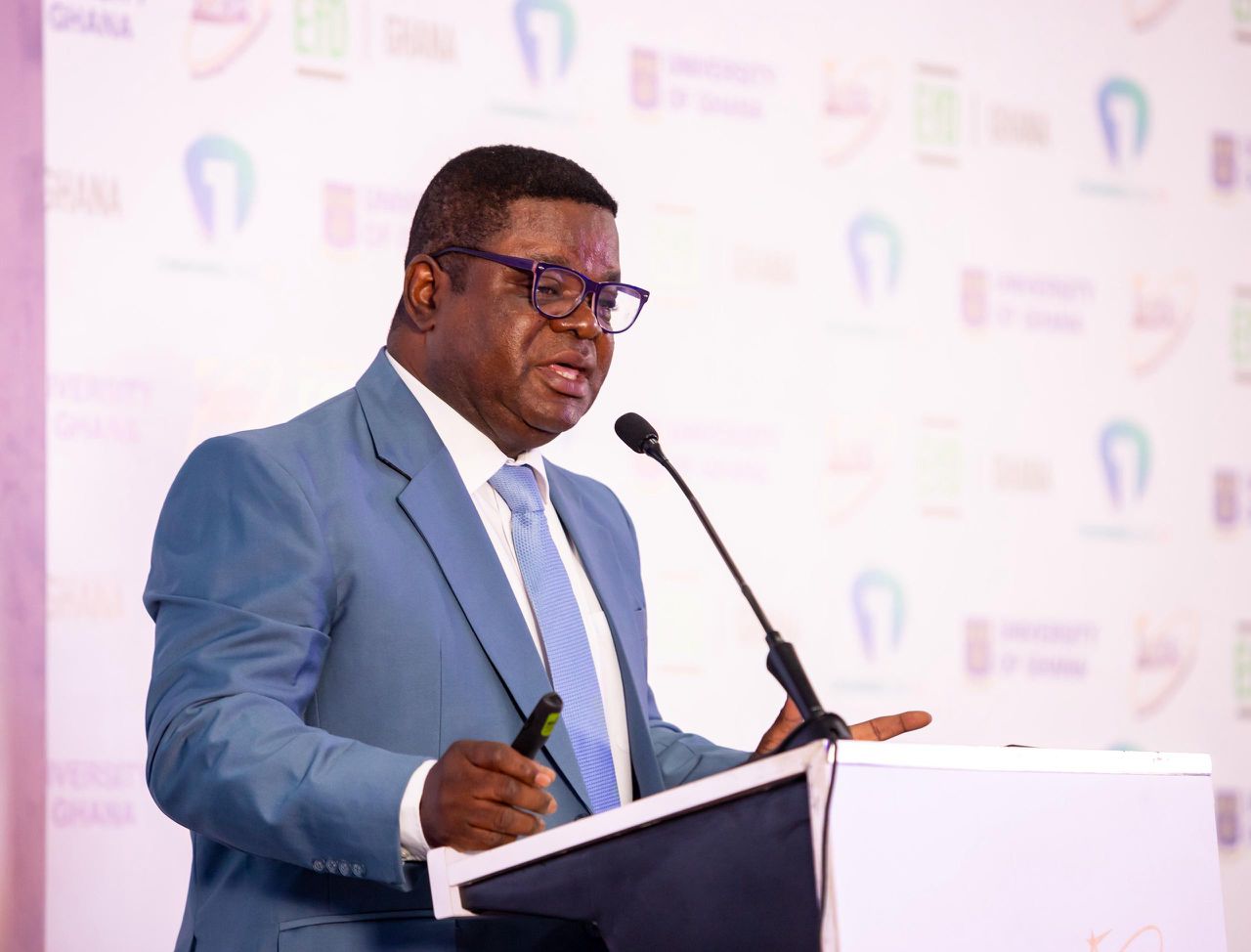
Ghana loses more than GHS 6.2 billion every year due to diseases linked to poor waste management and sanitation, a new study by the Institute of Statistical, Social and Economic Research at the University of Ghana has revealed.
The findings were presented at a high-level stakeholder engagement in Accra, on Thursday, 26th February 2026, where policymakers, Members of Parliament, local government officials, development partners and private sector actors gathered to examine the economic case for increased sanitation investment.
The research, led by Prof. Peter Quartey and Dr. Kwame Adjei-Mantey, is titled “An Economic Analysis of the Benefits of Adequate Investment in Waste Management and Sanitation in Ghana.” It assessed both the economic and social consequences of current sanitation practices and modelled the potential gains from improved financing.
According to the study, five diseases closely associated with poor sanitation malaria, cholera, pneumonia, typhoid fever and diarrhoea account for nearly 31.9 million lost workdays each year and an estimated 177,222 deaths. The researchers calculated direct medical costs at about GHS 5.8 billion annually, with an additional GHS 650 million lost through reduced productivity, bringing the total burden to over GHS 6.2 billion.
Despite these losses, Ghana currently spends an average of about GHS 38 per tonne of waste generated. The researchers described this as modest compared to the scale of the health and economic damage linked to poor sanitation systems.
Using cost-benefit modelling, the team found that under the current business-as-usual approach, every GHS 1 invested in waste management generates about GHS 180 in economic returns. However, under a best-case scenario — where investment rises to approximately GHS 1,028 per tonne in line with lower-middle-income benchmarks returns could increase to GHS 556 per GHS 1 invested.
In total terms, projected national benefits under the enhanced investment scenario could reach about GHS 58 billion in 2025 and rise further to GHS 67.2 billion by 2032. The projected gains are driven largely by sharp reductions in disease incidence, mortality and productivity losses.
Presenting the findings, Prof. Quartey urged government to stop treating sanitation as a residual expenditure. He stressed that waste management must be viewed as a high-return development investment capable of protecting public health and strengthening economic growth.
The presentation was followed by an extensive question-and-answer session. Participants raised concerns about how much of the disease burden could be directly attributed to waste. The research team explained that their modelling relied on global health data and assumed that about 45 percent of the selected disease cases were attributable to waste exposure. Sensitivity analysis was conducted to test different attribution levels.
Stakeholders also questioned whether the best-case scenario reflected on-the-ground realities, especially in slum and rural communities where waste collection remains inconsistent. Prof. Quartey acknowledged that waste management in such areas is more complex and costly due to access challenges. He noted that flexible and smaller-scale collection systems may be required rather than a uniform national model.
Other concerns focused on uncollected waste and dumping in drains and water bodies. The researchers explained that their modelling incorporated standardized ranges for lower-middle-income countries, taking into account infrastructure gaps and collection inefficiencies.
Members of Parliament present at the forum emphasized the need for stronger coordination across agencies. While some suggested the creation of a National Sanitation Authority, others cautioned against expanding bureaucracy and proposed strengthening existing institutional structures instead.
Education and job creation also featured prominently in the discussion. Prof. Quartey highlighted earlier regional research on green jobs and recycling, stressing that investment in skills development and public awareness could help unlock employment opportunities in the waste sector.
The research team concluded that Ghana’s annual sanitation-related losses far exceed current spending levels. They called for increased and sustained investment, targeted interventions in high-risk communities, and stronger data and budgeting systems within Metropolitan, Municipal and District Assemblies to ensure sanitation is prioritized as a central pillar of national development.

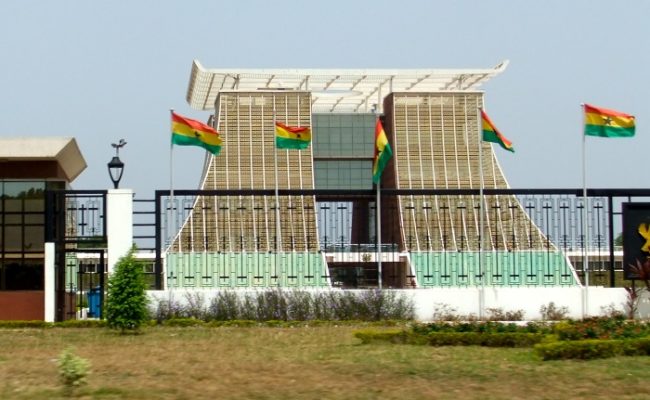
Ghana’s 69th Independence Anniversary Parade will take place at the forecourt of Jubilee House on March 6, 2026, the Information Services Department, ISD, has announced.
In a notice dated February 24, 2026, and signed by the Acting Director of the ISD, Dr Winnifred N. Mahama, media houses were informed of arrangements for coverage of the national event. Editors have been invited to submit accreditation applications no later than February 27, 2026, at 5:00 pm.
This will be the second consecutive year the national parade is being held at Jubilee House, the seat of government. The decision follows a similar arrangement in 2025, when the 68th Independence Day celebration was staged at the same venue as part of government efforts to reduce public expenditure.
Government officials previously indicated that last year’s event cost GH¢1.5 million, compared to an estimated GH¢15 million if it had been organised at Black Star Square.
Black Star Square, completed in 1961, has traditionally hosted Independence Day celebrations. Over the years, it has served as the main venue for civic and military parades, including marches by schoolchildren and security services.
Media Accreditation Guidelines
According to Dr Mahama, limited space and the expected high number of applications mean each media house will be granted only one accreditation slot. However, organisations with existing presidential accreditation may assign their already approved reporters to cover the ceremony.
Applications must be submitted through an official letter from the media house, clearly stating the names and contact details of the assigned journalist and crew. All applications must reach the ISD before the stated deadline.
Accreditation will not be transferable, and late arrivals risk being denied entry. Accredited personnel are required to dress in formal or business attire.
Photographers and videographers must report to the venue by 6:45 am for security screening and positioning. Accreditation badges must be worn at all times, and media personnel are to remain within designated zones.
Movement will be restricted during the national anthem, the presidential address, and other key ceremonial segments.
Only professional cameras and video equipment will be permitted. The use of drones and aerial devices is strictly prohibited unless prior written approval is granted. Tripods and monopods must be placed in approved areas, while stabilisers and gimbals will be allowed within specified guidelines. Live streaming via personal or mobile devices will not be permitted.
Access to the presidential dais and surrounding areas will be limited to official photographers and videographers assigned to the Red Security Zone. Other restricted areas include security checkpoints and designated VIP seating sections.

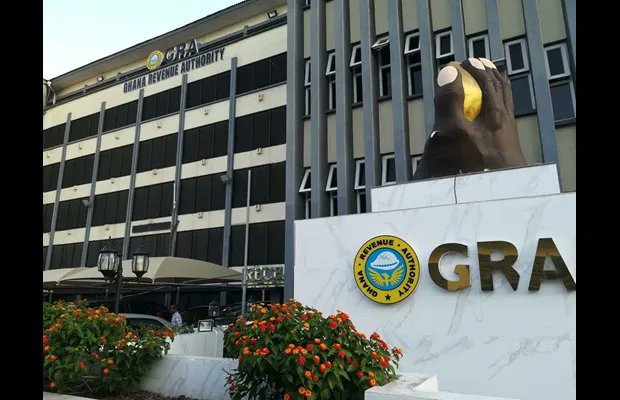
The Ghana Revenue Authority has interdicted five officers from its customs Division following what it described as discrepancies uncovered during an enforcement operation involving transit cargo bound for Niger.
In a press release issued on February 24, 2026, the Authority said the officers had been suspended with immediate effect pending the outcome of an internal investigation.
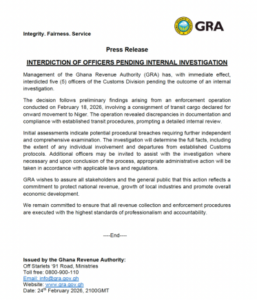
The action stems from preliminary findings linked to an operation conducted on February 18, 2026. According to the statement, the exercise focused on a consignment of goods declared as transit cargo for onward movement to Niger. However, officials identified irregularities in the accompanying documentation and compliance with established transit procedures.
Management said the anomalies were significant enough to warrant a comprehensive internal review.
“The decision follows preliminary findings arising from an enforcement operation conducted on February 18, 2026, involving a consignment of transit cargo declared for onward movement to Niger. The operation revealed discrepancies in documentation and compliance with established transit procedures, prompting a detailed internal review,” the statement said.
While the Authority did not specify the nature of the discrepancies, it indicated that early assessments pointed to possible breaches of procedure that required further scrutiny.
“Initial assessments indicate potential procedural breaches requiring further independent and comprehensive examination,” the statement added.
The GRA noted that the ongoing investigation would seek to establish the full facts, including whether there were individual departures from laid-down Customs protocols. It also signalled that the scope of the inquiry could widen if necessary.
“We remain committed to ensuring that all revenue collection and enforcement procedures are executed with the highest standards of professionalism and accountability.”

Eduwatch Demands Accountability for GH¢42.1bn Education Spending in 2026 SONA

Poor Sanitation Costs Ghana GHS 6.2 Billion Yearly – ISSER Study

ThirdWell launches Inclusive Business Centre to support Accredited Inclusive Businesses in Ghana



-

 Entertainment2 weeks ago
[EDITORIAL] Just as Ghana Rises on the Global Map; Mediocrity Creeps In: The Ordeal of Vyacheslav Trahov the “Russian Alien”
-
 General News2 weeks ago
Ghana to Ratify AU Convention on Ending Violence Against Women and Girls, Mahama Announces
-
 Business2 weeks ago
Cocoa Price Cut Sparks Fears Over Environmental Sustainability and Illegal Mining Surge
-

 Sports2 weeks ago
Aduana FC Coach Cioaba Aristica announces starting lineup ahead of Medeama Clash
-
 General News6 days ago
Mahama: We’ll increase efforts to clean polluted water bodies and reclaim mined lands
-
General News6 days ago
Mahama: Mining Must Leave Communities Better Than It Found Them
-

 Sports3 days ago
BREAKING: Salary Crisis hits Tension at Eleven Wonders Camp for the second time
-

 General News2 weeks ago
Government Transfers GH¢4.35bn Cocoa Road Debt from COCOBOD to Roads and Finance Ministries