
Business
ThirdWell launches Inclusive Business Centre to support Accredited Inclusive Businesses in Ghana

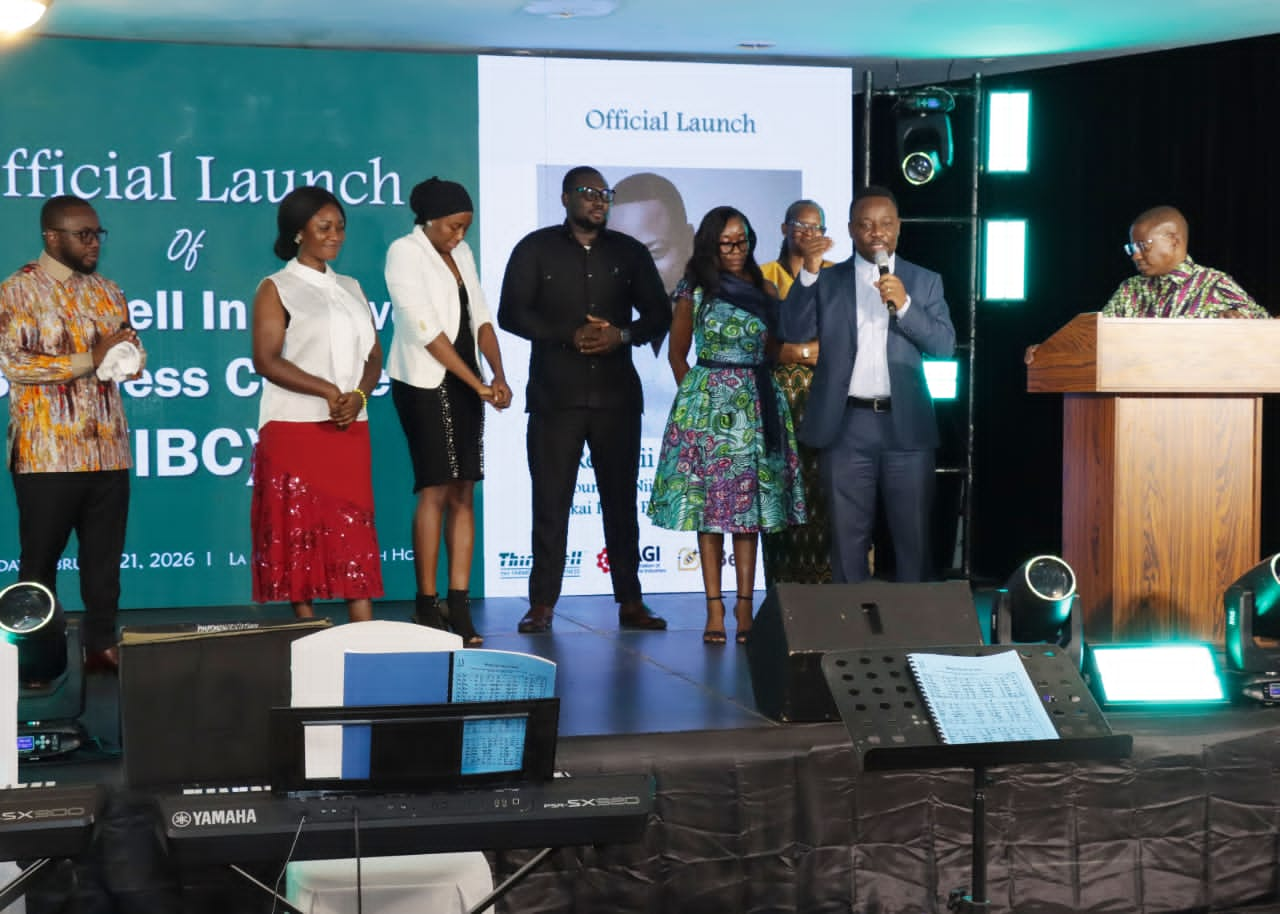
ThirdWell Inclusive Business Centre (IBC) has been officially launched in Accra. The official launch held at La Palm Royal Beach Hotel and unveiled by Rev. Nii Okai Okai supported by representatives from Ghana Chamber of Young Entrepreneurs (GCYE); Association of Ghana Industries (AGI), and ThirdWell Commodities; signals a renewed push to position inclusive business as a central pillar in Ghana’s quest for sustainable economic transformation.
The official launch brought together key stakeholders, including business leaders, investors, development partners, corporate institutions, academic bodies, and members of the media. The event marked an important milestone in Ghana’s journey toward building a more inclusive and sustainable economic system.

The ThirdWell Inclusive Business Centre (IBC) is a private not-for-profit organization established to empower inclusive businesses by promoting investment and partnerships that enhances their capacity to scale sustainable impact and drive systemic change in the economy. Describing IBC as a one-stop resource hub, the Founder and Chairman of the Centre, Mr. Osah Thompson-Mensah said IBC would provide strategic advisory services, corporate governance guidance and coordinated access to professional support for accredited inclusive businesses.
He further explained that ThirdWell Inclusive Business Centre was established to address the major challenges faced by many inclusive businesses and SMEs, particularly in strategic management, access to financing, and building strong partnerships. “The challenge has always been the lack of coordinated systems and accessible business services to help inclusive businesses grow and scale their impact. The Inclusive Business Centre serves as a One-Stop Resource Centre where businesses can access affordable strategy and business services to strengthen their operations and improve their readiness for investment and partnerships.”

Inclusive businesses are private sector businesses or business lines that generate profits by providing goods, services, and livelihood opportunities to people at the Base of the Pyramid (BoP) (low-income populations) on a commercially viable basis, making them a part of the company’s value chain as customers, suppliers, distributors, or employees. Inclusive businesses create innovative and affordable solutions for the needs of low-income groups and communities, turning underserved populations into active suppliers, consumers, and distributors; while also benefiting the businesses by creating new markets and products. Investments into and partnerships with inclusive businesses thus create positive systemic change for BoPs, communities and society.
Inclusive Businesses in Ghana are officially accredited by the Inclusive Business Accreditation Committee comprising AGI, MOTAI, MoFA, MESTI, GEA, GCYE, SEGh, CAG, after independent assessment by at least three (3) certified inclusive businesses consultants using a composite rating tool involving 47 criteria and 186 benchmarks. Mr Thompson-Mensah highlighted the progress made under the Inclusive Business Initiative in Ghana, revealing that 27 companies have already been officially accredited as inclusive businesses in 2024 and 2025. These businesses have generated a combined revenue of GH¢1.18 billion while impacting over 2.25 million people, demonstrating the powerful role inclusive businesses can play in driving economic and social transformation. He further acknowledged support from Deutsche Gesellschaft für Internationale Zusammenarbeit (GIZ), which sponsored groundwork for the inclusive business landscape study and institutionalization in Ghana, noting that sustaining the initiative now rests with Ghanaians.

Speaking at the launch, Osah Thompson-Mensah called for inclusive business to become the foundation of Ghana’s economic development strategy, describing it as the country’s most sustainable pathway to reducing poverty and improving living standards of low income groups and communities in Ghana. According to Mr. Osah Thompson-Mensah, Ghana lacks a long-term development ideology, despite the regular production of political party manifestos every four years. “We have manifestos, but we do not have a clear national development ideology or strategy,” he said, arguing that inclusive business and impact-drives-return ideology should underpin Ghana’s economic development strategy and framework. He further stressed that expanding inclusive business practices would significantly deepen social and economic impact.
Mr. Osah Thompson-Mensah noted that when citizens are economically empowered, they demand more goods and services, which stimulates production, drives factory expansion and boosts exports. Drawing parallels with developed nations, he expressed optimism that Ghana could achieve similar progress by embedding inclusive business principles into its long-term planning. He stressed that expanding inclusive business practices would significantly deepen social and economic impact, stating further that “More inclusive business means more impact,”
Mr Osah Thompson- Mensah also disclosed IBC’s intention to engage with the Ghana Stock Exchange to explore how listing small and medium-sized enterprises (SMEs) could address succession planning challenges and strengthen corporate governance. He observed that many Ghanaian businesses collapse after founders exit due to weak structures and overreliance on family succession. “When you list, you open yourself up not just to funding but to quality management and stronger corporate systems,” he said, adding that standards should not be lowered but processes can be rethought to maintain integrity while improving access.
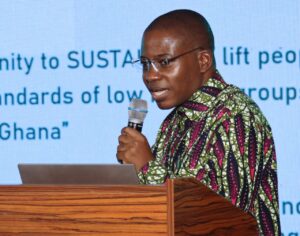
Also speaking at the launch, Mr. Sherif Ghali, CEO of the Ghana Chamber of Young Entrepreneurs, and also chairman of the event, called for inclusive business to be elevated to a national agenda. He highlighted the reality of poverty among many Ghanaians, particularly those earning below GH₵2,000, and urged companies to align profit-making with social inclusion.
“Until low-income individuals are integrated into value chains, businesses will continue to get richer while many people remain poor,” he said.
Mr. Ghali pledged support for the Centre and encouraged businesses, institutions and government to back the initiative, stressing that poverty reduction requires collective effort.

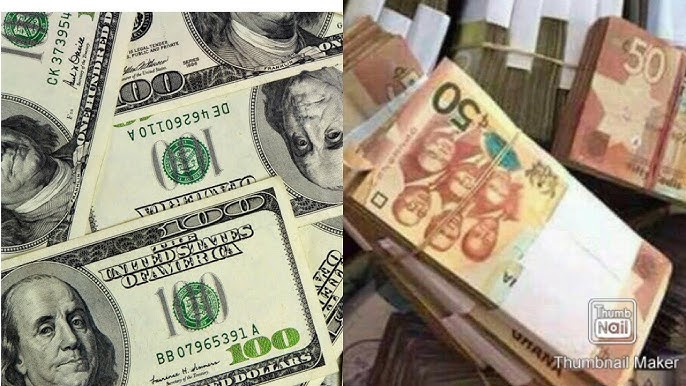
The Ghanaian cedi has posted modest gains over the past two weeks, buoyed by improved external conditions and renewed investor sentiment.
The local currency faced mild demand-driven pressure at the start of the period, in line with market expectations. However, it rebounded in the second week, supported by a broad-based “sell America” sentiment that weakened the US dollar and provided relief to emerging and frontier market currencies.
On the interbank market, the cedi appreciated by 0.09% against the US dollar, 0.86% against the pound sterling, and 1.16% against the euro. It closed at mid-rates of GH¢10.97 to the dollar, GH¢14.81 to the pound and GH¢12.93 to the euro.
The gains were also reflected in the retail market. The cedi strengthened by 0.6% against the dollar, 1.29% against the pound, and 1.11% against the euro, settling at mid-rates of GH¢11.63 to the dollar, GH¢15.55 to the pound and GH¢13.50 to the euro.
According to Databank Research, the cedi’s recent appreciation aligns with gains recorded across other major Sub-Saharan African currencies, underscoring the impact of sustained US dollar weakness.
The research firm expects the current tailwinds to support further strengthening of the cedi in the near term, as expectations of continued softness in the US dollar temper demand for the greenback. Market sentiment is also being shaped by heightened geopolitical risks, including concerns over a potential confrontation involving Iran.
Additional support is expected from targeted foreign exchange interventions by the Bank of Ghana. The central bank is gradually deploying a US$1 billion facility to meet market demand and stabilise the currency.
Analysts project the cedi could extend its gains to an interbank mid-rate range of GH¢10.85 to GH¢10.95 per dollar over the next fortnight. Retail rates are forecast to hover between GH¢11.55 and GH¢11.60 per dollar, with the possibility of tighter spreads should foreign inflows accelerate.
Despite the recent rally, the cedi opened this week trading around GH¢11.70 to the dollar in the retail market.
So far this year, the currency has gained 4.95% against the US dollar, reflecting a gradual but steady recovery.

Eduwatch Demands Accountability for GH¢42.1bn Education Spending in 2026 SONA

Poor Sanitation Costs Ghana GHS 6.2 Billion Yearly – ISSER Study

ThirdWell launches Inclusive Business Centre to support Accredited Inclusive Businesses in Ghana



-

 Entertainment2 weeks ago
[EDITORIAL] Just as Ghana Rises on the Global Map; Mediocrity Creeps In: The Ordeal of Vyacheslav Trahov the “Russian Alien”
-
 General News2 weeks ago
Ghana to Ratify AU Convention on Ending Violence Against Women and Girls, Mahama Announces
-
 Business2 weeks ago
Cocoa Price Cut Sparks Fears Over Environmental Sustainability and Illegal Mining Surge
-

 Sports2 weeks ago
Aduana FC Coach Cioaba Aristica announces starting lineup ahead of Medeama Clash
-
 General News6 days ago
Mahama: We’ll increase efforts to clean polluted water bodies and reclaim mined lands
-
General News6 days ago
Mahama: Mining Must Leave Communities Better Than It Found Them
-

 Sports3 days ago
BREAKING: Salary Crisis hits Tension at Eleven Wonders Camp for the second time
-
 General News2 weeks ago
Government Transfers GH¢4.35bn Cocoa Road Debt from COCOBOD to Roads and Finance Ministries